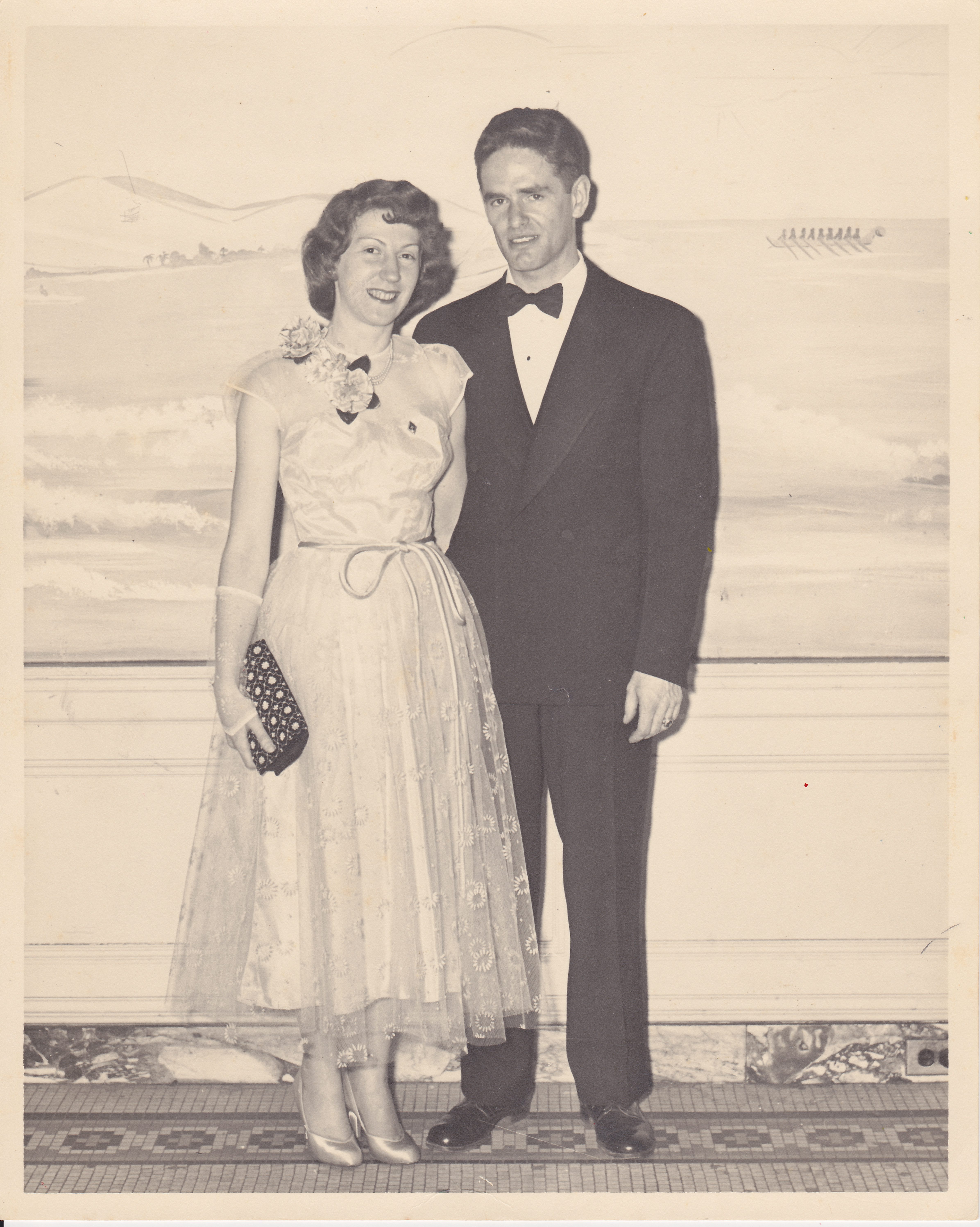
Two years ago this — Helen and I kept vigil through the night with my mother. Helen had snapped this picture while I was dozing.
Three generations of hands
I went home in the wee hours, grabbed a little sleep, then went back to the hospital to relieve Helen.
After struggling so much the day before, making terrible gurgling sounds as she tried to breathe, my mother finally slept peacefully. I think the atropine helped.
Atropine gets its name from Atropos, one of the Fates, the one who chooses the mechanism of death and ends a mortal’s life. I find that both strange and interesting.
But my mother slept.
And we took turns sleeping.
At the end, Helen was sleeping when my mother passed away. My siblings were all there, but Helen, who had been so close to my mom, so faithful and present in so many ways, was not. In retrospect, I should have called her. But I didn’t know when the thread of life would finally be severed. None of us really do.
November 3rd feels heavy, like a weight on my heart.
My friend, Michael McNevin, wrote a song we play every November 4. The first few lines run through my mind unbidden.
Thinking of the cold to come…
It was 61° this morning — not very cold, but I shivered anyway. Today my father goes for a physical as a step toward entering an adult home. I am so unsettled with this decision. Ah, the cold to come.
From what I hear it will make me numb…
I remember the numbness after my mother died. I don’t want to feel that again, and yet, it is inevitable. My father walks more slowly now, shuffling along with his walker. His pacemaker paces 90% of the time. His thinking is muddled at an unquantifiable percentage.
Two of his peers took him to lunch the other day. When his friend brought him home, he pulled me aside. “Your father really couldn’t follow any of the conversation today,” he said, “And he fixated on one small thing. That was all he could talk about.”
Yes, I’ve noticed that, too. It makes me sad.
Look at how the wind goes by…
A breeze refreshes, but the wind is the wind. It blows through our lives – pushing us along, trying to hold us back, knocking dead branches out of trees, grabbing loose items and skittering them away.
Two years ago my mother died on a cold November day.
I can remember walking up the hill to the hospital that last time when she was still alive. It was still dark, maybe 5 AM. I wanted to give Helen a chance to sleep. The wind blew tiny raindrops against my cheeks — portending tears to come.
I didn’t know yesterday was going to be such a great day and here’s why —
In preparation, I had focused on the tired parts of the day: the getting up before 4 AM and the getting home after 1 AM.
I was worried about the city, all those people crowded together and the tall buildings holding them in, a barricade between city and country, urban and rural, not home and my home — and I was spending a day on the wrong side of the barricade.
I braced myself against the day instead of leaning into it.
I felt like you, who had never been to the city before, should be going with someone who loves the city and that’s not me — but you wanted me to go so I figured I’d better make a good effort.
“What do you want to do?” I had asked you. We had several hours to kill on either side of Dear Evan Hansen.
“I dunno,” you replied, in that helpful way you have.
So I worried about that, too, and finally decided we should go to the New York Public Library. You love books. I knew that if it turned out to be just a bunch of books you would be thrilled. You would pull the oldest book you could find off the shelves so you could hold it in your hands, feel the paper, and smell the old book smell. I’ve seen you do that.
The library was the right choice. You reached up to touch one of the stone lions that guarded the main entrance.
Inside, I touched the Lego lion that guarded the entrance to the children’s room.
“Mom!” you said, aghast. “The sign says ‘Please do not touch.'”
Oops. My bad.
But what a magnificent place! You wished you could climb up the ladder to the second tier of books that ran the circumference of the study room. I wished I could have seen the original card catalog where now tables of computers sit, the card catalog’s modern replacement.
We walked the long hallways, climbed the marble stairs and admired the art work that was everywhere.
a long hallwayArtwork — a man readingArtwork — mother and child readingceiling in the McGraw Rotunda
As we were leaving, we noticed a sign for tours of the library. Our 2 hour visit served as a peek — there’s so much more, I’m sure. Next time we’ll have to take the tour.
Did I just say next time? Next time?
After spending some time there, I kind of want to go back. We should do that, don’t you think?
Laurel brought a math problem to me the other day.
I looked at it and looked at it, but years of only doing grocery store math or tip calculations have eroded away much of the math soil in my brain. I found myself asking the question Mary, my non-mathy daughter, asked all the time — why do we need to know this stuff?
Back in the day, I loved math. A math sheet was a page full of puzzles to be solved, and they all had answers.
Now the variables and exponents and coefficients and fractions jumble together and refuse to tell me the story they’re supposed to tell.
In real life, when is a-cubed-minus-three going to be a denominator in any equation?
I decided to go for a walk to think about the problem.
The corn has been harvested in the fields down the road which makes them nice places to walk the dog. Our road has minimal shoulders and most of the drivers don’t care about the speed limit on it. It can be a little scary walking on it.
In the closest field, the harvesters missed a bit of a row on the edge.
The stalks stand as sentinels — guarding nothing.
Nothing but a safe place to walk.
Sometimes in the summer, I would walk through the rows of tall corn to escape the sun and heat for a short leg of my walk. I would think about the time the farmer escaped from the nursing home that used to be down the road and wandered into the corn field. The state police had to bring helicopters to help find him.
But in the fall, the mowed rows are straight lines of what once was.
The shadows of the stalk stubs combined with the dried fragments of corn leaves made pretty patterns on the ground.
Maggie ran on ahead, and when I looked at her waiting for me down the field, I noticed where the planter had veered months ago — maybe because of an obstacle or maybe he was just distracted. The nice straight lines were not so nice and straight — like a math problem where the answer isn’t a sensible whole number, but full of exponents and variables.
By the time I reached the end of the row, I had figured out Laurel’s math problem. My brother had called me because I had sent it to him, and he confirmed what I suspected was the solution. It wasn’t a nice neat answer.
The end of the row was rounded. I could see where the tractor had turned.
The math erosion in my brain probably looks something like it.
Harvested — all that stuff I learned so many years ago gone now.
And rounded, like nearly every mental calculation I do.
Image from ALLOTSEGO.com from Veteran’s day 2016 — Mr. Hanson on the right
I don’t think he was there the first time we visited the Methodist Church a few years ago, but he was the second or third time we went back.
“Sally,” he said to me in his strong deep voice. I was flattered that he remembered me. It had been 40-some years since I sat in his 7th grade math class.
“Hi, Mr. Hanson,” I replied.
“You can call me Dick, you know,” he said, smiling. “You’re an adult now.”
“I don’t think I can,” I said to him.
Teachers, especially good ones, have a special status. When I hear kids today calling teachers by their first name, or, worse, just their last name, I cringe a little inside.
Sunday after Sunday he would engulf my hand in his while he greeted me. If I called him Mr. Hanson, he would give me a look and then say, “Dick, please,” so I took to calling him nothing.
“Good morning!” “Good to see you today!” “Merry Christmas!” I avoided the naming, and he allowed me to, until one Sunday, he said, “C’mon. You can say it.” He held my hand and waited.
I took a deep breath, and said, “Dick?” in the smallest of voices, and quickly followed it with “I don’t think I can.”
He looked at me a long time, then let go of my hand. “Okay,” he said, and he smiled at me but never mentioned the name thing again.
Mr. Hanson was one of those larger than life teachers. A former marine. Physically a big guy. A booming voice. A great smile.
I said something to another woman at church who had had him as a teacher. “I just can’t call him anything but Mr. Hanson,” I told her.
“I know,” she said, ” but let me tell you something about him. Do you remember when I was in the hospital?”
I did. When we were in school, she had been in a tobogganing accident that resulted in a broken neck, broken jaw, and months in the hospital. I spent many afternoons sitting in her room with her. Her jaw was wired shut. A device that resembled tongs attached to her skull and held her neck in traction via weights that hung down over the end of the bed.
“My mother was taking a mandatory First Aid class for teachers on Monday nights,” she said, “and she must have mentioned something about it to Mr. Hanson because he started showing up in my hospital room on Monday nights to visit. He never said anything to her about it, and it took me a long time to figure it out, but on the one night she couldn’t be with me, he came by.”
I wondered how many other Mr. Hanson stories are out there.
Therein is greatness.
Not doing big things that draw attention and bring accolades, but in doing the small things, unnoticed and unseen, but not unimportant.
“I hurried over so you could take a picture,” said Matt, the lifeguard who was taking over for me so I could home.
Two weeks of working together and he’s got me figured out. How many times has he heard me say, “I need to get a picture of that!” Or, how many times has he seen me grab my phone out of the office so I could snap a shot of the sunrise.
I told someone at Hutchmoot that I was practically giddy over the prospect of working at this job, and that hasn’t changed since it started.
Leaving the house at 5 AM to lifeguard for two hours every morning has been fun.
And stimulating. Adult conversation is such a treat.
The sunrises aren’t bad either.
I arrive in the dark. This morning I stood, looking out from near the pool, and snapped a grainy picture. The white dot in the distance is a lighted lamppost.
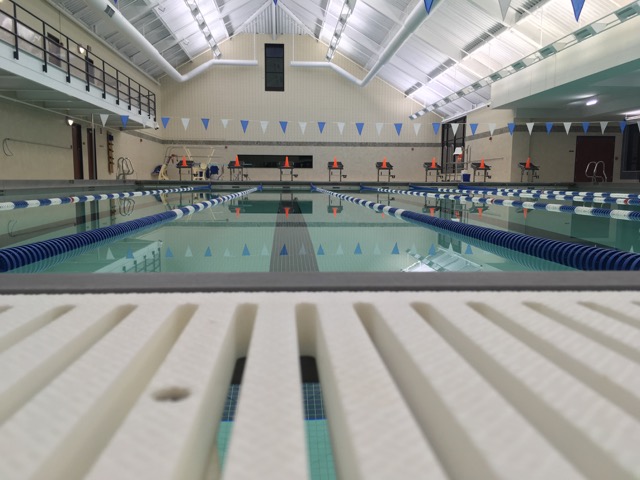
Since the pool was redone, it has a wall of windows facing east. The lights are always on in there. In the darkness, the pool area fairly glows when I arrive.
Of course, when working as a lifeguard, I’m not staring out the windows. I’m scanning the pool, in case any of those early morning lap swimmers need help. So far the only help anyone has needed is turning the music down or alerting maintenance that the hot water isn’t working in the showers.
But I love my co-workers. They are such interesting people. And we converse in complete sentences.
I’ve tried explaining to people how being a caregiver for someone with dementia is like taking care of a toddler. Anyone who has had children knows the stage of incomplete conversation. That’s how it is with my father these days. That, or trying to guess what he’s trying to say, or trying to follow the tangents that his mind travels down.
Right around the time I’m getting ready to go home — I can only really afford two hours when I know he’ll be sleeping — the sky is changing.
One day last week, I tried to take a picture of it, but the pool reflected back off the glass and gave me this shot.
So this morning I went from window bay to window bay trying to find a place that didn’t reflect the pool.
“Just step outside,” said one of the other guards, so I did.
Golly, it was pretty.
I stopped again just beyond the pool on my way home.
I wondered if there was a liturgy in Every Moment Holy for the sight of a beautiful sunrise.
Then I realized I already knew one, and recited on my way home —
But this one thing I bear in mind,
and therefore I have hope:
The steadfast love of the Lord never ceases;
His mercies never come to an end;
They are new every morning;
Great is thy faithfulness.
I started to write out the sequence of events that led up to the last time I remembered holding it in my hand, but none of it really matters. The important part of the story was that my wallet — a nice little clasp purse made by a dear friend — was missing.
At 5 AM, I was searching, trying to be quiet while the rest of the people in the house were sleeping, but I had to be at work at 5:15 AM and was starting to panic.
My mother often said, “It’s always the last place you look.”
The morning schedule was tight: lifeguarding at the pool from 5:15-7:15, go home, eat breakfast, leave by 8 AM to take Laurel to the dentist which was an hour-and-a-half away.
Every Moment Holy, my new favorite book, sat on the table where I had finished my morning readings. Was there a liturgy in there for lost things?
I searched through the Table of Contents, wasting valuable other search time, looking for a prayer to fit this occasion.
Nope.
But the beauty of Every Moment Holy lies in the title. Every moment is holy. Even the anxiety-ridden ones.
Before I left the house, I tip-toed into my father’s darkened room with a flashlight to see if perchance he had picked it up. My mother, in her dementia, used to squirrel away all sorts of treasures, and my father has started doing similar things. She had opted for shiny things — silverware and napkin rings, but he liked books and pens and shirts. My wallet wasn’t in his room, though.
I drove into the pool, worrying, and trying to allay my worries with words that could go into The Liturgy for Searching for Lost Items.
I got to the pool only to find the service door locked.
“Sorry, Sally,” said the woman at the front desk who let me in.
“No worries,” I said. It’s my standard response. Even when I’m worried.
And I was quite worried.
But the liturgy for lost or misplaced things was starting to take shape.
I found that when I started feeling the worry rise, it helped to think about what the Bible said about lost things.
I had two hours at the pool, three hours in the car, and an hour sitting in a dentist office to think about it. Six hours of pushing worry into prayer.
My initial thoughts:
O, Lord — I know You care about lost things
You talk about a shepherd leaving ninety-nine sheep to search for the one lost lamb
You talk about a widow searching for a lost coin
My later thoughts:
Lord, I’m holding on too tight to the temporal, to things that don’t last.
If I never find that wallet again —
If every worse case scenario I imagine comes true
If it was dropped and found by an unscrupulous person
Or taken because I wasn’t paying attention
If my credit cards and, worse, my identity are stolen,
It’s okay
Because I have everything I need in You
My hands are open, Lord.
Whatever You want from me is Yours
It was never mine to begin with
Truly my morning was holy.
Anxious — but also holy in a way I couldn’t have imagined.
My mother was right. It’s always in the last place you look. Sometimes it’s in a place you’ve even looked before.
I found it when I got back home. Even though I had looked there previously, it was in my father’s car.
Matt Canlis said at Hutchmoot that God is closer than you think and in places you don’t expect.
I realized that all my searching wasn’t about my wallet. It was about God guiding me into truths I need to learn.
Our work in Bosnia took place in Gradacac, a city about 3 hours north of Sarajevo.
Ostensibly, we were there to build a house.
Every morning we drove to the work site in two loads using a car lent to our group by a family for whom a house had been built by a previous team. We were a little cosy in the Peugeot station wagon but it got us back and forth on the narrow windy roads.
I asked Amy what the family who lent us their car would do for transportation that week.
“I don’t know,” she said. “Probably walk.”
At the house, the work were directed by maestros, some older experienced builders. Initially I’m not sure they trusted the skills of the Americans. Our men-folk were tested by wiring together lengths of rebar.
The women moved bricks.
Passing bricks
Eventually, we all got to try our hand at rebar-wiring.
Some got to do a little masonry.
Most of the time, though, while the skilled laborers worked, we waited for tasks we would be allowed to do.
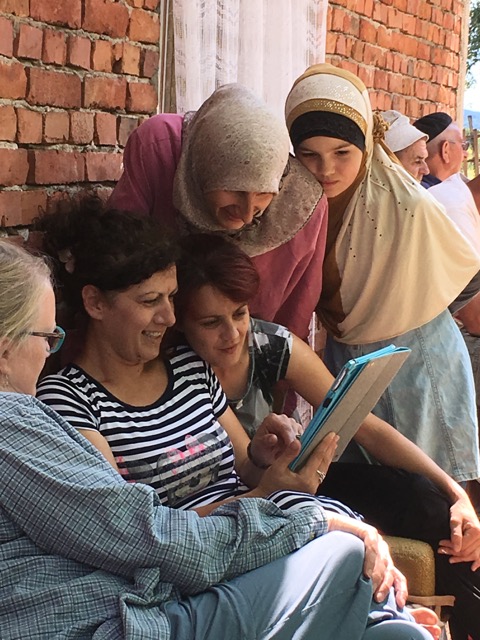
We talked.
We told them about our families
and about our lives.
We tried to learn some words in Bosnian.And they practiced their English with us.
In the evenings we were regaled with music and food.
Significant progress was made on the house.
When we got thereProgress
But I’m convinced that the real mission work took place in the realm of relationship.
On our last day there, we went back to say our good-byes. The families had been so incredibly generous to us. I wanted to give them something in return.
I had brought some bracelets made by women in Haiti. When one of my friends had been raising money for an adoption I bought them from her.
These I gave to some of the women. I asked our translator explain that these were made by women from another part of the world who were looking for ways to provide for their families. I told her to tell them that women all over the world can support each other in small ways like this because we understand each other’s struggles.
Then I took Tuga and Aleluja from my pocket. How could I possibly explain these little bunnies?
“In our religion,” I told the translator to tell Hanka, the woman I wanted to give them to — a woman who had shared her concerns about mental health in Bosnia, and how there was very little support for it, “we have a season called Lent. It’s a sad time. Jesus, who we believe to be the Son of God, knew He was going to die.”
I struggled to know how to express what I wanted to say — and, truth be told, I don’t remember exactly what came out of my mouth. I do, however, remember inwardly praying, as the lump rose in my throat, and I looked at the two rabbits sitting in the palm of my hand.
“I named these rabbits Tuga and Aleluja,” I said, and I looked at her to see that she recognized the words.
“Tuga means sorrow, right?” I asked, and she nodded. Her eyes were filling with tears, as were mine.
“Aleluja is a joyful word that we don’t say during Lent, so I hid this rabbit away.” I stuck the white rabbit behind my back. “But I put Tuga in my pocket and carried him with me everywhere, to remind myself that people all have sorrows hidden in the hearts.”
I looked at Hanka while the translator translated my words. I hoped it was making sense. Hanka kept nodding to show that she understood.
“All during Lent I carried Tuga and I thought about the deep sorrow of the world, but on Easter, the day that Lent ends because Jesus rose from the dead, I got Aleluja out from his hiding place and we were joyful again.”
I paused again, listening to the flow of Bosnian, hoping it was close to the essence of what I was trying to say. When the translator was done, I handed the rabbits to Hanka.
“I want you to have these,” I said, “because you know that people carry sadness in their hearts. Tuga reminds you of that, but Aleluja also reminds you that there is joy in the world.”
She nodded and hugged me. We were both crying.
My friend Leah, who had followed the posts about Tuga during Lent and was also on this trip, saw what was going on. “Is that Tuga?” she asked, and then she offered to take a picture of us.
I like to picture Tuga and Aleluja sitting on a window ledge in Bosnia, doing whatever two rabbits can do to remind us of God and of tenderness and of compassion in this world.
It was an unplanned ending for my rabbits’ journey, but it seemed a fitting one.
Tuga and Aleluja accompanied me to Bosnia this summer. At every place I stayed, I set them on the window ledge or my nightstand to remind me that every single person I would encounter on this trip has known both joys and sorrows..
Before traveling, I tried to read up on Bosnia, which turned out to be learning about Yugoslavia, which led to an attempt to understand the Ottoman Empire. The history of that land is layered and complex.
While the United States divides itself along racial lines, Bosnia and Herzegovina is divided along ethnic lines, and religion is often linked to ethnicity: most Bosniaks are Muslim, Serbs are Orthodox Christian, and Croats are Roman Catholic. Places of worship in Bosnia, though, have stood side by side for centuries.
Mosques and churches stood side by side
The wars that resulted in the break-up of Yugoslavia took place along those ethno-religious lines. The BBC documentary, The Death of Yugoslavia, begins its story with a rise in nationalism following the death of Tito.
The war in Bosnia was particularly horrible. Serbs slaughtered Bosniak men and boys, throwing their bodies into mass graves. The Bosniak women were systematically raped. Although it has been 25 years since their war, the scars are not fully healed. Fragments of bone are still being analyzed and those murdered are still being identified. In fact, we were in Bosnia for “Remembrance Day” — a day set aside to remember, to mourn, and to lay to rest those remains that have been found and identified in the previous year.
As we toured Sarajevo, we saw the site of the assassination of Archduke Franz Ferdinand of Austria, the event that triggered World War 1.
We stood outside the library and I felt sick in my heart as I tried to understand what part of a war involved burning all the books and historic documents that had been housed there.
We saw buildings still pock-marked by mortar shells.
Sarajevo Roses dotted the streets. These commemorated places of fatal mortar strikes — red resin filling the scars left and plaques on nearby buildings with the names of those who died.
Parks became cemeteries because they had no other place to bury the bodies.
Just months before I had visited several cemeteries in Normandy. Any cemetery is a sobering place to visit, but these war cemeteries were especially heart-wrenching. The cemetery in Sarajevo stood out because these brave young men were my peers.
“In the midst of life, we are in death.” (Book of Common Prayer)
From the start, Amy, the pastor organizing the trip, had said this was a non-proselytizing trip. In the context of Bosnia’s history, it made sense that this trip would not involve talk of religion. We were to be the hands and feet of Christ, ministering to the people of a wounded country. Our actions were our words.
I had an advantage over the others on the trip. I had a little bunny to remind me of the sorrow.