family · poetry

Margrethe

My great-grandmother, Margrethe, came over steerage
Which was at least two decks below the peerage

Her home had been Varde a small Danish town
Moving to Boston turned her life upside down

Her four young children accompanied her
Moving-reuniting family with father

He was a tailor who had come over ahead
Establishing his business to earn their bread

He worked for the wealthy on Boston’s North Shore
While living in an alley among immigrant poor

Speaking no English, Margrethe invited
Other Danish women similarly plighted

Their Kaffeeklatsches became a sweet haven
To encourage each other before anyone gave in

People of wealth sometimes didn’t pay their bills
Margrethe went without coal while the rich dressed in frills

It doesn’t seem fair — they worked so hard!
But that strong work ethic is its own reward

My grandmother worked hard; my mother did too
I learned there’s always something worthwhile to do!

My great-grandmother, Margrethe, came over steerage
Her legacy leaves me far richer than the peerage


This is my response to the W3 prompt: write a poem about a person who has had to leave home. Please include the word “home” in your poem.

I chose to write a Couplet Poem about my great-grandmother, Margethe. My grandmother, Margrethe’s youngest daughter, wrote afamily history and included the details that I used — like no coal on winter day because the rich customers “forgot” to pay their bill.

family

Here’s the wind-up..

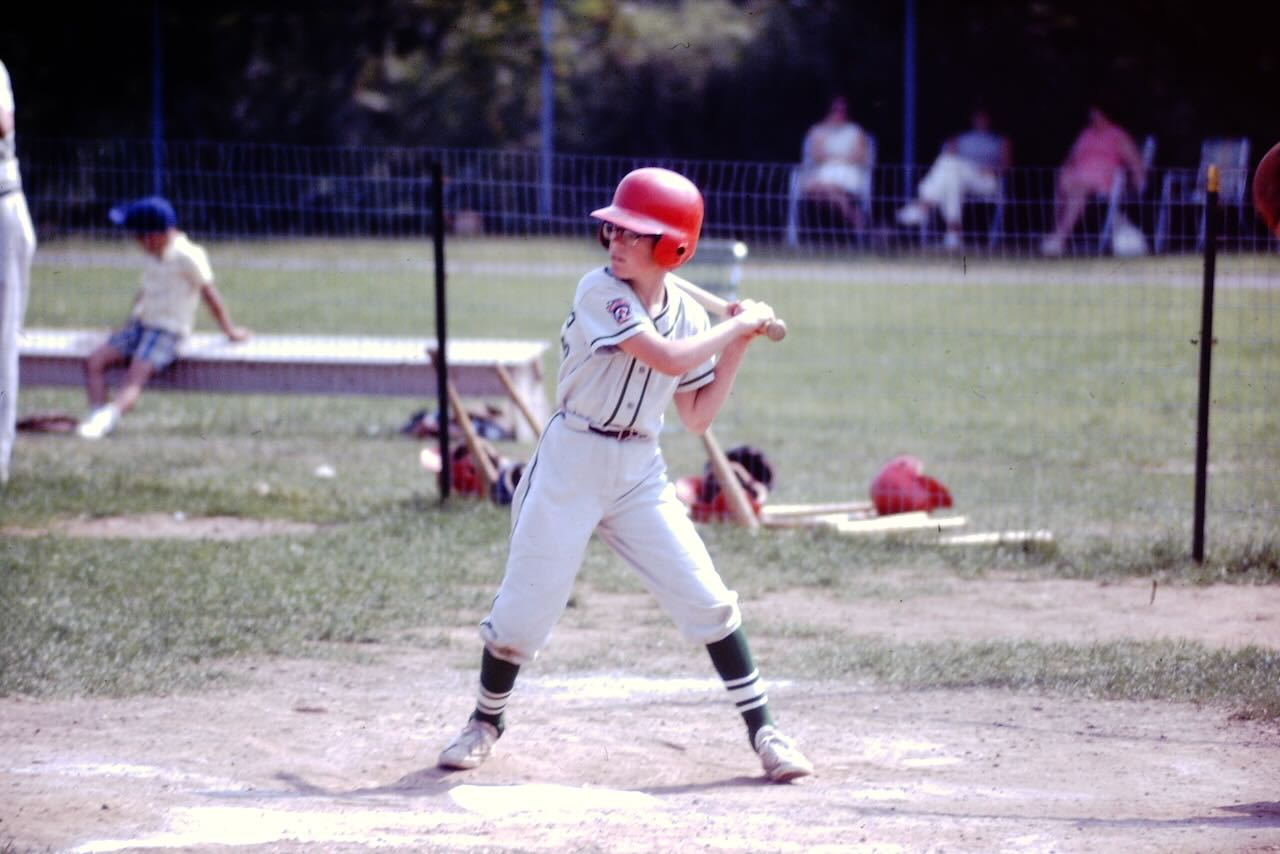
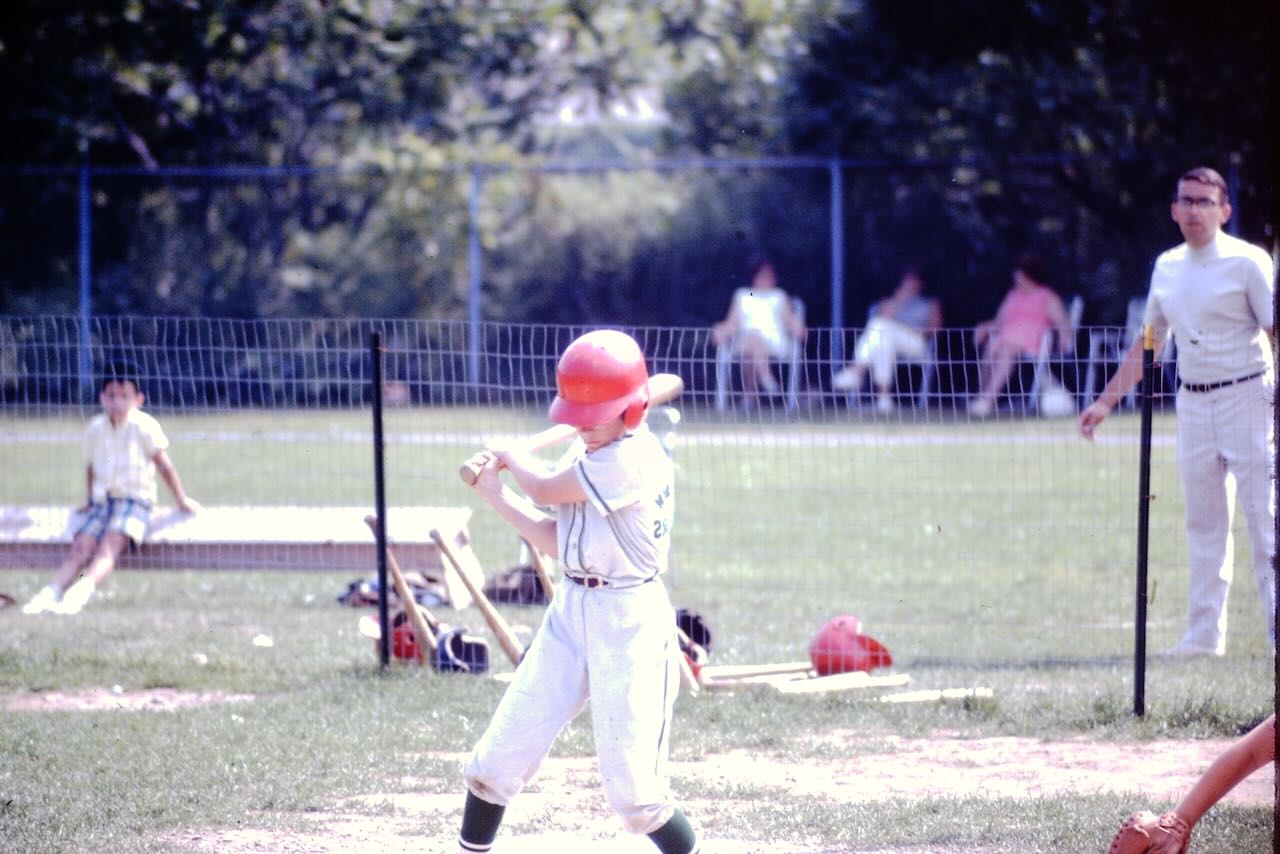
And the pitch!

I encouraged my kids to play either of two sports: swimming or soccer. They’re both fairly easy to understand.

In swimming the person who touches the wall first wins (assuming they swam the proper stroke legally).

In soccer, one team is heading toward one goal, the other toward the other. Kick the ball in the correct goal and your team scores a point. (Of course there are other rules, but that’s the general idea.)

Baseball, on the other hand, is not so easy.

I grew up on baseball, living in Cooperstown (home of the Baseball Hall of Fame and alleged birthplace of the game) and having a father who made annual pilgrimages to Fenway Park in Boston. I can still name Red Sox players from those days: Carl Yastrzemski, Tony Conigliaro, Rico Petrocelli, Carlton Fisk.

After my father died, a man told me the story of how he first met my father — they were both driving to a spot outside town (the dump) where they could pick up WBZ to listen to the Red Sox game in the car. When Keith realized that my father was listening to the same game, he tapped on the car window, introduced himself, and thereafter they listened together and became friends with the common bond of Red Sox baseball.

But baseball is hard to understand. Just ask a tee-ball coach. They’re the ones trying to explain the hitting, running around the bases, fielding, tagging the runner, etc. etc etc.

I’ve watched the little faces of the players go blank as the coach loses them in his explanation.

I’ve watched kids run around the bases in the wrong direction because the coach neglected to mention that requirement.

I’ve watched players making dandelion crowns in the outfield because they don’t understand that they are still playing the game even though they feel like they are just standing around far from where the game is actually taking place.

Yep. Baseball fails to hold the attention of young people.

They won’t understand for a decade that the pitcher (when they’ve moved beyond tee-ball and actually have a pitcher) and the batter are really two chess players trying to outthink and thereby outplay the other.

No – a lot of them will be swimming or playing soccer because their mom was bored with baseball.

Still, I love watching that moment when the pitcher is leaning in, resting his hand with the ball on his back, studying the batter, watching the signals the catcher is giving him, deciding in a moment which pitch to throw. Meanwhile the batter is mentally running through the pitches he has seen the pitcher throw and deciding how he will respond to each one.

Yeah, I love that moment.

But, honestly, I love watching the hand hit the touchpad in pool even more.


This is my response to Linda Hill’s Stream of Consciouness Saturday prompt: pitch

family · Life · poetry

Genealogy

It started with a phone call
“Who are you again?”
The letter arrived yesterday
I was full of curiosity

“Who are you again?”
His answer meant nothing
I was full of curiosity
Slowly the pieces fell into place

His answer meant nothing
I scribbled down some names
Slowly the pieces fell into place
Somehow we were related

I scribbled down some names
She mailed the letter with photos
Somehow we were related
She took me up the family tree

She mailed the letter with photos
She wrote stories of people I knew
She took me up the family tree
Naming people, naming places

She wrote stories of people I knew
The letter arrived yesterday
Naming people, naming places
It started with a phone call


This is my submission for this week’s W3 prompt. PoW Reena challenged us to “to explore the music of repetition by writing a pantoum on any theme or subject.

A pantoum unfolds in four-line stanzas, with each stanza carrying two lines into the next:

  • The second line becomes the first line of the next stanza.
  • The fourth line becomes the third line of the next stanza.
  • Add new lines in the second and fourth positions, letting the repeated lines gather fresh meaning in their new surroundings.

Continue for as many stanzas as you like. To bring the poem full circle, the final stanza traditionally uses the opening stanza’s third line as its second line, and the poem’s opening line as its closing line.

This is a true story. I got a strange phone call at work one day with someone asking me for my home address. We chatted for a while. I had no idea who he was — but I did eventually give him my address. I knew this could end badly and even joked with him that at least he wasn’t asking for my social security number or credit card information.

Just the other day the letter came from a distant relative. She had actually found me through this blog! She was out of the country, but wanted to send me something regarding a relative we had in common — so she recruited a friend to call and get my address.

aging · elderly · family · Life · poetry

The Bath

I ran the water
Helped her get into the tub
That was when I knew

She who had bathed me
Could no longer bathe herself
Our roles had reversed


This week’s W3 prompt: Choose one specific object or place from your childhood—a bedroom doorway, a schoolyard swing, a favorite toy, a familiar street—and write about the moment when it began to feel different: when you sensed that childhood was receding and something else had begun.

Does it count if I was in my 50’s when this happened?

Mary Cassatt, Public domain, via Wikimedia Commons
family · Music

Roamin’ in the Gloamin’

The music we hear as a child shapes us, doesn’t it? Last week, I wrote about “Night on Bald Mountain” in response to the Saturday Stream of Consciousness prompt. I can still picture the sleeve for the vinyl record we had.

This week, as soon as I saw the prompt, starts with gl–, my mind went to a song that my father used to play. He loved a Scottish tenor named Kenneth McKellar. If I close my eyes, I can still hear “Roamin’ in the Gloamin'” sung in that magnificent voice.

I remember asking my father what gloaming is. It’s evening or dusk. The song is about a fellow walking at that time of day with his sweetheart.

I think dawn and dusk ARE the prettiest times of day. There’s something about the liminal time, when it’s not quite one thing or the other, that makes it magical.

As the song says, “When the sun has gone to rest, that’s the time that we love best — Oh, it’s lovely roamin’ in the gloamin’.”

family

Little League Lessons

Once, twice, thrice
Three strikes! Yer out!
The words sound angry
But they’re just fact
Final judgment on a lone at-bat
The team bench is no haven
Brings no peace
Thoughts of why and if
Dreams of a hero home-run
Realization — none
Game over
Dejection
Until
Kind words from dad
Your swing looked great
Next time
Hope given
Love felt


This is my response to MLMM Wordle where writers are invited to weave the prompt words provided into a piece of prose or poetry. Here are the prompt words: once, three, haven, peace, thoughts, why, angry, if, final, love, none, dream

Alzheimer · Alzheimer's · dementia · elderly · family · Leaning In · Life · Writing

The Feeder’s Table

This is a draft written February 6, 2015, pulled from the draft folder because of the RDP prompt word: tame


From across the room, I heard the man bellow, “NO!”

I had no clue what this was in reference to — he was across the room, after all, and I was attending to my mother in the midst of her ritual folding and unfolding of her mealtime protector (aka – bib) while waiting for the food to arrive.

A woman at his table shouted out, “SNOW!” It was snowing out.

She laughed at her rhyme, a dry cackle-y laugh, not because she was a witch, although it did make me think of one, but because she was very old and shriveled, and even her laugh bore witness to that.

“He said, ‘NO,’ and I said, ‘SNOW,'” she said gleefully, and it reminded me of the little “jokes” that first- or second-graders make, when the littlest thing sends them into gales of laughter.

However, the jokesters were across the room, while my mother sat at the feeder’s table, a table set aside for residents who need assistance with eating. She dines with five other ladies with dementia.

To my mother’s left is a dear lady that reminds me of a sparrow. Her voice is quiet and sing-songy. Sometimes she makes sense and sometimes she doesn’t, but I always have to listen very closely when she speaks. (Professor Trelawny)

Next to Sparrow is a woman with a chiseled angular face. (Professor McGonigle) She never speaks. She sits erect and stern, like a statue of a school matron staring across her desk at a wayward student.  However, I had met her many years before, when she was an OB nurse. She had come into my room after I had given birth to somebody because she wanted to tell me about my father.

“I remember your father’s first day at the hospital,” she said. “He came in toting a little black doctor’s bag. A little black bag!” She laughed when she told me the story, and her eyes twinkled with the delight of that memory. My father still has that black bag with its stethoscope, reflex hammer, otoscope, and other doctorly treasures.

To her left sits a white-haired lady whose dementia has a Dr. Jekyll-Mr. Hyde effect on her.  (Quirinius Quirrell) One minute she is sweet and the next she is spewing venom.

Next to Mrs. Hyde sits the newest diner at the feeder’s table. I’ll come back to her.

To Newby’s left is Mrs. Tiggywinkle, so designated because of her hedgehog hairdo.  Teens pay a lot of money and use a lot of product to get hair like hers, sticking straight up all over her head. My father has to repeatedly request that my mother’s hair get combed. Some of us are just stuck with wayward hair that no amount of combing can tame, and I suspect that’s the case with Mrs. Tiggywinkle.


The draft ended and I never finished it. I don’t remember who the person I called Newby is, so I can’t come back to her now. I don’t even remember the point of this story.

My mother died 9 months later.

Reading drafts and posts from that time in my life are interesting to me. I’m glad that I chronicled the journey.

Advice to anyone going through a stressful time: Write down what you see and hear and feel. It’s a gift to your future self.

family · poetry

Gravy

I learned from my mother
Who learned from her mother
Who presumably learned from her mother
How to make gravy
The finishing touch to a homemade family dinner

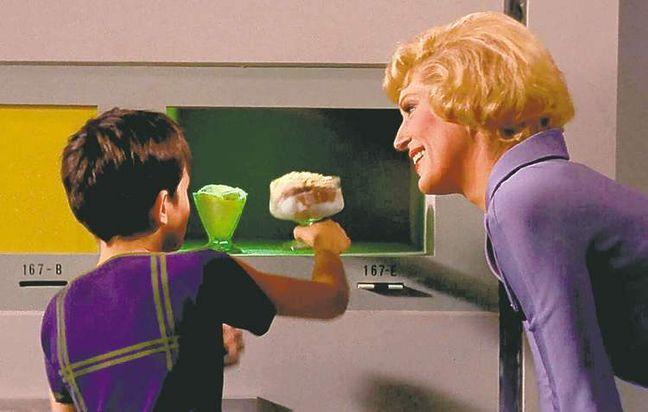
On the Starship Enterprise
The crew got their food from a replicator
They could order anything they wanted
It came out piping hot or cold, cooked to perfection
3-D printed nourishment

But
Replicated gravy
Made without love
Won’t taste
Right

Star Trek replicator

This is my response to W3 Challenge. Here are the rule which I sort of bent.

Write one three-line stanza poem that brings together a cultural tradition and modern technology.

Your poem can be playful, thoughtful, imaginative, or personal. Each line stanza may contain any number of syllables, so feel free to follow your own natural rhythm.

Structure

  • Line Stanza 1: Mention something traditional from your culture, such as a craft, art form, festival, song, food, or dance.
  • Line Stanza 2: Connect that tradition with technology, such as AI, an app, a digital tool, a virtual space, or a smart device.
  • Line Stanza 3: Show how the tradition and technology can work together, inspire one another, or create something new.

Most importantly, enjoy exploring how the past and the future can meet in just three lines stanzas.

family

Fill in the Blank

From June 2011 —

*****

I laughed aloud the other day when I heard a quote from Sartre — “Hell is other people.”  I don’t necessarily agree with it, but it made me laugh.  Sometimes dealing with people is hard.

My sister, who works in a church, once told me, “Ministry would be fun — if it weren’t for the people.”

Last night I found myself thinking, “Parenting would be fun — if it weren’t for the kids.”

You could go all sorts of places with this quote — just fill in the blank.

(blank) would be fun if it weren’t for the (blank).

A teacher might say, “Teaching would be fun if weren’t for the students.”

An RN might say, “Nursing would be fun if it weren’t for the patients.”

A retail salesperson might say, “This store would be fun if it weren’t for the shoppers.”

And so on.

Last night, Laurel couldn’t sleep.  There was a storm earlier in the evening.  But I don’t think that was what caused her insomnia.  The next day was going to be a busy day and I think she was anxious about it.  The problem was that I was tired.  I wanted just a few minutes to myself.  My compassion was very low.

Finally, after I snapped at her unkindly, she came to bed with me.  Parenting would be fun if it weren’t for these darn kids.

In the middle of the night I rolled over and found myself face to face with Chim-chim, her stuffed monkey.  She was hugging him in her sleep and I hadn’t even noticed that she had him when she came into bed.  Her monkey did a better job comforting her than I did.

Beyond the monkey I saw a little girl just trying to deal with life.

My heart melted.

Being a kid would be fun if it weren’t for the parents.

For the record, hell isn’t other people.

And being a parent can be heaven.

*****

Note from 2016: Draft folder rescue — this was first written 5 years ago. I briefly published it, but then took it down. I didn’t want anyone to misinterpret what I was saying. Parenting is incredibly fun — because of the kids. Sometimes parents just get a little tired.

Today’s note (July 9, 2016) — I took this post down not long after I published it THE SECOND TIME. Today it showed up when I searched “insomnia” which is the RDP prompt word of the day.

For whatever reason, it strikes a nerve and some people find it offensive. Let’s see how long it lasts this go-round.

family · Life

Hike to Star Field

This was originally written in March 2016 but has sat in my draft file since then. The RDP word of the day is trail which led me back to this post.


Temperatures were in the high 30s to low 40s that January day. Winter has been funny this year.

The warm air beckoned, Come! Come outside and play!

My daughter heard the call.

“I’m going to go for a quick hike to Star Field,” she said as she headed out the door.

Star Field was our go-to hike when the kids were little. From where we parked, it was about a 1 mile hike over easy terrain to a field with a great view of Otsego Lake. The kids could dawdle in the woods and not get lost because the road/trail was wide and straight.

She called a few minutes later. “The road is closed,” she said. I had forgotten that it was a seasonal road. “I may park in that lot off Lake Road and hike up past Natty Bumpo’s cave.”

The alternate route to Star Field was significantly steeper. I hadn’t been that way in years.

At home, I was trying to figure out what to have for dinner. My father isn’t a big pasta fan. That cuts my choices of things-to-make-for-dinner-that-everyone-likes-to-eat in half.

The phone rang again. “Hi, Mom,” and I knew immediately that something was wrong. She sounded shaky and scared. “Ummm…. Ummm… I slipped. There’s ice under the leaves and stuff on the trail.”

“Are you okay?” I asked.

“Yeah… I’m a little shaken. The trail was icy and I slipped.”

The more she talked, the better she sounded. She hadn’t worn the right shoes. She hadn’t figured on the ice. She thought she could find her way out by going up. She talked and talked and developed a plan.

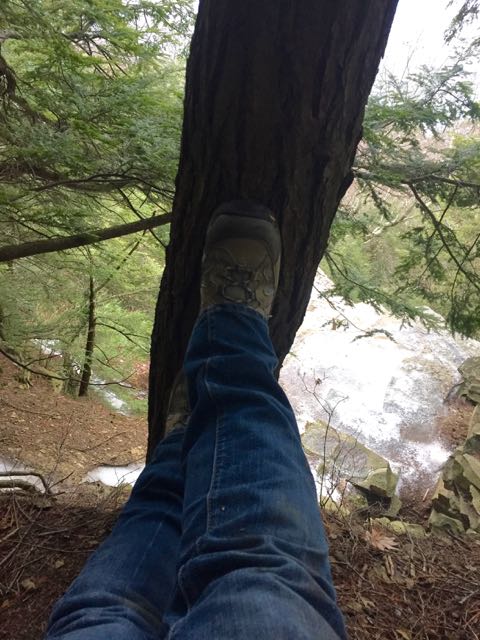
But then she sent me this picture:

IMG_5912

“It was a slow slide,” she said, “and this tree stopped me. See? I’m right by a drop-off. The tree saved my life.”

Now it was my turn to be shaken and scared.

“Don’t try to climb up,” I said. “Let me get help.”

“Who are you going to get?” she asked. “I’ll be fine. I’m pretty sure I can climb up to the trail.”

I stared at the picture on my iPod.

“Please stay where you are,” I begged. I wracked my brain for someone who might be able to help. I even called my outdoorsy son in British Columbia. Like he could help. He had some suggestions, but I was also watching the clock. We only had about another hour of daylight.


Here’s where the draft ended — but I’ll finish the story for you.

I went to the Adventure Department at the sports center where I now work. It was late in the day, but I had the photo that I showed the guys who were getting ready to go home.

One of them jumped up. “I’ll go get her,” he said enthusiastically. Within minutes, he emerged from a backroom with ropes and carabiners and all sorts of other gear slung over his shoulder. “Don’t you worry,” he said, as he headed out the door.

Of course I worried.

I couldn’t go with him because of other people who were depending on me.

It was an act of blind trust — but his exuberant confidence set my heart at ease.

And when my daughter walked through the door less than an hour later, I was thrilled.