family

Fortune favors…

Thinking today about fortune

I found many quotes about fortune favoring boldness or bravery:

  • Fortune favors the audacious. Desiderius Erasmus
  • Fortune favors the bold. Virgil
  • Fortune and love favor the brave. Ovid
  • Fortune always favors the brave, and never helps a man who does not help himself. P. T. Barnum

Then I took a little road trip.

I found this fascinating article about how changing a simple thing like font can improve retention and student performance.

  • Fortune favors the bold (and the italicized).

(Diemand-Yauman, C., et al. Fortune favors the ( ): Effects of disfluency on educational outcomes. Cognition (2010), doi:10.1016/j.cognition.2010.09.012)

And I found a quote from an entrepreneur, a young woman who followed her dreams and started an e-commerce fashion site

  • Fortune favors action! If you are reading this sitting on a job you don’t like, quit your daydreaming and start living the dream.  Ishita Sharma

This seemed an appropriate quote to follow hers:

  • In an über world, fortune favors the freelancer. Tyler Cowan (New York Times, June 27, 2015)

Louis Pasteur, the Father of Microbiology, kept cropping up.

  • Fortune favors the prepared mind. Louis Pasteur

Really, I was looking for a quote about bowling. Something along the lines of

  • Fortune favors those with bumpers in their alleys. 

I can’t find anybody who said that though.


But I know it to be true.

dementia · photography

Fog

Yesterday my father kept commenting on the fog.

“I can’t believe how foggy it is out there,” he said every time he looked out the window.

The dense fog lingered all day. When I went for my evening walk, a heavy mist still rested on the fields.

My father had been bemoaning it. “It sure would be nice to see some blue skies,” he said.

But I thought the fog was lovely.

I could still see the farm buildings.

I knew the river lay beyond the trees because I know this land. I’ve walked this road a thousand times.

The road I’m walking with my father is newer territory, though.

Even though my mother had dementia, my father was her main care-provider. When he made the decision for her to go to the nursing home, we all knew it was the right thing to do. The nursing home was well-staffed, and we knew she would receive good care. I helped, but I wasn’t the main care-provider.

Now I am. I marvel at the job my father did. Often, though, I don’t feel equal to the task. I wonder about the cost to my family.

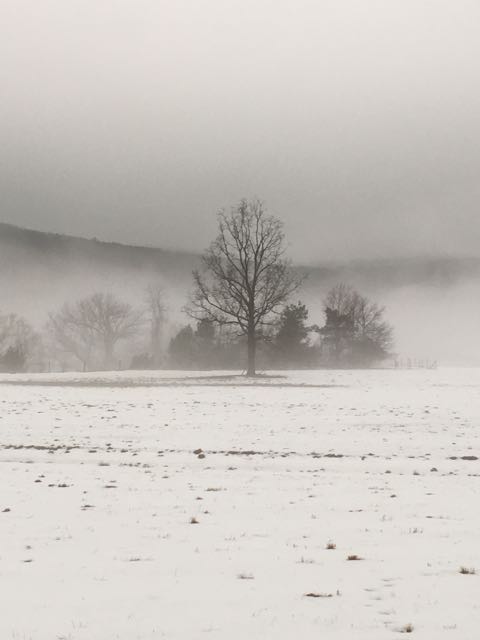
On my foggy walk last night, I stopped and looked at one tree for a long time.

It was so lovely against the backdrop of fog. Strong and independent.

Maybe as I walk this road with my father I need to look for those beautiful places.

We may not have blue skies, but there’s such beauty in the fog.

poetry

Dr. Purple Poem

Ah, Dr. Purple. Now they’ve got me thinking about him again.

Years ago, I wrote a lengthy poem about his life, thinking it would make a great children’s book. I sent it off to someone for feedback.  When she didn’t like my first two lines, I thought I should just nix the whole thing.

And I did.

I tucked it away — and had a terrible time finding it this morning. But the prompt today is “elixir” and I thought I could squeeze it into this poem. I couldn’t.

Below is a portion of my poem, telling one story I learned through my research.

the Moore Memorial Library where I spent many happy hours researching Dr. Purple

Dr. Purple lived in Greene
Back when the years began 18–

To provide for his family, with children four,
Dr. Purple opened a store.
There he sold paper and books,
Yankee notions, latches and hooks.
Then, the Postmaster he was named,
And he held the mail ’til it was claimed.

Still he practiced medicine,
For he loved to help his fellow men,
And when an accident occurred,
From his store he strode assured
That he could help the injured one
With bandage, salve, or anodyne.*

In 1856, one February day,
Mr. Mansfield drove his sleigh
Over the canal bridge right in town,
But the horse got spooked
And wheeled around
And tipped the sleigh onto its side.
“Whoa there, Nellie!” Mr. Mansfield cried.

But to the reins he held on tight,
And helpless people watched his plight
While Nellie dragged him forty feet
To Darby’s shop on Genesee Street.

Dr. Purple heard the cries,
Left the Post Office,
Ran outside
To where the injured patient lay
Unconscious on the ground that day.

Dr. Purple got some men
Who carried Mansfield to Whittenhall’s Inn.
When Mr. Mansfield came around,
He was quite bruised,
But otherwise sound.

Mansfield went back home that day –
There was no hospital in which to stay,
And Dr. Purple went back to work,
Sorting mail, just like a clerk,
And selling books and other stuff.
For being a doctor wasn’t enough…

*anodyne – a pain-killing drug or medicine


The poem goes on with other stories of his life.

He was an interesting man — acting as scribe at a local trial for Joseph Smith, testifying in many trials, publishing articles in medical journals and speaking to medical societies, proposing mandatory small pox vaccinations for school children long before that became law, deputized as US Marshall at one point to catch a mail thief, and more.

The question to me is, would other people be interested in Dr. Purple?

Uncategorized · Writing

Dr. Purple

Last week Mary and I went to a “talk” at the library.

I had seen the sign posted at the grocery store and taken a picture of it so I would remember to mention it to Mary.

But on Tuesday, March 14, everything was shut down in honor of Snowstorm Stella. I didn’t leave the house except to shovel for two days. By Thursday, the travel restrictions had been lifted and I made a trip to the grocery to pick up essentials. Someone had crossed out the date and handwritten Thursday, March 16, above it.

It turns out that someone was the local librarian. He went to every poster and changed the date.

And I was fortunate enough to see it in time.

Mary and I drove in to town and parked in front of the library that night. The snow was piled high and very few people were out and about — still. Stella was a doozy.

It turns out that Mary and I were two of six people, one of them the speaker, who ventured out that night.

We met at a rectangular table. One of the men quipped, “We need to change our name.”

The rest of the attendees were men. All over the age of 50.

Mary felt a little awkward, I could tell. They all knew each other. They talked about this and that, things familiar to them. Mary and I spoke in low voices to each other.

“You okay?” I asked her.

“Yep,” she said.

We’re both the kind of people who like to sit in the back unnoticed, but that was not going to happen at the Nights at the Round Rectangular Table.

The speaker spoke about different types of local histories, using books pulled from the library shelves for examples. A memoir. A book of old photographs. His own scholarly work about the history of a local township.

At the very end, he asked the librarian about checking out his book.

“You’re checking out your own book?” I asked.

He reddened slightly. “I’m in the middle of a move and all my books are boxed up.”

Before that, when he had finished his prepared words and taken a few questions, he asked, “Now I’d like to know why you came to this.” He turned to the man at his left who gave some answer that indicated that he was a regular at these affairs.

Mary was next. She looked like she was feeling more than a little awkward. She had already been put on the spot a few times during the discussion because she was so obviously the youngest person in the room. I tried to help her out.

“She loves history,” I said. “I saw the sign at the store and asked her if she was interested.”

They wanted to know what kind of history, what era, what she wanted to study. I think the whole reason the question had been asked in the first place was to find out what would bring a 17-year-old girl out on a snowy winter night to a talk about history.

“She brought me,” Mary said, pointing at me.

“And I came because of her,” I said, pointing back at Mary.

We both laughed. The men around the table chuckled. “I guess they each blame the other,” one of them said.

“Tell them about Dr. Purple,” Mary said.

Few topics are as interesting to me as Dr. Purple, a physician in Greene, NY, in the 1800s. When I first learned that Greene had a physician named Dr. Purple, I thought it would make a great children’s book. I started researching him.

One of the men at the table said, “Dr. Purple from Greene? That sounds like a children’s book.”

“That’s what I thought,” I told him, and I launched into telling them some of the interesting things I had learned about the man.

His life was messy, imperfect, but ultimately good. He was much loved by the townspeople.

Telling the men that night about Dr. Purple — and seeing their interest in his story — fanned the little flame of interest I keep burning for him.

The speaker gave me some suggestions on how to write such a book.

Maybe I’ll pull out my notes again and start organizing them.


A to Z Blogging Challenge

A is for Ambush

or,
A Preview for my 2017 A-to-Z Blogging Challenge

My topic for the A-to-Z Challenge this year is my kitschy collage artwork.

Sometimes I think of it as quirky; today it feels like kitsch.

I’ve planned out every day except one. J is giving me problems.

And some days, like A, I had multiple to choose from.

This was my initial A.

AMBUSH

I have two self-imposed rules for each card.

  1. No two pictures from the same book.
  2. It must tell a story.

I used to have a rabbit rule. A rabbit was to appear on every card, but I nixed that one. Rabbits can be hard to come by.

In the above picture, the monkey is Zephyr from Meet Babar and His Family (Laurent de Brunhoff),  the Lego Santa is from Snow Chase, a scholastic Lego book, the little boy is from Mother Goose Treasury, and the background is from Little Polar Bear, Take Me Home! (Hans de Beer).

You can make up your own story to go with it. I know what mine is. The collage definitely suggests a story.

But the picture bothered me. The boy’s scarf is blowing one way, and the Lego man’s beard is blowing another. Zephyr is actually standing on the polar bear but his head is hidden by the snowmobile. So I got this bright idea that I would “fix” the picture.

I added some greens to hide the scarf and partially mask where Zephyr is standing.

I wasn’t happy with the final product.

Oh, I’ll still send the card to somebody.

Just for laughs.

And because I know enough people who don’t mind imperfection.

But A is no longer Ambush.

Tune in next Saturday to find out what it is.

Faith · family

Just Keeping It Real

I read a comment on Facebook yesterday about women’s faith blogs — how they talk about messy lives but fail to show the mess. Let me show you my mess. Without my mess, my blog is meaningless.

It’s after 9 AM. I’m still in my pajamas. My top is an oversized men’s shirt that I bought at a thrift store. My flannel pants are old and comfy. I put on socks because my feet get cold in the morning. I grabbed the ones on the floor by my bed because they were closest, and I was bleary-eyed from a lousy night’s sleep. The socks are threadbare. Just keeping it real.

My left ankle aches. The bruising from my knee injury is draining to my feet. I asked a doctor about it — the husband of a friend — at a swim meet because I didn’t want to make a trip to the clinic. He said it was normal. It looks awful but no one sees my ankles, and I can live with the ache. But I prop my leg up like an old woman, and I guess I am.

When I finish my quiet time, I hide my pile of books on the floor by the chair where I usually sit. If I don’t, my father may start looking through them. It’s not there’s anything I don’t want him to see and I would be happy to share them, but something about unbidden looking feels like an invasion of my minimal privacy.

The dog follows me everywhere. She sleeps by my bed. I hear her licking at weird hours of the night. At 5 AM she follows me down the stairs, and up and down with me every time I use the bathroom or get something from my bedroom. She has bad breath and thunks up and down the stairs gracelessly.

The kitchen table is a mass of papers. My parents have always had clutter problems. I inherited that gene. What if something I recycle turns out to be important?

… but

If I choose to focus on the positives…

My coffee was delicious this morning. Fresh ground coffee beans make all the difference. Even “Fred” said this morning, “Mom, you make great coffee.”

Yes, “Fred” is visiting. And Helen. And Bud is back from his business trip. My father is working on the crossword puzzle in the chair next to me. Philip and Henry video-called this morning. I am surrounded by family and feeling oh-so-blessed.

Even the dog is in the room, lying on the floor far enough away that I can’t smell her. I can see where her coat is turning from black to gray and am reminded that she is an old dog. How much longer will we have her? I don’t know, but I’m going to be thankful for that time.

“Fred” is trying to write a haiku for Henry and every line rhymes. Helen laughs, and says, “Haikus don’t have to rhyme, you know,” but “Fred” keeps working on it.

Life is good. Even with a cluttered kitchen table and threadbare socks.


Faith

The Beginnings of Every Ordinary Day

“Holy cow!” my father said. “You must have gotten up early!”

I had just told him that I had already driven to the airport and back to pick up my husband from a business trip.

“No earlier than usual,” I told my father.

“What time do you get up?” he asked.

“5 o’clock,” I answered.

I didn’t tell him that he also gets up most mornings right around 5. I hear him on the monitor I have in my room because I worry about him falling or needing assistance.

He needs more and more assistance. The other day he called to me, “Sally? Sally?” with the door cracked open. When I checked on him, he was half-dressed and couldn’t think what to do next. But that was at 9 AM, around his usual time for getting dressed.

At 5 AM, on most days, I hear him get up to use the bathroom, but he goes back to bed. I get up, too, and go downstairs to make coffee.

The next 2 – 3 hours are blissfully mine.

Tuga and coffee in the pre-dawn

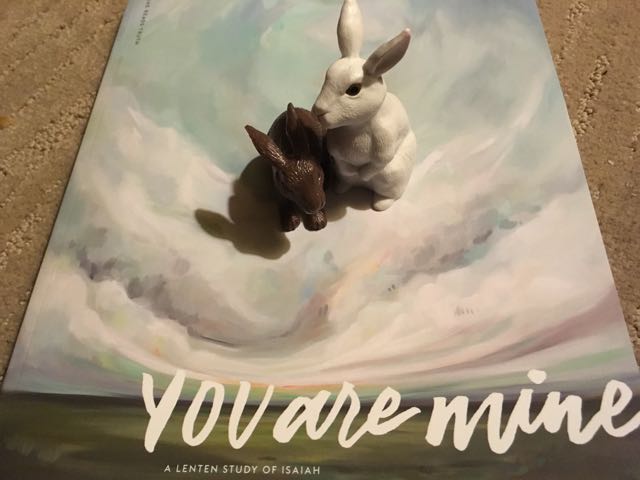
I read. My pile of books changes with the seasons.  Right now, I’m reading a Lenten devotional from She Reads Truth,

(rabbits not included)

The New Christian Year, daily readings following a liturgical calendar, compiled by Charles Williams, (my friend, Africa, who is learning to rebind books would be appalled at the white adhesive tape I used when it started falling apart on me),

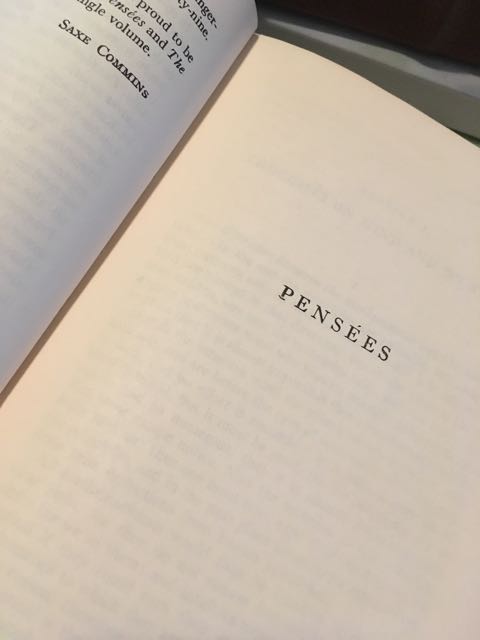
Blaise Pascal’s Pensées (a pensée a day keeps the mind at play, I tell myself),

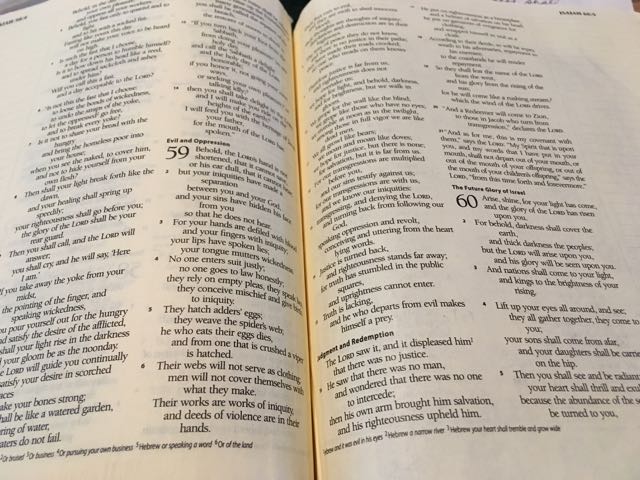
my Bible (5 Psalms and the chapter of Isaiah I’m memorizing),

and my prayer book. (Usually I have Lancelot Andrewes help me out here, but I’m giving him a break for Lent.)

I pray. The list grows longer and longer of the people I pray for by name. It’s rare when I cross someone off, but Antonin Scalia came off when he died, and Richard Hanna, my congressman, came off when he left office. Those girls kidnapped by Boko Haram? I chose one name off that list, and until I see her name in a follow-up story — and I frequently check — I’ll continue to pray for her and her family. Friends and family stay on my list forever. If you’re reading this, it’s highly likely that your name is there.

I moodle. Brenda Ueland defines moodling as aimless dawdling. I find it essential for my mental health.

Something about letting thoughts swirl and settle sets everything right.

Lancelot Andrewes has a prayer that one commentator deemed incomplete, but I find it the perfect way to end my beginning every day.

In every imagination of my heart
In the words of my mouth
In the works of my hands
In the ways of my feet

I give it all over to Christ and ask His blessing on those things — my imaginations, my words, my works, my ways — and then head into another ordinary day.

Book Review

Let Me Listen To Your Heart

Every time I see a copy of this book, Let Me Listen To Your Heart, in the thrift store or yard sale, I grab it so I can send it to someone who might appreciate it. This book of short writings by medical students in Cooperstown is poetic, poignant, and beautiful.

Some short excerpts* —

“So how are you today?”

What a stupid, stupid question. I know how you are — sick of freshmen like me practically giddy from my expensive education. You’ve seen me before….

Oh, yes, I have seen you before and put up the walls you describe your essay. But the young doctor goes on to describe finally connecting with the patient.

It’s a theme in the book. Listening. Moving beyond a list of memorized symptoms and linear diagnosis, to seeing a person. To hearing a person.

In another essay** the woman writer describes an ER patient being admitted for an overdose on a cold and rainy night. He had been referred to as a “scumbag”, which conjured up all sorts of images, before she actually met him.

[He was a]… scrawny little guy, with half-an-inch thick glasses and pretty bad acne…. I liked him immediately, almost instinctively — kind of the way you would like puppy that’s smaller and weaker than the others and has a really tough time getting its share of food.

We have so many preconceived ideas of what a patient should look like. She listened to his story, and concluded her essay with this:

The “scumbag” has long since drifted away, and I’m left sitting with a sad and lonely child. It’s raining again.

Another touching essay*** is about by a medical student who loves woodworking. By talking about curly maple, dowel joints, and cabinet-making, he finds a common bond with an otherwise obtuse patient. He ends his essay with this:

I was filled with the feeling that I had done something useful by finding the patient within the illness. And there to prove it, on the seat next to me, in the form of a hand plane, lay my first, unsolicited, fee.

My father came home with many such “fees” — fresh eggs, small paintings, handmade dolls for me and my sister.

When a doctor connects with his patient by seeing him or her as a flesh-and-blood person with history and future, who has a family, and work, and feelings, it can make all the difference.

I’m grateful that Bassett compiled this book back in 2002.

If you should see it somewhere, I suggest you grab it.


*”Getting Through” by Corey Magnell

**”Overdose” by Kristen Kalissaar Hunt

***”Fee” by Andrew Thomas

Faith · family

Caregiver’s Serenity Prayer

God, grant me the serenity to accept the things I cannot do,

I can’t “fix” my loved one.

I can’t make him think more clearly.

I can’t make him understand.

I can’t go back in time, and mustn’t languish over how or what he was, because he is who he is now and that’s where we are.

Courage to do the things I can,

I can handle business affairs — writing checks, paying bills, scheduling appointments.

I can do laundry.

I can prepare meals and serve snacks.

I can answer the phone.

I can chauffeur.

I can explain things over and over and over and over, and set my exasperation aside.

And the wisdom to know the difference.

When I lay in bed at night, let me not angst over the battle, but, in the weariness of a hard-fought day, take my rest knowing that I did the best I could.

Few will see or know what I do.

My own loved one will never fully grasp the sacrifice that I, and my husband, and my children, are all making on his behalf.

But it is right and good.

And You know, o Lord.

Let that be enough.


Adapted from The Serenity Prayer by Reinhold Niebuhr.

dementia · elderly

In the Parking Lot

I never know what I’m going to see in the parking lot at the local grocery store.

In the village of Cooperstown, there is one — yes, only one — grocery store.

I go there often. My father’s refrigerator is small, and we go through perishables fairly quickly. I started keeping a chart of how often I go to the grocery because I felt like I was going every day. It turns out that out of 50 days, I only went 36 times.

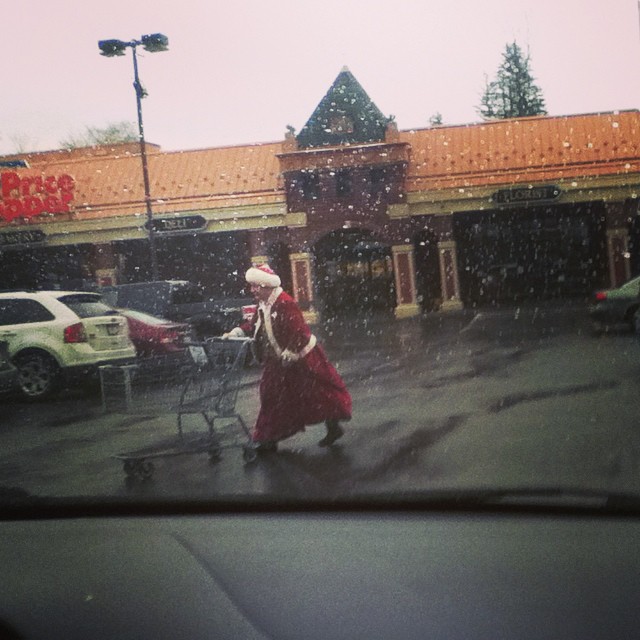
I never know what I’m going to see there. Once, I saw Mrs. Claus pushing a shopping cart up the parking lot hill to her car.

Yesterday, I stood behind an elderly man at the check-out. He paid for his groceries and handed his change back to the cashier.

“I think I owe you this,” he said. She shook her head in protest and smiled at him.

As he headed for the door, he turned and said to her, “See you tomorrow.”

Another person who goes to the store nearly every day.

As soon as he was out of sight, she put the loose change he had just given her into the container at the checkout for the this month’s charity — I think it’s Muscular Dystrophy.

“I tell my boyfriend that I have a sugar-daddy,” she said to me. “He gives me quarters every day.”

We both laughed, and she told me how he comes in every day and goes through her line.

“Once he brought me a poem,” she said. “It was strange and I didn’t understand it.”

Poetry can be like that.

I thought about my father and the way he focuses on young women who smile and are friendly. With him, I get irritated about the whole thing. It’s a fixation that bothers me, but I know that it shouldn’t.

The man at the grocery store didn’t bother me in the least. I could see how lonely he was. And old. And slightly confused.

I paid for my groceries and headed out to the parking lot. The man was standing in the middle of it, a look of consternation on his face.

“I can’t find my car,” he said, and I could hear the panic in his voice.

“What kind of car do you have?” I asked him.

“It’s a blue Ford, but I can’t find it anywhere,” he said, one hand on his cart, the other fumbling with his keys.

“Well, let’s see,” I said, and I began to look around.

With minimal effort, I found a blue Taurus and pointed to it. “Is that your car?” I asked.

A huge smile broke out on his face. “Yes! Yes, that’s it,” he said. “Thank you so much.”

I watched him push his little cart to the car and was grateful I could help.

As I drove home, I hoped he could remember where he left his house.

I’ll have to ask the cashier about it when I see her today.