In the press of the crowd He said out loud, “Who touched me?” After the shock Those with whom he walked Smiled and said to him bravely,
“You must understand, Many folks, many hands — How can we know who touched You?” Poor woman quaking Timidly shaking Confessed ’cause she knew that He knew
While He was speaking Others came seeking Bearing the saddest of news “Change of plans,” one said “You can’t wake the dead.” He pressed on, ignoring their blues.
“Why are you weeping? The child is but sleeping,” He said when he came to the place And taking her hand He told her to stand — And she did! What joy! Such grace!
Miracles start when we go Disbelieve what we “know” For no one can truly know God Reach out and touch Ask Him too much Human knowledge makes quite a facade
This is my day-late response to the MLMM Monday Wordle which challenges us to use these words in our post: must, wake, shake, make, shock, smile, brave, walk, plan, hands, pants, sad.
I wrote another fractured Bible story and got all the words in except “pants.” Can you see a place where pants could fit?
This story can be found in Mark 5. I love it because it reminds me to press beyond what we think we know.
The woman with the flow of blood would have been considered unclean under Levitical law — and yet, there she was, in a crowd, just wanting to touch the hem of Jesus’ robe.
He felt that touch. He healed her.
The little girl was dying when they sent for Jesus, but He didn’t make it in time. She died. The servants were dispatched to save him the trip.
But He came anyway — and raised her from the dead.
The whole story can be summed up with this — don’t put God in a box. Don’t think you know God so well that you know what He will do. As CS Lewis said of Aslan, He’s not a tame lion.
From “A Liturgy for Experiencing Road Rage” (Every Moment Holy, Volume 1, by Douglas McKelvey)
If my heart were more content in you, O Lord I would be less inclined to rage at others
Of course, I’m not the one struggling with road rage. In fact, I’m not even sure that the driver of the car in which I’m riding is struggling with road rage. He’s simply an aggressive driver.
I can’t even look when he accelerates up onto someone’s tail before initiating the pass. The speedometer needle goes far higher than I am comfortable seeing or experiencing.
But I’ve learned to keep my mouth shut in those situations. I say something later, but in the moment isn’t the time.
I looked up the prayer for road rage in Every Moment Holy. Doug has written a prayer for everything. Every moment IS holy.
Of course, I changed the words — because clearly I’m not the one with the problem. I prayed, “If his heart were more content in You, he would be less inclined” to drive so aggressively.
God, could you just fix him?
The next lines in the prayer say,
Let me gauge by the knot in my gut, the poverty of my own understanding of the grace that I have received
It’s kind of hard to pray that about someone else when I’m the one with a knot in my gut. I’m the one with a poverty of understanding.
So I go back to the beginning.
If my heart were more content in you, O Lord I would be less inclined to rage at others look to change others Let me gauge by the knot in my gut, the poverty of my own understanding of the grace that I have received
The knot in my gut these days is about so many things that are out of my control, the least of which is aggressive driving.
I open up my knotted hands. Again. To relinquish what I can’t change.
And I have the conversation. Again. “When you drive like that, it makes my very uncomfortable.”
[A week or so ago, I decided to started searching the Ragtag Daily Prompt word in my draft folder so I could relook at some of the things written years ago. Today’s word was FOUNTAIN — and finally a post came up — this one.This post was originally written in May 2019 and has been sitting in my draft folder ever since. I don’t know what prompted the post back then.]
Back in the 1980’s, when the AIDS crisis was sweeping across the country, some churches took up the cause by proclaiming it was God’s judgment. I know because I heard it — not whispered, but spoke aloud — “This is God’s JUDGMENT.” Homosexuals were considered a particularly nasty subset that fell under the heading of SINNER.
And no, I did not attend Westboro Baptist.
My brother, Stewart, responded differently. He was a pastor at the time and he began inviting people with AIDS and their caregivers to church suppers.
This may not sound like much today, but it was big. There was so much misinformation and fear around the issue. People were afraid of drinking from the same water fountain as someone with AIDS. Or being anywhere near them. Like the virus might leap from them to person to person like a strange deadly flea or bedbug.
But my brother invited them in — and I was shocked. “Aren’t you afraid?” I asked.
He answered my question with a question. “Don’t you think Jesus would have spent time with them? I think they are exactly the people He would have sat down to dinner with.”
I knew he was right.
Mine is a slow and heavy ship that takes years to change its course. It may have taken decades for me to totally rethink the issue, but I think Stewart moved the rudder just a little with that conversation.
I start every day with reading. I’ve done that for most of my adult life, although what I read has changed over time.
These days I have four different books that I’m reading. It’s a weave, pulling threads from four different sources, and letting them intertwine. Sometimes it’s amazing how it works sometimes, the similarity between two disparate books.
This morning I was especially struck by that. I’ve been reading William Willimon’s book Aging: Growing Old in Church. I finally finished a very long chapter called “With God in the Last Quarter of Life” which was subdivided into topics like Grief, Church Participation, Being a Burden, Economics, etc. The last section was on Memory.
I cared for both of my parents as their memories shape-shifted and deteriorated. This section of the book hid hard and hit home as I remembered that period of time in MY life. Here are a few quotes:
One reason the aging remember is to preserve a now disintegrating sense of self. We remember selectively, even desperately, defiantly, having lost a job and some of our friends and family. Remembrance is an act of defiance against injustice, recalling the lives of past victims in order that their witness may not be lost. …
And yet some of our feverish attempts to hold on to our memories may be a sign that we fear we are being forgotten. We may have bought into the widespread American notion … seeing ourselves as the sum of our efforts rather than as a gift of God’s love and vocation. …
The elderly… can be living bodily reminders to us all that our lives are not the sum of our attainments, never our sole possessions, but rather, from birth to death, God’s gifts.
Compare/contrast/weave those words in with these words from Brian Doyle. I’m reading his collections of essays called Eight Whopping Lies and other stories of bruised grace. Today’s essay was “What Were Once Pebbles Are Now Cliffs” in which he remembers his sons when they were the size of pebbles; now they are cliffs.
Time stutters and reverses and it is always yesterday and today. Maybe the greatest miracle is memory. Think about that this morning, quietly, as you watch the world flitter and tremble and beam.
It’s good to be reminded that I am not the sum of my efforts, my attainments, my possessions. Every day is a gift. And memory is also a gift.
One of the ways that I organize my thoughts each morning is reading. It sets me on the right path for today.
Then, I copy a quote or two into my journal. Writing out the words, I believe, helps them stick in my brain.
This weekend, I am not at home. I could have sworn that I brought a pen with me, but it is nowhere to be found. It’s probably with my glasses.
I’m at an inn, not a chain hotel. If I were in a hotel room, I’m sure there would be a pen or two, a pad of paper or two, and far less charm than where I’m staying.
So, this morning, here is where I will copy the quote that struck me.
I’m reading a book called Aging: Growing Old in Church by Will Willimon. For the past several years, I have focused on one author each year. This year, I chose William Willimon, who somewhere between his first book, Between Two Advents, an early book of his, and this one, he shortened his name to Will instead of William. I’m curious about that.
I also wrote a letter to him, yet to be printed and mailed, asking if I could meet him toward the end of the year. When you read a lot of books by an author, you feel like you know him. My authors have all been deceased by the time I’m bingeing on them. Will(iam) Willimon is very much alive. Maybe I’ll get brave enough to send that letter.
Anyway, today’s quote:
The poet T.S. Eliot lists three ills of aging: ills of the body, ills of the world, and ills of the past… Some older persons are consumed with remorse due to life paths taken and not taken, fractured relationships, and regrettable life choices…. Nearly every Sunday the pastor invites us to ‘confess our sins to Almighty God,’ an invitation for everyone to unburden and leave their regrets at the altar. Jesus commanded us to forgive our enemies, and sometimes our greatest enemy is our vain attempt to live our lives without mistakes and regrets.
I believe that a fundamental secret of successful aging is learning to affirm the lives God gives us in the face of regret that God didn’t give us the lives we thought we needed to live happily.
This post is brought to you by the JusJoJan prompt: organ. What a great word! When I read it, organize immediately came to mind. Organ could also refer to your liver or kidney, or a musical instrument. Then there’s organic chemistry. And organisms. Even a word like ‘organization’ can go in different directions! So thank you, Kaye, for a great prompt!
I can’t tell you the number of rude things that have been said to me because of the number of children I have. I have eight.
“When are you going to stop?” — said to me by a woman at church when I was pregnant with #4. She later said to me after that baby was born — a daughter after three sons, “You got your girl, thank God. You can stop now.”
Another woman told me, “You have too many children.” This was when I had, I think, six. I responded by asking, “Which one should I get rid of?” I received no answer.
I haven’t gone to high school reunions, in large part because I didn’t want to spend my evening answering questions about my family size. That — plus the fact that while my classmates went on to pursue careers, I chose to be a stay-at-home mom. I didn’t really want to spend an evening at reunion answering the question, “What do you do?”
I chose to be a mom.
And it was, without a doubt, the right choice for me. It shaped me. It allowed me to be creative and loving and strong. I developed patience. I learned that I LOVE taking care of people.
So much so that I took care of my parents, too.
Did I resent doing that? Never. Not even for half a second.
Now, while my age-cohort is retiring, I’m just a few years into my first full-time job since 1984.
I have an office where I work. People stop in a lot to say hi, to talk, to complain, to suggest. I have an open door. Just the other day I was telling someone how being a mom prepared me for the constant interruptions of having an open-door policy in my office. When you’re a mom, you learn that your interruptions ARE your work. The same is true for me today.
A man stopped in my office yesterday. He often pokes his head in to say hello. He was a caregiver for his disabled wife the last few years of her life. He used to bring her to the gym and wheel her around in her wheelchair so she could have contact with other people.
Then she died.
And it turns that by coming to the gym he was building his own support system. He comes every day — not to work out so much as to visit with people. He makes the rounds, and I’m on them.
Anyway, he poked his head in, chatted about nothing, and then asked about my necklace. My youngest daughter gave it to me and I always wear it.
It has three discs: one that’s a tree, and two progressively larger ones with the names of my children around the edge. When you have a large family, you have to be creative about mother’s jewelry.
I explained the necklace to him.
“You have eight children,” he said incredulously.
“Yes,” I replied.
“Did you adopt some?”
“No.”
“Did you have twins or triplets?”
“No,” I told, “they were born one at a time.”
I turned around to grab the photo I have of them on my bulletin board.
“There’re all adults now,” I said, showing him the photo.
“You have eight children?!”
“Yes, this is them,” I said.
He was shaking his head. “You have eight children?!?!”
“Yes –”
He was backing out of the doorway. I was feeling rattled and small and angry and sad.
“You have eight children?” he said again. “I need to process this.”
“I’m still the same person you’ve been talking to for a year,” I called after him, but I don’t think he heard me.
Don’t get me started.
There are so many things that can define a person. Mistakes made while young. How they invested their life over the past four decades. What they are doing today.
I have eight children. They are amazing people and I’m so proud of them.
Really. Don’t get me started.
This overly-wordy post is my response to the Stream-of-Consciousness prompt: don’t get me started.
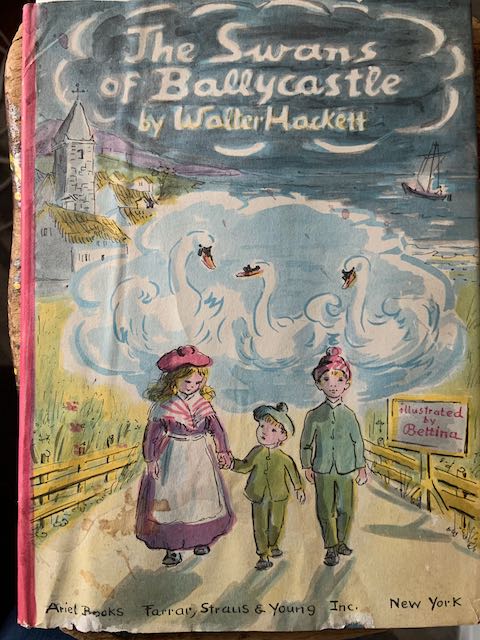
“In the Irish seaside town of Ballycastle, the people still tell the story of the three wandering swans…“
Thus begins the original Swans of Ballycastle, and thus begins my tale.
The children and a single father are introduced: “Deirdre, the oldest was ten, Kevin was eight, and Michael was only five. Their father’s name was Brian and he kept a small shop in the center of Ballycastle. The three children and their father lived on the second floor over the shop. Their mother had died when Michael was very young. Brian, the father, raised the children as best he could.“
The children were incredibly happy. They played make-believe games in the shop or wandered to the beach and built sandcastles. They were happy. They were content. Life was good.
One day, their father journeyed to Belfast to buy goods for the store. “In his absence, Widow MacConnell ran the shop and looked after the children. Not that she had much to do on that score, for Deirdre, as usual, took care of her younger brothers. She cooked, served the meals, swept and dusted and saw that her brothers went to bed on time.“
Brian was gone a long time.
“One morning the children rose and went downstairs. In the kitchen they found their father. With him was a strange woman.“
[Here the Sally-version takes over]
She was short and round. Her hair was white and curly, like the caps on the waves. She wasn’t old, but she wasn’t exactly young either. Her dress was ocean blue, billowy and soft. Her smile, when she saw the children, grew and grew. It was warm and welcoming.
Deirdre wanted to run to her immediately for a hug, but something stopped her. She didn’t know this woman and she was her brothers’ protector. Instead she looked to her father.
He took another sip of his coffee, stood, and said, “Deirdre, Kevin, Michael — This is your new mother.”
He opened wide his arms and the children ran to him. While they were gathered in their family hug, he reached his arm out to the new woman and pulled her into the embrace. Deirdre thought she smelled like the sea breeze and welcomed her closeness.
Her name was Cordelia, but she insisted that the children call her Corrie. “I would never dare to presume that I could replace your mother,” she said, “but I promise to love you as best I can.”
Corrie’s favorite thing to do was walk on the beach. Every morning, she led the little entourage to sandy shore. Michael held her hand now, instead of Deirdre’s when they walked.
Kevin and Deirdre found that Corrie had a wealth of wisdom about the sea and the shells and the birds and the fish. They would run ahead when the beach was in view and begin their hunts.
“What’s this?” they would ask, bringing her a shell. She always knew the name and a story about the creature that lived inside.
One day Deirdre found a golden coin stamped with the picture of a swan. “Look, Corrie,” she said, extending her open hand to her with the coin on it.
A shadow crossed Corrie’s face. “Throw that away,” she said sharply, “as far as you can into the sea.”
Deirdre pretended to throw it, but she folded her thumb over the coin while she made the throwing motion, then stealthily slipped it into her pocket.
Okay — this new story is going to take more than one day’s work. Tune in next Tuesday, for part Two.
I look for what I should be doing Since I am captain of my soul What is it I should be pursuing? What should I do to be made whole?
Surely, I can make some changes In my approach to living life Surely I can rearrange this Remove all this unneeded strife
And yet, and yet, and yet again I know I am not in control I bow my head, contrite amen – So be it, God — I yield the goal
To “not my will, but Yours be done –“ It’s not my race, but Yours I run
A few weeks ago I had decided to try to process the Sunday sermon by taking notes and writing something later.
Last week was my first week doing it. It accomplished these things:
First, I went to church. I’ve been skipping so much lately.
I told Fr. N. that I was mad at God.
“Is that okay?” I asked.
“Absolutely,” he replied. “Go ahead and swear at God. Tell Him this is shitty.”
It’s just that I spent so much time and effort praying about a situation that did not resolve the way I wanted to do. What’s up with that, God?
Second, I semi-paid attention. Okay — I was distracted that morning. I pulled myself away from the distraction long enough to write a single line which I read back to Fr. N. later in the week.
“You paid attention!” he said. That may have been an overstatement. Here’s the line:
The places where we have fallen flat on our faces — those are the places where God comes.
Third, I wrote a post to process it. It turned out to be pretty personal so I didn’t publish it. I realized that writing something and NOT publishing is okay, too. It felt good to write and process, though.
This week, I went to church in part because the lectionary readings (and therefore the sermon fodder) were some of my favorites passages: Isaiah 6 and John 3.
Fr. N. went with John 3. I settled in, waiting for him to talk about the wind. You know, how it “blows where it wishes, and you hear its sound, but you do not know where it comes from or where it goes.” (John 3:8)
It’s verses like that that encourage me to embrace the mystery. Too long I attended churches that knew all the answers.
Fr N, however, didn’t get the wind memo. He went in a different direction: baptism.
He talked about how Nicodemus wanted something that he, Nicodemus, could do, and instead Jesus told him something that was impossible.
Rereading my notes from yesterday’s sermon led to today’s sonnet.
It’s not entirely what Fr. N said, but it’s what I needed to hear.
Dear Barbara, Remember when We used to pray And say amen
To all of our Troubles and cares Passing them on – Gone – to “One Upstairs”
Who heard our words Read our mettle Enclosing us Thus to settle
And face what came– Oh! Life was hard Especially Yours. See — one card
Then another — Life dealt you crap Death, illness, hell Fell in your lap
Week after week We bowed our heads We wept, we prayed Life frayed to shreds
Why did we stop? I don’t recall Did we give up? Our cups to fall
And break, as did Our friendship? I Wish I knew what Shut that door. Why?
Why do people Move on from God, Friends, prayers, tears? Fears? Fatigue? Fraud?
I am a fraud Yes, yes. That’s true But we did pray A day or two
I was out for a drive with a friend the other night, and suddenly I recognized the landscape, the roads, the buildings. It had been years since I had driven out there but I used to meet weekly to pray with a friend. She lived out there.
We stopped meeting rather abruptly some 20 years ago — and I don’t remember why. I don’t remember a falling out. I don’t remember a lot of things from those years. They were so stressful.
But the stresses in my life were miniscule in comparison with hers.
This poem came out of the hashing around of those memories.
I need to add that faith failures — the doubts, the fatigue — they are all MINE, not hers. Pretty sure, anyway.
God, I need Thee. When morning crowds the night away And tasks of waking seize my mind; I need Thy poise.
God, I need Thee. When love is hard to see Amid the ugliness and slime, I need Thy eyes.
God, I need Thee. When clashes come with those Who walk the way with me, I need Thy smile.
God, I need Thee. When the path to take before me lies, I see it . . . courage flees– I need Thy faith.
God, I need Thee. When the day’s work is done, Tired, discouraged, wasted, I need Thy rest.
Howard Thurman, “Deep is the Hunger”
When I first came across this prayer/poem by Howard Thurman, I read it through multiple times. I can honestly say that I had never prayed for poise but it made so much sense. To start my day with confidence, even though it may seem daunting from the outset, seems so powerful.
Not in an I’ve-got-this way. Rather, a You’ve-got-this-therefore-I-can-do-it way.
I go back to this prayer regularly and pray for poise, for God’s eyes and smile, for faith, and for rest.