fiction · The Swans of Ballycastle · Writing

The New Swans of Ballycastle

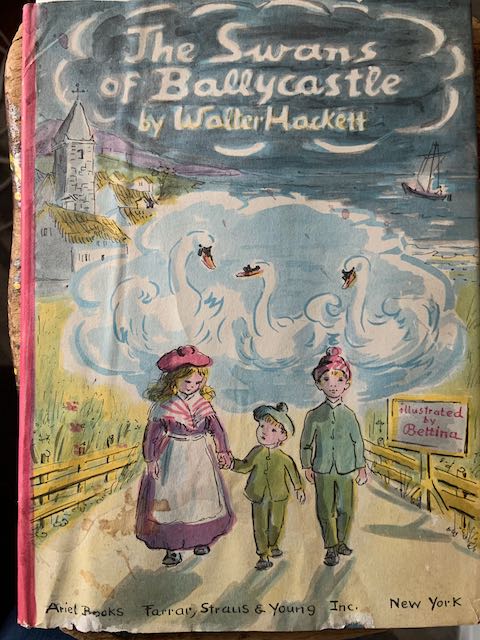
In the Irish seaside town of Ballycastle, the people still tell the story of the three wandering swans…

Thus begins the original Swans of Ballycastle, and thus begins my tale.

The children and a single father are introduced: “Deirdre, the oldest was ten, Kevin was eight, and Michael was only five. Their father’s name was Brian and he kept a small shop in the center of Ballycastle. The three children and their father lived on the second floor over the shop. Their mother had died when Michael was very young. Brian, the father, raised the children as best he could.

The children were incredibly happy. They played make-believe games in the shop or wandered to the beach and built sandcastles. They were happy. They were content. Life was good.

One day, their father journeyed to Belfast to buy goods for the store. “In his absence, Widow MacConnell ran the shop and looked after the children. Not that she had much to do on that score, for Deirdre, as usual, took care of her younger brothers. She cooked, served the meals, swept and dusted and saw that her brothers went to bed on time.

Brian was gone a long time.

One morning the children rose and went downstairs. In the kitchen they found their father. With him was a strange woman.

[Here the Sally-version takes over]

She was short and round. Her hair was white and curly, like the caps on the waves. She wasn’t old, but she wasn’t exactly young either. Her dress was ocean blue, billowy and soft. Her smile, when she saw the children, grew and grew. It was warm and welcoming.

Deirdre wanted to run to her immediately for a hug, but something stopped her. She didn’t know this woman and she was her brothers’ protector. Instead she looked to her father.

He took another sip of his coffee, stood, and said, “Deirdre, Kevin, Michael — This is your new mother.”

He opened wide his arms and the children ran to him. While they were gathered in their family hug, he reached his arm out to the new woman and pulled her into the embrace. Deirdre thought she smelled like the sea breeze and welcomed her closeness.

Her name was Cordelia, but she insisted that the children call her Corrie. “I would never dare to presume that I could replace your mother,” she said, “but I promise to love you as best I can.”

Corrie’s favorite thing to do was walk on the beach. Every morning, she led the little entourage to sandy shore. Michael held her hand now, instead of Deirdre’s when they walked.

Kevin and Deirdre found that Corrie had a wealth of wisdom about the sea and the shells and the birds and the fish. They would run ahead when the beach was in view and begin their hunts.

“What’s this?” they would ask, bringing her a shell. She always knew the name and a story about the creature that lived inside.

One day Deirdre found a golden coin stamped with the picture of a swan. “Look, Corrie,” she said, extending her open hand to her with the coin on it.

A shadow crossed Corrie’s face. “Throw that away,” she said sharply, “as far as you can into the sea.”

Deirdre pretended to throw it, but she folded her thumb over the coin while she made the throwing motion, then stealthily slipped it into her pocket.


Okay — this new story is going to take more than one day’s work. Tune in next Tuesday, for part Two.

Faith · poetry · Sermon Recap

Sermon Recap 05.26.24

I look for what I should be doing
Since I am captain of my soul
What is it I should be pursuing?
What should I do to be made whole?

Surely, I can make some changes
In my approach to living life
Surely I can rearrange this
Remove all this unneeded strife

And yet, and yet, and yet again
I know I am not in control
I bow my head, contrite amen –
So be it, God — I yield the goal

To “not my will, but Yours be done –“
It’s not my race, but Yours I run


A few weeks ago I had decided to try to process the Sunday sermon by taking notes and writing something later.

Last week was my first week doing it. It accomplished these things:

First, I went to church. I’ve been skipping so much lately.

I told Fr. N. that I was mad at God.

“Is that okay?” I asked.

“Absolutely,” he replied. “Go ahead and swear at God. Tell Him this is shitty.”

It’s just that I spent so much time and effort praying about a situation that did not resolve the way I wanted to do. What’s up with that, God?

Second, I semi-paid attention. Okay — I was distracted that morning. I pulled myself away from the distraction long enough to write a single line which I read back to Fr. N. later in the week.

“You paid attention!” he said. That may have been an overstatement. Here’s the line:

The places where we have fallen flat on our faces — those are the places where God comes.

Third, I wrote a post to process it. It turned out to be pretty personal so I didn’t publish it. I realized that writing something and NOT publishing is okay, too. It felt good to write and process, though.


This week, I went to church in part because the lectionary readings (and therefore the sermon fodder) were some of my favorites passages: Isaiah 6 and John 3.

Fr. N. went with John 3. I settled in, waiting for him to talk about the wind. You know, how it “blows where it wishes, and you hear its sound, but you do not know where it comes from or where it goes.” (John 3:8)

It’s verses like that that encourage me to embrace the mystery. Too long I attended churches that knew all the answers.

Fr N, however, didn’t get the wind memo. He went in a different direction: baptism.

He talked about how Nicodemus wanted something that he, Nicodemus, could do, and instead Jesus told him something that was impossible.

Rereading my notes from yesterday’s sermon led to today’s sonnet.

It’s not entirely what Fr. N said, but it’s what I needed to hear.

poetry · prayer

Lost Prayer

Dear Barbara,
Remember when
We used to pray
And say amen

To all of our
Troubles and cares
Passing them on –
Gone – to “One Upstairs”

Who heard our words
Read our mettle
Enclosing us
Thus to settle

And face what came–
Oh! Life was hard
Especially
Yours. See — one card

Then another —
Life dealt you crap
Death, illness, hell
Fell in your lap

Week after week
We bowed our heads
We wept, we prayed
Life frayed to shreds

Why did we stop?
I don’t recall
Did we give up?
Our cups to fall

And break, as did
Our friendship? I
Wish I knew what
Shut that door. Why?

Why do people
Move on from God,
Friends, prayers, tears?
Fears? Fatigue? Fraud?

I am a fraud
Yes, yes. That’s true
But we did pray
A day or two


I was out for a drive with a friend the other night, and suddenly I recognized the landscape, the roads, the buildings. It had been years since I had driven out there but I used to meet weekly to pray with a friend. She lived out there.

We stopped meeting rather abruptly some 20 years ago — and I don’t remember why. I don’t remember a falling out. I don’t remember a lot of things from those years. They were so stressful.

But the stresses in my life were miniscule in comparison with hers.

This poem came out of the hashing around of those memories.

I need to add that faith failures — the doubts, the fatigue — they are all MINE, not hers. Pretty sure, anyway.

prayer

God, I need Thee

God, I need Thee.
When morning crowds the night away
And tasks of waking seize my mind;
I need Thy poise.

God, I need Thee.
When love is hard to see
Amid the ugliness and slime,
I need Thy eyes.

God, I need Thee.
When clashes come with those
Who walk the way with me,
I need Thy smile.

God, I need Thee.
When the path to take before me lies,
I see it . . . courage flees–
I need Thy faith.

God, I need Thee.
When the day’s work is done,
Tired, discouraged, wasted,
I need Thy rest.

Howard Thurman, “Deep is the Hunger”


When I first came across this prayer/poem by Howard Thurman, I read it through multiple times. I can honestly say that I had never prayed for poise but it made so much sense. To start my day with confidence, even though it may seem daunting from the outset, seems so powerful.

Not in an I’ve-got-this way. Rather, a You’ve-got-this-therefore-I-can-do-it way.

I go back to this prayer regularly and pray for poise, for God’s eyes and smile, for faith, and for rest.

It is my prayer for 2021.

Life · Uncategorized

The Clothesline

… one may find it extremely helpful to discover a clothesline on which all of one’s feelings and thoughts and desires may be placed.

Howard Thurman, The Creative Encounter

I woke up feeling irritable. Then, my cinnamon rolls didn’t turn out (I think I left out an ingredient). My pizza was cold when I got around to eating it. And now, it’s bedtime and I haven’t written anything. Humbug.

I found myself thinking about Howard Thurman’s clothesline.

Clotheslines have happy memories for me. My mother would dry the sheets on the clothesline up by the chicken coop. In the spring and summer, the sheets smelled like mown grass. In the fall, they carried the crisp fresh smell of autumn. When Bud and I bought our first house, I asked for — and got — a clothesline that stretched from the house to the garage. At our next house, he installed a shed-to-tree line with a pulley.

The idea of hanging thoughts on a clothesline appealed to me. Thurman was talking about putting our negative thoughts there to allow them to “float away” and then replace them with higher thoughts.

Honestly, I think I need two clotheslines.

The first would be for those thoughts I need to put aside. They are easy to identify. They have to do with cinnamon rolls with forgotten ingredients, cold pizza, parenting challenges, and disharmonies in my life.

The second clothesline is the better one. I have quotes I’ve copied from books I’m reading, scriptures I’m working on memorizing, and little notes people have sent or given to encourage me. What if I make a little clothesline — a quoteline — of those encouragements? I could stretch a length of twine somewhere, write quotes on little slips of paper, clip them to the twine, and then reread them often.

After a year like 2020, I could do with regular doses of encouragement. Could you?

Uncategorized

A Slower Tempo

Take your time and expect them to take theirs. Be very tolerant. Be as undemanding as you can. This slow tempo will help the contemplative side of your life: but if you get in a frenzy and want quick results, you will run into spiritual disaster. I repeat, disaster.

Thomas Merton, Seeds of Destruction, letter to a Papal Volunteer leaving for Brazil

Early yesterday morning I shopped at a warehouse store during their senior citizen hour. Yikes — yes — I qualify as a senior. I thought it would be a zip-zap-zoom trip. Nobody else would be there so I could grab my things and get home pretty quickly.

I was wrong.

It turns out that senior citizen hour at a warehouse store means that most of the shoppers are driving their shopping carts instead pushing them.

They drive slowly.

Down the middle of the aisle.

And stop frequently.

Zip-zap-zoom turned into wait-wait-wait.

I remembered taking my father to Target in past few years and he tried to drive one of those carts. I guess it’s not as easy as it looks.

I laughed when I read Thomas Merton this morning. He was writing to a volunteer heading to Brazil in the early 1960s. The different country, the different culture — it fit so perfectly with my shopping expedition. The slow tempo did indeed help the contemplative side of my life. I paused and listened to the Christmas music playing in the store. I prayed for patience when I realized that those one-way arrows on the floor don’t apply during senior hour. I prayed for a shopper who was struggling and short-tempered. I helped someone find something.

The warehouse store may not have been Brazil but it was another world.

What is Christmas, though, if not a venture into another world? The ultimate venture.

Lord, let me take my time and be tolerant,
not just at Christmas, but all the time.
Christmas is a good season to begin.
The world feels disastrous enough.
I don’t need to add to it.
Amen

Uncategorized

The Last Page

Here’s an author’s perspective: We work REALLY hard to tell a story in a certain way–we edit and re-edit and agonize over what parts to tell in what order, because the *way* the story unfolds is integral to the story itself. And the ending–specifically the surprise of the ending–was, for me, the thing I literally worked toward for ten years. It’s like tasting one ingredient of a cake before it’s been mixed with everything else and allowed to cook. If the author wanted you to have that last page information at the beginning of the book, he or she would have set it up that way and told the story as a flashback. Last page readers: I beg you all to cease and desist. Repent, ye!

Andrew Peterson, part of a Facebook thread on reading the last page of a book while in the middle of a book

Dear Andrew,

You’ll be pleased to know that I have repented.

Your reader,
Sally

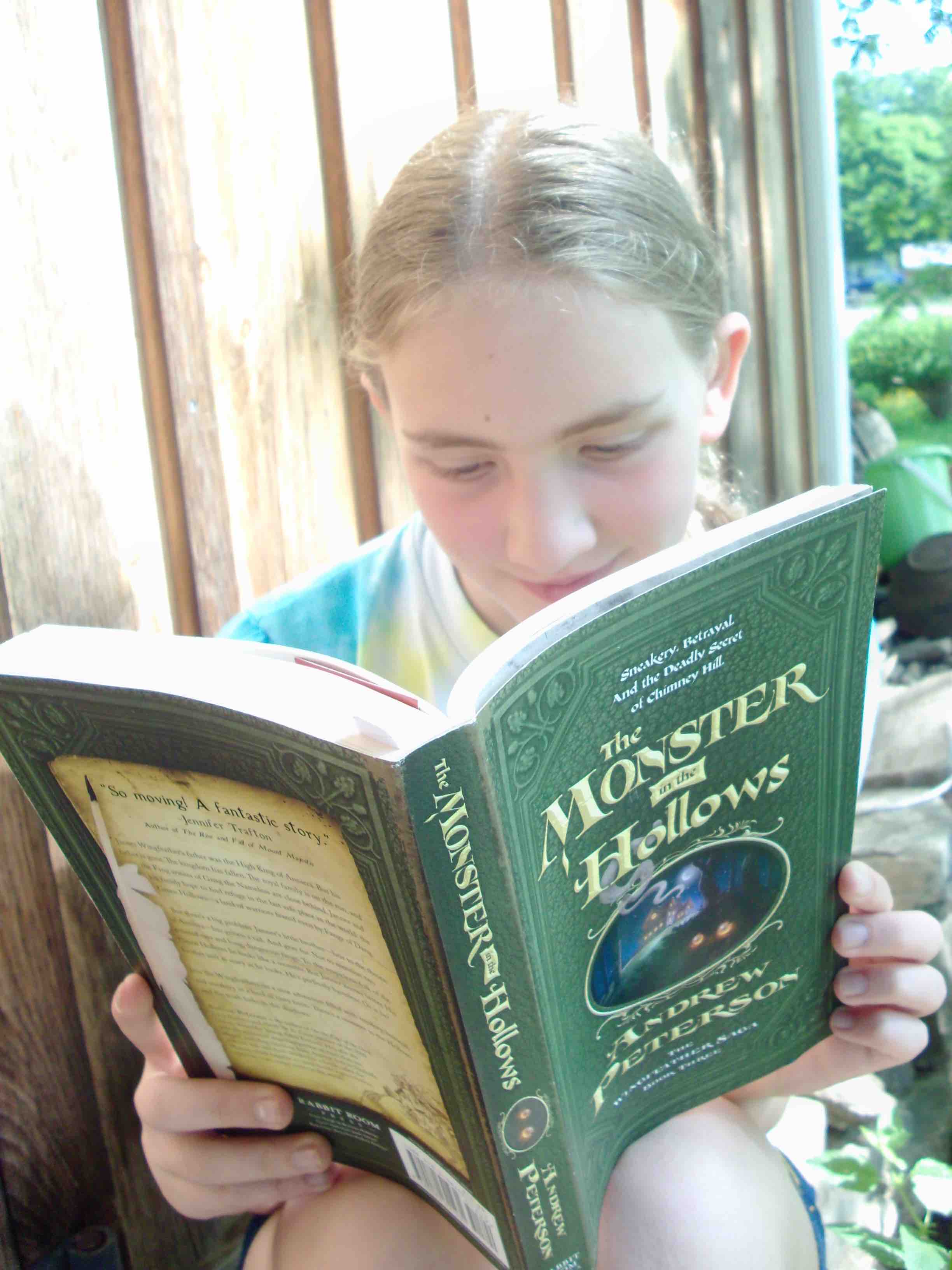
Mary reading one of Andrew’s books (2016)

It hit me the other day as I refreshed my favorite news site yet again, that my news-junky-ism and my back-of- the-book reading are symptoms of the same problem — a lack of faith in the author or The Author, as the case may be.

This morning as I was praying over the big things happening these days — things over which I have NO control — I was so convicted. 

Do you trust me? God whispered. 

“Yes, God,” I said. “I trust You.”

Wait patiently, He said.

I refreshed the news site a few more times while I waited.

Sally, do you trust me?, He whispered again.

“Yes, God,” I said. “You know that I trust You.”

Wait joyfully, He said.

I tried to focus on happy things while I waited… but the news on the screen caught my eye and my hand wandered over to keyboard so I could hit refresh.

Sally, do you believe me, He whispered a third time, not believe IN Me, but believe ME?

And I was grieved — not at Him, but at myself — because He had to ask me a third time.

I searched my heart before I answered. “Lord, I’m trying,” I said. “It’s just that I NEED to know what’s going to happen. What’s going to happen on January 6? What will happen on January 20? When will COVID be behind us? Just let me know a couple of pages out — I don’t need to see the last page.”

Hush, He said. Live today. Live it well. Tomorrow will be here soon enough.

I’m pretty sure He also added, And stop reading the last page when you’re in the middle of a book.


Faith · prayer

Prayer of Confession

In the Book of Common Prayer, the morning prayer of confession begins,

ALMIGHTY and most merciful Father; We have erred, and strayed from thy ways like lost sheep…

I was interested to read Lancelot Andrewes note on this prayer —

We have wittingly and willingly run from Your ways like an untamed heifer

img_0672Last summer, on my walks, I often saw the cattle in a neighboring field.  Sometimes they would run up to the fence as I walked past. One liked to lower his head and shake his horns at me threateningly.img_9663 I tried to reassure him that I meant no harm. I was simply out for a walk.img_0675

My bovine friends — or not-friends — became a fixture on these walks. I would scan the field to see where they were grazing. When one escaped, I tried to encourage him to go back with his compadres, but it’s hard to encourage an 1800 pound animal and keep a safe distance. img_0504

One fall day, Bud was working in the barn across the street when he heard the screech of tires. He ran out to see a woman, wide-eyed, sitting in her stopped car in the middle of road, staring a herd of cattle thundering toward her up the road. They ran past the house, tipping the mailbox as they went and disappearing over the crest of the hill followed by men in pick-up trucks.

“I had seen them trying to load them into a trailer earlier,” Bud told me. “Must be they decided to get them to the other farm the old-fashioned cattle drive way.”

That evening, when we went for a walk, we saw the guys in the pick-ups sitting outside the pasture that had once held their steer.

“That was something else,” Bud said to them, “watching them run up the road.”

“They didn’t want to get on the trailer,” one guy said, “and broke the fence. If you see ’em, let us know.”

“You weren’t herding them?” we both asked.

“Hell, no,” the man replied.

About a dozen steer were now on the wild in Otsego County, including the one who occasionally menaced.

As best I know, they were never found — although I did hear of occasional steer-sightings.

I pictured them when I read Lancelot Andrewes words.

Breaking through the fence — wittingly and willingly.

Running from the livestock trailer — running from Your ways

Like wild cattle — like an untamed heifer

It’s quite an image.

Almost exquisite — if one can use that word for cattle.

dementia · Faith · family

If You Say So

The following is an edited version of a post first published on January 2, 2012. I wrote it when my mother was still living at home and I was trying to help my father with her.

My sister and I can carry on conversations using just things my mother says.

For instance, my mother often says, “If you say so.”

Making the sandwich #1This is usually in response to something she doesn’t believe to be true.  Like, she’ll be preparing a meal for, say, 150 people.  (150 is her favorite number.)  I’ll say to her, “Mom, there are only going to be five of us for lunch today — You, me, Dad, Mary and Laurel.”

She’ll look at me with a look that says, I don’t believe a word of that.  But out of her mouth will come the words, “If you say so.”

It’s a phony acquiescence.  She’ll continue right on making 150 sandwiches.

Or, she’ll be getting ready for church, and I’ll say, “Mom, today is Tuesday.  There’s nothing going on at the church today.”

She’ll answer, “If you say so,” and then continue getting ready for church.

She started saying it as a cover for her memory loss.  It was easier than arguing.

The reason I wanted to start off the new year with those words, though, is because they tie in so beautifully with something else I’ve been thinking about.  I’ve been thinking about how the earthly life of Christ was book-ended with two statements of yielding.

First, when the angel told Mary she was going to have a baby, she responded with,

Behold, I am the servant of the Lord; let it be to me according to your word.

Luke 1:38

I’m quite sure there must be a translation out there that translates her words as, “If you say so,” not in an I-really-don’t-believe-a-word-of-it way, but in the way I would like to be able to say them to God. A yielding.

When Jesus was praying in Gethsemane before his death, he said these words,

Father, if You are willing, remove this cup from me.  Nevertheless, not my will, but Yours, be done.

Luke 22:42

Can’t you just hear the “if you say so” in there?

“Father, take this cup away from me, but, if you say so, I’ll do it.”

When God asks me to go through something, I’d like to be able to say, “Okay, God, if You say so.”

I want 2012 (and now 2017) to be an “If You Say So” kind of year, a year of yielding to the Father’s will.  I want to be like Mary and Jesus,  who, facing trials and uncertainty, still trust God’s overarching plan.

However, I want to be sincere in my words — not like my mother  just saying words to smooth things over.

If you say so.

Simple words from a person with Alzheimer’s.

Words also to live by.

A to Z Blogging Challenge

Yuck

A few weeks ago I babysat my grandson and got to change his diaper.

When I first became the mother to a little boy, my mother had warned me to not leave a boy uncovered too long. Beware the fountain of youth. You know.

Even with that sage advice, my oldest son squirted me right in the face shortly after I brought him home from the hospital. I learned to get everything ready before the big reveal so I could be quick and cover it up in a jiffy if I needed.

With my grandson, I was prepared. I had my method down. Get the wipes ready. Unfold the new diaper. Take a deep breath, then take off the wet diaper.

Of course, he nailed me. In spite of. And laughing all the while.

I think this ritual of male creatures marking their territory starts very young.

PICT0853Cleaning bodily fluids is the yuck of motherhood.

Changing diapers.

Wiping noses.

Cleaning vomit.

Dressing battle wounds of wars fought with siblings or sidewalks.

It’s in those most intimate, personal, yucky moments that love takes root and grows.

My friend’s house became a crime scene when her husband was murdered there. A group of women went to the house and scrubbed the blood off the floor. Men patched the bullet holes in the wall. Cleaning the yuck became an act of love.

Jesus washed His disciples’ dirty feet on the night He was betrayed.

And Joseph of Arimathea wrapped His body — head bloody from the crown of thorns, hands and feet pierced by nails, his side opened with a spear — Joseph wrapped that bloody body in a linen cloth and laid him in a tomb.

The yuck of love.

In more ways than one.

Caring for aging parents is such a privilege. Laundering soiled garments, gently bathing fragile folds of flesh, cleaning unmentionables, because, you know, we are cultured and couth.

Those are the sacramental moments of life.

The farmers have been spreading the manure on the nearby fields this week. The aroma fills the air. Yuck.

But when the alfalfa grows, lush and green, nutrient rich because of the timely application of poo — we forget the yuck.

So it is with children.

And aging parents.