family

Irma

It seems hard to believe that this beach where I have walked and relaxed and played will have a storm surge of 5, 10, 14, 17 feet of water. The numbers keep getting higher every time I look at the news.

My sister, who lives in Bonita Springs, Florida, has long been an avid Weather Channel watcher. She says that her cats like to watch, too.

I always laugh about it. “You can’t change the weather,” I say, which is true, but unhelpful.

But now Irma plans to visit.

I’ve collected shells on Sanibel, and felt the waves wash over my feet. Little waves of the incoming tide. Not Irma.

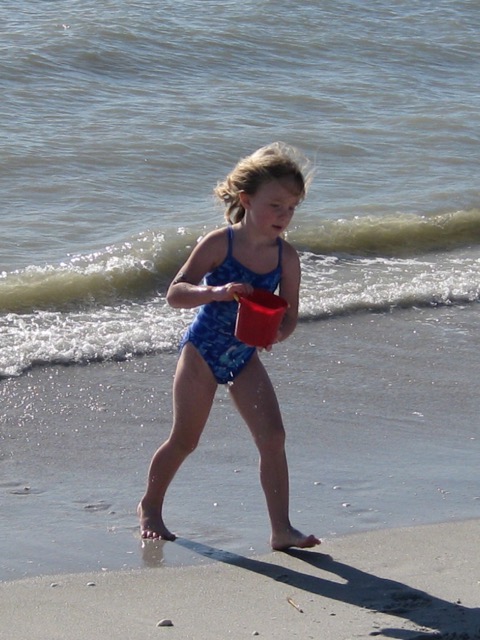
My children have gathered buckets of sand and water as they played there. All in safety.

At Sanibel in 2008
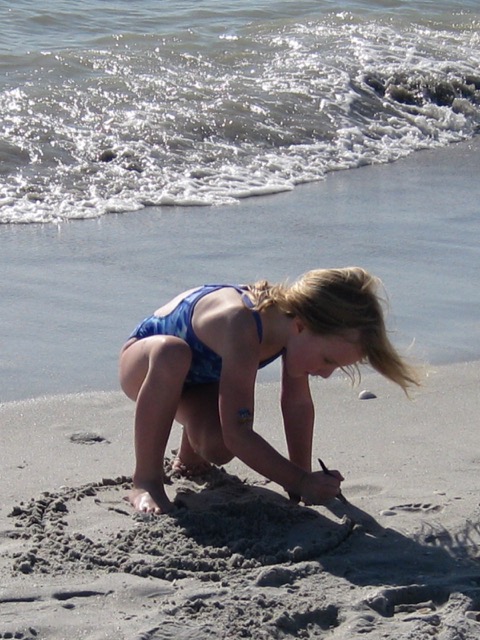
Drawing in the sand (2008)
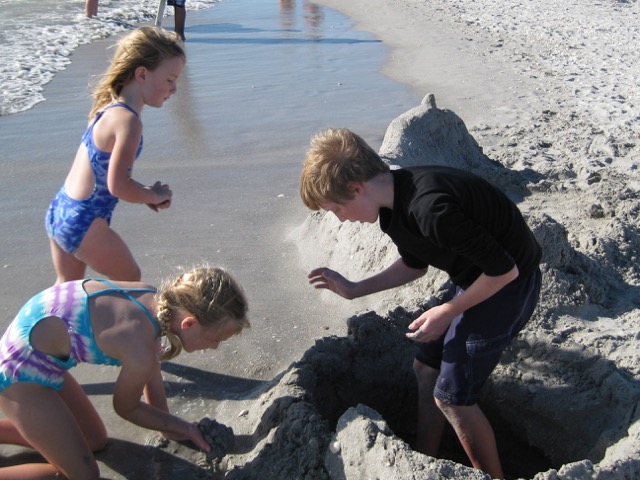
Building a castle (2008)

It’s hard to imagine how changed it will be.

“Is it too late to evacuate?” I asked my sister this morning.

“Oh yeah,” she replied.

As Irma’s winds grow closer, a crescendo unlike anything my Florida family has experienced, my worries will also grow.

And grow.

And grow.

I had my own little bout with worry recently. Waiting for appointments and answers is the worst. But, in the end, my answers were all good news.

With Irma, I’m afraid that the waiting isn’t the worst part.

It’s too much to hope for good news.

I’ll watch the Weather Channel with a pit in my stomach, waiting for the storm to pass.

My prayers are with all who stay in Florida.

Psalm 55:8

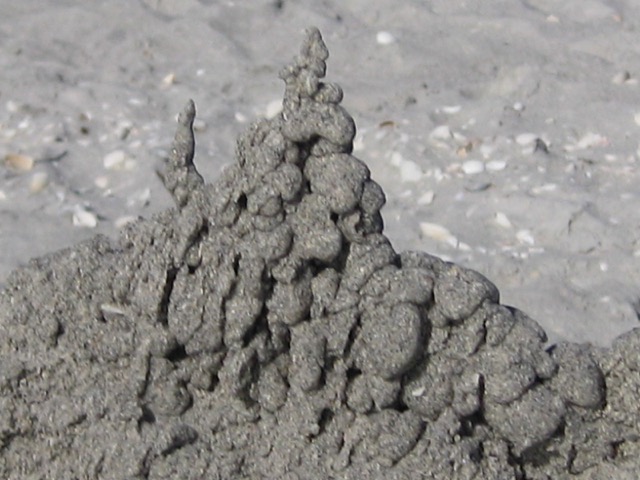
Sand castle at Sanibel (2008)
family · poetry

Rain

I’m beginning to anticipate
What his response might be —
My mother blamed “the others”
For things we didn’t see,
But my father’s not a blamer
So, when he can’t explain
“It fell down from the sky,” he says,
Like some mysterious rain.

I crawled around the other day
With flashlight in my hand.
Half his hearing aid was missing
And I tried to understand
How these darn things fall apart so much
Half in one room, half another
I would have blamed “the others”
Had I been my mother.

Then Laurel called me from the kitchen
“Wha-T?” I said, but I
Emphasized the “T” too much —
And I can tell you why —
I was getting irritated
At the time that it had cost
Looking for a hearing aid
Half of which was lost.

“Grampa wants you,” she said timidly
And so I went to see
What it was he wanted now
From irritated me
“I found it!” he was saying.
I was surprised at what I saw
The missing piece of hearing aid
Resting in his paw.

“Where’d you find it?” I demanded.
I knew I should happy
But, you know, I wanted answers
And he’d better make them snappy.
“Can you fix it?” he was asking —
Not answering my question
It’s a skill he has in conversation –
Changing the direction

But I was dogged — “Where’d you find it?”
“It fell out of the sky,”
He said, as if that answer
Would satisfy my cry.
He told me again yesterday
When I asked about a pin
He had fastened to his sweatshirt
And I asked where it had been —

Apparently the sky inside
Varies precipitation.
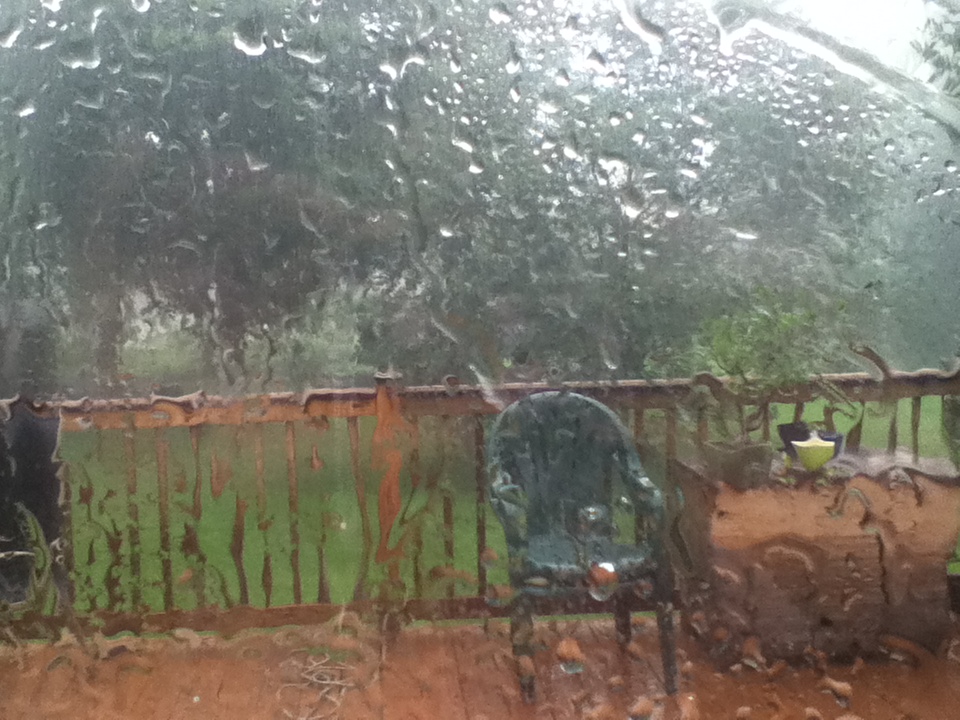
Outside I see it raining rain
Inside, to my frustration,
It yields an odd assortment
Of hearing aids and stuff
That I couldn’t have imagined.
I should be thankful; it’s enough —

The lost hearing aid was found
I’m not still crawling on the ground

Rain

For Peter:

Perhaps another explanation is that a wolverine
Creeps into the house at night, stealthily, unseen
And hides my father’s hearing aids
Tapes them to the ceiling
Whence they fall on Dad, while I am searching, kneeling.

family · photography · poetry

Blonde

Me — about 3

My hair was blonde when I was small
But it grew dark as I grew tall
My mother had the same thing too —
Blonde that darkened as she grew

’tis a funny thing — this natural blonde —
Some maintain, and don’t respond
To aging with six shades of brown
But old age gives its hoary crown

To all in silvery grayish white
Tresses giving up the fight
To stay the hue of summer sun
And let winter overrun

Vanity, you try my hair
But you won’t win ’cause I don’t care


In response to Daily Prompt: Rhyme

Cee’s Fun Foto Challenge: Alphabet with a Twist – B

dementia · elderly · family

Barefoot Girl

“Oh, I see you’re a barefoot girl this morning,” my father said, looking at my feet.

I was indeed barefoot, as is often the case when I’m still in my pajamas.

“A barefoot girl with shoes on,” he continued, smiling as he said it.

My daughters are often barefoot in the summer — and he says the same thing to them.

A barefoot girl

“What’s he talking about?” one of them asked once.

“It’s a poem he memorized,” I told them.

I asked him about it — and he dutifully recited two verses:

‘Twas midnight on the ocean,
Not a streetcar was in sight,
The sun was shining brightly
For it had rained all night.

‘Twas a summer’s day in winter
The rain was snowing fast,
As a barefoot girl with shoes on,
Stood sitting on the grass.

More verses are available on the internet, all unattributed, but those are the two he remembers.

Poetry and music get stored in a different part of the brain, I think — one that survives longer unscathed by dementia. It’s fascinating to think about.

Yesterday, he said something about Laurel going to the skating rink when I was taking her to the pool. He pulls up the wrong word often.

I also had a tough time convincing him that R2D2 wasn’t a radar unit. He was working on a crossword puzzle. R2D2 was the clue and he needed a 5-letter word beginning with R.

“R2D2 is a robot, Dad,” I told him.

“Why doesn’t radar work?” he asked, in all seriousness.

“Because it’s a robot. Robot will work there,” I said.

He made his if-you-say-so face and went back to the crossword.

Maybe if I made up a poem about it and had him memorize it, he would remember.

elderly · family

Sights and Sounds

Yesterday my father told me that he was have vision problems.

“Everything is blurry,” he said, “and I feel like I’m seeing double.”

My heart sank. A stroke — the word ran through my mind, a leering devil of a word that filled me with fear.

He looked fine. He was standing, leaning gently on his walker. His speech was fine. He had walked from the porch to the kitchen with his walker and stood in the doorway talking to me.

“Let me wash your glasses for you,” I said, gently lifting them off his face. “Maybe that’s the problem.”

I carried them to the sink and ran water over the lenses, carefully washing first one lens and then the… oh my goodness — a lens was missing.

“You’re missing a lens, Dad,” I told him, and  showed him by poking my finger through the frame. We both laughed because this was a much better explanation for the double vision than some of the alternatives.

I began searching and quickly found it where it had fallen on the floor. It’s not hard to pop back in. I’ve done it many times. Within a few minutes, everything looked normal again.

This morning, when he came out, he said, “I’m having a devil of a time.”

“What’s going on, Dad?” I asked.

“WHAT?! I can’t hear you! I can’t find this hearing aid,” he said, pointing to his right ear.

“I’ll find it for you,” I told him, and went to his bedroom where I usually could locate things like missing hearing aids in pretty short order.

I looked.

And looked.

And looked.

I knew he was waiting for breakfast so I left the looking and went back to the kitchen.

“I can’t find it, Dad, but I’m sure we will,” I told him.

“What did you say?” he asked.

Later, when the home health aide came, we searched and searched. We stripped the bed, looked under every piece of furniture in his room, the garbage, pockets of clothes in the laundry, everywhere.

“My mother used to say, ‘It’s always the last place you look,'” I told the home health aide.

She laughed. My kids just get annoyed when I say that these days.

Finally, we gave up. “I guess I’ll have to call audiology,” I told her.

“Don’t call yet. It’s got to be here somewhere,” she said.

“I’ll wait until next week,” I said, hoping it would appear magically over the weekend.

We shouted the not-good news to my father while he sat reading the paper with his solitary hearing aid. Then I left to pick up Laurel at the pool.

No sooner was Laurel in the car than my phone rang. I handed it to her, asking to answer and put it on speaker phone.

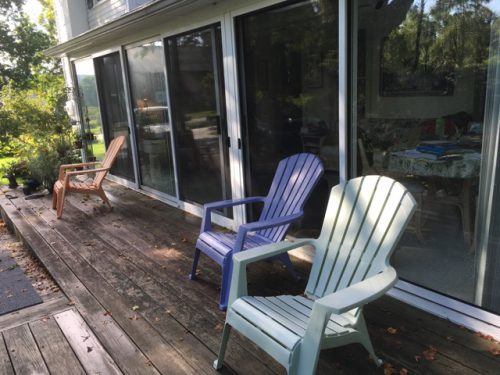
“Sally?” crackled the voice of the home health aide. “Sally? You’re not going to believe this, but I found it. It was on the floor of the side deck right by that purple chair he sits in. It got rained on, but it still works.”

Hallelujah!

The real mystery is how it got there.

I had walked my father into his bedroom at 10:00 the night before, and I’m 95% sure he had it in his ear then. Some time during the night, it mysteriously made its way outside.

I don’t want to think about it.

photography · Writing

A is for Appetite (Or, 5 Things About Zombies)

Please forgive this post. I blame it on my brother and the fact that I’ve been struggling to write.

“Why don’t you write ’10 Things About Zombies’?” my brother suggested.

“I don’t know ten things about zombies,” I said.

“Make them up,” he said, but I couldn’t think of anything.

“Zombies are dead,” I told him.

“You need to come up with something more interesting,” he replied.

Exactly.

So I tried.

I came up with five facts, but the first one is really a correction.

Zombie Fact #1: Zombies are not dead; they are undead.

Cee Neuner is starting a weekly photo challenge called “Alphabet with a Twist.”  For the next 26 weeks, she’ll feature a different letter ~~ with a twist ~~ for her Fun Foto Challenge.

Maybe it’s because I’m a little twisted myself — but, I felt like I could commit to this challenge.

A (with a twist) is Ap. The photo needs to feature something that begins with the letters “Ap.”

I’m adding my own second requirement for this challenge. I’m going to use old family pictures.

Zombie Fact #2: Zombies don’t like to be photographed. Most zombie photos are staged and not real.

A few years ago, I started scanning my father’s slides to get them into a digital format. All of the photographs in this post were taken by my father before I was even born. Not staged. 100% real. No zombies.

So…. A is for Appetite.

Zombie Fact #3: Zombies like watermelon.

Watermelon is red and juicy. If you look at zombie pictures (which I know are staged) they often have red juicy stuff running down their chin. Watermelon, while not the consistency of brains or flesh, looks appetizing enough to fool your average zombie.

My mother told me that watermelon was sometimes soothing for a child that was teething. I like to think that’s why she was feeding it to Stewart in this picture, but she may have kept watermelon on hand in case of zombie attack.

Stewart eating watermelon

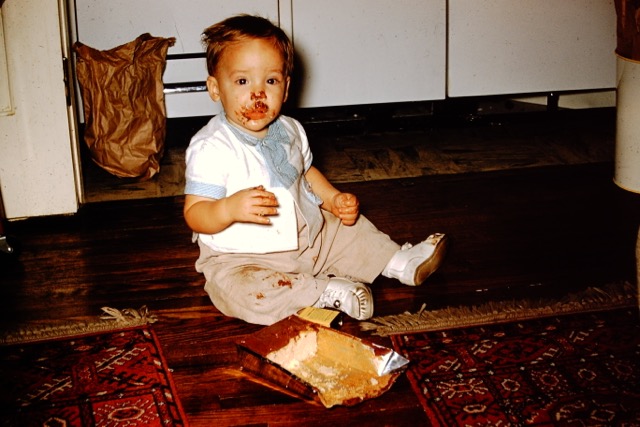
Zombie Fact #4: Zombies are delighted when they see a baby with food on his or her face.

Zombies really aren’t so different from the rest of us. What parent hasn’t taken a picture of junior with spaghetti on his head or chocolate ice cream smeared all over his face?

For zombies, though, they find it attractive because they identify with it. Most zombies have lost their swallow reflex. Remember the zombie pictures with red liquid dripping down their chin? Well, they can’t help it. Their swallow reflex died with them and didn’t come back to life. That’s why they talk the way they do. That’s why they eat the way they do. When they see a baby with food all over his face, they think he’s one of them. They feel a kinship.

Stewart with food on his face

This can actually be used to a family’s advantage when under attack. Hold the food-covered baby in plain view while the rest of the family slowly backs out of a room invaded by zombies. The zombies will be so enamored that they won’t attack. Once everyone is out the room. Shut the door and run.

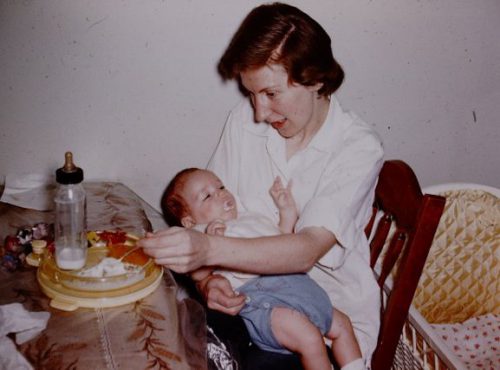
This is a picture of my mother feeding Stewart.

He doesn’t have anywhere near enough food on his face to distract zombies. It’s okay. He lived his whole life without a single zombie attack.

My mother and my oldest brother have both passed away but they will never be zombies, because —

Zombie Fact #5: A person who lives a life of service to others can never become a zombie.

My mother and my brother both gave freely and generously of themselves. It’s like a zombie vaccine.

This should serve as a reminder to all.

We should be kind.

We should be generous.

We should put others first.

— if for no other reason than it will keep us from being zombies.


photography

There’s No Place Like Home

*click* *click* *click*… There’s no place like home… There’s no place like home…. *click* *click* *click*

Dorothy, in the “The Wizard of Oz”

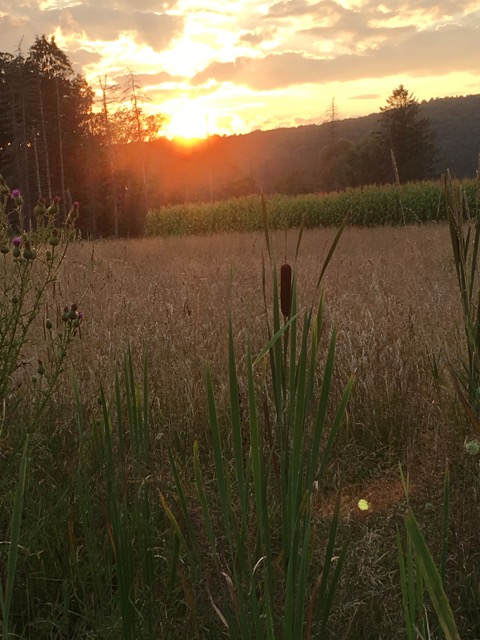
Cattails and sunset — August 10, 2017
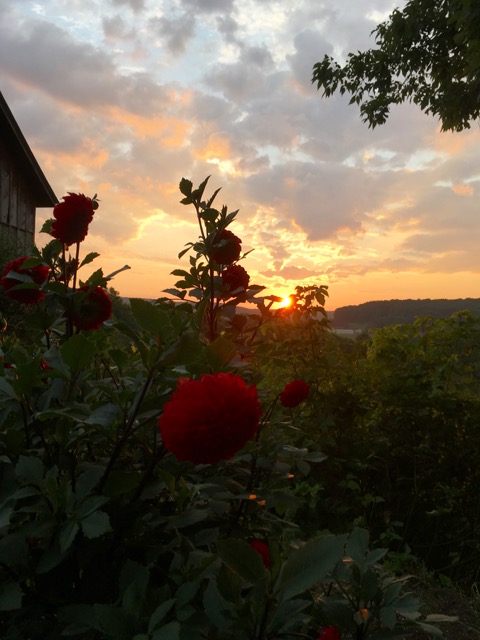
Dahlias and sunset — August 10, 2017
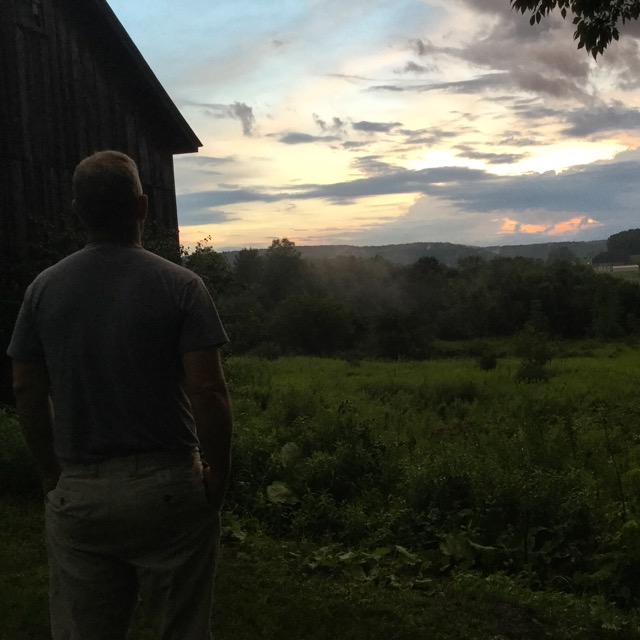
The neighbors slowly heading off to bed — August 10, 2017
Evening walk — August 12, 2017
Enjoying a summer evening — August 12, 2016

Home doesn’t usually happen in a jiffy. It can take years — even decades — for the roots to go down so deep that no matter where a person goes in the world, he or she can feel the call of home.

Truly, there is no place like home.


Day #7 of a nature photo challenge. It’s my home.

If this is a challenge you would like to do, it’s pretty easy — 7 days of nature photographs taken by you.

flowers · photography

Flower Power

When you take a flower in your hand and really look at it, it’s your world for the moment.

Georgia O’Keefe

The summer of 2014 was the Summer of Flowers.

Owen and Emily were getting married in September and I filled my garden in Greene with flowers that we might be able to use for the wedding.

Emily is incredibly organized. She planned everything so well. She probably didn’t need me to grow flowers, but it was a gift to me — to choose flower plants, and watch them grow and bloom.

These are all flowers grown in my garden in Greene for Day #6 of a nature photography challenge.

photography · Travel

The Elements

One of my favorite family trips was in June 2015 when we all traveled to British Columbia for Sam and Donna’s wedding.

The Pacific Northwest is God’s country. It’s wild and beautiful.

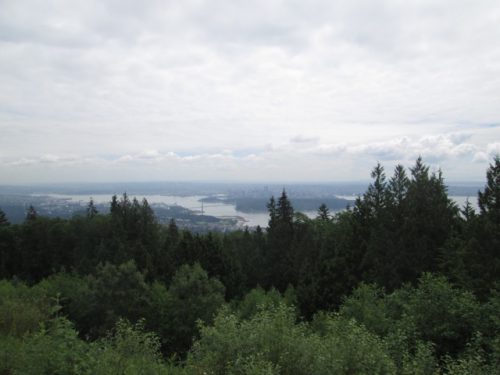
Sam drove us to an amazing vantage point, looking down on the city of Vancouver.

Sky (and earth and water)

It made me feel small and big at the same time.

That same day we visited Whytecliff Park where we climbed around on rocks and skipped stones in Horseshoe Bay.

Earth and Water

My Facebook profile picture is from there that day.

Earth and Water (and me in between)

Everything about that trip was wonderful. My family was all there. A dear friend joined us. The wedding was beautiful.

Since we had to fly out of Seattle, we spent a day there on the tail end of the trip.

We walked all around Seattle. Through Pike’s Market. Though the Olympic Sculpture Park. To the Space Needle.

We didn’t go up in the Space Needle, but instead went to Chihuly Garden and Glass Museum which is near the base. The intermingling of glass sculptures and native plants is stunning.

I sat for a while at the base of the “Sun”  in the heart of the garden —

Fire

A robin sang its familiar song. I could hear him long before I found him, perched on one of the rays of the sun.

I’m sure there’s an object lesson somewhere in that — but I’m not going to try to find it.

Rather than try to tie all these random thoughts together, I’ll leave with a quote:

I don’t ask for the meaning of the song of a bird or the rising of the sun on a misty morning. There they are, and they are beautiful.

Pete Hamill


In response to this week’s Photography Challenge: Elemental


My friend, Renee, tagged me in a photography challenge that involves posting nature photos (taken by me) for seven days. She did it on Facebook, but I’m going to do mine here, starting with far away places and moving closer to home every day.

For Day #4, I used pictures from Vancouver, BC and Seattle, WA. I was just under 3000 miles from home!

I’m going to tag some of my favorite bloggers to take up the challenge too. If you’re tagged and don’t want to do it, that 110% fine with me. I totally understand.

…Relax (Sorry, I realized that I don’t even know your name!) — I’m tagging you. I know you don’t post many pictures, but maybe you can use 1,000 words instead. You do have a way with words. 🙂


Life · Travel

Learning a New Language

Ayla’s English was impeccable. Well, nearly impeccable.

When we first met, someone asked her how old she was.

“Twenty,” she said, without batting an eye.

“Twenty?” someone else questioned.

She flushed and giggled a little, realizing her mistake.  “No, twelve.”

I turned to Amina, our official translator. “Are twelve and twenty similar in Bosnian?” I asked. It would make sense, because they’re pretty similar in English.

“Yes,” she replied.

It reminded me of words that I hesitated to use in Croatia. I had learned over 350 Croatian words using an app before I traveled. Some words, however, I consistently confused.

For instance — zabranjen, which means forbidden, and začinjen, which means spicy.  It would have been kind of funny if I pointed to a food asked “Zabranjen?”

apricots(?) and plums

It turns out that Bosnian food really isn’t terribly spicy, just delicious.  Everything is fresh. The bread was baked fresh for us every day. We had fresh plums, apricots, watermelon. A salad made with fresh tomatoes and cabbage, lightly seasoned with salt, oil, and vinegar was served at several meals (I even got to help make it once.)

They made a most delicious soup called čorba.  The secret ingredient, I learned, was okra. Not fried okra like one would find in the south, but okra that had been cut into little pieces and dried and strung. I’d like to make it here, but I’m not where to find the okra.

Yes, that’s me slicing tomatoes, but Anna, next to me, is eating čorba

Back to Ayla — as I said, her English was excellent. When Amina wasn’t available, I would ask Ajla for help communicating and she was fantastic.

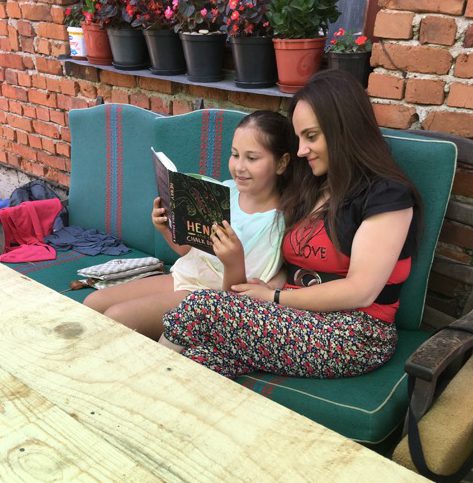
I had brought along a friend’s book to read, a children’s book called Henry and the Chalk Dragon, and finished it on my flight to Dubrovnik. I quickly realized that Ajla had the language skills to read the book — if she was interested. She was.

Ajla and Amina

Some things get lost in translation, though. Mary and I were talking yesterday about the time when Mary was telling a  story she made up with talking and flying animals, Ajla said, “You are a great storyteller  — in the lies.

How could we explain the difference between imagination and lies?

Henry and the Chalk Dragon is a very imaginative book, with chalk creatures coming to life — but it’s also full of truths. I hope Ajla can see them.

She wants to be an artist, and here’s one truth  from Henry that she needs to understand:

You have to be brave to be an artist…. It takes a fearless knight to imagine something and then let it out into the world.

Jennifer Trafton Peterson, Henry and the Chalk Dragon