photography · Writing

A is for Appetite (Or, 5 Things About Zombies)

Please forgive this post. I blame it on my brother and the fact that I’ve been struggling to write.

“Why don’t you write ’10 Things About Zombies’?” my brother suggested.

“I don’t know ten things about zombies,” I said.

“Make them up,” he said, but I couldn’t think of anything.

“Zombies are dead,” I told him.

“You need to come up with something more interesting,” he replied.

Exactly.

So I tried.

I came up with five facts, but the first one is really a correction.

Zombie Fact #1: Zombies are not dead; they are undead.

Cee Neuner is starting a weekly photo challenge called “Alphabet with a Twist.”  For the next 26 weeks, she’ll feature a different letter ~~ with a twist ~~ for her Fun Foto Challenge.

Maybe it’s because I’m a little twisted myself — but, I felt like I could commit to this challenge.

A (with a twist) is Ap. The photo needs to feature something that begins with the letters “Ap.”

I’m adding my own second requirement for this challenge. I’m going to use old family pictures.

Zombie Fact #2: Zombies don’t like to be photographed. Most zombie photos are staged and not real.

A few years ago, I started scanning my father’s slides to get them into a digital format. All of the photographs in this post were taken by my father before I was even born. Not staged. 100% real. No zombies.

So…. A is for Appetite.

Zombie Fact #3: Zombies like watermelon.

Watermelon is red and juicy. If you look at zombie pictures (which I know are staged) they often have red juicy stuff running down their chin. Watermelon, while not the consistency of brains or flesh, looks appetizing enough to fool your average zombie.

My mother told me that watermelon was sometimes soothing for a child that was teething. I like to think that’s why she was feeding it to Stewart in this picture, but she may have kept watermelon on hand in case of zombie attack.

Stewart eating watermelon

Zombie Fact #4: Zombies are delighted when they see a baby with food on his or her face.

Zombies really aren’t so different from the rest of us. What parent hasn’t taken a picture of junior with spaghetti on his head or chocolate ice cream smeared all over his face?

For zombies, though, they find it attractive because they identify with it. Most zombies have lost their swallow reflex. Remember the zombie pictures with red liquid dripping down their chin? Well, they can’t help it. Their swallow reflex died with them and didn’t come back to life. That’s why they talk the way they do. That’s why they eat the way they do. When they see a baby with food all over his face, they think he’s one of them. They feel a kinship.

Stewart with food on his face

This can actually be used to a family’s advantage when under attack. Hold the food-covered baby in plain view while the rest of the family slowly backs out of a room invaded by zombies. The zombies will be so enamored that they won’t attack. Once everyone is out the room. Shut the door and run.

This is a picture of my mother feeding Stewart.

He doesn’t have anywhere near enough food on his face to distract zombies. It’s okay. He lived his whole life without a single zombie attack.

My mother and my oldest brother have both passed away but they will never be zombies, because —

Zombie Fact #5: A person who lives a life of service to others can never become a zombie.

My mother and my brother both gave freely and generously of themselves. It’s like a zombie vaccine.

This should serve as a reminder to all.

We should be kind.

We should be generous.

We should put others first.

— if for no other reason than it will keep us from being zombies.


photography

There’s No Place Like Home

*click* *click* *click*… There’s no place like home… There’s no place like home…. *click* *click* *click*

Dorothy, in the “The Wizard of Oz”

Cattails and sunset — August 10, 2017
Dahlias and sunset — August 10, 2017
The neighbors slowly heading off to bed — August 10, 2017
Evening walk — August 12, 2017
Enjoying a summer evening — August 12, 2016

Home doesn’t usually happen in a jiffy. It can take years — even decades — for the roots to go down so deep that no matter where a person goes in the world, he or she can feel the call of home.

Truly, there is no place like home.


Day #7 of a nature photo challenge. It’s my home.

If this is a challenge you would like to do, it’s pretty easy — 7 days of nature photographs taken by you.

flowers · photography

Flower Power

When you take a flower in your hand and really look at it, it’s your world for the moment.

Georgia O’Keefe

The summer of 2014 was the Summer of Flowers.

Owen and Emily were getting married in September and I filled my garden in Greene with flowers that we might be able to use for the wedding.

Emily is incredibly organized. She planned everything so well. She probably didn’t need me to grow flowers, but it was a gift to me — to choose flower plants, and watch them grow and bloom.

These are all flowers grown in my garden in Greene for Day #6 of a nature photography challenge.

photography · Travel

The Elements

One of my favorite family trips was in June 2015 when we all traveled to British Columbia for Sam and Donna’s wedding.

The Pacific Northwest is God’s country. It’s wild and beautiful.

Sam drove us to an amazing vantage point, looking down on the city of Vancouver.

Sky (and earth and water)

It made me feel small and big at the same time.

That same day we visited Whytecliff Park where we climbed around on rocks and skipped stones in Horseshoe Bay.

Earth and Water

My Facebook profile picture is from there that day.

Earth and Water (and me in between)

Everything about that trip was wonderful. My family was all there. A dear friend joined us. The wedding was beautiful.

Since we had to fly out of Seattle, we spent a day there on the tail end of the trip.

We walked all around Seattle. Through Pike’s Market. Though the Olympic Sculpture Park. To the Space Needle.

We didn’t go up in the Space Needle, but instead went to Chihuly Garden and Glass Museum which is near the base. The intermingling of glass sculptures and native plants is stunning.

I sat for a while at the base of the “Sun”  in the heart of the garden —

Fire

A robin sang its familiar song. I could hear him long before I found him, perched on one of the rays of the sun.

I’m sure there’s an object lesson somewhere in that — but I’m not going to try to find it.

Rather than try to tie all these random thoughts together, I’ll leave with a quote:

I don’t ask for the meaning of the song of a bird or the rising of the sun on a misty morning. There they are, and they are beautiful.

Pete Hamill


In response to this week’s Photography Challenge: Elemental


My friend, Renee, tagged me in a photography challenge that involves posting nature photos (taken by me) for seven days. She did it on Facebook, but I’m going to do mine here, starting with far away places and moving closer to home every day.

For Day #4, I used pictures from Vancouver, BC and Seattle, WA. I was just under 3000 miles from home!

I’m going to tag some of my favorite bloggers to take up the challenge too. If you’re tagged and don’t want to do it, that 110% fine with me. I totally understand.

…Relax (Sorry, I realized that I don’t even know your name!) — I’m tagging you. I know you don’t post many pictures, but maybe you can use 1,000 words instead. You do have a way with words. 🙂


Life · Travel

Learning a New Language

Ayla’s English was impeccable. Well, nearly impeccable.

When we first met, someone asked her how old she was.

“Twenty,” she said, without batting an eye.

“Twenty?” someone else questioned.

She flushed and giggled a little, realizing her mistake.  “No, twelve.”

I turned to Amina, our official translator. “Are twelve and twenty similar in Bosnian?” I asked. It would make sense, because they’re pretty similar in English.

“Yes,” she replied.

It reminded me of words that I hesitated to use in Croatia. I had learned over 350 Croatian words using an app before I traveled. Some words, however, I consistently confused.

For instance — zabranjen, which means forbidden, and začinjen, which means spicy.  It would have been kind of funny if I pointed to a food asked “Zabranjen?”

apricots(?) and plums

It turns out that Bosnian food really isn’t terribly spicy, just delicious.  Everything is fresh. The bread was baked fresh for us every day. We had fresh plums, apricots, watermelon. A salad made with fresh tomatoes and cabbage, lightly seasoned with salt, oil, and vinegar was served at several meals (I even got to help make it once.)

They made a most delicious soup called čorba.  The secret ingredient, I learned, was okra. Not fried okra like one would find in the south, but okra that had been cut into little pieces and dried and strung. I’d like to make it here, but I’m not where to find the okra.

Yes, that’s me slicing tomatoes, but Anna, next to me, is eating čorba

Back to Ayla — as I said, her English was excellent. When Amina wasn’t available, I would ask Ajla for help communicating and she was fantastic.

I had brought along a friend’s book to read, a children’s book called Henry and the Chalk Dragon, and finished it on my flight to Dubrovnik. I quickly realized that Ajla had the language skills to read the book — if she was interested. She was.

Ajla and Amina

Some things get lost in translation, though. Mary and I were talking yesterday about the time when Mary was telling a  story she made up with talking and flying animals, Ajla said, “You are a great storyteller  — in the lies.

How could we explain the difference between imagination and lies?

Henry and the Chalk Dragon is a very imaginative book, with chalk creatures coming to life — but it’s also full of truths. I hope Ajla can see them.

She wants to be an artist, and here’s one truth  from Henry that she needs to understand:

You have to be brave to be an artist…. It takes a fearless knight to imagine something and then let it out into the world.

Jennifer Trafton Peterson, Henry and the Chalk Dragon

family · Life

Hospitality

Hospitality is certainly part of Muslim culture… It is a reminder of the importance of hospitality in understanding people and allowing them to know you. In our American culture we don’t place as high of a premium on it, and we kind of expect that we can just tell people what we think, and they’ll just accept it because we told them. We don’t have that element of hospitality anymore that allows us to really get to know people on a heart level. 

Jonathan Trousdale, The Bosnia Project

Amy had warned us about Bosnian hospitality before we traveled — but mostly it was in terms of coffee drinking. I thought, That’s not such a problem. I like coffee.

And it was true — we were offered lots of coffee. Served in tiny cups and often with sugar cubes. Made the Turkish way.

It turns out I prefer my large American mug of coffee with half-and-half in it.

But Bosnian hospitality – oh my goodness!

Ajla, our junior hostess, playing the harmonica (aka accordion) for us

The coffee was such a tiny part of their hospitality. On two nights we were welcomed into homes for veritable feasts. The first of those meals I would place in the top ten meals of my life. The food was absolutely amazing, especially the baklava.

Bosnian hospitality also includes music. At that first feast, Ajla started the musical segment off playing the “harmonika” (aka accordion), but then there was singing and dancing that went on late into the night. Such a celebration!

Two nights later we dined at a fudbal (soccer) club and watched a game that included the two men from our group.

Bill-2 and Bill-1 dressed for soccer
Watching the game before dinner

After the game and dinner, someone got out an accordion again and the men sang. The best men’s choirs in the world had nothing on this group. It was wonderful.

The second dinner in a home was on our last night in Gradačac. We drove and drove on winding country roads until we came to the house. We dined on a large porch that overlooked a valley. Once again, an accordion came out after dinner. The food was great, the singing fun, and the view spectacular.

More accordion!
What a view!

If I could do one thing in the Bosnian way, it wouldn’t be making coffee or bread or pie or even baklava — although all those things were amazing — if I could do one thing the Bosnian way, it would be to practice hospitality.


The panorama of the valley is my day two entry for the photography challenge I’m doing. It involves posting nature photos (taken by me) for seven days.

I’m going to tag some of my favorite bloggers to take up the challenge too. If you’re tagged and don’t want to do it, that 110% fine with me. I totally understand.

Maneé Trautz — I’m tagging you for three reasons.

One — because when I was looking for hospitality quotes I found one that said “Be a flamingo in a flock of pigeons.” I’m not entirely sure why that’s a hospitality quote, but it made me think of you and your flamingo series back in February (which I loved).

Two — your last post included a picture of a turtle. My last post included a picture of a turtle! Total kismet. (Plus, turtles amble, and that’s the word of the day.)

Three — You haven’t written much lately, my friend. (nudge, nudge)


photography · Travel · Uncategorized

Little Things in Dubrovnik

“I suspect many of us walk past true gems every day without considering where they came from and what journeys they have endured.”

Richard LaMotte, Pure Sea Glass: Discovering Nature’s Vanishing Gems

After our morning swim in the Adriatic Sea, Leah set about collecting sea glass. She gathered quite a few pieces in her hand and then left them in a little pile on the beach. The fun for her was in the finding.

Sea glass from the Adriatic

I imagined some child coming to the beach after we left and being delighted by the little collection of green, white, and amber bits. The pieces had lost the smooth shimmer of new glass,  but they had a better beauty given to them by the Adriatic Sea.

For me the lesson was in leaving it behind. I am a saver from a long line of savers. We save everything. In fact, I took a few pebbles from the beach home that day. They were so pretty and I wanted to remember that morning.

They’re still in my bag, though.

And the snapshot of the sea glass is enough to help me remember.

I need to learn to let go — of stuff.

On the sea glass morning, when we got back to our apartment, a small turtle poked his head out in the garden.

A little turtle in the garden at our Airbnb

One of the biggest lessons from my European travels is that Americans need to slow down. We’re always in a hurry, always watching the clock. So much of the world takes life at a more leisurely pace — and it’s wonderful.

It’s good for the body.

It’s good for the soul.

Take a walk with a turtle and behold the world in pause.

Bruce Feiler


My friend, Renee, tagged me in a photography challenge that involves posting nature photos (taken by me) for seven days. She did it on Facebook, but I’m going to do mine here, starting with far away places and moving closer to home every day.

Today, Day #1, is from Dubrovnik, where I was 4500 miles from home!

I’m going to tag some of my favorite bloggers to take up the challenge too. If you’re tagged and don’t want to do it, that 110% fine with me. I totally understand.

Anna Brown — I’m tagging you first for three reasons.

One — because when I first discovered you, you were in MONGOLIA. Talk about the farthest reaches of the world. Plus, I think you’re still pretty far away — somewhere in the wilds of Canada.

Two — you’re somewhere in the wilds of Canada (did I already say that?) and I think Canada is absolutely beautiful.

Three — I love when you write, and you haven’t written much lately, my friend. (nudge, nudge)


dementia · family

Helpful Words

A foggy morning (that has nothing to do with the post)

“It happens to all of us, you know,” someone said to me when I was talking about my father’s latest foggy episode.

Yesterday morning, when my father was studying his watch, I asked him what time he had.

“Hmmm,” he said, studying the hands and the numbers, “it looks like it’s two minutes past… past… I think it’s two minutes past Tuesday.”

I texted my sister. “I have the title for the book about Dad and dementia — Two Minutes Past Tuesday.”

Funny — but so not funny. Not even remotely funny the more I think about it.

Later in the day he had essentially forgotten my oldest brother, or, at the very least, key elements of Stewart’s life.

“It happens to all of us,” this person said to me, when I told about the things my father had said. “It’ll happen to you. It’ll happen to me. It happens.”

Such a glib response made me wonder if I talk too much about my father and his struggles. I try not to.

The other day when two of my children had a discussion that devolved into nastiness, I said, “Let’s try this again. First she said this (fill in the blank), and then you responded with this (fill in the blank) — but what could have been a better response?”

We talked through possible responses that could have diffused rather than ignited the situation.

It probably won’t work. The next time, they may get after each other again, but maybe a seed has been planted. A seed with a better fruit.

Last night as I lay in bed thinking about the unhelpful response thrown my way, I wondered what I really was looking for in sharing the story of my Dad’s poor thinking. What would have been a better response?

Nobody can really fix the situation. It is what it is.

But here are a few things that may have sounded better.

My sister’s response — “Oh my.” Two words show that she feels the same dismay that I do.

“I’m sorry.” It can be a pat response, but it can also be very sincere. It shows compassion and sympathy.

“That must be so hard.” Yes, yes, it is. I appreciate when people acknowledge that.

“Is there anything I can do?” Yes, there is. You can visit him. Don’t worry about whether he’ll remember your name or not — because the visit isn’t about you. Don’t worry if there are long periods of silence while he searches for words, or if he loses his train of thought altogether. He loves having people sit with him, talk with him, and listen to the same stories (or story fragments). Don’t feel that it’s a waste of time because he may not remember. For that hour that you’re there, he’s loving it. I’m loving it, too, because he’s being fed mentally by the presence of another person.

“How are you doing?” Some days I’m not doing terribly well with all this. Thanks for asking.

family

The Rest of the Story (or, An Ethical Question)

If you knew that one phone call to an influential person would elevate the level of care received in a health care setting, would you make that phone call?

I delved into that question yesterday when I met with someone on an unrelated matter. After taking care of some business, our conversation detoured into my father’s most recent emergency room experience.

“Call me next time,” he said, and handed me his card. “Keep this in your wallet and call me.”

“I won’t call you,” I told him.

My parents raised me to believe that everyone should be treated in the same way. Everyone deserves dignity. Everyone deserves good care. Everyone.

Yet, despite my saying otherwise in this man’s office, I had, the day before, been searching for his phone number while sitting at Hallway 6 with my father. It turned out the website wouldn’t load because it was down for maintenance.

As my sister would say, “It was a God thing.”

I was ready to throw my principles out the window for a little respect for my father. See how shallow I am?

But God, or happenstance, kept me from calling, and my principles remain mostly intact.

Because, in the midst of this search for someone who could get us out of the hallway situation, Roy the cheerful PCA came along.

Tell him a story,” he said.

The rest is history — castles in Bosnia and a hallway bed that became a place for storytelling.

Next time, would I make the phone call? I like to think not.

When I sit quietly with my ideals, everything is clear. I am confident in how I would act given a difficult situation.

But in the midst of a trial, idealism and nobleness vanish like smoke. I need safety measures and reminders in place. I need websites to malfunction.

I intentionally did not put that business card in my wallet. I don’t want to be tempted.

A different hallway bed I sat beside last year.
The call bell for the hallway bed last year. My father didn’t even receive this.


Leaning In · Life · Travel

Things I Would Have Done Differently in Bosnia

While I was in Bosnia, I began thinking of things that I would do differently next time.

First, I would bring my computer.  I intentionally did not bring my computer on this trip, so I could “unplug” a little. I had my phone which I thought would be adequate.

I learned something about myself, though. When I journal with a notebook and a pen, I tend to write little notes to myself. Reminders of the day. Conversations occasionally, but with minimal extras.  When I write on my computer, I write complete sentences. Or complete thoughts. (<– see what I did there?) I edit, delete, rewrite, and write a little more — because the process of writing helps me to unfold my thoughts more completely.

In Bosnia mosques and churches – side by side — something I’m still pondering

For two weeks, I didn’t do that. Now I am left with a hopelessly tangled knot. I try to write about an experience I had there and I can tell something isn’t right about what I just wrote, but I’ve lost the moment. Sigh.

So — next time, the computer travels with me, and journalling will be worked into the schedule.

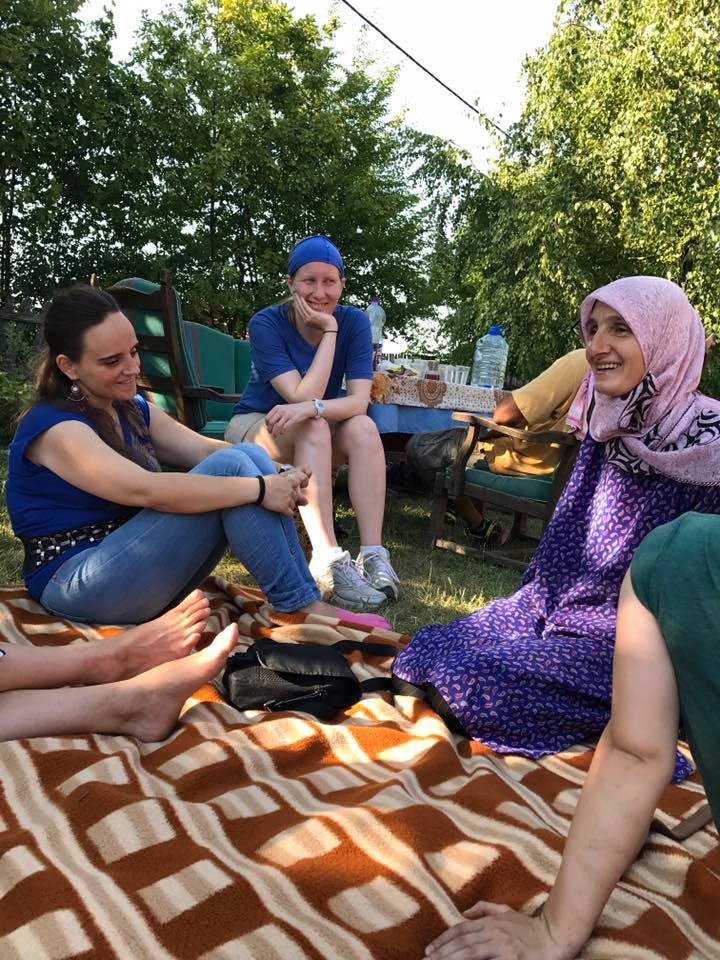
Second, I would bring more gifts. I was overwhelmed with the generosity of the Bosnian women. They gave us clothes, jewelry, hand-made lace items, plums — not because we needed them, but because they wanted to express things that only a gift can express — Thank you. I appreciate you. I want you to remember me. I was thinking of you and I wanted you to have this.

Group photo — I’m holding some clothing given to me as a gift

Quite frankly, I wasn’t prepared at all for that. I had thrown a few things in my bag to give, and gave them on our last day. (Stay tuned for a future post about that.) But I really wished I had more, much more, because I wanted to say all those things that only a gift can express. (See previous paragraph.)

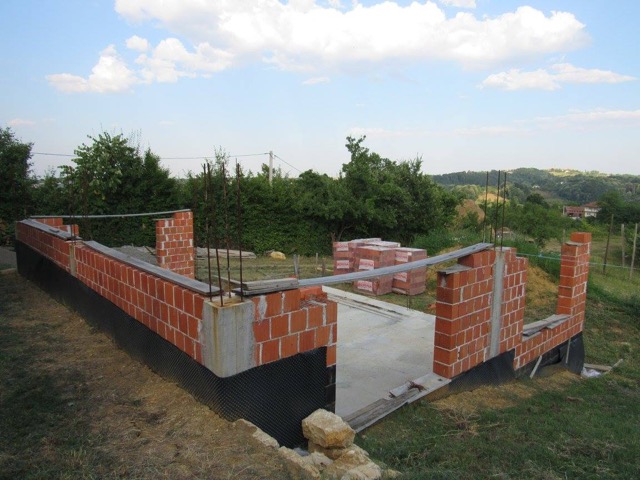
Third, skip the brick brigade.

Passing bricks

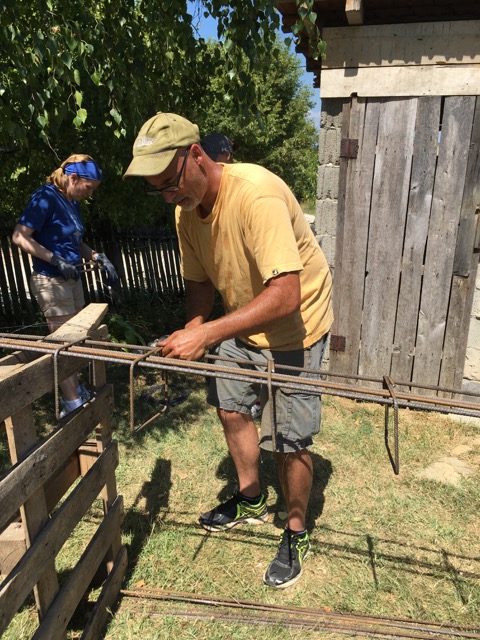
Ostensibly, we were there to help build a house. I was a little skeptical of my part in that from the get-go, but figured there must be something I could do. A prerequisite for the trip was the ability to carry bricks uphill. Well, we carried them downhill. And not even that. We formed a brick brigade and passed them down the line in the many-hands-make-light-work spirit. Moving a palette of bricks took, maybe, 20 minutes. It just felt like, um, fluff — well, as fluffy as brick-moving can be. Later in the week, I saw a truck deliver bricks much closer to the work site. It made me wonder how much of the original delivery site was so that the Americans could feel useful. I didn’t want to feel useful; I wanted to be useful.

Which is why, fourth, I would have volunteered more in the kitchen. On the last day, I went into the kitchen with the Bosnian women. Perhaps I should have stuck with moving bricks because I was pretty terrible at scraping potatoes. Had I started earlier in the week, by this point, I might have gotten the hang of it. Had I known I would be doing that before we left, I would have brought some peelers. As gifts. To say, I want you to remember me — every time you peel potatoes.

Cutting cabbage

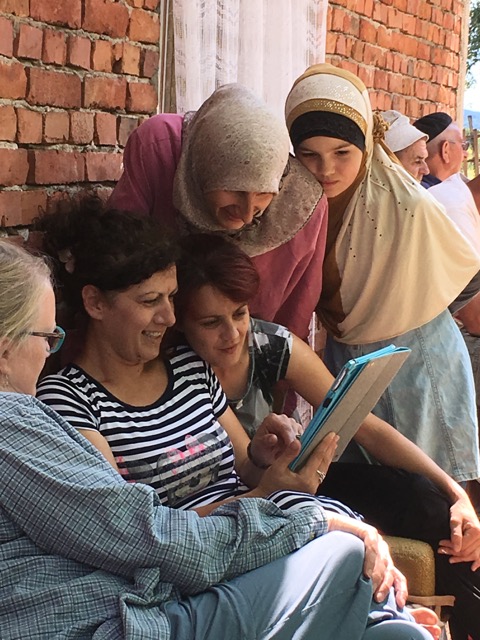
But peeling potatoes and cutting cabbage were the highlights of my week. We communicated through hand gestures (when the translator stepped out) and demonstration. We laughed at my clumsiness – ineptness needs no translation and neither does laughter. The women asked if I wanted to make the traditional pie, but, if I couldn’t peel a potato well, I was afraid what I would do to the pie.

Our hostess making pie

Next time, though, I would head straight for the kitchen. I would help with the daily bread-making and soup-making. And I would learn the Bosnian way of rolling out pie dough. (It was pretty amazing!)

Last, I would leave the photography to other people. If I had left my computer home so I could be unplugged, I should have left the camera off so I would stay in the moment. I’m not the greatest photographer. One girl on the trip was truly gifted in that area. My pictures are adequate at best.

In addition to shoveling cement, Nicole took fabulous pictures

Once, when we went out on a boat, Amina, our translator, asked me to take a picture of her. The first three or four pictures that I tried to take were so bad that she turned to someone else. I should have warned her that I was lousy photographer.

As the week went on, I took less and less photographs. I tried to memorize the things I was seeing, smelling, tasting and feeling. All the pictures in the post were taken by someone else — proof that I didn’t need to take any.

A number of people have asked if I will go back to Bosnia.

I guess I need to, if only to do it better.