When I first saw the Stream of Consciousness prompt for today — water — I immediately thought about a quote that I had jotted in my journal a few days ago.
“Let us bless the humility of water Always willing to take the shape Of whatever otherness holds it.” John O’Donohue
He also blessed
“The buoyancy of water, Stronger than the deadening, Downward drag of gravity”
I’ve always been a water person. Being in or near water is a happy place for me.
When I don’t feel well, I take a bath. One of the times I was in labor, I sat in jacuzzi to relax and almost didn’t make it out in time. Aches and pains seem to diminish in the shower.
I love to swim — for the exercise, the mental health, the solitude, the refreshingness of it.
I love to sit in the presence of water and hear the gentle lap of lake waves or the bigger crashes and rhythm of ocean surf.
I love to stand on a bridge and watch the water rush, flow, trickle — whatever that day brings — underneath. I love to drop a stick or a leaf or a flower in on one side, then watch it emerge on the other. Sometimes the object gets caught in an eddy and swirls in circles for a bit before moving on or under or off to the side.
Water supports me and yet offers resistance when I exercise in it.
If I could sing the praises of water, I would, but it would be a poor song in comparison to the song water sings itself. Murmurs, gurgles, steady streams, rain drops on windows or the roof.
I started a second job a couple of weeks ago working at a church. I have my own office and desk. It’s there that I realized how much I need to be surrounded by clutter to work efficiently.
Crazy, isn’t it?
There are Tidies in the world — who have clean, clear spaces in which to work. They work hard to create those spaces, and I’m sure those spaces allow them to focus on what it is they’re trying to write.
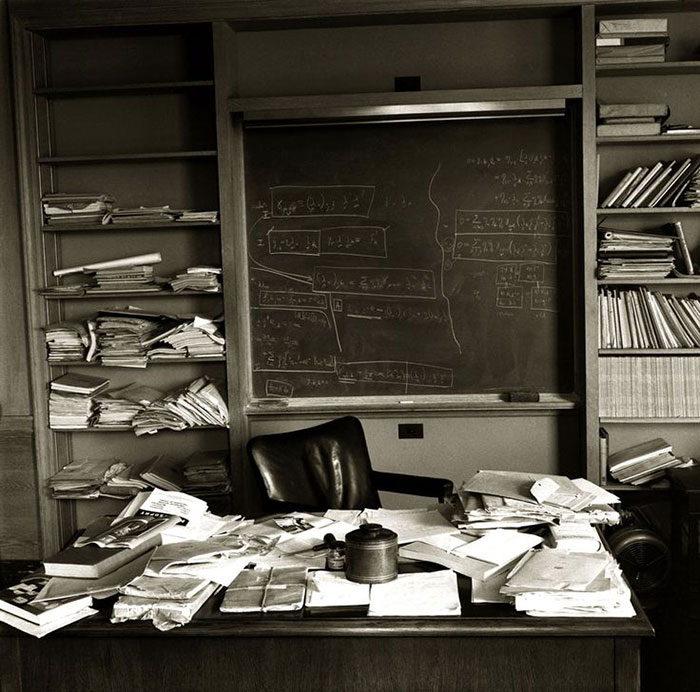
It’s refreshing for me to know that there are also Messies — who are surrounded by papers and books that aren’t in neat little stack. Even the books on the shelves behind them are in a bit of disarray.
There were over 100 authors on the list and I wrote down 21 names of writers whose workspaces warmed my heart.
Albert Einstein was the first I came to. Is he a writer? I think of him as a scientist. Anyway, I saw the photo, and laughed. How did he get my desk?!
Albert Einstein’s office just hours after his death on April 18, 1955. (Photographer: Ralph Morse. Image Source: Time & Life Pictures/Getty Images.)
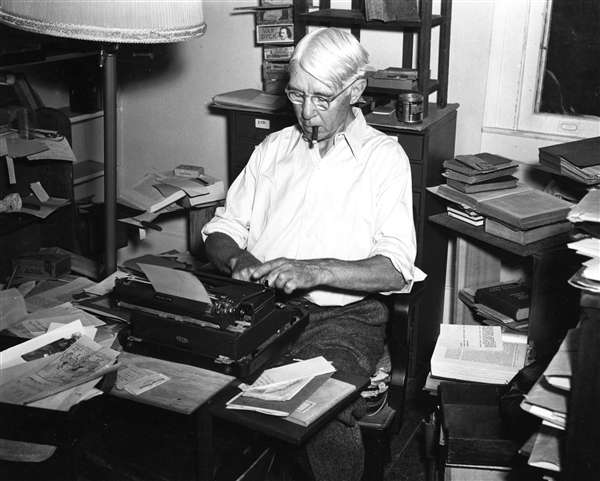
Carl Sandburg, one of my favorite poets, was a Messy.
Carl Sandburg Typing in His Upstairs Office at Connemara Photograph by June Glenn
Arthur Miller, Dylan Thomas, Edward Gorey — I kept working my way through the list, scribbling down writers whose workspace mirrored mine.
Eric Carle delighted me with his. Granted, he is both writer and artist for his books, but I LOVE his space.
My list continued. I won’t bore you with every name. Jack London, J.D. Salinger (sitting naked on an upturned suitcase, writing on the open tailgate of a station wagon — not exactly how I would do it, but his space was definitely a messy space), Ray Bradbury (I went through a serious Ray Bradbury binge when I was in high school so was happy to see that we had a common bond), Truman Capote, and William F. Buckley, Jr.
I’ve never read anything by William F. Buckley, Jr — I think of him as a politician and political commentator — but I’m intrigued.
William F Buckley in his converted garage office
Somehow seeing other people’s messes makes me feel better about my own.
When I show up at my new job,i get out some notebooks and papers to which I may need to refer and spread them on the desk.
I drove to Roanoke and back, stopping overnight in DC where we visited an amazing new museum called Planet Word. I delivered my middle daughter to school and drove home yesterday.
In the meantime, I fell behind in the minimal writing I’ve been doing. Tanka Tuesday and W3 — you’re on my list for today. Readers, stay tuned.
For this post, though, my Stream of Consciousness writing exercise, I want to try to unravel the writing process a little more. I’ve been wrestling with the W3 prompt for this week which is to use line or lines from Leonard Cohen’s song “Anthem” as part of a new poem.
I had Anthem on repeat for a good year at one point not so long ago. It’s a great song.
There is a crack, a crack in everything. That’s how the light gets in
Leonard Cohen, Anthem
So… process… I reread the words to the song, and immediately, the whole thing was playing in my head.
How can I take something so epic, so classic, and craft it into something new?
Enter Doctor Who. Remember the episode when the Doctor meets young Amy. For the record, it’s called “The Eleventh Hour,” S31 E1. My favorite line: “Must be a hell of a scary crack in your wall.”
Process — continued — Suddenly I have two sets of background singers in my head. One is singing, “Must be a hell of a scary crack,” and the other responds, “That’s how the light gets in, that’s how the light gets in.”
Seriously, I even hear a tune to their words. I can hear them going back and forth. And it’s like I’m just waiting for that lead singer to step up to the main mic and start singing the verses.
That’s what I have to write. The verses that go with the background vocals.
In the meantime, all I can think about is this homeless man that came in to eat the hotel breakfast at 6 AM of my day in DC.
I was drinking my coffee and doing my morning reading down in the breakfast area while my daughter was still sleeping in our room. He walked past me, and the first thing I noticed was the worn grocery store bag he was carrying filled with recyclables — bottles, mostly.
He wore a dirty army green jacket — and that was noteworthy to me because it was hot out, even at 6 AM. His hair was unkempt. He was unshaven. All this was one quick impression as he passed me.
I had my back to the food, so I didn’t see what was happening. I was reading, so I didn’t even really pay attention to it at all. There were a few other patrons there plus the woman who was keeping the food stocked and the area clean.
Suddenly, four men went past me in a hurry. They were big and wore vests with the word “SECURITY” emblazoned on them.
I heard the scuffle behind me, but didn’t turn to look.
They literally dragged the homeless man out. He cried, “Where is the humanity?! Where is the humanity?!” all the way out the door.
Then silence.
I sipped my coffee and pondered his question.
The woman who worked the breakfast came over to me. “I’m so sorry,” she said. “He can’t just come in here like that.”
“I understand,” I replied. “It’s sad, though, isn’t it?”
“If he came back at 10, I would give him the leftover food,” she said. “I have to throw it away. I’d rather it be eaten.”
We co-existed in silence for a bit, each lost in our own thoughts.
“Thank you,” I finally said. “You do a lovely job here.”
But that story, I knew later, was the fodder for the verses to go with my insistent background vocals.
Because, really, where is the humanity? It’s masked by a scary crack. And that’s where the light gets in.
The multi-event races are probably a better depiction of my month of April.
So. Many. Things.
I chose to participate in the A-to-Z Challenge — which involved posting through the month of April using a different letter of the alphabet for each day. April 1 was A. Today, April 29 is Y. For the challenge, I chose to write four lines of a limerick and ask my readers to finish the limerick.
Like an idiot, I thought, I’ll collage every day, too. A collage to go with each unfinished limerick I post.
Each collage takes time.
And they started to feel forced.
For me, art needs to kind of happen.
When I sit down to intentionally create something, it generally looks like crap. BUT, when I sit down and start to play with the various images I’ve already cut out, something different happens. I suppose, it could still look like crap, but the process is definitely more satisfying.
The letter X. I searched for names that begin with X. When I saw Xaviera, I thought of a tiara. That was the seed.
I looked through what I had with princesses and tiaras, but all those darn tiaras were sitting firmly entrenched on the princesses’ heads —
SUPER GLUE! — Actually, I thought of Ramona Quimby making a crown for herself out of burdocks. I remember reading that to my kids and KNOWING that had I thought of that at age 8, I would most certainly have done it.
From there, I went to the idea of princess whose crown kept slipping, and like Ramona, didn’t think through the consequences of her solution.
Where would the princess be after that? I suppose she would have gone to see the royal physician to get it removed. I found a picture that I could use as background for a doctor’s office.
I labeled the blank tube “Super Glue.” Sure she would have brought the tube with her to show the doctor.
I labeled the book Stupid Things We Do. I wanted to write Stupid Things People Do but didn’t have enough space. Surely the royal physician would have had to pull out a book like that for a reference before he tackled the problem at hand.
Today’s limerick proved to be a problem because once I settle on Yoda, I wanted to use Yoda-speak, but my mind couldn’t twist the words around appropriately. I felt like I was in a yoga class with pretzel people.
So anyway — this month I had those two things going on — limericks and collages — and then life kept happening, too.
Work — busy, busy, busy.
Church — must write the minutes to a meeting that happened two weeks ago!
Taxes were in the middle of the month — yes, I procrastinated.
The grass is growing — must figure out my mowing dilemma.
Life keeps chugging along.
The good news is that two things will finish up tomorrow — limericks and collages.
This blather has been brought to you by Linda Hill’s Stream of Consciousness Saturday.
I lied I promised a poem and blather I may just blather I won’t give you a poem Not today I can do this thing Next Saturday
Yesterday, the prompt was “reversal” and, like an idiot, I all-too-quickly decided I would write a reverse poem. I used the word reversal instead of reverse because it actually shows up that way in the interwebs.
Last night I sketched out my idea — two opposing thoughts to put at each end with a few middle-ish words. This morning, I filled that page with words and arrows and crossing-things-out and carets to insert new words. It was a mess. It definitely needs more work.
So I got out my computer and stream-of-consciously wrote the intro to this post — which CAN be read forward and backwards, but it’s not really two opposing ideas.
Next Saturday, I hope to have a worthy poem to accompany my blather.
If we were having coffee this morning, I would bore you with all the new words and concepts I learned this week.
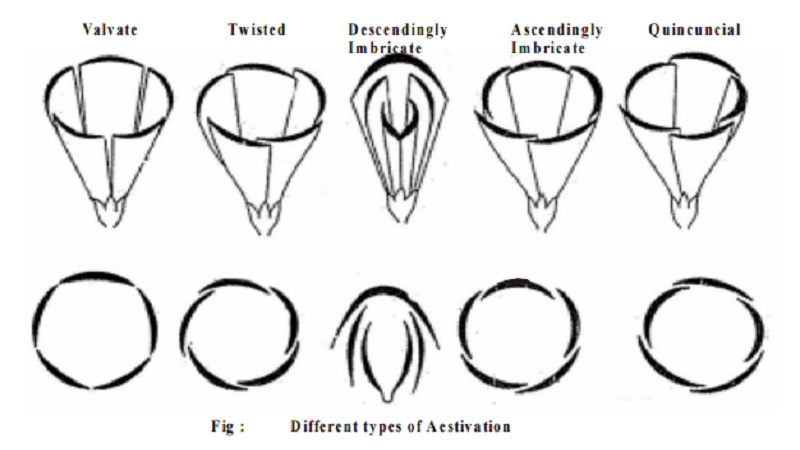
Check out this one: AESTIVATION. It has two definitions. In zoology, it’s a state of dormancy during hot weather, as compared with hibernation, which is that dormant state in cold weather. Snakes in the desert aestivate.
But the second definition is the one I fell in love with. In botany, aestivation is the arrangement of petals and sepals in a bud before it opens.
I also learned the concept “Homo Faber” which means “Man the Maker.” One definition I found talked about man making tools to “control” their environment. I prefer to think about it more along the lines of Dorothy Sayers in her book The Mind of the Maker. There she talks about us being made in the image of God and the only thing we really knew about God at that point in the scriptures is that He created. We were made to be creative.
After my father passed away in 2019, I had some pretty serious struggles. In the spring of 2020, I found myself going for frequent walks to think — but more and more my thoughts were dark and morbid. Finally, I reached out for help and found a mental health counselor. We talked A LOT — and we still talk. I also admitted my struggles to my primary care provider who prescribed an anti-depressant. It helped, too.
There were a few times that I tried to wean myself off the anti-depressant, but quickly saw the dark road again. Then, this past fall, I found that I was forgetting to take it. I tried a bunch of different systems to help me remember, but none of them worked.
And the truth was that this time I was not seeing the darkness. Instead, I found myself feeling creative again. I mean, look at me! I’m writing here again!
I talked to my counselor about it. “I think I’m doing really well,” I told her. I showed her some of the Christmas gifts I had made — MADE — for my co-workers. “Do you think it’s okay if I just stop the anti-depressant? I promise to start again if I see the darkness or feel the darkness or have those dark, dark thoughts. I just refilled the prescription so I have a supply ready.”
She gave me her blessing — with a thousand caveats, of course, as I presume she must. She confirmed that the anti-depressant could also stifle creativity. I would have talked to my primary care provider, too, but she has since moved on to another city.
I say all this not to give my own blessing to anyone who stops taking a prescribed medication. Always have someone else in your loop who can monitor you and keep an eye on you!
I say all this because I feel alive again. Grief threw me into a period of aestivation. Now I’m ready for my petals to start opening.
This post has been brought to you by true Stream-of-Consciousness writing (thanks, Linda Hill). 49% of me says that I still have time to delete, but the 51% wins. I’m leaving the blather in the hopes it will be what someone else today needs to hear.
First, let me just say HOLY COW!! WRITING ONLY 23 WORDS IS A CHALLENGE!!
There. Got that off my chest!
I was thinking about Sabbaths and how we need to take breaks — regular breaks — from hard things. There’s discipline and then there are nutso compulsions. I work at a gym, so I see a lot of those people who are very disciplined about their training, but I also see people who compulsively overtrain to a point where it’s pretty unhealthy.
Writing 23 words is not unhealthy. It’s hard, though! But I decided that I would be disciplined about it six days a week and on the seventh I would blather. Uncontrollably blather. And use Linda Hill’s Stream of Consciousness (SoCS) writing prompt as my excuse.
Today’s prompt: “out of the box.” This isn’t really an out of the box story, but it’s the first thing that came to my mind so I’m going to run with it.
Over the last few weeks I have found myself.
I know that sounds ridiculously pop-psychology 1980s, but when you’ve lost yourself and found yourself again, it’s kind of amazing.
For my regular readers, remember when I wrote this post: What’s Your Goal? I was incredibly frustrated by someone trying to help me by asking me about my goals. I was too lost in the darkness of a deep forest of I-don’t-know-what to even understand that question.
Fast forward to maybe two weeks ago.
No wait — in the intervening time — about 9 months — I took on some new duties with my job. I’m helping bring some senior programming to the facility where I work. To do that, I’ve been working with a woman who has been running a senior program at another location. This past Thursday, January 5, was the big day of inviting seniors in for an Open House.
Like I said, leading up to it, I’ve been meeting regularly with a woman who has been doing this job elsewhere. We’ve discussed rooms to hold events and places to store materials. We’ve discussed personnel to be involved and practical safety issues for the population we’ll be working with. It’s all been so good.
Then the lightbulb went on a couple weeks ago. I was talking to one of my daughters about it, about a few ideas I had. Specifically, I said, “We should have a ‘Bird’ month of programming. We could have one of the artists lead an art project involving birds. We could maybe build some birdhouses, We could have someone speak on backyard birding and ways to attract birds.”
I was on a roll and getting excited as the ideas started to flow. “We could go out birding. We could get out the badminton nets if people wanted to hit the birdie back and forth.”
“Mom,” my daughter said, “this is what you do.”
And she was so right. I’m an idea person.
That free flow of ideas had been so stuffed in for so long, for so many reasons.
Not everyone likes idea people. One of the people I work with is an idea-shutter-downer. “Stay in your lane,” she said to me when I made suggestions.
Out of the box may not be the right term for what I’m feeling.
Maybe out of the dark forest. Or out of a hole.
I feel alive again. The Open House was a HUGE success.
What’s my goal? To use my unique giftedness to serve other people. I LOVE doing that. Now I have an outlet for it with the senior programs where I work.
A guy asked me this at the front desk the other morning. I’m not exactly sure what he had heard about me or where. I hesitated.
“Umm… I’ve done some writing,” I said.
“Do you have a blog? Do you have followers?” he asked.
Is that what makes a person a writer? A blog? Followers?
“I used to write every day,” I told him, “but once I dropped the habit, it was really hard to pick it back up.”
Is that true, or what? I don’t care what the habit is, but once you give yourself permission to break it, it’s all downhill.
Every diet I have ever tried has fallen prey to just-this-once permission.
Habits.
“I have a plan for writing next year,” I told the man. “I’m going to write 23 words every day.”
He looked at me like I had just said I was going to hop on one foot barefoot in the snow every single day. Problem #1: there’s no snow here in July therefore I couldn’t possibly do THAT every day.
“23?” he repeated back to me.
“Yes! I can write 23 words,” I said.
He looked puzzled. “But why 23? Is that like the 23rd Psalm or something?”
I laughed. “No, because it’s 2023. And 23 well-chosen words sounds like a good challenge, and one I can do.”
“Just 23?”
“That’s the challenge — don’t you see? To choose 23 words — just 23 — no more, no less,” I replied.
“What are you going to do with them?” he asked, clearly still bewildered.
“I’ll post them on my blog,” I said.
“You know, some people just write in a journal,” he said.
I sighed.
I DO write in a journal. Every day. Journalling is, for me, a form of remembering and processing. It’s not writing.
Not like 23 words.
Hopefully this will go better for me than my last personal challenge.
Anyone care to join me?
A sample —
23 words I wrote today after a busy, busy day at the gym where I work:
So many visitors! In that sea of unfamiliar faces it is nice to see a familiar one a smile a wave a friend ❤
If you think about it, they’re pretty amazing things.
I remember as a child being amazed at my father’s vast vocabulary. He knew a lot of words. I forget what the exact challenge was, but I was scouring the dictionary for a word he didn’t know. (Aside: I realized as I wrote those words that kids today don’t have that dictionary-searching experience. If they need to look up a word, they don’t pull out an enormous heavy book; they simply type the word into a search bar, or click on the word, and ~ poof! ~ there’s the definition.)
Anyway, I was searching the dictionary and found a word that I was sure he wouldn’t know: Quisling. He not only knew the word, he knew the origins. For the record, a quisling is a traitor who collaborates with an enemy occupying force for personal gain. Vidkun Quisling did just that in Norway in WWII.
That kind of word is called an eponym, a word that was a person’s name. In looking up the definition of eponym, I found that the word boycott is an eponym. Charles Boycott, an English landowner in Ireland back in 1880 treated his tenants so badly that they decided just to ignore him.
Fascinating, right?
Last Sunday, I was preparing for a class at church. For a year or more I’ve been attending an Episcopal church, but honestly, I still don’t know what I’m doing. All this standing, kneeling, sitting, genuflecting, making-the-sign-of-the-cross stuff gets confusing. I’m pretty sure that God doesn’t entirely care if I forget to genuflect before I enter the pew. Still, I’d like to understand the whys and try to be respectful. So the rector invited me to a book study on Walk In Love: Episcopal Beliefs & Practices (by Scott Gunn and Melody Wilson Shobe). The topic last week was the Eucharist.
It turns out that the prayer book has six different terms for this thing that we do in church. “The Holy Eucharist is called the Lord’s Supper, and Holy Communion; it is also known as the Divine Liturgy, the Mass, and the Great Offering.”
I love when other languages have words for which we have no English equivalent. For example, there’s Danish hygge (warm, fuzzy, sitting-by-the-fire feeling), German schadenfreude (getting pleasure from someone’s misfortune), and Hawaiian pana po’o (scratching your head when you can’t find something). I particularly liked discovering this Halloween-y word, vybafnout, Czech for jumping out and saying “Boo!”.
Back to Eucharist, though, I can’t help but wonder if we don’t have a human equivalent of what God intended in this sacrament. We don’t have one word for it. We don’t have even one way of doing it.
I’ve taking communion with matzo crackers and little individual cups of grape juice, hunks of leavened bread ripped from a whole loaf and dunked in juice, little round wafers dipped in real wine, and even Girl Scout cookies with a little milk. You may think that last one sacrilegious, but I’d go back to God looking at our hearts.
In the class someone asked about the elements becoming the body and blood of Christ. “Is it magic?” she asked.
“It’s mystery,” I blurted out, and Father went with that, expounding on sacramental mystery.
In preparing for class, I followed rabbit trails, as I am wont to do. I came across the word aumbry and looked it up (not in a dictionary, but in the search bar). An aumbry is a recessed cupboard in a church where sacred vessels and vestments are stored.
From there I found pyx, a small round container where the consecrated host can be stored.
And then I came across monstrance. Such a Halloween-y word with such a non-Halloween-y meaning. No monsters, but instead a vessel in which the consecrated host is displayed.
Monstrance
Words — they’re pretty amazing, right?
But I also don’t like when people’s words don’t match their lives (my own included).
I recently came across a quote from Thomas Fuller that I keep thinking about: “How easy is pen and paper piety for one to write religiously! I will not say it costeth nothing, but it is far cheaper to work one’s head than one’s heart to goodness.”
Gah — It’s New Year’s Day and I really want to get back into writing.
“I resolve to write every day in 2022.”
That sounds so pretentious. And lofty. And ridiculous. Yes, that’s it — utterly ridiculous because I barely posted anything in 2021 and I probably made the same resolution.
That’s where you come in, Kim. As I sat here squirming in my chair, feeling knots in my stomach — knots of both of anticipation and dread — I thought, what if I just wrote a letter to Kim every day?
I can picture you reading it. I know you’ll be kind in your responses. I owe you so much.
I think that‘s it, too. I owe you so much. So many thank you’s. So many responses to your faithful checking in on me. You know the road I’m walking — and you know how to encourage me on it. Have I ever thanked you for all that?
And here you are — unbeknownst to you at the time of my writing this — helping me again.
For the month of January 2022, I resolve to write to Kim every day. I’m going to use the prompts from Linda G. Hill’s blog. She calls Saturdays “Stream of Consciousness” and I’m not allowed to go back and edit. This may explain some of the blather in this post. I would ordinarily cut some of it out. But, then again, I probably wouldn’t end up posting because I would say, This is total blathering. Or blithering as the Scots might say.
Wednesdays are “One Liner Wednesdays.” Not exactly sure what happens there, but I’ll jump in and give it a go. At least for January.
All the other weekdays will have a prompt. So if I write to you about gobbledygook or unicorns, just know that that may be the prompt and I’ll try to work it into something meaningful I’d like to say to you.
Because I do have so many things I want to say to you — most of them centered around gratitude. You’ve been a good friend.
And if I fail to write you any of the days of January, just know that the failing is mine, not yours.





 Hot Dogs and Marmalade
