Faith · prayer

Every Moment Holy: When Technology Fails

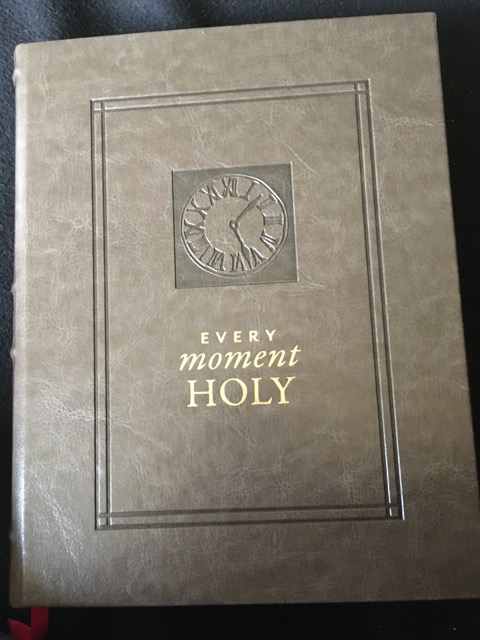
Yesterday, I was frantically looking through my newest favorite book, Every Moment Holy, by Douglas McKelvey. Two of my sons were trying to get my computer to interface with the flat screen monitor at the church so I could do a presentation about my trip to Bosnia.

More and more, when young people talk technology around me, it sounds like a foreign language. As in Bosnia, when I used my minimal Croatian to pick out words and phrases that sound semi-familiar, I tried to understand what my sons were talking about as they worked. It turns HTMI doesn’t mean “Hey, Too Much Information” because it’s really HDMI and it’s a cable and it didn’t work for our situation.

When Philip asked me if I had a firestick, all I could think of were matches. I didn’t have any, or a Fire TV Stick for that matter. Karl drove to my brother’s house and borrowed his Google Chromecast doohickey, which would have worked, if I could download the app onto my computer, which I couldn’t, because no one knew the WiFi password at the church. Then, the hotspots that Philip set up on my phone kept failing.

Pastor Tom asked me if I wanted to wait until next week.

“No,” I said, “because some of my children drove down from Syracuse for this.”

The truth is that I didn’t want it lingering in the back of my mind for another week. My poor youngest children had lived with an irritable mom long enough.

I brought Every Moment Holy with me because I planned to close with a prayer from it. It’s a brand new book from Rabbit Room Press, with liturgies for nearly every occasion — for setting up a Christmas tree, for doing laundry, two for changing diapers, for the paying of bills, for stargazing. One hundred liturgies to practice the presence of God in the midst of our daily lives.

Surely I would find a liturgy for those moments when technology fails.

While my sons worked and talked techno-gibberish to each other, I searched the book.

I finally settled on “A Liturgy for a Fleeting Irritation” which mostly fit:

I bring to you Lord, my momentary irritation, that you might reveal the buried seed of it — not in the words or actions of another person [or, I added, in the failure of technology], but in the withered and hypocritical expectations of my own small heart…

I read through it once, twice, thrice, trying to calm my anxious heart, and hoping a miracle would occur.

While I ended up doing the presentation awkwardly holding my laptop so the front row could see the pictures, and though I couldn’t hold the computer and my notes so I did a fair amount of babbling, my words were mostly well-received.

Still, I feel like there’s a need for a liturgy for when technology fails — so I wrote this prayer.

For the next time.

Almighty God
You, who spoke worlds into being
Who, with Your own finger, wrote on tablets of stone
And later wrote lost words in the dirt –
You never required the technology that is so much a part of our lives today.

We carry miniature Towers of Babel in our pockets
And turn to them far more often
Than we turn to You.
Forgive us.
Forgive me.

Remind us, Lord, that we are made in Your image.
You have equipped us with everything we need
To complete the work You have called us to

Let us acknowledge Your presence in our midst
Even when technology fails
Especially when technology fails.

And help us to BE present to those around us.

Amen

Hutchmoot · poetry

Godspeed

Taken 7:30 AM October 13, 2017

~~ Morning Prayer ~~
Thank you, God, for the beauty
Of the light upon the trees,
And though I see it every day,
Help me always see
The cloak upon the river
From the morning fog
And help me, Lord,
To always hear the mundane dialogue
Those simple common moments
That make up my day
To see,
To hear,
To taste,
Feel,
Smell —
To be present,
This I pray.
Amen


“You’re the Godspeed guy,” I said, when I finally recognized the man with whom I had been in conversation.

“That’s right,” he replied.

“That movie was life-changing for me,” I told him.

Godspeed, the movie.

Not the 2009 “intense, dramatic thriller set in the lingering light of the Alaskan midnight sun” (IMDB description).

No — I’m talking about the documentary subtitled “The Pace of Being Known.”

“Did it make you want to move to Scotland?” Matt Canlis asked, and he explained that that’s what some people got from it.

“Not at all,” I said. “It made me want to slow down.”

“Good,” he said.

Last year, after watching Matt’s film at Hutchmoot, I started taking long walks into town. My New Year’s Resolution for 2017 — to not use self-checkout at the grocery store — grew from the movie.

No, he didn’t talk about grocery stores in Godspeed. He talked about taking time to see people and the importance of community.

Then, there he was — in person.

Matt Canlis, the Godspeed guy, spoke at Hutchmoot this year. I wrote down more of his words than any other speaker.

Things like — “When God says, ‘Here I am,’ He’s always closer than you think, and in places you don’t expect Him.”

Or, “Our home is our greener grass.”

When I was at the grocery store yesterday, not using the self-checkout, waiting in line behind two other people, I marveled at the way the woman at the register knew not only me, because I go there every day, but the young man who refused the gas points — “Oh, that’s right. You walk everywhere.” — and the older man — “When are you retiring?” “The 28th.” “Of this month?!” After he nodded, she stopped counting out his change and turned to  grasp his hand in warm congratulations. “I’m so happy for you,” she said.

She was living at Godspeed, seeing the people who come through her line, and interacting with them. It’s so much better than a self-checkout.

I started a new job this week, lifeguarding for a couple of hours in the early morning before anyone at the house is awake. It was a way to help the new Aquatics Director. She was desperate for lifeguards, and I thought, I can do that.

“Lifeguarding is mind-numbing,” Philip said to me when I told him what he was doing.

He should know. I’m working a shift that he used to work as a teen. He did push-ups and walked laps around the pool to stay awake at 6AM, but that’s my time of day.

This morning, at the pool, one man struck up a conversation telling me about Native American artifacts he found in a field. After every dive, he would swim over to where I was standing to tell me a little more.

Another woman warned me that I may have to rescue her. “I haven’t swam in a while,” she said.

“That’s okay,” I told her. “I haven’t lifeguarded in a while.” We both laughed.

Lifeguarding is most definitely a Godspeed job.

My greener grass includes a pool. Not many people can say that.

Plus, the commute in the early morning is beautiful (check out the photograph at the top!).

And, I got to meet the Godspeed guy, which was one of the highlights of going to Hutchmoot.

poetry · Writing

Fraud

The writing wasn’t brilliant for Hot Dogs and Marmalade;
The draft folder overflowed with posts that were half-made.
Then when another prompt went by, a photo challenge, too —
The proprietress of the sorry blog wondered what to do.

Another day, another fail, another fruitless quest;
Yet still she clung to hope which springs eternal in the breast;
She thought, if only I could find a quote that tickled at the heart –
I think that I could pull it off, if I but had a start.

But Pascal obfuscated, as did Saint Benedict,
(the former was an intellect, the latter just too strict)
So upon that foggy brain grim melancholy sat,
For she had found no resonance, only quotes that fell quite flat.

From a few subscribers there rose a lusty yell;
It rumbled on the Macbook, it rattled in the Dell;
It knocked upon ol’ Facebook — well, that’s not really true.
It probably went unnoticed! It’s okay if I withdrew.

‘Cause life is very busy. I’ve got toilets to unclog,
Question-answering by the hour — and don’t forget the dog.
Grocery shopping, laundry washing and vacuuming to do;
Cook the dinner, wash the dishes. (Oh, yeah — the kids help too.)

Let me tell you there are days when I try to write some prose
But then my father needs some help, because he can’t get on his clothes.
And when my darling children ask for help with school,
I lose what patience I possess. Yes, I lose my cool.

Fraud!” cry the readers, and the echo answers fraud;
“You say you are a Christian. You say that you love God!
You say that you’re a writer. You think you’re super-Mom.
If you were any of those things, I think you’d keep your calm.”

pssst…. Please lean in closely. I’ve a secret I must tell:
Some days I feel quite zombie-ish when life’s not going well.
But feeling dead and being dead are two very different things
And I’ve a heart within which hope continually springs

Because, somewhere in this favored land the sun is shining bright;
The band is playing somewhere, and somewhere hearts are light,
And somewhere folks are laughing, men raise a glass and toast;
And there’s even joy on WordPress — I published a cheesy post.

Hutchmoot

The New Hutchmoot

Two explanations before you read the actual post:

  1. Hutchmoot is a hard-to-describe conference but the video on their homepage (www.hutchmoot.com) captures its essence.  If you’re unfamiliar with Hutchmoot, you may want to watch the video first. It’s an old video and this year they changed venues.
  2. I began my Hutchmoot weekend with Jonathan Rogers’ writing workshop which he began with a mention of incurvatus in se.  The Latin translation of incurvatus in se is “curved inward on oneself,” and I squirmed a little as I felt the uncomfortable recognition of seeing myself in that phrase.  I explain all this to apologize to those of you who received this post twice. I posted it once, realized I was going all incurvatus-in-se on you, took it down, and then thought, why not.  It’s where I am. This is probably the first of many posts I’ll write as I process the things I heard and experienced at Hutchmoot 2017. Hopefully it will be my only incurvatus-in-se one.


As a parent, I have had to send children back to their rooms to change clothes because the beloved t-shirt/sweatshirt/pair-of-jeans no longer fit.

“Can’t I wear it just one last time?”

“No,” I had to learn to say.

By nature, I am a resistant-to-change person. I cried when our neighbor cut down some pine trees between our houses that had gotten too tall. I blamed my tears on my pregnancy at the time. But I also cried when the village cut down a mostly dead maple in front of our house and I was past child-bearing. In both cases, I never got used to the absence of those trees.

I like things to stay the same.

Forever.

But children grow.

As do trees.

As do conferences.

On Day One of Hutchmoot 2017, I sat in my car in the parking lot for a long time before walking into the new venue. The walkway looked forebodingly long.

It’s funny — I don’t remember hesitating 7 years ago when I attended my first Hutchmoot. I had arrived on foot after using a hand-drawn map to navigate the tree-lined streets and find the Church of the Redeemer.  I walked right in, even though I didn’t know a soul there. By the end of that weekend, I had made lifetime friends.

This year I was afraid of the newness. Afraid I would get lost in a new space. Afraid I would no longer belong.

Like a child sent to put on the new clothes, I wondered if it would be stiff and awkward. I worried if it would be uncomfortable.

I longed for the Church of the Redeemer — for the inside ramp that hosted many conversations, for the little kitchen off the living room that was always full of goodies, for the swing set outside, for the awkward bumping into people as we all tried to navigate the cramped merchandise space.

Once upon a time, two brothers counted forks and knives and spoons in a church kitchen to determine how many guests they could invite to the table. They wondered if people would come to this feast they were planning.

And people came.

Year after year after year…

Until so many hungry souls grasped at the opportunity to come to the feast that the brothers decided they needed a place that had more room at the table.

But I worried that there would be no room for me.

So I sat in the parking lot, staring at a walkway that, though empty, looked like a gauntlet.

When I finally walked in, every fear came to fruition. It was big and uncomfortable. The hallways, which basically formed a triangle, felt like a maze. I forever turned the wrong way.

I looked for familiar faces but saw mostly unfamiliar ones.

Which, as it turned out, was a good thing. I met some delightful people.

It seems that my little Grinch heart still has more sizes to grow — and it grew over the weekend.

Like a new piece of clothing, the new venue became more comfortable over time. Some aspects were definitely better, but others, from the old, I missed.

Ah, regeneration. Chris Eccleston will always be my favorite doctor. Church of the Redeemer will always be my favorite venue for Hutchmoot.

But I gave the Christ Community Church a try. When I pushed away from the table there, I was full.

Full of all the goodness that I have always experienced at Hutchmoot — and maybe a little bit more.

Life

A Wedding and a Funeral

My brother called yesterday morning. His voice caught as he asked, “Can Bud and Karl come help me dig a hole?”

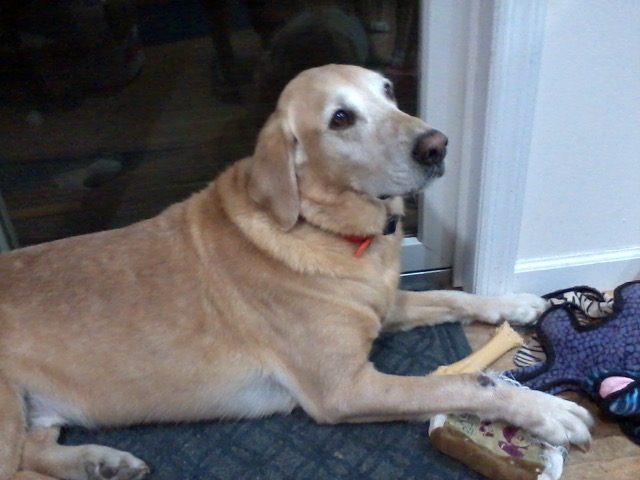
His dog was dying. Hudson wasn’t any old dog, he was beloved. A gentle soul — fun, funny, with a sweet disposition. I knew he would be sorely missed.

Bud and Karl went up mid-morning to help dig the deep hole. Peter had chosen a spot along the trail he used to walk every day with Hudson.

Earlier in the week, when Peter had learned about Hudson’s cancer, he had asked Karl to come play soccer with Hudson, one of the dog’s favorite activities. Then, another day, Laurel and Karl had gone to try to play with him, but Hudson didn’t have the energy to get up, so they lay on the floor beside him, resting their hands on his golden coat, and told him stories of fun times they had had with him.

When Bud got home from digging the grave, he showered and we headed out to a wedding.

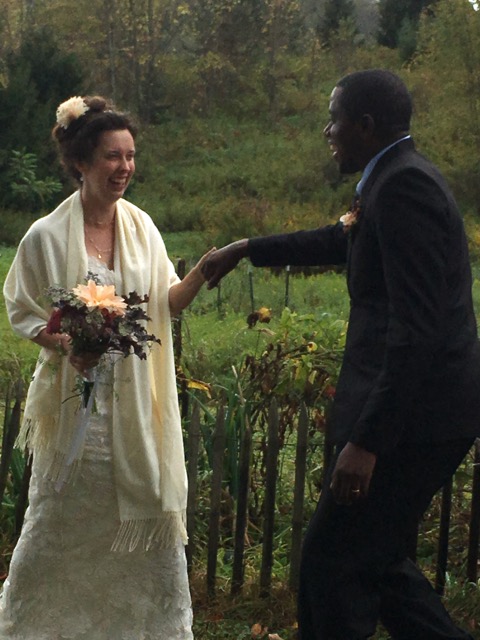
I had never been to a Quaker wedding before, but it was lovely. Lots of silence. At the beginning of the service a man explained the proceedings. We would sit in silence until the bride and groom were ready to say their vows. Then, they would stand and say their vows to each other — no minister. More silence would follow, but friends and family were invited to share any words they wanted with the bride and groom. The service would end when we all held hands, an act initiated by one designated person, the person who was explaining it all to us.

Then, he said something like, “Please allow some silence between sharing your words to allow the words of the previous person to settle.” I pictured watering my plants and how the water sometimes waits at the surface before seeping into the soil.

His final pre-service words were, “Also, at Quaker services, children are always welcome.”

That’s how it should be at every service, I thought.

Lots of children were present. Little Augie, a few rows ahead of us, blew kisses at us, and said, “Da-da-da-da.” I think it was his new word. The little girl behind us identified pictures in a board book. Across the aisle, a baby cried, was soothed, and fell asleep.

Yet, in the midst of all that, there was silence.

Katie and Adrian

When the bride and groom stood to say their vows to each other, each one’s voice started quietly. We strained our ears to hear, but, as their words went on, they became stronger, clearer. It was obvious that they believed deeply in these vows, a proclamation of their love and commitment to each other.

I could go on and on — about the wedding, the reception, and visiting with dear friends. We had a wonderful time.

But, back at my brother’s house, the vet tech came to euthanize Hudson.

When we got home from the wedding, Bud headed back to my brother’s. He told me later how tenderly my brother and his wife had laid Hudson in the hole, covering him with a blanket. They put some of his favorite toys in with him. Bud told them that he would finish filling the grave with dirt for them and that he would do it gently.

Hudson

Although my heart was full from the wedding, it ached for my brother.

This past week, for the third time in little over three years, I held a box with the cremains of a family member. My brother-in-law’s ashes arrived in a cardboard box that I kept briefly here before passing them on to another family member.

In the midst of life, we are in death. In the midst of death, we are in life.

I’m thankful for the wedding — a shiny bit of joy to balance the darkness.

I’m thankful that my brother-in-law is finally at peace.

And I’m thankful for a dog, who did everything a dog is supposed to do for his master, serving as a trusted friend and companion.

Amen.

friendship · Life

Small World

Bud found a piece of paper covered with words on the coffee table this morning. “What’s this?” he asked.

“Word Battle?” Mary guessed.

Yes, Word Battle.

I am addicted to play a game called Word Battle. Here’s what I like about it:

  • It’s fast. A game is completed in less than 5 minutes.
  • It’s challenging. You can have anywhere from 9 – 13 letters with which to make a word.
  • It’s a community.

A fellow player posted this picture this morning.

She captioned it: For all my WB friends.

She lives in England — and there are quite a few British players.

But the circle of players is the circumference of the earth.

The best players seem to be from the Philippines and India. I asked another player once why that was.

He said, “Because we learn our native language before English.  But because we actually ‘learn’ English, we spell and write better than the native speakers!”

The more I play, the more I feel like I “know” the other players — well, as best anyone can know someone they will never meet in person and only chat with in short spurts while waiting for games or during games.

I know that one player is the process of publishing a book, another is applying to Brown, and another is confined to a wheelchair and has a therapy dog.

One player’s daughter died recently, at the age of 30. I watched the word spread through the other players. I think I was not alone in whispering a prayer for her in her grief.

We discuss the virtues of coffee and tea, as well as rum, vodka, and other drinks. The political discussions can get hairy — but I know far more world politics than I would have known otherwise.

In fact, that’s some of what was on the paper — Hindi phrases and politicians’ names.

Yes, sometimes they chat in Hindi — and it irks me not to know what’s being said. So I write it down and look it up.

I wrote “Feku” down the other day, thinking it was a who, but when I asked another player, she laughed.

“It’s Indian slang,” she said.

Then I worried that it was inappropriate, and asked her that.

“No, it’s a politician who lies,” she responded.

Ha — so that’s a worldwide problem.

The other day, all the players played the word COGIES while I came up with some insignificant, less point word. I’ve seen COGIES played, but it’s not a word I ever use, so I don’t usually think of it.

“What’s a cogie?” I asked.

“I don’t know, but I’ve seen it played lots of times,” one player responded.

“Never ask a woman her age, or a Scrabble player the meaning of a word,” another answered.

For the record, a cogie is a small bowl.

A pandit and a pundit are essentially the same thing.

Ecce is directly from the Latin — means, “Behold.”

And, in this crazy world, where virtual and real mix together in a jumble of letters, Word Battle can mean friends.

elderly · family · Life

Shouting

Laurel said the other day, “We should all learn another language. As a family, you know?”

“Why?” I asked.

“Well, then if we’re someplace all together and we want to say to something to someone in the family but we don’t really want everyone else to know, we can just say it in that other language,” she said.

I think she was thinking along the lines of a let’s-get-out-of-here signal.

“Like Swedish,” she said. “We could all learn Swedish and nobody would know what we’re saying.”

“Ummm… you’d be surprised,” I told her. “I’m pretty sure Amy knows Swedish.”

Amy — former pastor, dear friend.

“Oh, well…” Laurel said. “You know what I mean.”

Personally, I think we should all learn sign language. Not as a secret language — because there are a lot of people in the world who know sign — but as a quieter way of communicating.

I can always tell when my father’s hearing aids aren’t working.

“What?” he’ll ask.

Frequently.

“I’m having trouble hearing you,” he’ll say.

I’ll check to see if his hearing aids are in, and, if they are, if he has turned them on. Often these days he forgets the latter.

The other day Mary had a dentist appointment. As she and I headed out the door, I stopped to check my father’s hearing aids — and turned them both on. He was on his way to sit in the living room with the Daily Jumble.

An hour later when we got home, he was standing at the kitchen table.

“What’s going on, Dad?” I asked.

“I need to put this in my…” and his voice trailed off as he searched for the word. He was holding a hearing battery in his hand.

“You need to put a new battery in your hearing aid?” I asked.

“Yes,” he said, and he pointed to his right ear — where there was no hearing aid.

“Okay, I can help with that,”I said. “Where’s the hearing aid?”

“That’s the problem,” he said.

“Did you set it on the table here?” I asked, and began moving papers and looking.

“I don’t know,” he replied — and that became his reply to every question.

“Where were you when you took it out?”

“I don’t know.”

“Were you sitting in your chair in the living room?”

“I don’t know.”

“Did you go in your bedroom?”

“I don’t know.”

I began looking everywhere — the bedroom, the bathroom, the living room, the dining room, the kitchen, the sun porch. I crawled around on the floor, looking under furniture, putting my cheek to the floor because that made it easier to see the incongruity of the hearing aid.

“Is it in your pocket?” I asked.

“I don’t think so,” he replied, but he dutifully emptied his pockets for me.

All this conversation was taking place at a high volume — because of the missing hearing aid. That, alone, is exhausting.

Twenty minutes into the search and I was ready to give it a rest. My neck hurt from sleeping in a bad position the night before and this cheek-to-the-floor business wasn’t helping. I sat down.

“We’ve got to find it!” my father said when he saw me sitting. He was looking through some papers that hadn’t been moved in a year. The hearing aid would surely not be among them.

“Criminy,” I muttered under my breath. My neck ache was quickly becoming a headache.

“Keep looking,” he said urgently. “We can’t stop looking!”

I got back to my feet and went back over the same places I had been looking. Finally, in his bedroom, I spotted it poking out from the back edge of a chair cushion.

I could see the relief on his face when I brought it to him.

“Where did you find it?” he asked.

“On the chair in your room,” I replied, while trying to put the new battery in.

“Where?” he asked again.

“On the chair in your room,” I replied, while trying to put the hearing aid in his ear.

“That’s better,” he said, once it was in place. “Where did you find it?”

Something in me snapped. “ON THE CHAIR IN YOUR ROOM,” I shouted — not in a nice way.

I left in search of Advil.

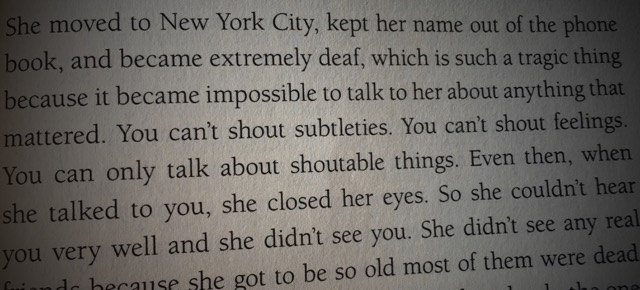
Frederick Buechner, in his new book The Remarkable Ordinary, talks about his mother’s hearing loss and the difficulty of shouting conversations.

from “The Remarkable Ordinary” by Frederick Buechner

I thought about my deaf friends who read lips so well — and appreciated that I don’t have to shout at all with them.

When Laurel said she wanted to learn Swedish, all I could think is that I’d rather learn sign language.

That way maybe I could communicate better with my friends who use it.

And when I’m old and hard-of-hearing, my family can converse with me without shouting.

Life · photography · poetry

At the Window

At a Window
by Carl Sandburg

Give me hunger,
O you gods that sit and give
The world its orders.
Give me hunger, pain and want,
Shut me out with shame and failure
From your doors of gold and fame,
Give me your shabbiest, weariest hunger!

But leave me a little love,
A voice to speak to me in the day end,
A hand to touch me in the dark room
Breaking the long loneliness.
In the dusk of day-shapes
Blurring the sunset,
One little wandering, western star
Thrust out from the changing shores of shadow.
Let me go to the window,
Watch there the day-shapes of dusk
And wait and know the coming
Of a little love.

(Public domain)


I’ve written and deleted so much blather about windows these past few days.

It’s hard to gather all the loose ends of my thoughts into something — anything, really — that makes sense.

I love this picture I took two summers ago when the milk house was being torn down. One window remained of the broken down building. It had the prettiest view over the valley.

Roger Bacon said,

Prosperity is the blessing of the Old Testament; adversity is the blessing of the New, which carrieth the greater benediction, and the clearer revelation of God’s favor.

The world is so broken.

Yet somehow, in the midst of it, or over it all, a great benediction is being whispered — and it’s that little bit of love. That hand that reaches in to touch me in my dark room, breaking my loneliness.


Now I look through a dirty pane
Where cobwebs
and
The dust of the world
Blur my view

I rub at it
With my fingers
And though my hands
Come away dirty
The grime on the glass remains

If I but drop my eyes
No glass obscures my view

And to my right
A larger scene awaits

Overhead
The sun
(so bright I dassn’t look)
Shines
and
Brightens the whole world:
The valley
The river
The barn on the horizon

Yet I squint
At my dirty pane
Wishing I could see more

Life · poetry

Haiku

Frederick Buechner, in his book, The Remarkable Ordinary: How to Stop, Look, and Listen to Life, explained the haiku better than I have seen it explained before:

The whole genius of the haiku is that they don’t mean anything. People who try to figure out what a haiku means are beating up the wrong path… The haiku settles for doing, as I read it anyway, one very simple but very crucial thing — it tries to put a frame around the moment. It simply frames a moment.

Since I was a child, I can recall pausing and thinking, “If only I can remember everything about this moment forever.” My everythings ranged from listening to my mother cook in the kitchen, seeing the rainbow circles around the lights in the pool after swimming without goggles, the raucous cawing of crows for no apparent reason, the smell of freshly cut alfalfa, the toad in the garden that startled me when I was weeding, and so on. If I had known that the haiku served that purpose, I might have worked harder on my haiku-ing.

Today’s prompt, Planet, got me thinking about all the times I tried to see the planets as my brother pointed them out to me. He can read the night sky so well. (He even knows zombie and wolverine constellations that nobody else does.)

I would squint and try to follow his finger to the tiny red dot that he said was Mars. Sometimes I saw it, but often I didn’t.

How could I write a haiku about that time I didn’t see Mars?

Squinting in darkness
His finger pointing at stars
I couldn’t see Mars

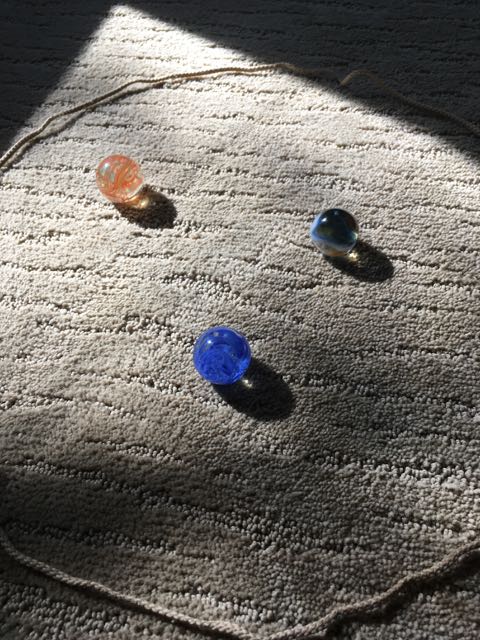
Then I remembered his favorite marble, a small blue glass orb that resembled planet Earth.

When we played marbles, I could barely balance the shooter marble on my thumb in order to plink it into the ring. If his Earth marble was in play, though, that was the target. Winning that one meant winning everything.

Pretty glass marbles
Inside a corral of string
(flick) – plink – Earth is out