Faith · family

Graceball


IMG_8900Cleaning off the shelves in my father’s study reminded me of the things he loves to read about — history and baseball. The older I’ve grown, the more I’ve loved reading about those things as well.

I’ve always loved reading about baseball. Not modern baseball, but the old days. Like the deadball days in The Glory of their Times by Lawrence Ritter, one of my favorite baseball books ever. Or the Brooklyn Dodgers. Or the Negro Leagues, both awful and beautiful.

So I grabbed a book on my dad’s bookshelf called The Teammates by David Halberstam. It’s a story about the enduring friendship between four ballplayers: Ted Williams, Bobby Doerr, Dom DiMaggio, and Johnny Pesky.

Ted Williams was one of my father’s heroes. An unlikely hero, in my mind, because he was a hero with baggage. He was foul-mouthed and arrogant. Loud. He wasn’t gracious, wouldn’t tip his cap to the crowd, even in his last game, at his last at-bat, where he nailed his last home run.

John Updike, in Hub Fans Bid Kid Adieu, said about Ted Williams, “Gods do not answer letters.”

But Ted Williams could hit the ball.  Lou Boudreau came up with the Williams Shift for a reason. Why Ted Williams, in that instance, didn’t follow Wee Willy Keeler’s motto — “Hit ’em where they ain’t” — is a mystery to me.

The Teammates softened my thoughts on Ted Williams. It showed a more human side to him.  One Ted Williams story lingers with me.  In the words of Bobby Doerr  —

“… and when lunch was over Ted turned to us and said he wanted to take and show his dad’s photography shop.  And so we went across the street from the hotel, and there was a building there, all the offices empty now, nothing there but an empty building. Then he began talking about his father, who had not been successful, was out of work a lot, and had been drinking a lot. And as he talked you could just see it roll out, this little kid in this terrible world, all the unhappiness, all the things which had never gone away, and which had been stored up for so long. It was clear that his dad had never been there for him.  And then when we came out he took us to this nearby corner, and he said, ‘This is where my mother made me march with the Salvation Army, and I would try and hide behind the bass drum.’ As he talked I could see it all, the little boy back then, the shame, and the pain, and the broken home, and how much he hated all of it. As we were walking around, and he was letting us into his childhood, I was thinking to myself, ‘This is where it all started.’ I’ll never forget that day when he took us around because all you could feel was the sadness of it. The sadness of that little boy, and the sense that it had weighed on him so heavily for so long.”

As I read that story i understood better how baseball is a game of grace. The very best players fail two-thirds of the time when they get up to bat. A batter is allowed three strikes. A pitcher is allowed four balls. A team three outs.

Baseball is not like the pure athleticism of a race, where the first one to finish wins. It’s a game of trying and trying again. Perseverance. Moving on past a failure. And another failure. And another failure. Grace.

The whole game is grace. There’s always another pitch, another at-bat, another game, another season.

It’s why the battle cry of the Red Sox — “Wait till next year” — rings true.

Hope is a cornerstone in baseball. It exists at every single base.

*****

Today my daughter Mary follows in my footsteps (and her aunt’s) by starting a job at the Baseball Hall of Fame.

When combined with the Daily Prompt: “Childhood”, and the fact that this post turned up when I did a draft folder search of that word, you can understand why I’m posting this today.

Originally written last October. Never posted till now.

A to Z Blogging Challenge

Zero

I began at the end, with my mother’s dementia. Now I’ll end at the beginning of my mother’s life.

Actually, the pre-beginning.

The zero before the one-two-three.

That space the game token rests on before the first roll of the dice.

The Beforeward.

Whatever it’s called.

My grandmother gave the family a great gift when she wrote her autobiography. Through that, I know the following:

My great-great grandfather was a chimney sweep.

I'm practically related to Dick van Dyke
I’m practically related to Dick van Dyke

My great-grandfather was a bushelling tailor who, “did not make suits, but refitted and repaired them.” He came from Denmark in 1892, found a tailoring job, and then sent for his family.

Family pictureMy great-grandmother came over steerage with four children. She couldn’t speak any English. My grandmother still remembered the name of the woman who taught her mother English. Lydia Buxton, may your descendants be blessed.

My grandmother and her brother were born in a tiny house in an alleyway in Beverly, Massachusetts.

My great-grandfather took in dry cleaning for extra money. My grandmother and her brother delivered clothes for him. One of her sisters worked for him every afternoon and sometimes all day Saturday. Still, they struggled to make ends meet. My grandmother wrote, “My father sometimes had to wait weeks for his money from wealthy people who would not take the time to write a check. My father would have to ask the coal dealer to wait until he received pay for his work.”

But they made sure the children went to church and to school. They had music in their lives. Piano. Violin. Choir.

My grandmother had wanted to become a teacher, but there was no money for “Normal School,” where high school graduates could be trained to become teachers. So she took a job as a switchboard operator for the Woodbury Shoe Co. and earned $6 a week, two of which went to her father for room and board.

She met my grandfather at church. A church group gave her a surprise 16th birthday party, and my grandfather and his twin brother argued over who would get to take her home. She couldn’t tell them apart at the time.

He had stopped school in the 11th grade to take a bank job.

They married and had four children. My mother was the youngest.

Aviary Photo_130749679699200104She was a little girl who loved to catch snakes and would stand up to bullies.
When she grew up, the bully she held off wasn’t named Normie, but was named Alzheimer’s.

Doing this A-to-Z Challenge in her honor has been fun.

Thanks, Mom, for everything.


A to Z Blogging Challenge · Alzheimer's

Vulnerable

“Fred” made the mistake of saying the words “crew cut” within hearing of the man with the clippers.

“Everybody has a bad haircut story,” I told him. “Now you have yours.”

What made the whole thing ironic is that “Fred” had just been to a conference from which he took away the importance of vulnerability.

“Failure is an event, not a person,” he told me, repeating a Zig Ziglar quote one of the speakers had used.

“Exactly,” I said, pointing to his head.

Every disaster, whether large or small, brings us to a crossroads. One path pretends the problem never happened and hides the challenge from all the other travelers. The other path is vulnerability and sharing the struggle.

My mother taught me the importance of vulnerability. I remember watching her after her breast cancer surgery. She had a full radical mastectomy back in the days when the plastic surgeons weren’t inserting inflatable boobs even before the radiation treatments.

Her prosthesis was external, a little mass of weighted jell that fit into her bra.

Which she got tired of and did without after some years.

My mother was not defined by her breasts.

Or her breast cancer.

She went to visit women who had had mastectomies before they left the hospital and faced the world.

“This does not define you,” she told them.

And she lived, a walking testament to life after breast cancer.

That open-ness, that vulnerability, helped me to start writing about her and her Alzheimer’s.

I think if she had fully understood, if her brain had not been fogged by dementia, she would freely given her blessing to the whole thing.

“Write about the incontinence,” she would have said. “Maybe it will help somebody else going through the same thing.”

She would laugh and say, “Write about that time when I tried to walk the two miles into town because no one would believe me that I needed to go to a meeting.” I walked with her, and Helen came to pick us up.

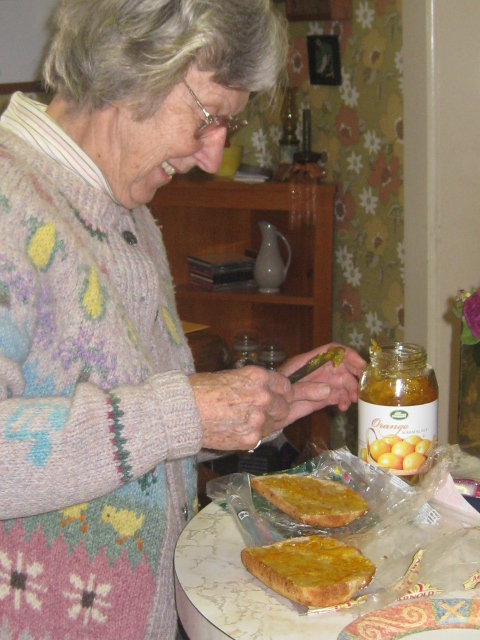
“Write about the funny things I said. And how you had to show me that underwear went on first, before the pants. Write about the marmalade.”

It’s not dishonoring to use tough situations so that others know they are not alone in what they are experiencing.

Quite the opposite.

It is most honoring.

I think she would be pleased.

Making the sandwich #1
Mom and her marmalade
A to Z Blogging Challenge

Rich

My father has told me a number of times, “You’re one of the richest people I know.”

I respond with, “Yeah, and maybe someday I’ll have money.”

Not this year, though. The money part, that is.

When I filed our taxes our income had gone down. It was the first time in many years that I didn’t have to file a Schedule C or SE for my swim officiating pay. Scholastic swim officials are paid, and I had been working for a number years at the modified, high school, and college level.

But, in the late fall of 2014, at the end of the girls’ season, I realized that I couldn’t commit to officiating during the boys’ season which runs November to February. I contacted the assigner and let her know. She emailed me for the next season, fall 2015, and again, sadly, I told her that I couldn’t do it.

Both times, I knew it was the right choice. As much as I love officiating swimming, it doesn’t compare with how much I love my family.

And, as it turned out, instead of scoring dives or disqualifying breaststrokers, during each of the seasons I have missed, I have had the privilege of caring for aging parents. No one can put a price tag on that.

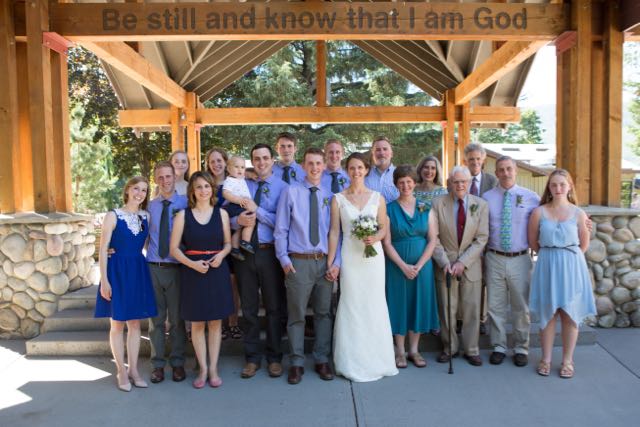
Here is an partial list picture of my assets.

Zaengles, Pollocks, and Uricks at Sam & Donna's wedding
Family at Sam & Donna’s wedding

I wish I had photographs, too, of the circle of friends who do such a good job caring me.

Patrick Meagher said, “Some people are so poor, all they have is money.”

I am rich indeed.


A to Z Blogging Challenge

November

“Did I do anything for your last birthday?” I asked Laurel this morning.

I honestly couldn’t remember. Laurel’s birthday and my mother’s deathday were too close together.

“Uh-huh,” she answered. “You made rice.”

Not really sure that will win me any parenting awards. Rice. In the microwave.

But it is one of her favorites.

November was a blur.

“Did I buy you any presents?” I asked her.

“Yes,” she answered. “Pajamas.”

At least it wasn’t socks and underwear.

Wait — maybe I got her those, too, and she was too polite to tell me.

I remember so little of that month.

Did we celebrate Thanksgiving? Did I make the turkey?

What did I do for the 30 days that November hath?

I looked through the pictures on my computer for clues.

Here is the story they told:

On the day my mother died, I noticed the sunset. IMG_7769 (1)

My sister and I helped my father.

Donabeth, Dad, and me

On Laurel’s birthday, I went for a walk.

The stone bridge

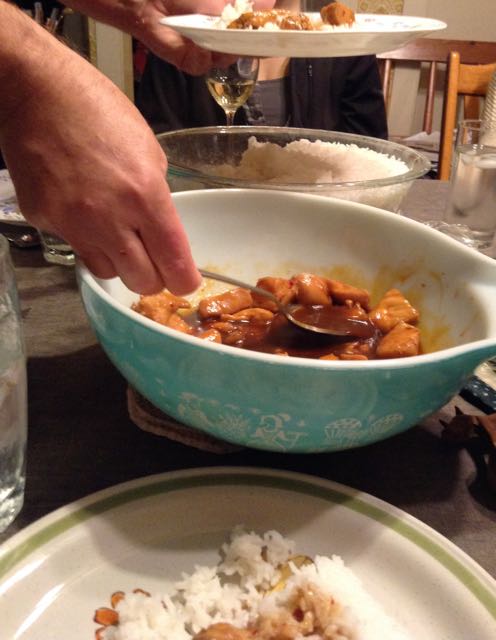
I made the previously mentioned rice — and some chicken to go with it. Broccoli, too, but it didn’t make the photo.

Birthday dinner

The kids played cards (probably while I was making rice).IMG_0340

And all through November, life continued.

Family gathered.

Jacob, Henry, Laurel

We played games.

Family games

I sat at the Columbarium.

The Columbarium

Laurel swam.

Swimming

I noticed a sunrise.

Sunrise

And I’m pretty sure we had Thanksgiving.IMG_7874


A to Z Blogging Challenge · Alzheimer's

Kind

The ABC’s of how I’m feeling:

A is for ANGRY

B is for BITTER

C is for CRANKY

Clearly I’m doing this A-to-Z Challenge all wrong.

I feel angry.

And not kind.

I hung up on Time-Warner yesterday. Told them we were switching to Direct TV.

I’m not happy with them.

I posted a rant yesterday and almost immediately the person I ranted about contacted me. I was in the midst of a conversation with a different friend.

“I should have said something to her before I posted it,” I told my friend about my other friend — are you following this? Too many unnamed friends, I know.

But I knew the right way to handle the situation — and I didn’t do it. I posted a stupid blog post. (It has since been edited.)

This is how not to do things, kids. Talk to people who upset you. Don’t rant on your blog. Do as I say, not as I do.

I believe in handling things the right way and in kindness. Sometimes belief isn’t enough. We have to actually do it.

I’m working to memorize Isaiah 58, a chapter where God is dealing with a people who are oblivious to their sin.

“Look at me fasting,” they say to God. “Look at my sackcloth and ashes. Look how humble I am. Why aren’t you noticing any of this?”

And God says to them, “I really want you to be nice to each other. Don’t be grumpy. Don’t strike out at people. I want you to fast from your meanness. Put that aside instead of food. Undo someone’s yoke. Feed a hungry person. Invite a homeless person into your home. Sheesh!”

He didn’t really say the “sheesh” part. I added that.

But you get the point.

Can I just say here, in the depths of this post where few people will probably read, that life is hard right now? My father is struggling — and he doesn’t even know he’s struggling.

“You’re not thinking clearly,” my brother and I told him, ganging up on him to persuade him to have a medical test which may put us on a path to improvement.

“That’s what they keep telling me,” he said, in a tone that showed that he clearly didn’t believe a word of it.

It reminded me of a post that I had long since taken down. The post, from April 2011, had been called “Four Questions.”

It ends with kindness — which works for “K”.

****

Four Questions

Mom -- April 2011
Mom — April 2011

Question #1

I asked my mother this question one day when we were in the car, “Mom, do you know what Alzheimer’s is?

She knew the answer. “It’s a condition where people can’t think sensibly,” she responded.

Yes, it is. It’s not a condition where someone doesn’t think sensibly. They can’t. And yet, sometimes, they can. Like being able to answer that question with a pretty concise response shows some sensible thinking.

Question #2

Yesterday my mother handed me a sheet of address labels that had come in the mail to her.

“These are for you,” she said.

“I can’t use these, Mom,” I told her. “They have your name and address on them.” I tried handing them back to her, but she pushed them over to me again.

“That way you won’t forget me,” she replied.

I felt a little ache in my heart at those words. “Mom, I won’t forget you,” I reassured. “Will you forget me?” I asked it, even though I already knew the answer.

“Oh, no,” she said. “I’ll never forget you.”

But moments later, she forgot that she had even given me the address labels and took them back to her pile of things. She removed one and stuck at the bottom of a note she had written herself about dinner with a friend. It was a dinner with a friend that had taken place months or years ago. She had forgotten. But she stuck the address label on the bottom of the note.

“This will help me remember,” she said. Oh, if only it were that easy.

Question #3

Alzheimer’s is a condition where people can’t think sensibly. The varying pieces of information that are constantly coming at us are no longer being filtered correctly in the mind of someone with Alzheimer’s. It’s impossible to make sense of it all.

When my parents were going through some of the clutter that had accumulated at their house, my father picked up a kitschy dog made out of golf balls. “We could probably get rid of this,” he said.

Are you going to get rid of me?” she asked. With the filters missing, that was what she heard.

“You’re too valuable,” he told her. “We’re not going to get rid of you.” She still has value. She needed to hear that.

Question #4

In difficult situations, so many people show little kindnesses. With my mother’s Alzheimer’s, people have been so kind. Total strangers, long-time friends and family members have all pitched in to keep my mother safe and to make life easier for my father. I know my father appreciates it, but I often wonder if my mother is even aware.

Yesterday, she answered the unasked question I have had for a long time. Are you aware of all the things people do for you?

She was looking for my brother. “He’s up at his house, Mom, right next door,” I told her.

“That’s right,” she said. “He has been so nice. Every night he brings dinner right down to us so I don’t have to fix anything.”

Yes, he does. And his wife does. And I’m so glad you recognize that. Even if you don’t always recognize me. I know it’s because you can’t think sensibly.

A to Z Blogging Challenge

Juggling

“Can you still juggle?” I asked Helen the other day.

She picked up three somethings — I don’t remember what they were — pom-poms or apples or Easter eggs — and juggled them quite handily.

I’ve seen her do it before. We have a video of it. As she focuses on juggling golf balls, she keeps her eyes on them and her mouth is wide open.

Like a ukulele player who presses his lips together or sticks his tongue out to the side while playing.

We aren’t all professional.

When jugglers juggle they have to focus, and something else may fall by the wayside in order to keep the balls in the air.

I guess I’m back at imperfection.

This is supposed to be about my mother.

And juggling.

***

My mother was most at home in the kitchen. She cooked for our family, for her church family, for special occasions, and for the every day. Huge spreads. Humble soups. Everything always delicious. (Except the beef heart. And the lamb burgers.)

Her juggling took place in the kitchen. She had an amazing talent for getting all the food on the table piping hot for us to enjoy. Her timing was perfect.

I, on the other hand, serve lukewarm green beans with hot meatloaf and cold potatoes. I forget to heat the plates the way that my mother did. I can’t get people to the table on time. I have not yet figured out the art of juggling many food dishes in the kitchen.

When my mother began struggling in the kitchen, we should have seen it for it was, a sign of dementia. She couldn’t keep all the balls in the air anymore. She called me for help more and more.

And I was resentful.

Critical.

Unsympathetic and unaware that she was moving into a strange vortex that left her confused in the kitchen.

“You make such good scalloped potatoes,” she called one day to tell me. “Could you make some for Dad and me? We have company coming tonight.”

I bristled inside. I was home with seven or eight children, tired, frustrated — and honestly, the last thing I wanted to do was make scalloped potatoes for my mother so she could go golfing and still have a nice dinner to serve her guests.

But I did it.

In retrospect, I think she was worried about her cooking — and how sad that is for me to realize today!

But she had dropped one of the balls she was juggling and asked me to help pick it up.

If only I had known. If only I had understood better in those early days.

People — be patient and kind. Don’t mock the open mouth of someone keeping the balls in the air.

We’re all juggling something.

And we all drop balls.

We all need help, not criticism.

A to Z Blogging Challenge

Imperfection

I hit “Publish” and rushed out the door.

We had such a busy Saturday, but I was feeling the tyranny of the urgent regarding the A to Z Challenge.

“Just a minute! Just a minute,” I called to my family as they were heading out the door at 7:30 AM.

I wanted to edit some more. I wanted to delete and reword and create something that wouldn’t make me cringe when I pictured other people reading it.

But I hit “Publish” and ran.

And worried.

And cringed.

We had a great day — family breakfast at a diner with 10 Zaengles present.

Slow Art Day at the Stone Quarry Hill Art Park (followed by Slow Food prepared by local college students).

The Stacks (Slow Art Day)
“Stacks” (Slow Art Day)
Artist David Harper talking about "Stacks" (Slow Art Day)
Artist David Harper talking about “Stacks” (Slow Art Day)
"The Trees Shall Be My Books" -- working title for the piece
“The Trees Shall Be My Books” — working title for “Stacks” (Slow Art Day)

That particular installation, “Stacks,” has always been my favorite piece at the Art Park, and now even more so.

We spent the afternoon into the evening babysitting our grandson — who is the cutest baby ever.

By the time we left their house, it was 12 hours from the time we had left our house in the morning. Since I didn’t have my computer with me, I couldn’t obsess over the post. By the time we got home, I was exhausted and went to bed.

Yesterday — Sunday — I was determined not to spend the day worrying over my blog. And I didn’t. Mostly.

This morning, I went to the orthodontist with Laurel, and did no blogging.

By afternoon the letter “I” was looming, lurking, taunting.

I’ve seen the meme — There is no “I” in team — or something like that, and I kept thinking there is no “I” in art either.

Jennifer Trafton Peterson has talked about art as a gift that we offer. Each time I have heard her say those words, she uses the same hand gesture — cupped hands that move from her heart outward, like an offering of something precious.

But I used to bake cookies for extra income, and more than once, in the chaos of my kitchen, forgot to add the baking soda. Molasses crinkles don’t crinkle without the baking soda. They come out of the oven as hard little balls that are nearly inedible. Those cookies were so imperfect that they ended up in the compost heap. That’s all they were fit for.

The other day I brought my father to a concert at the nursing home where my mother had lived. The flutes were out of tune with each other, and the band struggled with tempo, but they played the old familiar songs and the people sang along with “God Bless America” and “O Susanna” not caring one lick about the tuning.

Their music was their offering, from the hearts of the musicians to the gathered — and appreciative — audience.

I recognize through them that art doesn’t have to be perfect to be appreciated.

But sometimes art is like cookies without the baking soda. It really belongs on the compost heap.

My heart poem has gone the way of inedible cookies.

Sorry.

A to Z Blogging Challenge · poetry

Heart

In a hurry this morning — but don’t want to fall behind in my A to Z postings.

A ditty has been running through my head since accompanying my father for his echocardiogram.

The screen looked similar to ones I knew from pregnancy ultrasounds, but no baby..IMG_8547

I had written a more thoughtful piece about a visit to the cardiologist several months ago.

Then I turned the ditty in my head into a bad poem that I posted for a couple of days. Subscribers would have seen it. (And, really, I’m so sorry!)

It was so cheesy that I took it down.

I’d much rather you read “The Cardiologist.”

A to Z Blogging Challenge · family

Generations

G is for generations.

PICT0937
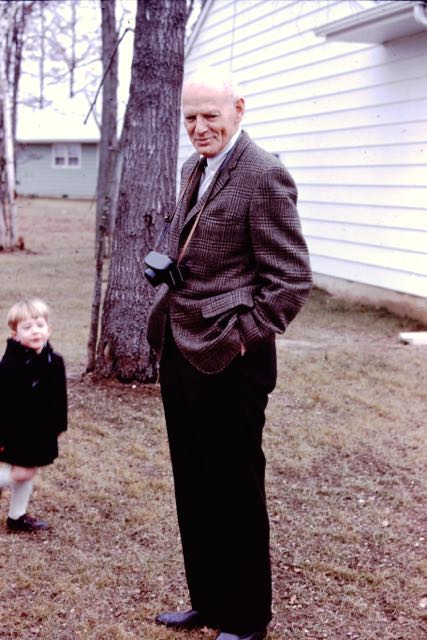
My grandfather (1968?)

I wanted so badly to have Philip meet my grandfather, my father’s father. He was a great guy.

Bud and I had made a trip home that fall when I was pregnant, but that was the last time I would see my grandfather.  On the next trip, when Philip was 6 weeks old, we attended my grandfather’s memorial service.

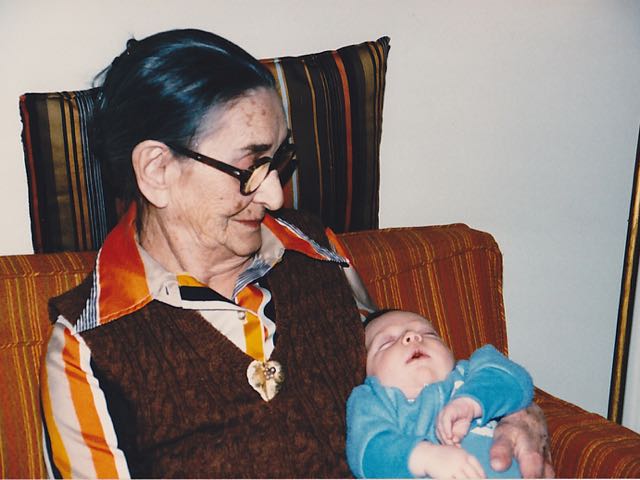
Nana and Philip
Nana and Philip

Nana, my father’s mother, was still alive, but she was quite ensnared in the web of Alzheimer’s. Still, there’s something about holding a baby that reaches beyond those cobwebs, and touches something deep inside.

Babies are magical beings with superpowers. A sleeping baby brings calm to a turmoiled spirit. A smile from a baby can soften the hardest heart, and a giggle can melt a glacier.

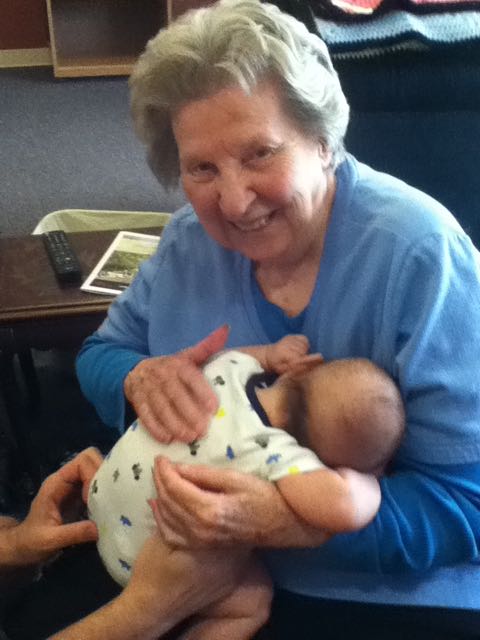
I’ll never forget when Philip brought his little boy, Henry, to meet my mother. My mother rarely smiled toward the end. Not real smiles that reached her eyes, anyway. She still occasionally laughed, but that usually bled into tears, and it was for strange things, like a recitation of Paul Revere’s Ride.

But Henry — Philip gently placed Henry in my mother’s arms and still held his hands there to support Henry lest she forget. He was so tiny at the time.

My mother gazed down at this tiny creature who snuggled against her bosom. Instinctively she patted his back, and then looked up at us with one of the best smiles in a long, long time.Mom and Henry

My father has that picture out. He looks at it periodically.

“Look how happy Mom is there,” he’ll say.

Yes, she is.

Henry will never remember that day anymore than Philip would have remembered meeting my grandfather if things had worked out.

But I’ll remember my mother’s smile that day.

A smile is a good thing to remember.