I ran into someone who has been promising to visit my father. When I saw her at the Post Office and she asked, “What can we do to help you and your father?” my answer was easy. Visit him.
I was telling Mary about it later. “Visiting is so easy to put off.”
“Yeah,” she said, “I don’t think I’d be very comfortable with it either.”
Visiting isn’t hard, though.
I wrote a list of ten things to do when visiting an elderly person — to make visits easier, if you don’t know how.
1. Listen — Listening is a slow-paced skill that has gotten lost in our rush-rush society. My father struggles to find words. Finding the patience to listen is so good for me.
2. Ask questions — I once heard someone suggest asking elderly people to talk about a time they got in trouble as a child. It brings out some funny stories. My father likes to talk about important days in history and the early days with my mother. Sometimes a question or two is all it takes to get a conversation rolling.
3. Look at photo albums — My mother always had a few small photo albums in her room at the nursing home. My father has some by his chair. She worked at identifying the people. He recalls past adventures.
4. Read — Sometimes I read to my mother. I discovered that picture books worked especially well. Reading to someone with dementia, though, is not unlike reading to a toddler. Her attention span was sometimes short and we would skip pages to reach the end.
5. Listen to him (or her) read — My father reads to me. When he chooses books to read, he often chooses thick books with small print. “Why don’t you choose an easier book?” I asked him once.
“I like to challenge myself ,” he replied.
So he ends up reading passages out loud. I think it helps him process. He is not unlike a 3rd or 4th grader, following the words with his finger, moving his lips all the while, often whispering aloud — and then going back and reading it to me.
Right now he’s reading The Bounty Trilogy — a fat book containing all three of the Bounty books by Charles Nordhoff and James Norman Hall.
“Captain Bligh was a bad guy,” he told me about six times yesterday.
“Yes, that’s why the crew mutinied,” I replied. “Spoiler alert.”
We would repeat the conversation about an hour later.
Someone visiting him could easily ask about what he’s reading, and I’m sure my father would be happy to tell him and read to him.
6. Write a letter — My father has wanted to write a few letters but, in addition to the struggle for words, the fine motor skills required for writing are lacking. Recently I’ve taken dictation from him to try to help.
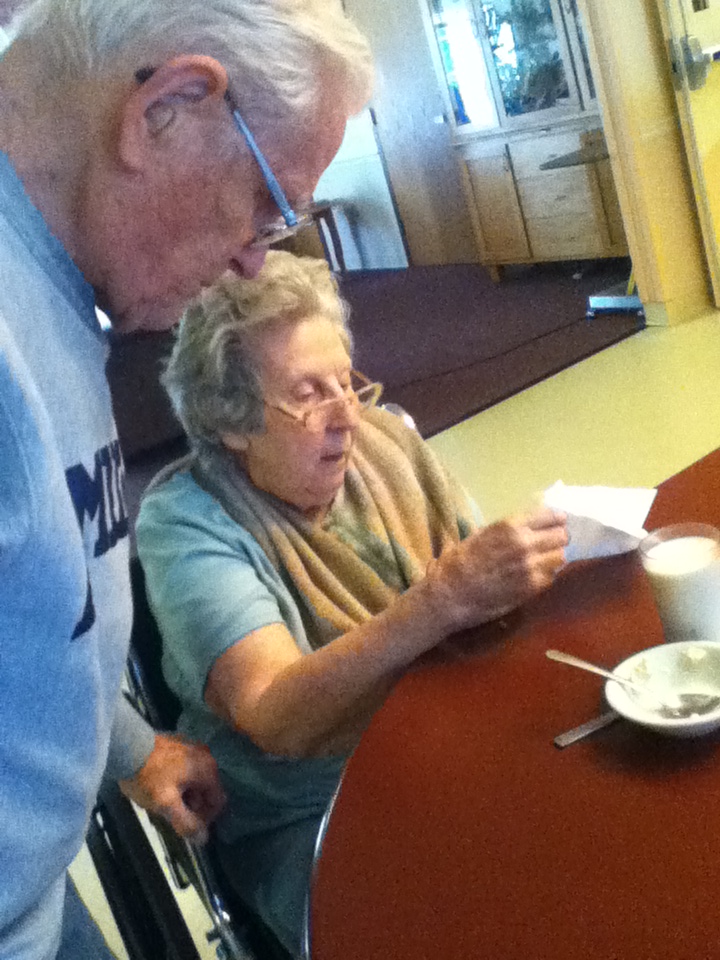
Helen and Fred
7. Do puzzles or play games — My father still does the daily jumble and crossword, but more and more he needs a little help. He transposes letters or gets the down and across mixed up. I usually help him with a few answers and then let him keep working on it.
Helen used to play rummy with an elderly man. He cheated constantly and accused her of cheating — and they both laughed about it. It was a great way for them to visit.
8. Walk — One person that came to visit my father asked about the house. He gave her a walking tour, talking about the changes we had made to the house. It was a slow process because he stopped to talk about different pieces of artwork etc. He likes to walk outside, too, when the weather is nicer. But he needs someone with him.
One of the twice daily visits which were always at mealtime.
9. Sit — For several years, I watched my father visit my mother every day twice a day. She couldn’t carry on a conversation toward the end so he just sat with her.
Now I sit with him most evenings while he watches television. Wheel of Fortune, Jeopardy, a baseball game, whatever.
10. Share a meal — My father could win prizes for being the world’s slowest eater, but we sit together every night to eat. I’m so thankful that my daughters patiently wait until he’s done. No devices. Just conversation. It is good.
The sad thing about a list like this is that the people involved in elder care will see it and nod in agreement, but most other people (myself included in years past) will just gloss over it.
But then, again, Karl applied for a job at a retirement home. Maybe this will be helpful…
A friend who is helping care for an elderly relative told me about one evening when she went to visit her aunt and she found her wearing no pants. It reminded me of a poem I had written when my mother did something similar.
Here’s my poem:
My mother had no pants on
When she came down the stairs.
The funny thing about it was
It seemed she didn’t care.
The Emperor’s New Clothes became
The Grandmother’s New Pants –
Invisible clothes or missing –
I took another glance.
My children both politely
Turned their backs to her.
Modesty would dictate
Their behavior be demure.
“Mom, you need some pants on!”
“I know,” was all she said.
She settled in the kitchen,
Looking to be fed.
“Go put some pants on now,”
I commanded best I could.
“I will,” she said, but sat there,
So I didn’t think she would.
My father finally got her
To get up and find some pants.
I thought (but didn’t do)
A little happy dance.
Sometimes I let my toddlers
Run around with legs quite bare.
A child in only diapers
Would never get a stare.
But a grannie wearing panties,
Well, that’s a different sight.
Embarrassing for all involved —
It simply isn’t right.
So, help me, Lord, to understand
What is it I should do
When my mother comes down pantless
And doesn’t seem to have a clue.
It took some work for me to find the poem for my friend. I’ve started and stopped a number of blogs under various names.
Once I went through and started systematically deleting everything I had ever written — a self-inflicted devastation.
A lot of my writing is lost forever.
Meh.
Honestly, who cares? They’re just words.
I console myself with that fact that far more important words — words written by Jesus Himself in the dirt (John 8) — are forever gone.
Yesterday, on a forum, someone asked this question: “…what are the favorite blog posts you have written? Perhaps not the ones that have generated the most traffic, though it could be that, but the ones that reveal you.”
Believe it or not, I thought of this little poem. Actually, I thought of a few little poems I’ve written. I still can’t find one of them.
But when words and life are hard, poetry — dumb little rhyming poems — give a structure and a lightness to my thoughts.
“Is there going to be a civil war?” one of my children asked yesterday.
“Gosh, I hope not,” I replied.
The tension in our country is alarming. I’ve never lived in a place where is an active war is being fought, and I don’t think I want to. As Rodney King once said, “Can’t we all just get along?”
To me, the question raised an interesting perspective. From a young person’s point of view, does it look like we’re headed for war?
And what would we hope to gain?
Aren’t there always peaceful solutions?
The Women’s March drew huge numbers. Friends and relatives of mine participated. I did not. Some of the signs I saw posted on social media were positive action signs, but others were angry and negative.
Last week we celebrated Martin Luther King Jr Day. He said,
Darkness cannot drive out darkness; only light can do that.
Hate cannot drive out hate; only love can do that.
Yet, there they were — hating the haters, as if two wrongs make a right.
Hate is a double-edged sword that we wield by the blade. Everyone is hurt by it.
Volunteer for a group you care about — Absolutely get involved in constructive ways. Women’s shelters. Homeless shelters. Counseling centers. Food banks. Look around you. Be hands on. Do good.
Be involved in the political process — Learn what candidates really believe. Use your head. Their actions and their words matter. If you’re a person of faith, pray about it. Be open-minded. Think. Don’t be a blind follower. Make your own decision. Do your research. Forget labels. Look at character.
Be your own Congressional Oversight Committee — The real Congressional Oversight Committee monitors the executive branch. Hurrah! May they do their job well! But you can oversee your elected representatives. Pay attention to what is going on in government and don’t be afraid to let your elected officials know what you think. Know the names of the people who represent you and let them know, in positive ways, what your thoughts are. Visit “How to Contact Your Elected Officials” to learn how to get in touch with them.
I love the fact that we can have peaceful protests in this country.
Let’s just keep it constructive, encouraging, and productive.
The other day a friend posted on Facebook a rejection she had received for poetry submitted for publication.
She is a wonderful poet and writer, and I ached because a rejection feels like, well, a rejection — a failure — and she is not a failure.
How do we measure success? I asked myself — and, in a flash, I saw the scene that I wrote out below. It’s a totally made up story, kind of like a nightmare — but here it is for what it’s worth.
“Thank you for filling out the questionnaire,” the doctor said, studying the paper in front of him. He was checking off my answers with a pencil. I felt like it was more a quiz, than a get-to-know-you form for the first visit.
“You prefer to be called Sally?” he asked, looking up at me.
“Yes, I do,” I replied. I smiled at him, but he was already looking back down at the paper.
“Height, okay… Weight,” he looked up at me again. “You might want to lose a few pounds.”
“I know,” I said, “but things have been stressful lately, and I stress-eat…” My voice trailed off. I was hoping for a bye, but he just kept going down the list.
“You noted that you’re a writer,” he said, looking up again.
“I did?!” I said, questioningly because I didn’t remember putting that down.
He picked the paper up and turned it toward me, his finger pointing at a fill-in-the-blank mid-page. In my handwriting, next to the word “employment,” was the word “writer.”
“Oh,” I stammered, “I’m not really a writer. I don’t know why I wrote that.”
“Do you write?” he asked.
“I guess,” I said.
“Have you submitted pieces for publication?” he asked.
“A few, I guess, a long time ago.”
“How many times have you been rejected?” he asked. It was more of a demand.
I squirmed uncomfortably. What was this all about? I wondered.
“I don’t know,” I said. “I don’t understand. Why do you need to know this?”
He glared at me.
“Can I change my answer?” I asked.
“Real writers have a pile of rejections,” he said. “I think changing your answer would be wise.”
He picked up a pen and neatly crossed out my response, then sat with pen poised waiting for my new answer. “Employment?” he asked.
“Umm.. I’m mostly a mom,” I said.
“How many children do you have?” he asked.
“Eight,” I told him. I found myself sitting a little straighter in the chair now. Surely this would impress the man.
“How many times have they broken your heart?” he asked.
“What?!” I asked.
“You know, how many times have they fallen, made bad choices, or failed?” he said.
“I thought you would want to hear about their successes. They’re doing pretty well,” I said.
“Real mothers have their hearts broken on a regular basis. They start off putting bandaids on skinned knees and move on to bruised egos and hurt feelings. They ache with their children. I’m trying to determine if you are a real mother,” he said, and then he repeated his question. “How many times have they broken your heart?”
I thought of the many emergency room visits, the hospitalizations, the times I stood outside a bedroom door and prayed for the child inside. I thought the listening and the insufficient advice I tried to give. I thought of skinned knees, skinned hands, stitches in the head, broken bones, tears, tears, tears, and more tears. I thought of driving when called for help and crying all the way, dropping kids off for college and crying all the way home, and watching them get married and crying for joy.
“How many times have they broken your heart?” he asked for the third time.
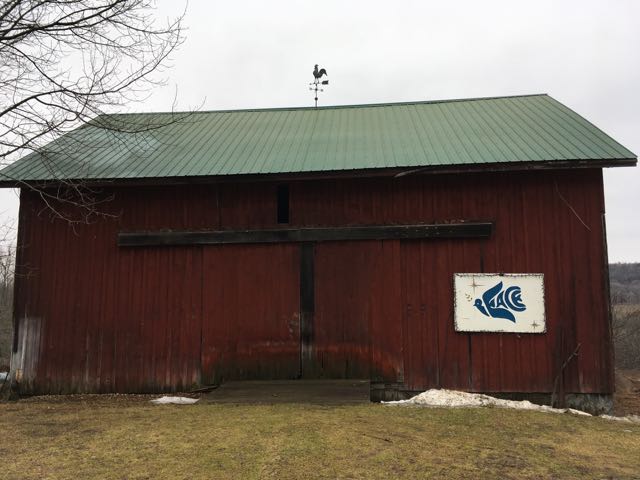
The side facing the road is red, the traditional color of many barns. My mother painted the Peace Dove around 40 years ago on a sheet of plywood. Bud found it in the barn this fall and decided to hang it for the holidays.
The northern side bears remnants of the red. Also a few broken windows.
And a tree with a cool twisty trunk.
The messy back side is a mish-mash of red, green (discolored plywood), and black, where the silo used to stand.
Here is what remains of the old silo — metal bands and wooden staves becoming one with the earth.
The southern side is all gray, discolored in the one corner where a truck cap leaned against it for years.
I think this side is the prettiest.
I took a picture of it during the summer just because I liked the way it looked.
It’s lovely, don’t you think?
Exposure to the elements and weather brings about changes — like the trials in our lives. We end up with some scars and a few broken parts.
But if we lean in, we might find some beauty there.
I thought I had a large family when I was growing up.
My parents had five children — a nice, symmetrical boy-girl-boy-girl-boy.
Then I met my husband. He was the second of thirteen. As if that wasn’t enough, his cousin also came to live with them when her mother passed away, so really there were fourteen children in the family. And one bathroom.
Big is a relative term. My family was not big in comparison with Bud’s.
Bud and I have eight children — somewhere in between mine and his. Not that we planned it. We never sat down and said, “I grew up in a family of five kids. You grew up in a family of thirteen. Let’s split the difference.”
That would have been silly.
That would also have been nine.
We are just blessed. So very blessed.
When I saw on Cee’s Photography blog a challenge about Big and Small, of course I thought of family.
Really — that’s pretty much what I think about 90% of the time. Family will never be an overworked topic for me.
In particular, I thought of this photograph — my youngest and my oldest sons.
Karl and Philip — 1998?
This was at Philip’s wedding. Karl was gaining on Philip a very little.
Karl and Philip 2007
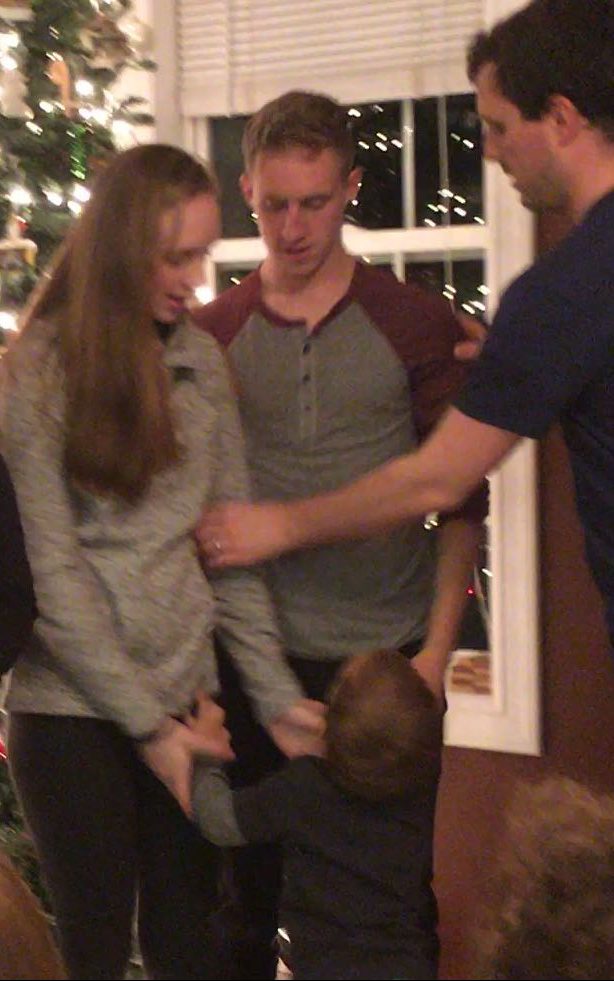
In recent pictures I found this one of Philip next to Karl while setting up a family shot. Philip’s little boy, Henry, loves his Uncle Karl.
“Can I rearrange this room?” “Fred” asked a couple of days before Christmas.
“Sure,” I said. “What do you want to do?”
“I want to move the Christmas tree,” he said, “and, I don’t know, I need to think about it. But the feng shui in this room is all wrong.”
“You can’t move the Christmas tree,” I said. “It stays by the sliding door so people driving past the house can see the lights.”
I told Bud about it later.
“Who’s Frank Schwa?” he asked.
How do I explain feng shui, the harmony in a room, to man who had hoed out so much junk just to make this room usable?
The family room, as we called it, had become a depository — first for the boxes that we moved out of my brother’s apartment after he passed away, then for the boxes and furniture we moved when we rearranged to make space for a downstairs bedroom and bathroom for my father, and finally for the boxes that we moved home from the nursing home after my mother passed away.
Maybe the feng shui was all wrong.
Maybe the “flow” didn’t work.
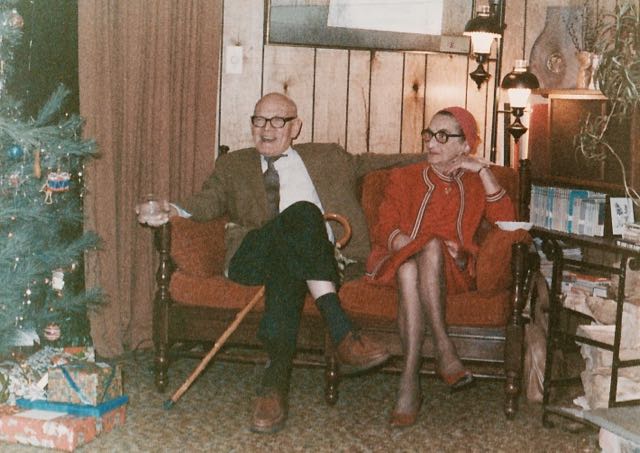
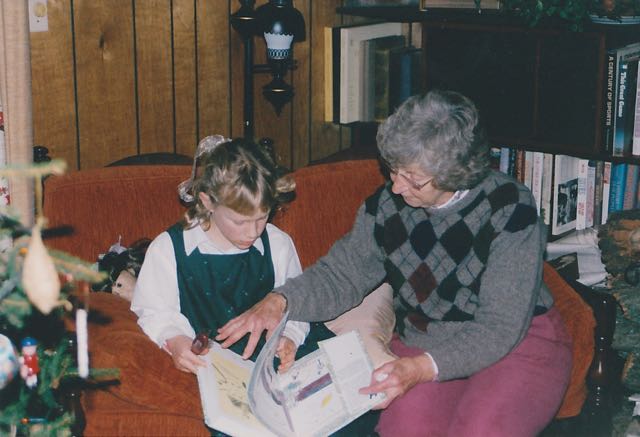
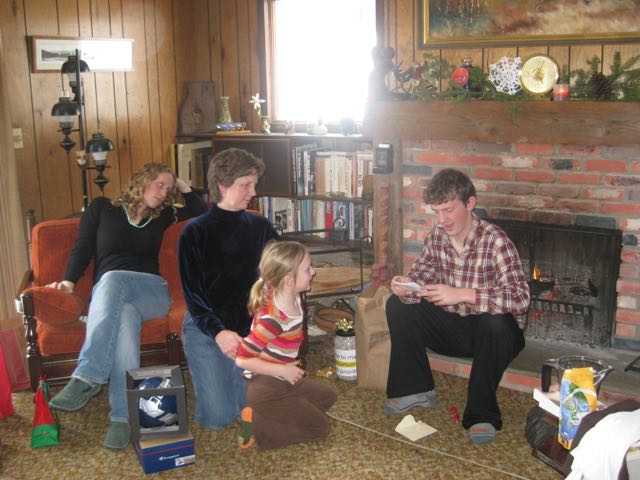
But there’s a level of comfort in that same orange loveseat being in the same spot through the years.
My grandparents — Christmas 1979Christmas 1999Christmas 2009
I confess — we moved it this year, though. Not because of feng shui, but to make room for a smart TV.
The focal point still is, and always has been, the fireplace.
I think Frank Schwa would approve.
The ambience, the aesthetic appeal — both are present in its friendly warmth.
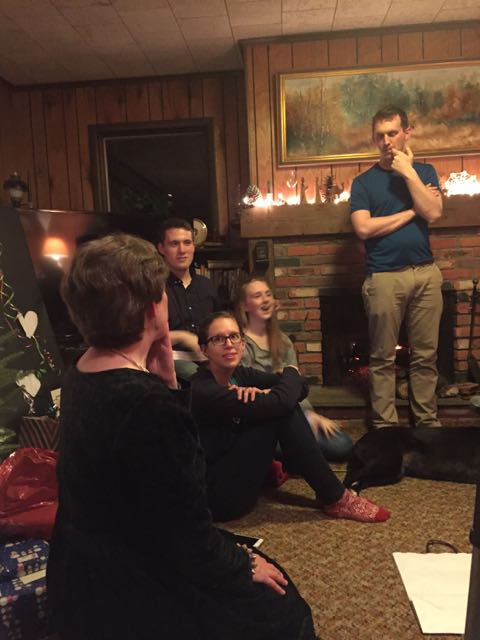
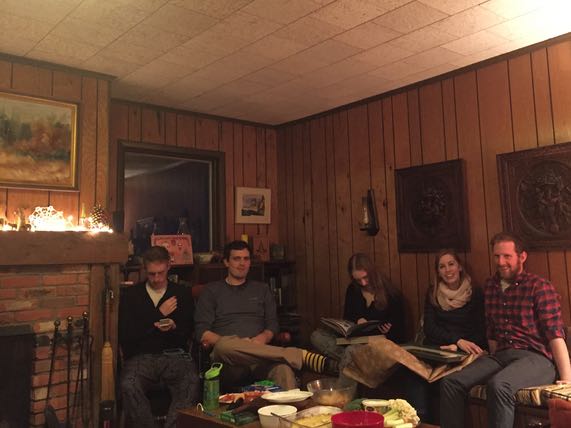
Even more important to me, though, are the people who fill the room.
The way you can tell which of these boys isn’t my brother is the Yankees shirt. No one in my family would dare to wear such a thing.
My parents did a good job raising colorblind children in a lily-white town. I never heard either of them make any kind of racist statement. Instead I watched both of them operate from a platform of compassion toward all people.
Every summer for a number of years my parents invited Fresh-Air children from New York City to stay with us for a week or two. Honestly, what made Hector and Barbara different from me wasn’t the color of their skin. Rather it was their experiences as city kids.
We had a garden and a menagerie. We caught frogs in the pond during the day and fireflies in the yard at night. We could see the stars.
Barbara and I shared my room. We lay in bed at night and talked. She missed her mom and her mother’s food the same as I would have missed my mom and her cooking.
The battle for middle-class America isn’t about seeing or not seeing the color of the skin. It’s about understanding the similarities and differences of our experiences.
At our Sunday worship service before MLKJr Day, a woman talked about her experiences in the late 60s – early 70s when she, a white woman, was married to a black man. Her husband, college-educated and employed, some days was quite late getting home because police prevented from entering his own neighborhood simply because of the color of his skin. She spoke about “white privilege” — something we white folks can’t see because we live it.
In Cooperstown, I remember watching both white and black baseball players inducted into the Hall of Fame. Arrogance comes in all colors. But so does humility and friendliness.
My two favorite ball players that I met when I worked at the Hall of Fame — Cool Papa Bell and Ernie Banks — were both black. I don’t know a single one of their statistics, but I remember their smiles and the way they made me feel.
Jackie Robinson is one of my father’s heroes. When I read his story, it made me cry. Such indignity in the way he was treated. Such strength in his response.
But I ramble.
I hope I have passed on to my children what was given to me — eyes that don’t see skin color. It can’t stop there, though.
Now we need to understand the difference of our experiences.
Whenever I drive my father anywhere, he comments on the houses we pass.
“Those are some well-kept houses,” he says, especially in the summer when the yards are groomed and flowers are blooming.
Somewhere along the line maintaining his house became too much.
My mother kept beautiful gardens. She was outside nearly every day in the spring and summer planting, weeding, and pruning so that passers-by were treated to some beauty.
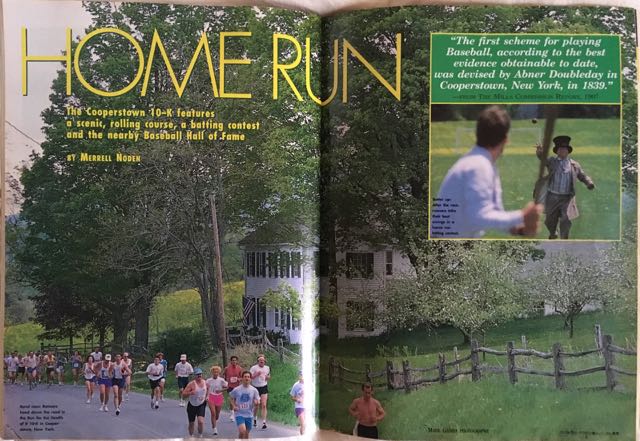
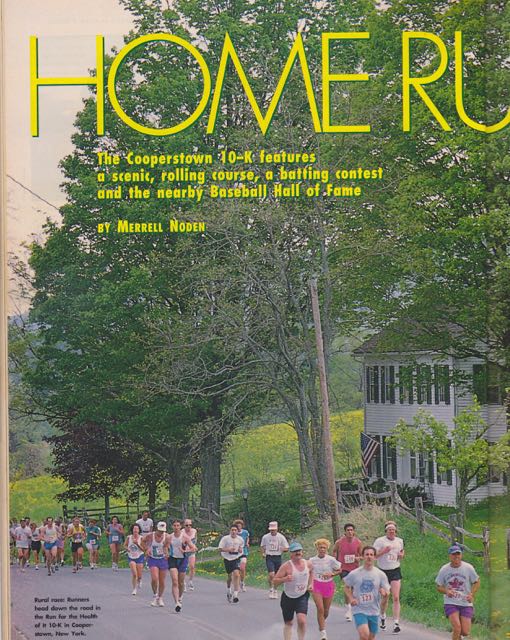
In May 1994 the house was featured in a 2-page spread of Runner’s World magazine. A 10K race was routed right past the house.
the 2-page spreada better picture
As dementia crept in, we discouraged her from being out near the road. I was worried about her safety.
Plus she would shake her fist at cars that drove past too fast.
I was worried she would get a reputation for being a crazy old lady.
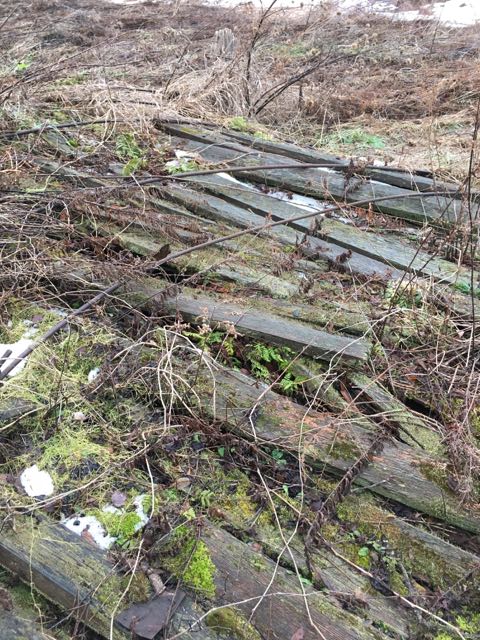
As the gardens were overtaken by weeds, the fence rotted. The split rail fence needed a number of rails replaced but when my father purchased new rails a few years ago and brought them home, he discovered they were too short.
“That’s okay,” he said to me. “I’ll just dig up the posts and move them closer.”
My eighty-something father, who was struggling was balance issues and growing frailer by the minute, honestly thought he could do that.
With aging parents — as with children — figuring out how to address challenges without totally discouraging them with you-can’ts is tricky.
“How about if we get someone to help you with it?” I suggested.
“I can do it,” he insisted.
But he didn’t.
And now the rails are rotting in a pile.
Bud has been working hard to reclaim the gardens. Last summer, he weeded and weeded and weeded. He cleared brush. He mowed. He pruned. He’s one of the hardest working people I know and I wondered if my father even noticed.
We were driving to get his haircut last week, and he commented on how well-kept the houses were on the way.
“It takes a lot of work to keep a house looking nice,” I said.
My father was quiet for a few minutes staring out the window. “When is Bud coming again?” he finally asked.
“Friday,” I told him, “when he gets done with work.”
I was relieved because that told me two things:
He made the connection between the work required to keep the house looking nice and Bud.
He recognized that Bud and I don’t get to see each other every day.
We’re doing it for him.
It isn’t easy, but it’s important.
And I’m grateful that we can be there — and get that house looking nice again.












 Hot Dogs and Marmalade