elderly · family

Surgery

Each member of the surgical team looped through the room.  An introduction. Name and date of birth requested. The why-are-you-here question.

My mother didn’t know the answers when I had sat in the same spot with her some years before. I helped.

My father knew — for the most part.

“Did you have anything to eat this morning?” the anesthesiologist asked.

“Not too much,” he answered.

“He had nothing,” I said.

“Has the surgeon marked on you yet?” a nurse asked.

“No, I don’t think so,” he answered.

“Yes, he did,” I replied.

“Can you tell me about your other surgeries?” the surgeon asked.

“It’s been years and years,” my father answered.

“Last August he had a VP shunt put in, and a few years before that he got a pacemaker,” I answered.

He knew his name. He knew his birthday. He knew what the surgery was.

All in all, I’d say he did pretty well.

A few weeks ago, he had had an episode of chest pain that landed him in the Emergency Room. They ask a different set of questions.

“Are you still a full-code?” the nurse had asked, but then she looked to me for the answer. It’s an uncomfortable question.

“Well, I’m not ready to cash in yet!” my father answered.

“Would you like to be placed on life support?” she asked.

“I’m not going to live forever, you know,” he replied.

His mixed responses were confusing, but he and my mother had both very clearly written out their wishes many years ago. I told his doctor and she asked that I bring in a copy to put in his chart. Just so it’s there.

Last night, I went for a walk. The fields were fifty shades of green. The timothy alone was a full palette of color — spring green, grass green, grey green, a whispery pale green at the very edges of the flower-head.

The fields whispered with the breeze, carrying along its little breaths like a melody passed around an orchestra. The meadow swayed and danced, and the only audience for this performance was the deer, the red-wing blackbirds, and me.

When the Bible talks about grass, it’s usually in reference to transience.

“The grass withers, the flower fades…” (Isaiah 40:8)

The comparison isn’t that man will last forever. We are just as transient.

A surgery day is a time to remember that.

It’s a time to pause. Even if we’re not ready to cash in, it’s okay to remember that we aren’t going to live forever either.

*****

The surgery went well. He’s already home. He’s not ready to cash in yet — and neither am I.

family · Life · photography · Travel

Red-Winged Blackbird

The red-winged blackbirds begin check-check-check-ing at me as I walk down the road.

With dog, without the dog — it doesn’t matter. I’m a threat and they need to let the world, or, at the very least, their fellow blackbirds know that danger approaches.

They sit on fenceposts, telephone wires, tree branches, cattails, and other tall weeds.

Red-winged blackbird speck

I have stopped on multiple occasions to try to snap pictures of them. I either end up with a tiny speck of a bird or empty wires, branches, etc.

They flee from the fenceposts when I stop walking. I can’t focus on taking a picture while walking. My phone is my camera, nothing fancy for zooming in. Walking pictures are a mess.

Frankly, I’ve given up on photographing them.

For me, the red-winged blackbirds must be enjoyed from a distance or in my periphery. As abundant as they are, they are also too elusive for me to photograph well.

Sometimes life is like that, don’t you think? It simply can’t be tackled head-on. We can’t stop and savor each little thing, but we can enjoy the brief moments as they pass.

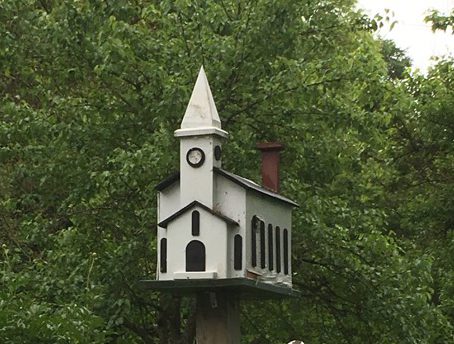
Now the birds that have taken up residence in our birdhouse tease me in the same way. One tiny nondescript bird sits on the chimney of birdhouse, singing merrily, until I get out my phone/camera. I look to find the camera icon on my screen, look back up, and she’s gone. Either both birds in the pair are blasé brown, or I haven’t seen the mister.

Elusive

I need to improve my mental camera when I see them or my memory of their song or create some other method if I ever hope to identify these occupants.

Or, maybe I need to stop worrying about it and enjoy the moment.

Does everything have to have a name? Does everything have to be captured and held?

In our instant electronic gadgety techno age, we’ve lost the looking-out-of-windows and being-in-the-moment.

Sometimes I wonder if children riding in the car down the east coast of the United States even see the Pedro billboards. Or, in rural Nebraska or Iowa, if they see the monotony of corn fields. Or is that when they’re busy watching Frozen for the umpteenth time?

Because if they miss Pedro and the corn, they’ll most certainly miss the many red-winged blackbirds check-check-check-ing from the fencepost.

Life · Writing

First Aid

I took a lot of first aid classes back in the day.

First Aid.

Advanced First Aid.

First Aid and CPR.

First Aid for lifeguards who work at camps in the middle of nowhere.

First Aid for ambulance dispatchers.

Okay, I may be making some of those up. But I WAS an ambulance dispatcher at one point in my life. And I worked as a lifeguard at more than one camp in the middle of nowhere. I think my title at one was lifeguard and the other was Aquatics Director, which sounded lofty and important, but I basically did the same job at both camps. Lifeguarded.

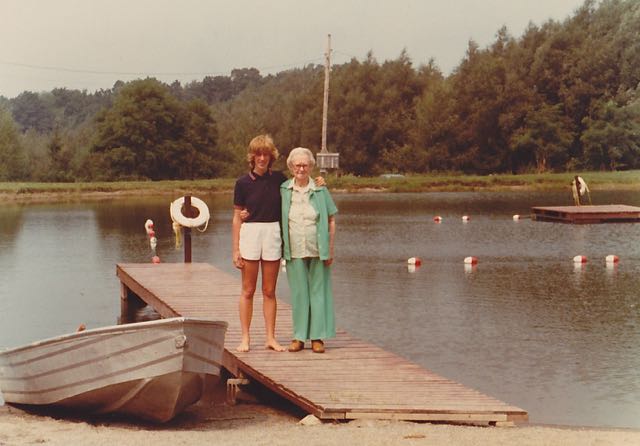
My grandmother came to visit me at one of the camps where I lifeguarded.

My one rescue in all my years of lifeguarding was at a camp. A little boy with Down Syndrome zipped past me while I unlocked the gate to the pool. He jumped right into the deep end. His eyes widened when he realized he couldn’t touch the bottom, and, as he floundered there, I reached in, grabbed his arm, and pulled him to the side. I actually didn’t need any lifeguarding classes to do what I did in that moment. It was all instinct. After that, his counselor made sure he had on his lifejacket before they headed to the pool.

Once, when I was coaching high school girls, I had a swimmer that had donated blood earlier in the day. Her puncture wound from donating opened while she was swimming and started bleeding. A lot.

“C’mon out,” I told her, and placed my hand firmly over the wound to apply pressure.

Meanwhile, another swimmer started feeling light-headed from the sight of the blood. “Stay at the wall,” I called over my shoulder to the woozy girl as I walked the bleeding swimmer to a bench. A couple of swimmers stayed with Woozy.

I wondered where the lifeguard was when I saw her hurrying toward me, pulling on latex gloves as she came. I looked at my hand on the girl’s arm. I was holding the arm up while she lay on the wooden bench. I had blood on my fingers. There was blood rivulets down her arm. A trail of blood drops led from the pool to the bench.

The lifeguard stopped. She blew her whistle and cleared the pool, helping Miss Light-Headed out and shepherded the girls away from all the blood.

My first First Aid classes had been pre-AIDS and pre-blood-borne-illness precautions. My instincts and early classes kicked in long before I thought about getting gloves on. Apply pressure and elevate.

I don’t know if that makes me a good responder or a bad one.

I guess I’m a gut responder.

Then I spend the next ten years second-guessing myself.


Back to Bleh — this morning I thought, I’m going to look at the Daily Prompt, and if I’m inspired, I’ll write. The prompt was “Puncture,” and I immediately thought of Sucking Chest Wounds — doesn’t everybody?

I had learned about them in First Aid a long time ago, and found them fascinating, although I always thought it a little silly to learn about them because they fell into the category of Probably-Information-I-Will-Never-Use.

The initial title for this post was “Sucking Chest Wounds,” but when I started writing, well, you see what came out. Nary a word about sucking chest wounds.

Bleh.

And no good conclusion.

Double bleh.

Writing

Bleh

“Everything I write is stupid,” I told the girls the other night. “I need to just stop.”

Of course they gave the obligatory, “No, Mom. We like it.”

But I was all phooey-on-everything.

Laurel said, “What if you just didn’t write every day?”

Now there’s a novel idea.

Some things feel a little wrong to write about — like my father’s decline. As cathartic as it was to write about my mother, the catharsis isn’t there this time. It documents, I suppose, like this morning’s conversation —

Dad: I had the strangest phone call this morning. I answered the phone and nobody was there.

Me: What phone did you answer?

Dad: The phone in my bedroom. It rang at 7 AM.

Me: You don’t have a phone in your bedroom.

Dad: Well, nobody was on the other end.

It’s such a sad documentation.

A lot of other things fall into the does-anyone-really-care-about-this category.

Like the indigo bunting that flew into the window the other day. While it lay stunned on the deck, I took this picture, so I could look it up to identify it. When the cat came trotting up the ramp, I ran out the door to shoo her into the house so she wouldn’t bother the bird. Then I picked up the bird and moved him to a safer place. He perched on my finger after I scooped my hand beneath, and he weighed about as much as popped popcorn. I placed him where I could see him from inside. About an hour later, he flew away. A fascinating story — with no point at all.

Sometimes writing feels so bleh.

A hiatus is in order.

Or, at the least, a taper.


Faith

Tender Mercies

It was hard for me to feel peaceful in Paris, what with the busyness of the place and all.

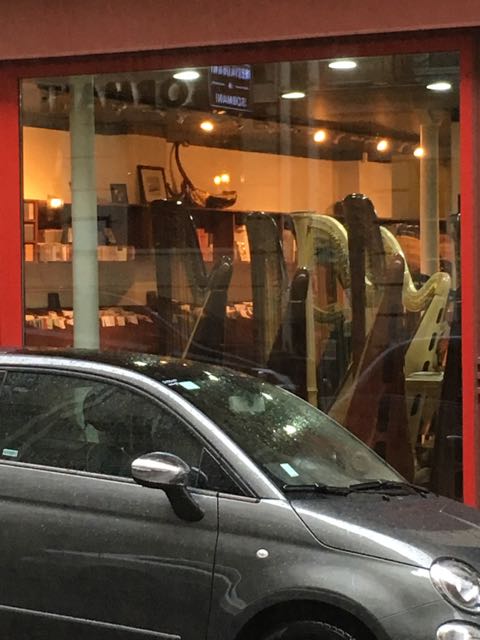
Then I remembered the harp store.

Our hotel was on a narrow streets not far from the Arc de Triomphe. On our first night there, we had walked to a little bodega (not sure what the French word would be) at the end of the street to buy something and the poor store owner was in the midst of an argument with a couple who looked strung out on something. He would glance nervously at us, the naive Americans, and argue a little more in French with the couple. It probably was a good thing I couldn’t understand what was being said.

In my heart, I bemoaned the city. It was all too much.

But the next morning, when I stepped out the door, I saw the harp store, wedged into a tiny space precisely where I couldn’t miss it.

It was lovely and reminded me of those tender mercies God gives us to help us remember Him.

Yesterday, back in rural New York, I was reminded over and over of those little mercies all around me.

As I drove Mary into work, I turned onto the street where Cooperstown has their helicopter pad. I quickly pulled my phone out of my pocket and handed it to Mary.

“What?” she asked.

“Get some pictures,” I said.

The state police were taking their dogs-in-training for helicopter rides. Mary snapped a bunch of pictures.

“They’re probably pretty bad,” she said apologetically.

“That’s okay,” I told her. “I just want to remember this. It’s pretty awesome that we live in a town where dogs get to go for helicopter rides.”

The line of police cars at the helicopter pad

Where else could I go to see such a sight?

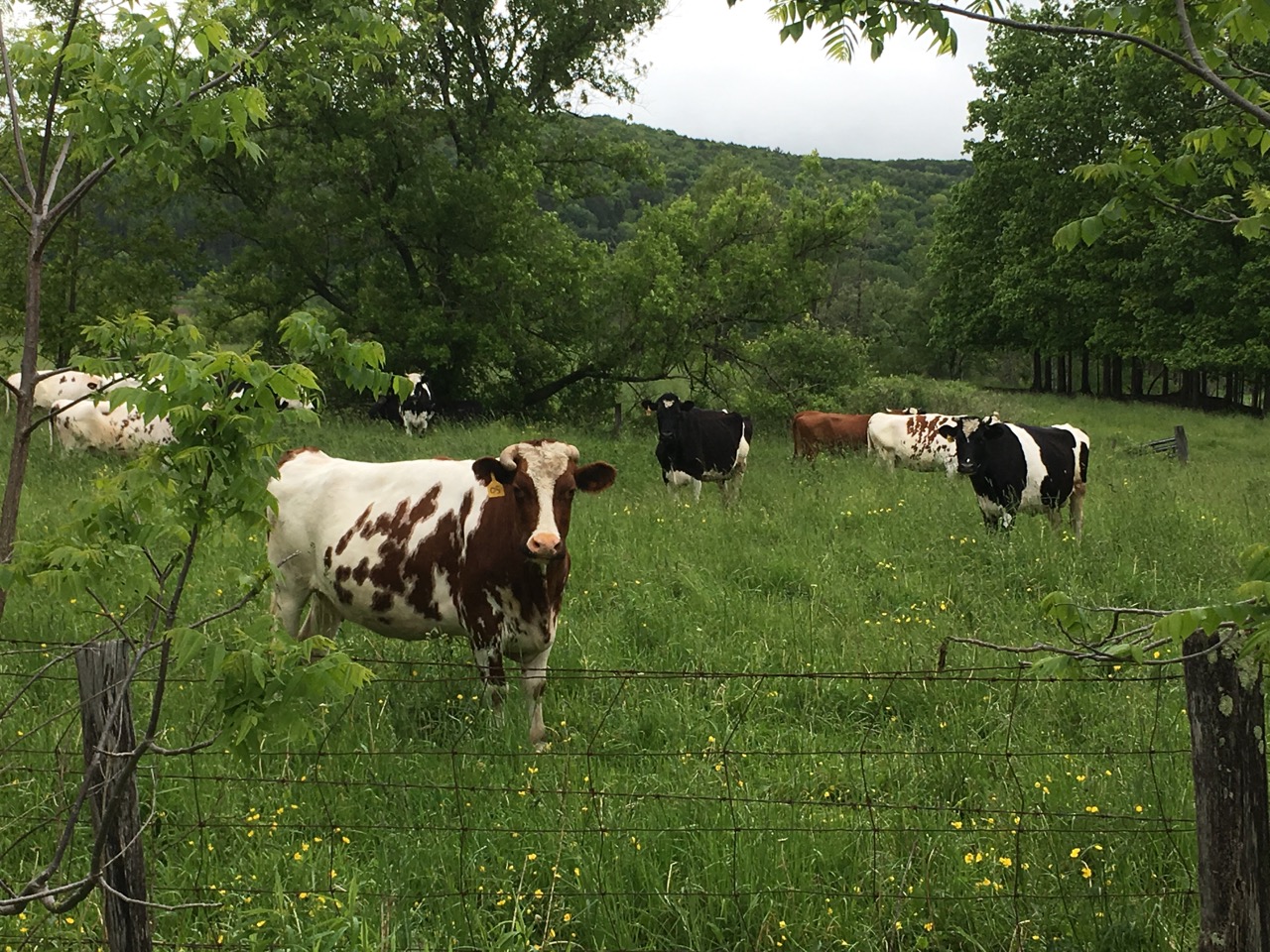
On my evening walk, the cows were in the field near the road.

A week ago, another blogger had written about playing Queen and watching the bovine reaction — “most of their uncomprehending faces turned toward the noise, and turned right back to chewing cud sightlessly.” A few nights later I decided to play a little music for the cows near me. Mozart — one of my favorites, and what I had been listening to — elicited little-to-no reaction.  They perked right up for Andrew Peterson though; some even approached the fence. (For the record, it was “Hosanna” that I played.)

Owen thought I should play John Gorka’s song “Winter Cows” for them. So last night, that’s what I did. This was their response.

Hmm… I wonder what it is about Andrew Peterson.

Also, where else could I test out cows’ listening preferences on my evening walks?

Further on, I saw a deer.

She watched me for a while before bounding away.

And then there was the sunset — all golden and lovely.  

The steadfast love of the Lord isn’t just new every morning. It’s there throughout the day if we but open our eyes to see it.

family · poetry

The Angels Were Angry

And the angels were angry
At the crispness of the cake
“HOW DARE YOU,” they bellowed,
“MAKE SUCH A MISTAKE?!”

They brandished flaming swords
To bar me from my kitchen —
I felt like such a failure;
I knew they were itchin’

To use their blazing rapiers
Against the likes of me
Because I multitasked disaster
Where disaster oughtn’t be

Oh, the angels were furious
While smoke rose from the range
So I pondered how to soothe them
Then I spotted something strange —

A hero in a paper bag!
He boldly stood between
Me and my catastrophe
Better sight ne’er seen

“Begone!” I think he shouted —
Or maybe it was “Gwam!”
giggle-giggle “Wook! Wook!
Here I am!”

So the knight-in-paper-bag
Took my mind off of burnt cake
And I played with little Henry
Before I cleaned up my mistake.

Life

Chalk Throwing

Three teachers that shaped me used the not-socially-acceptable technique of throwing chalk at the students.

One teacher threw a piece of chalk at me for passing notes during class. He threw it, and then he called me a “stupid Pollak”, an ethnic slur for someone of Polish ancestry — which I wasn’t — and a mispronunciation of my last name. I was angry. I vowed never to take another class in that subject again. And I didn’t — until college. Trigonometry was the last math class I took in high school.

Another teacher threw chalk, erasers, whatever was handy — and called students “Harry Lipschitz”. Maybe because I was never the target of his missiles, or maybe because I liked the subject matter more, I worked really hard for that teacher and have a lifelong love of music, largely because of his influence. Not every former student shares my opinion though.

The third teacher smacked yardsticks against the chalkboard and broke them on a regular basis — the yardsticks, not the chalkboards. He threw also chalk. And erasers. He had a large wooden machete that he would rest on a student’s shoulder and gently tap the “blade” against his or her neck, all the while asking him or her to solve a problem or answer a question. We loved this teacher. We paid attention. We laughed. We learned.

Sometimes, I think, we try to over-simplify problems or solutions.

I had a teacher that threw chalk at me and he made me want to quit learning, therefore all teachers should be forbidden from throwing chalk.

But I also had a teacher who threw chalk who made me love learning, therefore all teachers should be required to throw chalk.

Or, I had a teacher that threw chalk, and some students really liked him, while others did not, therefore chalk-throwing should be discretionary.

But why is it that one teacher can throw a piece of chalk and we laugh, and another teacher can throw chalk and we want to quit? The answer lies not in the throwing of the piece of chalk.

I don’t even know where I’m going with this. I just know that nothing is simple.

I mean, is social media bad, or is social media good?

Are guns bad, or are they good?

Are drugs bad, or are they good?

Is chalk bad, or is chalk good?

Are teachers bad, or are they good?

Dogs?

Gluten?

Coal?

Government?

What I do know is that when we know something for sure, we are most in danger of being wrong.

For the record, in my opinion, chalk throwing is not a great idea for teachers… yet I learned a lot from a couple of chalk-throwers.


Faith · Life

A Run With Andrew Peterson and Friends

Laurel told me something about wearing exercise clothes making you want to exercise, so I bought the uniform of the runner — leggings — and it sort of works. Once I put them on, I feel like I’ve made the commitment to run.

This morning I really didn’t want to run — and when I say “run”, I mean “walk-run”, with more walking than running at this point in my 5K run app.

So, I didn’t want to run, but I had on the leggings and my father was still sleeping and Mary was downstairs in case he got up anyway and I had no other excuses. I headed out the door and down the hill.

About 5 minutes in, I heard a *ka-pling* from my phone, so I checked to see if I was supposed to start running, but it was a message from a friend. I barely had time to see her name when I heard the *ding* signaling time to run. I shoved my phone back in my pocket, and began running and praying for her.

Lord, I don’t know what’s going on with my friend

Meanwhile, in the background of my run, Andrew Peterson was singing, “Keep to the old roads, keep to the old roads, and you’ll find your way…”

I focused on a distant tree, telling myself I could run that far. It’s a thing I do because I really hate running – set a short-term goal.

*ding* — I could walk again. I pulled out my phone and read her note. “We are very lost and hurt…”

“Keep to the old roads,” sang Andrew. He was on the last chorus.

Lord, help her to remember the old roads. Help her find her way.

I know that lost feeling, when it seems everything is wrong and wasted. I thought of another friend who recently lost her home in a fire and the heavy ache she must feel, sifting through ashes. I’ve gotten those heart-wrenching phone calls and driven to far emergency rooms. I sat with my mother through her last breaths.

*ding* — Time to run again. I picked a barn to run to. Andrew was singing “Dancing in the Minefields.”

“This is harder than we dreamed…” Indeed, it is. Marriage, parenting, life.

It all is so hard and no one warns us about that.

Or they do, and we don’t believe it because we have stars in our eyes and hope in our hearts. But the stars are replaced with the pollution of life, stinging our eyes. And the hope in our hearts withers like an unwatered plant.

Lord, walk with her in these shadowlands.

And so my walk-run went.

Andrew sang, “So when my body’s weak and the day is long, When I feel my faith is all but gone, I’ll remember when I sing this song, that I believe….”

And I prayed.

Andrew sang, “Isn’t it love?”

And I prayed.

The last bit of my run-walk is miserable, absolutely miserable. I start off going downhill which means I finish going up.

I thought about a comment Jonathan Rogers had recently made when someone praised him for being an encouragement.  He said something like, “I’m like the cross-country coach who pulls alongside in the golf cart, takes a drag of his cigarette, and tells you to keep going.”

I thought about a new friend who wished me Bon Courage and explained that it’s not about bravery, but strength and resolve.

I thought about my friend who is lost and struggling, and that we’re all like the guy in the golf-cart, smoking our cigarettes and encouraging from our comfort, while we really don’t understand the pounding on the pavement pain of the runner in that moment, and that we need strength and resolve, and to be able to set our sights on reachable goals.

We also need to remember the ultimate goal — that running with endurance the race that is set before us. We have a cloud of witnesses — not riding golf-carts. We need to focus on Christ for our strength and resolve, our bon courage.

And so I prayed for my friend as I finished that final hill.


family

My Mother’s Closet

My mother’s  closet has only been hers.

When my parents bought this old farmhouse 50 years ago, it had one closet — a tiny one, at that.

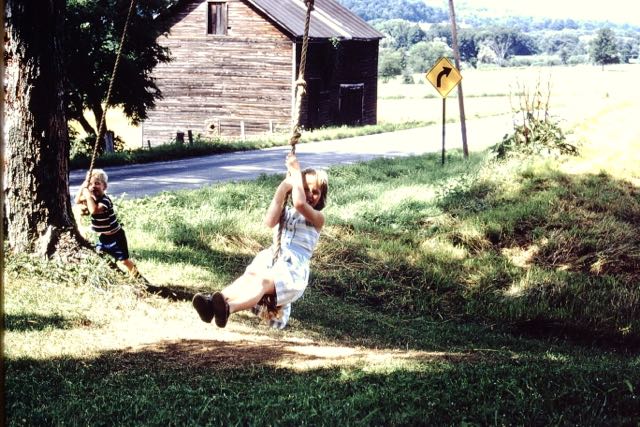
While we kids put up a rope swing, my father put in closets.

Putting up the rope swing
Swinging
putting in closets

Bi-fold doors must have been in then, because that’s what he installed — in his closet, my mother’s closet, my sister’s closet, and my oldest brother’s closet. The rest of us didn’t get closets; we had cardboard wardrobes.

I stood outside my mother’s closet the other day, hesitating to open the door. It has to be done — the cleaning of it, I mean. She’s been gone over a year and a half. My son is staying in that room. And he sure could use a closet.

But I stood there, not wanting to look again at what’s inside.

The brown wool plaid skirt. The green skirt with Greek meander border. The dress she wore at my wedding.

The ruffled blouses that she wore to dress up.

The sweaters.

The housecoats, even.

They’re housecoats, for crying out loud.

But I can picture her standing in the kitchen wearing them, making our lunches for school.

A woman I know lost her house in a fire recently.

Is that how you want to deal with your mother’s things? a voice whispered in my heart. I knew it wasn’t God, because He didn’t burn my friend’s house down. He doesn’t threaten to burn houses down. I saw, however, in my mind’s eye, my fingers being forcibly pried off the things I’m holding onto.

Is that how I want to deal with my mother’s things? No. Absolutely not.

But they must be dealt with.

Garbage? No. That’s wasteful. My mother was never wasteful.

A yard sale? No — I don’t think I could bear watching people paw through her things.

Donate to the church’s rummage sale? No — same reason.

I think I need to box it all up and take it to a donation point in another city. She would want some good to come of it all.

Then, I’ll have to look at an empty closet.

And mourn a little, allowing the closet’s history to move just a wee bit distant into the past.

Before my son moves his stuff in and the closet has its second occupant.