Sabbath

Sabbatical

Walter Brueggemann, in his book “Sabbath as Resistance”, referred to the idea of “seven”-ing our lives. “People who keep Sabbath live all seven days differently,” he said.

I decided that 2018 will be my Sabbath year.

Each week, I hope to reclaim the Sabbath by turning off my phone and computer. Imagine 24 hours every week without the tyranny of the urgent!

I mentioned this to my co-early-morning lifeguard this morning and her reply was a little off-putting. She said nothing, as in not a word. I babbled on for a little longer about taking a break from devices. Still nothing — from a usually good conversationalist. Either this is the dumbest idea in my history of dumb ideas, or I struck a nerve, or she just didn’t “get” it, or it was some sort of weird allergic response. Note to self: don’t discuss device abstinence at 5:30 in the morning.

Even the computer games, which I have so often rationalized as a way to relax, will go.

St. Francis de Sales said,

For if we spend too much time in a game, it is no longer recreation, but occupation: we refresh neither our minds nor our bodies, but on the contrary, we depress and weary them.

St. Francis penned that 400 years ago, never imagining this world of handheld devices that entertain. Once a week, those games won’t even be an option for me. I will power down.

Brueggemann spoke also about the Sabbath year — “Every seven years [is] an enactment of the sabbatic principle.” Basically, this means spending the whole year living generously.

In the Biblical Sabbath year, the land lay fallow. (Fallow means “usually cultivated land that is allowed to lie idle during the growing season” Merriam-Webster) I tried to think what I could leave fallow.

And I settled here. This blog. My story.

This blog began as a place to write about my mother and my father, and caregiving, and the struggles of life in a large family. I wrote the story that I know best — my story.

For one year, I’ll set my story aside and (try to) tell other people’s stories.

Sort of like Humans of New York, on a much lesser scale. And not as good. And without photographs.

Of course, I’m in the story because I’m the narrator, but I hope to minimize me. It may be a skill that I’ll hone as the year goes on.

I’m starting with a man named Bruce. I listened to his story on a flight from Nashville to Detroit 7 years ago — and I still think about it.

family

Carpet

“How long do you think the new carpet smell will last?” one of my co-workers asked.

I had to leave work early because the carpet guys were coming.

“I have no idea,” I replied. “Is that like the new car smell?”

My family replaces carpet every 45 years or so whether it needs it or not. This particular carpet had reached replacement age. It was the color of cat vomit, which, I suppose, was both a pro and a con. The new carpet, grey-ish brown, will hide dirt well, but probably not cat vomit. Oh, well. I guess you can’t have everything.

When my husband and I bought our first house, we immediately tore all the carpet out. Lovely hardwood floors were hiding beneath it and we wanted to enjoy them.  Bud hacked the carpet into manageable size chunks to roll up and put in the alley for the garbage man.  About halfway through the task, he noticed that the rolls were disappearing from the alley. Back in the house, he watched as our new neighbor on the other side of the alley went out to scavenge the latest roll. She was carpeting her garage with our discards.

The second house we purchased had green plush carpet throughout the second floor. When we first looked at the house, Bud said, “We can pull this up and replace it.” I agreed. Seventeen years later, when we moved out, it was still there.

The third house had mostly hardwood floors, but upstairs, in one bedroom, a previous owner had laid orange shag carpet. It was hideous. “This has got to go,” Bud said. I agreed. Eleven years later, it’s still there.

The carpet we replaced is at my father’s house. As we reclaimed this particular room — it had become the depository for so much stuff that there was no place to sit — everyone has enjoyed it, even my father. Maybe especially my father. Whenever we have a fire in the fireplace, he loves to sit back there and enjoy its beauty and warmth.

Yesterday he asked about going back there.

“They’re putting in new carpet,” I told him.

“Can we walk on it yet?” he asked after the installers left.

I had no idea. My experience with new carpet is pretty meager. Actually, it’s pretty non-existent.

This morning I vacuumed so we could move the furniture back in. Pay no attention to the shelf of books that fell down during the night.  Or the fact that I didn’t vacuum neat straight lines, something Bud liked to do with that old green plush carpet when we were showing the house. Just note the carpet that’s NOT the color of cat vomit and picture a crackling fire in the fireplace.

Ah — new carpet for Christmas.

It smells okay — but once we put our Christmas tree in there, it will smell like Christmas.

And then, hopefully, it will begin to smell like home.

dementia · family

Roots

I need to apologize to Osyth. A few weeks ago in her blog, Half-Baked in Paradise, she wrote about moving. Something about her words broke my heart. Maybe it was this:

My heart felt the leaden weight of sorrow because my safe-place, my home, my warm hug, my protective cloak, call it what you will has gone.

When she posted again, I didn’t even go read it. I couldn’t — I was still grieving over her move. Then she posted again, and I read it. In fact, she started re-blogging a series about her home, and the renovations there, and I binged. She’s posting day by day. Like a glutton, I looked the whole series up and read it, laughing — actually revelling with her — at the great adventure she has been on for some time. (Start here: Coup de Coeur: Part One)

Sorry, Osyth, for not waiting for you to repost them all. I’m just the kind of person who likes to read the end of the book before I read the middle.

Home is something so dear to me. One of my many started-and-discarded blogs had the tagline, “I love where I live.”  And I do. I love upstate New York.  I love Cooperstown. I love the four seasons, the Susquehanna River, Otsego Lake, the trees, the village streets, the country roads, the people, the cows, even the tourists. This is my home — and the thought of living elsewhere is almost unthinkable.

My father keeps asking me what brought me to Cooperstown.

“What do you mean?” I ask him.

“What made you come here?” he’ll say, as if that clarifies anything.

“Are you asking about why I first moved to Cooperstown?”

“Yes,” he replies.

“We moved here as a family in 1967,” I say. “You took a job at Bassett Hospital as the head of their General Services department.”

“Yes, that’s right,” he replies, every time, remembering, or acknowledging the plausibility of this story.

“I was a child,” I remind him, “your child. I didn’t have a choice.”

“Where did Bud come from?” my father asks, trying to piece together my family.

We’ve gone through this many times now. I know the questions that are coming, but it’s sad because he has lost a large chunk of my life.

“I took a year off from college and met Bud while I was working at Bassett,” I say.

He nods, but I’m not sure he remembers anything about this.

Long pauses punctuate our conversation.

“Where did you come from?” This question often comes next. It’s another one that needs clarification. I’m sure he’s not asking about the birds and the bees, so I name the army base where I was born.

“How long did you live there?”

My mom and the children she moved with all by herself

“Six weeks,” I tell him. “When I was a baby, Mom loaded me, Stewart, Donabeth, and Peter into a station wagon to join you in Fort Riley.”

Yes, I was 6 weeks old. My oldest brother was 5 years old, my sister not quite 4, and my middle brother only 21 months old. Whenever I asked my mother about my birth and first year of life, all she would say to me was, “That was a hard time.” I’ll bet it was. The legend of a super mom.

“I don’t remember any of that,” my father says, and, of course, he wouldn’t because he was busy working at his fledgling career as an army doctor.

Another long pause. I begin to focus on whatever it was I had been doing before this conversation began.

“So what made you come here?” my father will ask, and we’ll start the whole thing again.

“You did, Dad,” I tell him. “You did.”

Coaching swimming · Life

Coaching Imogene Herdman

Yesterday I made a girl cry.

The head coach told me, “You did the right thing.”

When I told the story to one of my sons, he said the same thing. “That was the right decision,” he said.

Still, I went to sleep thinking about her and woke up thinking about her.

Basically, I’m coaching Imogene Herdman. If you’ve never read The Best Christmas Pageant Ever. The opening line in the book is, “The Herdmans were absolutely the worst kids in the history of the world.” Imogene is all Herdman.


In fact, I’ll call my swimmer Imogene for this post.

She’s mean. A real bully. Lots of name-calling. Shoving. Swimming over top of other kids. Always late — when she shows up at all. Mouthy.

I’ve said to my co-coaches more than once, “I need to figure Imogene out. Where does the mean come from?”

A lot of kids these days are from broken homes and blended families, so I don’t want to assume that’s the root, but I think it plays a part. She’s been displaced by a baby half-brother in her home. She’s a hers, but he’s a theirs.

My group of swimmers is developmental. They’re mostly around 10 years old and still learning the strokes. We practice Monday, Wednesday, and Friday.

On Tuesdays, however, I coach a different group, a higher level group, because their coach can’t make Tuesdays at all.

A few parents of swimmers from my group have asked about having their child practice on Tuesday with me. Piano lessons and other activities make it hard to make it to all the practices. I’ve answered that on a case-to-case basis.

Imogene showed up last Tuesday.

“Can I practice today to make up for some of my missed practices?” she asked.

I paused. “Can you be nice?” I asked.

“Yes,” she said, looking up at me so hopefully.

“Can you listen and do what you’re told?” I asked. She often doesn’t.

“Uh-huh,” she said, and gave me a please-please-please smile.

“Okay, we’ll give it a try,” I said.

She made it about 40 minutes before she started pushing and swimming over top of other kids.

The next day, she didn’t come to practice. She went to the locker room, though, and told the other girls, “I’ve been moved up to another group.”

“Was Imogene moved up?” my saintly swimmers asked.

“No,” I told them.

She came Friday in full-on bully mode, skipped the meet on Saturday, and then at Monday’s practice told me that she was coming on Tuesday.

“No, Imogene,” I told her. “Coming on Tuesday is a conversation I need to have with your parents. You can’t just decide that you’re coming.”

But she came.

And I made her get out.

“We talked about this yesterday,” I said to her.

“I have a note from home,” she replied, but didn’t offer to show it to me.

“I’d like to have a conversation, not a note,” I told her.

She stared at the deck.

“My problem, Imogene, is this,” I continued. “You aren’t always nice to the other swimmers in your lane. You don’t do what I ask you to do. You skip practices. You skip meets.”

Tears filled her eyes.

“I can’t go to swim meets,” she said, her lower lip trembling. “I have a baby brother.”

“Can you ask some of your friends for rides to meets?” I suggested, but as soon as I said the words, I knew the answer. She doesn’t have many friends.

The tears rolled down her cheeks. I thought of Amanda Beard’s memoir, In the Water They Can’t See You Cry. On deck, standing in front of me, I could see the tears.

“Tuesday practices are a privilege for our group,” I said. “I need to talk with one of your parents.”

With that, she left.

And I felt like crying.

“You did the right thing,” the head coach said. “She can’t run the show. You feel badly because you’re kind.”

I didn’t feel kind.

I felt like I had kicked Imogene Herdman out of the Christmas Pageant. At the start of Advent.

For me, swim team has always been about a thousand different things other than swimming. Now it’s about a Christmas Pageant bully.

How do I reach Imogene?

Faith · family · photography

Rough and Slippery Roads

Those who journey on level ground have no need to give one another their hands, whereas those who are on rough and slippery roads hold fast one to another… in order to walk securely and help one another in the many difficult places through which they have to pass.

St. France de Sales, Introduction to the Devout Life

A helping hand while climbing the rocks at Whytecliff Park

God, in His mercy, blessed me with a number of people who offer me their hand in the difficult places.

This Thanksgiving, I’m thankful for each one of them.


family · photography

Another Sunrise Post

Laurel and I left before the crack of dawn for a swim meet this morning.

As we came over the top of Murphy Hill, I caught my first glimpse of the eastern horizon.

“That’s going to be a beautiful sunrise,” I told her.

She started to laugh.

“Just you wait,” I said, assuming she was laughing at me gushing over another sunrise. “Some day 50 years from now, you’ll see a breath-taking sunrise, and you’ll think, Mom would have liked that.”

“What are you talking about?” she asked.

“You laughed,” I said.

“I thought you said, ‘That’s no surprise’,” she said, referring to the conversation we had been having before I was distracted by the crack of dawn breaking through the sky ahead of us.

We both laughed. I mis-hear a lot. This time is was someone else’s turn to hear incorrectly.

I handed Laurel my phone. “See if you can take a few pictures on the way,” I said.

And she did.


I know that beautiful sunrises are simply caused by light reflecting through particles in the atmosphere.

Still, it was a lovely way to start the day.

Every time we came around another curve or crested another hill, the view just got better.

It doesn’t happen often , but I’m so glad that some days are like that.

family · Uncategorized

October Gratitude

On October 29, I am grateful for these — collected over the course of the month.

  1. Harvest time
  2. A few stalks left behind
  3. Airports
  4. A full-circle rainbow seen from above
  5. Tennessee sunrise
  6. A quiet place to stay
  7. That bald-headed guy resting his arm on the chair (below)
  8. The woman in the middle in the greenish shirt (above) (Her eyes always sparkle.)
  9. Dining with friends
  10. A new book
  11. An afternoon walking around a mall with a friend (sorry, no picture)
  12. The Dalek I saw there
  13. A bald eagle sighting
  14. A new job
  15. Chipmunks in the house (only the tail visible here)
  16. Mice trapped in an empty can and released into the wild
  17. Beautiful sunsets
  18. A girl to take the picture for me while I drive (rearview mirror)
  19. Late autumn colors
  20. The way the afternoon sun hits the hills
  21. Concentric spiky circles
  22. Apples
  23. Pears
  24. Hallmark movies
  25. Family humor
  26. A funny sign
  27. A visit from my grandson (the walker isn’t his)
  28. My father and my grandson playing together
  29. A military funeral (no photo, but a memory I’ll hold onto)

How has your October been?


Grief · Life

Mr. Hanson

Image from ALLOTSEGO.com from Veteran’s day 2016 — Mr. Hanson on the right

I don’t think he was there the first time we visited the Methodist Church a few  years ago, but he was the second or third time we went back.

“Sally,” he said to me in his strong deep voice. I was flattered that he remembered me. It had been 40-some years since I sat in his 7th grade math class.

“Hi, Mr. Hanson,” I replied.

“You can call me Dick, you know,” he said, smiling. “You’re an adult now.”

“I don’t think I can,” I said to him.

Teachers, especially good ones, have a special status. When I hear kids today calling teachers by their first name, or, worse, just their last name, I cringe a little inside.

Sunday after Sunday he would engulf my hand in his while he greeted me. If I called him Mr. Hanson, he would give me a look and then say, “Dick, please,” so I took to calling him nothing.

“Good morning!” “Good to see you today!” “Merry Christmas!” I avoided the naming, and he allowed me to, until one Sunday, he said, “C’mon. You can say it.” He held my hand and waited.

I took a deep breath, and said, “Dick?” in the smallest of voices, and quickly followed it with “I don’t think I can.”

He looked at me a long time, then let go of my hand. “Okay,” he said, and he smiled at me but never mentioned the name thing again.

Mr. Hanson was one of those larger than life teachers. A former marine. Physically a big guy. A booming voice. A great smile.

I said something to another woman at church who had had him as a teacher. “I just can’t call him anything but Mr. Hanson,” I told her.

“I know,” she said, ” but let me tell you something about him. Do you remember when I was in the hospital?”

I did. When we were in school, she had been in a tobogganing accident that resulted in a broken neck, broken jaw, and months in the hospital. I spent many afternoons sitting in her room with her. Her jaw was wired shut. A device that resembled tongs attached to her skull and held her neck in traction via weights that hung down over the end of the bed.

“My mother was taking a mandatory First Aid class for teachers on Monday nights,” she said, “and she must have mentioned something about it to Mr. Hanson because he started showing up in my hospital room on Monday nights to visit. He never said anything to her about it, and it took me a long time to figure it out, but on the one night she couldn’t be with me, he came by.”

I wondered how many other Mr. Hanson stories are out there.

Therein is greatness.

Not doing big things that draw attention and bring accolades, but in doing the small things, unnoticed and unseen, but not unimportant.

Mr. Hanson died last week.

I’m sorry (not sorry) that I could never bring myself to call him Dick. I’ll miss his strong handshake, resonant voice, and warm smile. I’ll miss his presence.

Rest in peace, sir.

Faith · prayer

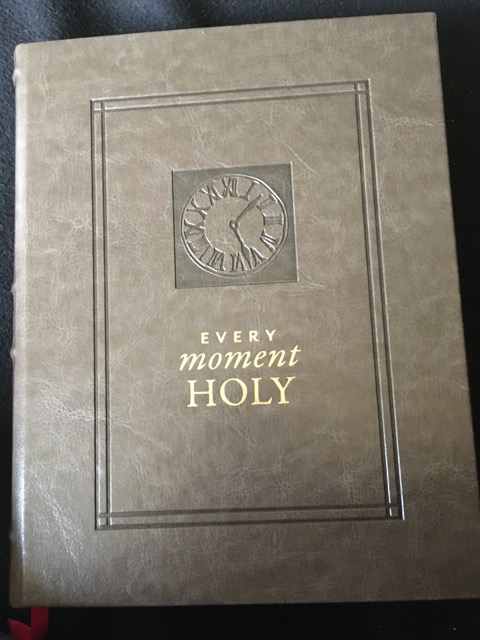
Every Moment Holy: When Something Is Lost

I lost my wallet.

Again.

I started to write out the sequence of events that led up to the last time I remembered holding it in my hand, but none of it really matters. The important part of the story was that my wallet — a nice little clasp purse made by a dear friend — was missing.

At 5 AM, I was searching, trying to be quiet while the rest of the people in the house were sleeping, but I had to be at work at 5:15 AM and was starting to panic.

My mother often said, “It’s always the last place you look.”

The morning schedule was tight:  lifeguarding at the pool from 5:15-7:15, go home, eat breakfast, leave by 8 AM to take Laurel to the dentist which was an hour-and-a-half away.

Every Moment Holy, my new favorite book, sat on the table where I had finished my morning readings. Was there a liturgy in there for lost things?

I searched through the Table of Contents, wasting valuable other search time, looking for a prayer to fit this occasion.

Nope.

But the beauty of Every Moment Holy lies in the title. Every moment is holy. Even the anxiety-ridden ones.

Before I left the house, I tip-toed into my father’s darkened room with a flashlight to see if perchance he had picked it up. My mother, in her dementia, used to squirrel away all sorts of treasures, and my father has started doing similar things. She had opted for shiny things — silverware and napkin rings, but he liked books and pens and shirts. My wallet wasn’t in his room, though.

I drove into the pool, worrying, and trying to allay my worries with words that could go into The Liturgy for Searching for Lost Items.

I got to the pool only to find the service door locked.

“Sorry, Sally,” said the woman at the front desk who let me in.

“No worries,” I said. It’s my standard response. Even when I’m worried.

And I was quite worried.

But the liturgy for lost or misplaced things was starting to take shape.

I found that when I started feeling the worry rise, it helped to think about what the Bible said about lost things.

I had two hours at the pool, three hours in the car, and an hour sitting in a dentist office to think about it. Six hours of pushing worry into prayer.

My initial thoughts:

O, Lord — I know You care about lost things
You talk about a shepherd leaving ninety-nine sheep to search for the one lost lamb
You talk about a widow searching for a lost coin

My later thoughts:

Lord, I’m holding on too tight to the temporal, to things that don’t last.
If I never find that wallet again —
If every worse case scenario I imagine comes true
If it was dropped and found by an unscrupulous person
Or taken because I wasn’t paying attention
If my credit cards and, worse, my identity are stolen,
It’s okay
Because I have everything I need in You

My hands are open, Lord.
Whatever You want from me is Yours
It was never mine to begin with

Truly my morning was holy.

Anxious — but also holy in a way I couldn’t have imagined.

My mother was right. It’s always in the last place you look. Sometimes it’s in a place you’ve even looked before.

I found it when I got back home. Even though I had looked there previously, it was in my father’s car.

Matt Canlis said at Hutchmoot that God is closer than you think and in places you don’t expect.

I realized that all my searching wasn’t about my wallet. It was about God guiding me into truths I need to learn.