fiction · The Swans of Ballycastle · Writing

The New Swans of Ballycastle

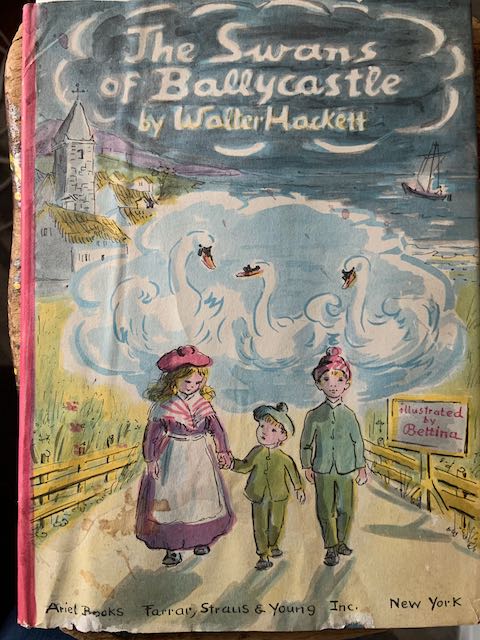
In the Irish seaside town of Ballycastle, the people still tell the story of the three wandering swans…

Thus begins the original Swans of Ballycastle, and thus begins my tale.

The children and a single father are introduced: “Deirdre, the oldest was ten, Kevin was eight, and Michael was only five. Their father’s name was Brian and he kept a small shop in the center of Ballycastle. The three children and their father lived on the second floor over the shop. Their mother had died when Michael was very young. Brian, the father, raised the children as best he could.

The children were incredibly happy. They played make-believe games in the shop or wandered to the beach and built sandcastles. They were happy. They were content. Life was good.

One day, their father journeyed to Belfast to buy goods for the store. “In his absence, Widow MacConnell ran the shop and looked after the children. Not that she had much to do on that score, for Deirdre, as usual, took care of her younger brothers. She cooked, served the meals, swept and dusted and saw that her brothers went to bed on time.

Brian was gone a long time.

One morning the children rose and went downstairs. In the kitchen they found their father. With him was a strange woman.

[Here the Sally-version takes over]

She was short and round. Her hair was white and curly, like the caps on the waves. She wasn’t old, but she wasn’t exactly young either. Her dress was ocean blue, billowy and soft. Her smile, when she saw the children, grew and grew. It was warm and welcoming.

Deirdre wanted to run to her immediately for a hug, but something stopped her. She didn’t know this woman and she was her brothers’ protector. Instead she looked to her father.

He took another sip of his coffee, stood, and said, “Deirdre, Kevin, Michael — This is your new mother.”

He opened wide his arms and the children ran to him. While they were gathered in their family hug, he reached his arm out to the new woman and pulled her into the embrace. Deirdre thought she smelled like the sea breeze and welcomed her closeness.

Her name was Cordelia, but she insisted that the children call her Corrie. “I would never dare to presume that I could replace your mother,” she said, “but I promise to love you as best I can.”

Corrie’s favorite thing to do was walk on the beach. Every morning, she led the little entourage to sandy shore. Michael held her hand now, instead of Deirdre’s when they walked.

Kevin and Deirdre found that Corrie had a wealth of wisdom about the sea and the shells and the birds and the fish. They would run ahead when the beach was in view and begin their hunts.

“What’s this?” they would ask, bringing her a shell. She always knew the name and a story about the creature that lived inside.

One day Deirdre found a golden coin stamped with the picture of a swan. “Look, Corrie,” she said, extending her open hand to her with the coin on it.

A shadow crossed Corrie’s face. “Throw that away,” she said sharply, “as far as you can into the sea.”

Deirdre pretended to throw it, but she folded her thumb over the coin while she made the throwing motion, then stealthily slipped it into her pocket.


Okay — this new story is going to take more than one day’s work. Tune in next Tuesday, for part Two.

books

12 months to read 12 books

In a recent brief foray into Facebook, I happened to see this challenge: read twelve books in twelve months recommended by twelve friends.

Easy-peasy, right? Except I read very little fiction these days. I look at my current pile of books. I’m rereading Pascal’s Pensees. I’m starting over on Art & Fear by David Bayles and Ted Orland, a book I started years ago and never finished. Then I have unfinished books by John O’Donohue and Brian Doyle that I want to tackle. Again. I’m mostly stuck slowly reading thought-provoking books.

12 books in 12 months? I saw that and thought, Pshaw. Literally. That’s what I thought.

Except there’s this. In the post-election numbness, I stumbled across a years-old recommendation from a friend to read a young adult book. (Nevermoor: The Trials of Morrigan Crow recommended by my friend Leah) I zippity-doo-dah-ed through that book and was glad I had.

The truth is I LOVE children’s books, early chapter books, and young adult books. 12 children’s books? Yes, that I could do.

So my question for you is, do you have a book you remember reading as a child that you loved? Or a book you recently read to your child or grandchild that you thought was amazing or even just worthwhile?

I’ll take the first twelve that I haven’t yet read and make a list for 2025.

Uncategorized

The Last Page

Here’s an author’s perspective: We work REALLY hard to tell a story in a certain way–we edit and re-edit and agonize over what parts to tell in what order, because the *way* the story unfolds is integral to the story itself. And the ending–specifically the surprise of the ending–was, for me, the thing I literally worked toward for ten years. It’s like tasting one ingredient of a cake before it’s been mixed with everything else and allowed to cook. If the author wanted you to have that last page information at the beginning of the book, he or she would have set it up that way and told the story as a flashback. Last page readers: I beg you all to cease and desist. Repent, ye!

Andrew Peterson, part of a Facebook thread on reading the last page of a book while in the middle of a book

Dear Andrew,

You’ll be pleased to know that I have repented.

Your reader,
Sally

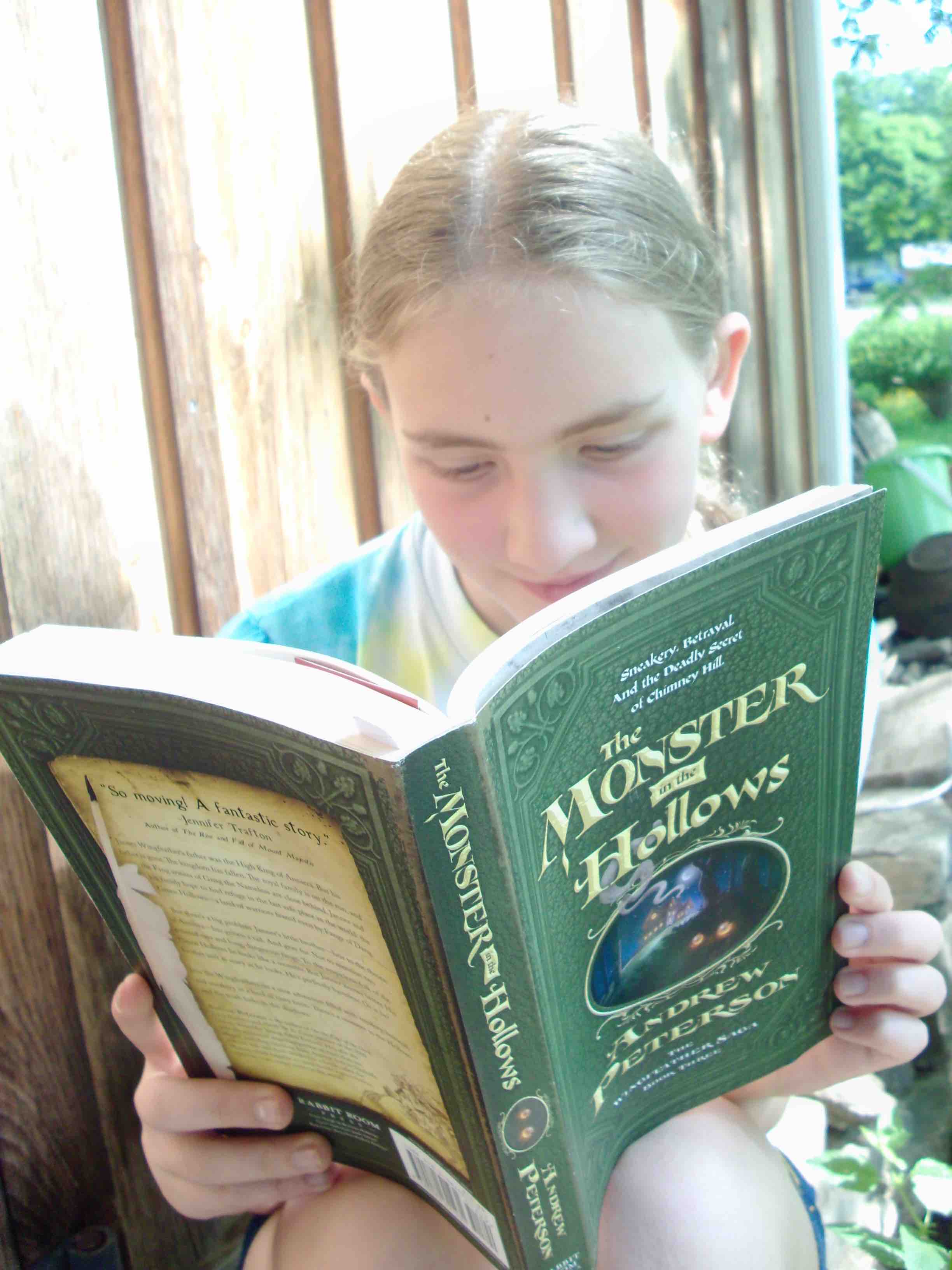
Mary reading one of Andrew’s books (2016)

It hit me the other day as I refreshed my favorite news site yet again, that my news-junky-ism and my back-of- the-book reading are symptoms of the same problem — a lack of faith in the author or The Author, as the case may be.

This morning as I was praying over the big things happening these days — things over which I have NO control — I was so convicted. 

Do you trust me? God whispered. 

“Yes, God,” I said. “I trust You.”

Wait patiently, He said.

I refreshed the news site a few more times while I waited.

Sally, do you trust me?, He whispered again.

“Yes, God,” I said. “You know that I trust You.”

Wait joyfully, He said.

I tried to focus on happy things while I waited… but the news on the screen caught my eye and my hand wandered over to keyboard so I could hit refresh.

Sally, do you believe me, He whispered a third time, not believe IN Me, but believe ME?

And I was grieved — not at Him, but at myself — because He had to ask me a third time.

I searched my heart before I answered. “Lord, I’m trying,” I said. “It’s just that I NEED to know what’s going to happen. What’s going to happen on January 6? What will happen on January 20? When will COVID be behind us? Just let me know a couple of pages out — I don’t need to see the last page.”

Hush, He said. Live today. Live it well. Tomorrow will be here soon enough.

I’m pretty sure He also added, And stop reading the last page when you’re in the middle of a book.


Life

The Little Free Library

For Mother’s Day 2019, my husband built a Little Free Library for me and set it up across the street. (If you aren’t familiar with Little Free Libraries, they are free book exchanges.)

Choosing a book from the Little Free Library

Yesterday, my husband and I were in the living room when a car pulled up across the street. A young couple got out and went to the Little Free Library. They spent a looooooong time there.

I should back up and say that my Little Free Library has a romance novel problem. A group of locals uses my library as their exchange place — and those fat well-worn romance novels take up too much space. I limit the romance novels to one half of one shelf which means that I must regularly remove some just so I have room for other books.

Back to the couple at the library — I really wasn’t staring at them the whole time, but would occasionally check to see if they were still there.

I saw her take a romance novel. I whispered a little thank you.

He took books off the shelf, leafed through them, and put them back.

Over.

And over.

Finally he selected a book — a history of the Boston Red Sox that had been there a while..

The two walked to their car and I thought they were done, but then I saw them walking back with different books in their hands.

She marched over and placed a new romance novel in the right spot. I sighed.

He paused between the car and library. He held his book out and looking at it. I watched him pull it close to his chest in a tender embrace, then lift it to his lips and kiss the cover before placing it in the library.

(As I was telling Mary this story, she said, “Ewww…… COVID.” Yes, I suppose, but there’s hand-sanitizer in the library and I can wipe down his book.)

At this point, I imagine you are as intrigued as I was. What was the book?

I do know the answer.

But I’m not going to tell you.

Instead, I’ll leave you with the question I’ve been thinking about for days — what book would I kiss before giving it away to an unknown person? What book would you?

A to Z Blogging Challenge · About My Dad

L is for Library Book Sale

We have at least 3 copies of Grandfather Stories by Samuel Hopkins Adams — thanks to the library book sale.

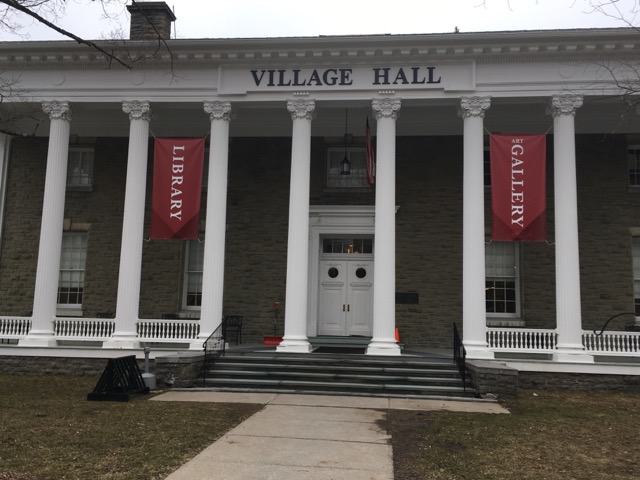
For years and years, the Cooperstown Village Library has held their annual book sale over 4th of July weekend. Their large porch would be filled with tables covered with books, with boxes of books waiting underneath. That abundance of books overflowed onto the lawn where tents were erected under which stood more tables of books. The tents overflowed into a few boxes by the sidewalk labeled “Free.”

I love the library book sale. I still go every year, even though it’s now much smaller. I haven’t taken my father the past few years, partly because of mobility. The sale has been moved to the side of the building and is all in tents. By losing the sprawl and setting it on a slope, it’s harder to navigate with a walker.

We used to make it an annual thing though — the two of us waiting for the sale to open so we could be among the first to find the treasures there. I can think of few things more fun than poking around in piles and boxes of old books.

A few months ago, he was looking at all the bookshelves in the back room. “Where did all these books come from?” he asked.

“You bought them,” I said.

“I did?” He seemed surprised. “Well, I have good taste,” he said.

He tended to head toward the history section to find books on the Civil War, and then to the sports sections to find books on baseball.

Local history was always of interest to him. One year, I found a copy of an older book about the Loomis Gang, an outlaw gang in central New York, and showed it to him. He rejoiced, like I had just handed him a winning lottery ticket. Another year I found an obscure Walter Edmonds book that made him happy.

One year, he found a 1896 book called Max and Maurice: A Juvenile History in Seven Tricks by William Busch. Max and Maurice were the first names of my grandfather and his identical twin brother. Fortunately, the book was not about them. The story, all in rhyme, told of two boys who played horrible pranks on the people in their small town. In the end, they were ground up in a grist mill and eaten by ducks.

A gory story — but not a Gorey story. My brother buys those.

It’s not the same going to the library book sale without my father, but the books we already own are more than enough to keep him occupied.

In recent years he has read Mutiny on the Bounty by Charles Nordhoff and James Norman Hall at least three times, and probably from three different copies of the book, all thanks to the library book sale.

When he would find a favorite book, I watched him show it to the people around him. When none of them would take it, he would go ahead and buy it himself. I’m pretty sure he bought back some of his own donated books.

He couldn’t leave an old friend on the table.


Faith

First Sunday of Advent 2017

I peeked at the first page of The New Christian Year (compiled by Charles Williams) one last time before putting it on the shelf.

My well-worn copy is even more well-worn now that I’ve been through the book several times. The New Christian Year isn’t so new anymore. My copy is from 1941 — and it was written in but not falling apart when I got it. I picked it up at a used bookstore, not knowing what a dear friend it would become. It’s falling apart now, like a Velveteen Rabbit of books.

Charles Williams introduced me to so many Christian thinkers — St. Augustine, John Donne, Lancelot Andrewes, William Law, and Blaise Pascal to name a few.  The New Christian Year helped me fill my bookshelves with deep, rich books.

But, when I read Brueggemann’s Sabbath as Resistance earlier this year, I knew I was reading a modern author who would challenge me to change my life and deepen my faith. I ordered Gift and Task as soon as I finished the Sabbath book.

When it arrived, I set it aside. I would have to wait for Advent, the start of the Christian year.

My brand new copy of Walter Brueggemann’s Gift and Task beckoned me this morning.

All those pages so new and clean.

Oh — to write in the margins!

Brueggemann starts the Christian year not with light and hope, but with a roar.

…Advent is “in like a lion,” a roaring truthfulness that disrupts our every illusion…

…Christmas is not a safe, private, or even familial enterprise but is preoccupied with great public issues of war and peace and issues of economic justice that concern the worth and bodily well-being of human persons. Our Advent preparation may invite us to consider the ways in which we ourselves are complicit in the deep inhumanity of our current world.

Not what I was expecting at all.

Indeed, for me, Advent roared in like a lion, but Brueggemann concluded today with these words –

The lion opens space for the Lamb, who will arrive soon.

I hope I’m ready for this new Christian year.


family

Mentor

A Facebook friend has been asking a “Question of the Day.” Yesterday, he asked this:

Who is your “I’ve never met you and likely never will” mentor?

I realize more and more how much of a mentor my mother was for me. She was, above all the other things, a caregiver. Obviously I’ve met her, though. I just didn’t appreciate her enough in that role.

The thing is — a caregiver’s mentor is never going to be in any spotlight.

She’s going to be home, quietly doing mundane tasks.

She’ll find her strength and solace in an abiding relationship with God.

She’ll be able to count on one hand her closest friends, but will still have a wider circle of loved ones, people she cares deeply about and who care deeply about her.

However, most people won’t even be aware of half of what she does.

*****

The other day, at Cooperstown’s Antiquarian Book Fair, I found a treasure that comes close to finding my mentor.

I found a Book of Common Prayer with a name imprinted on the front: Rachel Ware Fuller.

Inside, the inscription told me that the book had been a gift from her son.

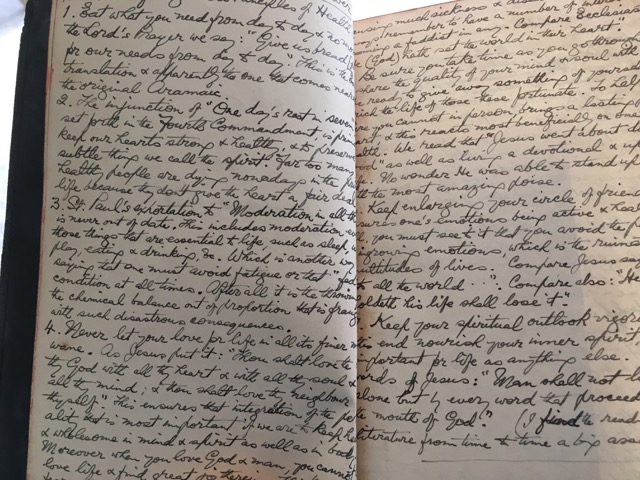
And then, there were pages and pages of handwritten notes.

I thought I had found the treasure I’ve been searching — a mother’s spiritual summation, all the things she has learned through parenting and wifing and friending and living. This would have been the mentor I never met and never will.

However, further inspection showed the notes to be from a Samuel Clark Harbinson, an Episcopal rector at a New England church. I’m not sure how the book was transferred from Rachel Fuller to him, but it was. Another inscription revealed that.

His notes are fascinating. And challenging. And thought-provoking.

Someday though, I hope to find a well-worn book with the margins and flyleaves full of notes written by a caregiver. I want it to have a coffee spill on a page or two, and ink smeared by tears on many pages.

And notes. Lots of notes.

I’ve already started accumulating a collection of other people’s journals and some religious books with notes in the margins.

But I’ll keep looking, at book sales, and in book boxes, for this Holy Grail of books.

That’s where I’ll find my mentor.

Stewart

Vultures (and a boxful of Buechner)

I’ll admit that I felt a little vulture-ish, looking through my brother’s belongings, and, in the course of deciding where things should go, choosing a few things to keep for myself.

The good thing is that my family is really not about material possessions.

Q: What did one vulture say to the other vulture?

A: I’ve got a bone to pick with you.

That (^) never happened, not even once.

We sorted through piles and piles and piles of papers. We sorted through boxes and boxes of stuff. I know stuff is a terribly nondescript word, but it is so apropos that I feel okay about using it.

Stuff includes notepads (see previous post) and office supplies, playing cards, games, craft supplies, photographs, and books.

One collection of odds-and-ends I put together was party supplies: crepe paper, balloons, plastic eggs, strings of styrofoam skulls, strings of ceramic chili peppers, a giant plastic sombrero serving dish, and smaller Cinco de Mayo serving accessories.

Two vultures were eating a dead clown. One asked the other, “Does this taste funny to you?”

I found a tin full of little plastic doo-dads.  I showed them to one of his friends, and she laughed. “I’d like to keep that if I could,” she said. “Those were all cupcake toppers from celebrations.”

Stuff also included artwork, mugs, dishes, canned foods, toiletries, and books.

A vulture tried to board an airplane lugging two dead raccoons but was stopped by the stewardess. “I’m sorry,” she said, “but airline regulations only allow one carrion per passenger.”

My sister found two framed pieces of art that she really liked and was able to pack them in her suitcase.  She called me later to tell me that she just realized that she had probably given Stewart those pictures years ago. “No wonder I liked them so much,” she said, laughing.

Other stuff included old computers, monitors that no longer worked, flash drives, cameras, CDs, DVDs, VHS tapes, a Kindle, and books.

Did I mention that Stewart had books?

Q: What’s the difference between a lawyer and a vulture?

A: A vulture has wings.

Quite honestly, Stewart was the antithesis of a vulture and a lawyer.  He did, however, have boxes and boxes of books. Several of them contained all his law books from when he was in law school. Is there a market for twenty year old law textbooks? I rather doubt it.

DSC00719It was in these boxes of books that I found my treasure, my keepsake from Stewart. I found a box full of Buechner. In fact, it held 15 books by Frederick Buechner, 6 books by Robert Farrar Capon, a Henri Nouwen book I didn’t own, and a book by Elie Wiesel. Jackpot.

Frederick Buechner is one of my new favorite authors. His thoughts are profound and full of grace. In fact, this quote of his, not about vultures, captures some of the most comforting words I have read since Stewart’s death.

“When you remember me, it means you have carried something of who I am with you, that I have left some mark of who I am on who you are. It means that you can summon me back to your mind even though countless years and miles may stand between us. It means that if we meet again, you will know me. It means that even after I die, you can still see my face and hear my voice and speak to me in your heart.”

When I look at this collection of Buechner on my bookshelf, I will remember my brother.

And I won’t feel like a vulture.