family

The Rest of the Story (or, An Ethical Question)

If you knew that one phone call to an influential person would elevate the level of care received in a health care setting, would you make that phone call?

I delved into that question yesterday when I met with someone on an unrelated matter. After taking care of some business, our conversation detoured into my father’s most recent emergency room experience.

“Call me next time,” he said, and handed me his card. “Keep this in your wallet and call me.”

“I won’t call you,” I told him.

My parents raised me to believe that everyone should be treated in the same way. Everyone deserves dignity. Everyone deserves good care. Everyone.

Yet, despite my saying otherwise in this man’s office, I had, the day before, been searching for his phone number while sitting at Hallway 6 with my father. It turned out the website wouldn’t load because it was down for maintenance.

As my sister would say, “It was a God thing.”

I was ready to throw my principles out the window for a little respect for my father. See how shallow I am?

But God, or happenstance, kept me from calling, and my principles remain mostly intact.

Because, in the midst of this search for someone who could get us out of the hallway situation, Roy the cheerful PCA came along.

Tell him a story,” he said.

The rest is history — castles in Bosnia and a hallway bed that became a place for storytelling.

Next time, would I make the phone call? I like to think not.

When I sit quietly with my ideals, everything is clear. I am confident in how I would act given a difficult situation.

But in the midst of a trial, idealism and nobleness vanish like smoke. I need safety measures and reminders in place. I need websites to malfunction.

I intentionally did not put that business card in my wallet. I don’t want to be tempted.

A different hallway bed I sat beside last year.
The call bell for the hallway bed last year. My father didn’t even receive this.


family · Life

Tell Me a Story

During our down time in Bosnia, Leah starting asking, “Tell me a story.”

It was so open-ended that I struggled with it.

I asked her if she got the idea for that from La La Land. Those words were the lead-in to my favorite song from the movie.

Leah assured me that, no, she had been asking that question for years. I’m pretty sure that La La Land got the idea from her.

So, sitting in the shade one day, she said, “Tell me a story.”

“I can’t,” I told her. “I need some parameters.”

“Okay. Tell me a story about when you were in grade school,” she said — and I did. I told her about a day in 3rd grade when I experienced agony and ecstasy, as best a 3rd grader can.

In short, our class had gotten back from a trip to the library. I had checked out Mark Twain’s “The Prince and the Pauper.” My teacher, Miss Bliss, held up the book (and me, figuratively) as an example of a student choosing good literature to read. Later in the day, I couldn’t find my math paper in my desk — I’ve been a messy for as long as I can remember — and she dumped the contents of my desk on the floor in the middle of the classroom. I can still remember that shame. Same day.

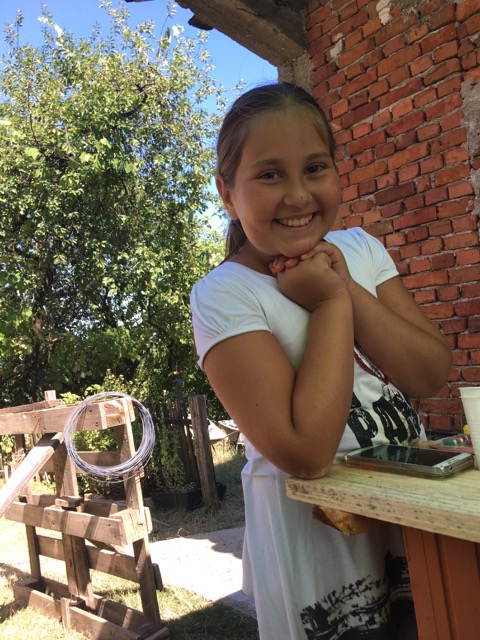
Later, Leah asked Mary to tell a story, and Mary launched into an imaginative story with dragons and little girls. Ajla, one of the Bosnian girls, listened wide-eyed and delighted.

“You are a great storyteller,” she told Mary, “in the lies.”

Ajla

Ajla’s English was excellent. Except when she didn’t know the right word.

Yesterday, I spent some time at the emergency room with my father.

As we waited and waited, I grew fidgety. An excellent PCA named Roy helped turn my attitude around.

Roy had stopped by my father’s hallway bed several times. He was always cheerful. On one of his check-ins, he looked at me and said, “Tell him a story.”

I was busily mentally drafting complaint letters and griping to my sister via text. I didn’t respond to Roy, so he repeated it.

“I’m talking to you,” he said. “Tell him a story.”

“I can’t,” I said. “I need some parameters.” It was a deja vu moment — and I was back in Bosnia.

“I’ll get you started,” Roy said. “‘Once upon a time in a castle far, far away…’”

I laughed, and took up the story.

“Dad, did I tell you about the castle where we stayed in Bosnia?”

“A castle?” he asked.

the castle

“A real castle,” I repeated, “from the Ottoman Empire.”

Telling him about the castle took our minds off the fact that we were waiting in the emergency room.

With Leah, it took our minds of the heat and lethargy of the day.

“Tell me a story.”

Those are magical words.


family

Mentor

A Facebook friend has been asking a “Question of the Day.” Yesterday, he asked this:

Who is your “I’ve never met you and likely never will” mentor?

I realize more and more how much of a mentor my mother was for me. She was, above all the other things, a caregiver. Obviously I’ve met her, though. I just didn’t appreciate her enough in that role.

The thing is — a caregiver’s mentor is never going to be in any spotlight.

She’s going to be home, quietly doing mundane tasks.

She’ll find her strength and solace in an abiding relationship with God.

She’ll be able to count on one hand her closest friends, but will still have a wider circle of loved ones, people she cares deeply about and who care deeply about her.

However, most people won’t even be aware of half of what she does.

*****

The other day, at Cooperstown’s Antiquarian Book Fair, I found a treasure that comes close to finding my mentor.

I found a Book of Common Prayer with a name imprinted on the front: Rachel Ware Fuller.

Inside, the inscription told me that the book had been a gift from her son.

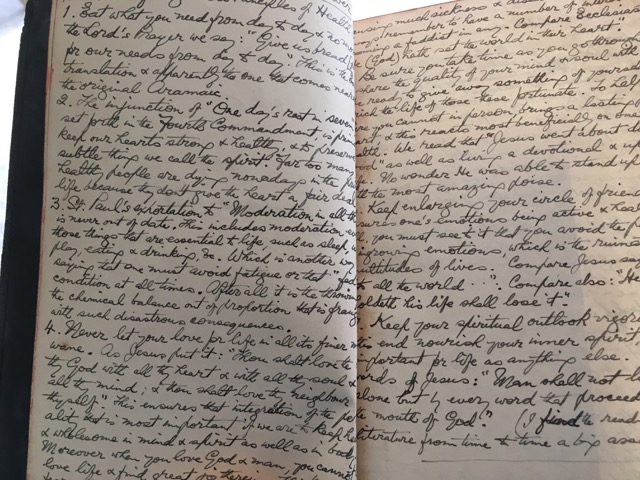
And then, there were pages and pages of handwritten notes.

I thought I had found the treasure I’ve been searching — a mother’s spiritual summation, all the things she has learned through parenting and wifing and friending and living. This would have been the mentor I never met and never will.

However, further inspection showed the notes to be from a Samuel Clark Harbinson, an Episcopal rector at a New England church. I’m not sure how the book was transferred from Rachel Fuller to him, but it was. Another inscription revealed that.

His notes are fascinating. And challenging. And thought-provoking.

Someday though, I hope to find a well-worn book with the margins and flyleaves full of notes written by a caregiver. I want it to have a coffee spill on a page or two, and ink smeared by tears on many pages.

And notes. Lots of notes.

I’ve already started accumulating a collection of other people’s journals and some religious books with notes in the margins.

But I’ll keep looking, at book sales, and in book boxes, for this Holy Grail of books.

That’s where I’ll find my mentor.

family · Life

Good-bye, Odyssey

Bud said that he woke up in the middle of the night wondering if it was the right decision.

I reminded him all the reasons why — the catalytic converter, the exhaust system, the timing belt, the short circuits in the electrical system.

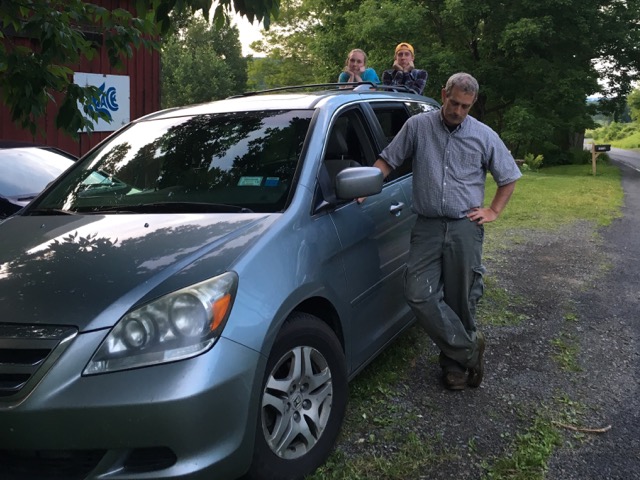
Still, our Honda Odyssey had taken us many miles — well over 200,000. Many trips to Florida, to South Carolina, to North Carolina, to Washington, DC, as well as the hundreds, maybe over a thousand trips between Cooperstown and Greene.

It’s almost as old as Laurel.

It has served us well.

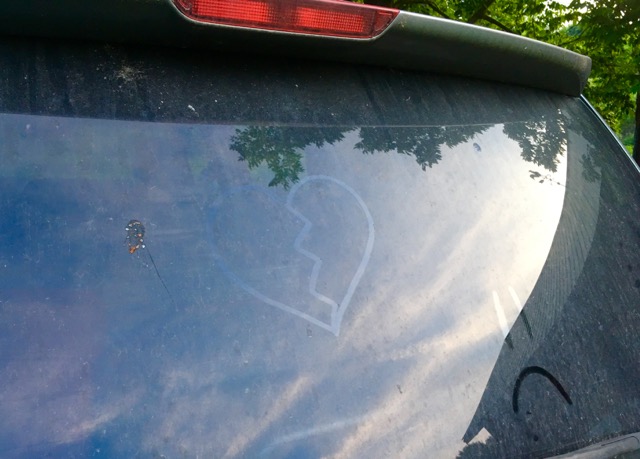
When Philip was a little boy and we traded in one of our cars, he drew sad faces in the dirt on the windows. Laurel did the same last night with the Odyssey. My bookend children think the same.

Sad face, broken heart, bird poop (right to left)

We’re trading in the Odyssey. It makes us sad.

Sad

We’re getting a new car. It makes us happy.

Happy

I told a friend that we get a new car every twelve years or so, whether we need one or not.

We need one.

It was the right decision.


elderly · family

Surgery

Each member of the surgical team looped through the room.  An introduction. Name and date of birth requested. The why-are-you-here question.

My mother didn’t know the answers when I had sat in the same spot with her some years before. I helped.

My father knew — for the most part.

“Did you have anything to eat this morning?” the anesthesiologist asked.

“Not too much,” he answered.

“He had nothing,” I said.

“Has the surgeon marked on you yet?” a nurse asked.

“No, I don’t think so,” he answered.

“Yes, he did,” I replied.

“Can you tell me about your other surgeries?” the surgeon asked.

“It’s been years and years,” my father answered.

“Last August he had a VP shunt put in, and a few years before that he got a pacemaker,” I answered.

He knew his name. He knew his birthday. He knew what the surgery was.

All in all, I’d say he did pretty well.

A few weeks ago, he had had an episode of chest pain that landed him in the Emergency Room. They ask a different set of questions.

“Are you still a full-code?” the nurse had asked, but then she looked to me for the answer. It’s an uncomfortable question.

“Well, I’m not ready to cash in yet!” my father answered.

“Would you like to be placed on life support?” she asked.

“I’m not going to live forever, you know,” he replied.

His mixed responses were confusing, but he and my mother had both very clearly written out their wishes many years ago. I told his doctor and she asked that I bring in a copy to put in his chart. Just so it’s there.

Last night, I went for a walk. The fields were fifty shades of green. The timothy alone was a full palette of color — spring green, grass green, grey green, a whispery pale green at the very edges of the flower-head.

The fields whispered with the breeze, carrying along its little breaths like a melody passed around an orchestra. The meadow swayed and danced, and the only audience for this performance was the deer, the red-wing blackbirds, and me.

When the Bible talks about grass, it’s usually in reference to transience.

“The grass withers, the flower fades…” (Isaiah 40:8)

The comparison isn’t that man will last forever. We are just as transient.

A surgery day is a time to remember that.

It’s a time to pause. Even if we’re not ready to cash in, it’s okay to remember that we aren’t going to live forever either.

*****

The surgery went well. He’s already home. He’s not ready to cash in yet — and neither am I.

family · Life · photography · Travel

Red-Winged Blackbird

The red-winged blackbirds begin check-check-check-ing at me as I walk down the road.

With dog, without the dog — it doesn’t matter. I’m a threat and they need to let the world, or, at the very least, their fellow blackbirds know that danger approaches.

They sit on fenceposts, telephone wires, tree branches, cattails, and other tall weeds.

Red-winged blackbird speck

I have stopped on multiple occasions to try to snap pictures of them. I either end up with a tiny speck of a bird or empty wires, branches, etc.

They flee from the fenceposts when I stop walking. I can’t focus on taking a picture while walking. My phone is my camera, nothing fancy for zooming in. Walking pictures are a mess.

Frankly, I’ve given up on photographing them.

For me, the red-winged blackbirds must be enjoyed from a distance or in my periphery. As abundant as they are, they are also too elusive for me to photograph well.

Sometimes life is like that, don’t you think? It simply can’t be tackled head-on. We can’t stop and savor each little thing, but we can enjoy the brief moments as they pass.

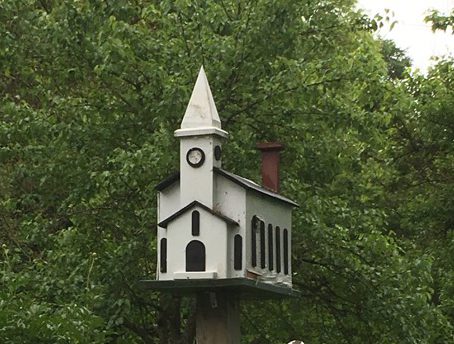
Now the birds that have taken up residence in our birdhouse tease me in the same way. One tiny nondescript bird sits on the chimney of birdhouse, singing merrily, until I get out my phone/camera. I look to find the camera icon on my screen, look back up, and she’s gone. Either both birds in the pair are blasé brown, or I haven’t seen the mister.

Elusive

I need to improve my mental camera when I see them or my memory of their song or create some other method if I ever hope to identify these occupants.

Or, maybe I need to stop worrying about it and enjoy the moment.

Does everything have to have a name? Does everything have to be captured and held?

In our instant electronic gadgety techno age, we’ve lost the looking-out-of-windows and being-in-the-moment.

Sometimes I wonder if children riding in the car down the east coast of the United States even see the Pedro billboards. Or, in rural Nebraska or Iowa, if they see the monotony of corn fields. Or is that when they’re busy watching Frozen for the umpteenth time?

Because if they miss Pedro and the corn, they’ll most certainly miss the many red-winged blackbirds check-check-check-ing from the fencepost.

family · poetry

The Angels Were Angry

And the angels were angry
At the crispness of the cake
“HOW DARE YOU,” they bellowed,
“MAKE SUCH A MISTAKE?!”

They brandished flaming swords
To bar me from my kitchen —
I felt like such a failure;
I knew they were itchin’

To use their blazing rapiers
Against the likes of me
Because I multitasked disaster
Where disaster oughtn’t be

Oh, the angels were furious
While smoke rose from the range
So I pondered how to soothe them
Then I spotted something strange —

A hero in a paper bag!
He boldly stood between
Me and my catastrophe
Better sight ne’er seen

“Begone!” I think he shouted —
Or maybe it was “Gwam!”
giggle-giggle “Wook! Wook!
Here I am!”

So the knight-in-paper-bag
Took my mind off of burnt cake
And I played with little Henry
Before I cleaned up my mistake.

family

My Mother’s Closet

My mother’s  closet has only been hers.

When my parents bought this old farmhouse 50 years ago, it had one closet — a tiny one, at that.

While we kids put up a rope swing, my father put in closets.

Putting up the rope swing
Swinging
putting in closets

Bi-fold doors must have been in then, because that’s what he installed — in his closet, my mother’s closet, my sister’s closet, and my oldest brother’s closet. The rest of us didn’t get closets; we had cardboard wardrobes.

I stood outside my mother’s closet the other day, hesitating to open the door. It has to be done — the cleaning of it, I mean. She’s been gone over a year and a half. My son is staying in that room. And he sure could use a closet.

But I stood there, not wanting to look again at what’s inside.

The brown wool plaid skirt. The green skirt with Greek meander border. The dress she wore at my wedding.

The ruffled blouses that she wore to dress up.

The sweaters.

The housecoats, even.

They’re housecoats, for crying out loud.

But I can picture her standing in the kitchen wearing them, making our lunches for school.

A woman I know lost her house in a fire recently.

Is that how you want to deal with your mother’s things? a voice whispered in my heart. I knew it wasn’t God, because He didn’t burn my friend’s house down. He doesn’t threaten to burn houses down. I saw, however, in my mind’s eye, my fingers being forcibly pried off the things I’m holding onto.

Is that how I want to deal with my mother’s things? No. Absolutely not.

But they must be dealt with.

Garbage? No. That’s wasteful. My mother was never wasteful.

A yard sale? No — I don’t think I could bear watching people paw through her things.

Donate to the church’s rummage sale? No — same reason.

I think I need to box it all up and take it to a donation point in another city. She would want some good to come of it all.

Then, I’ll have to look at an empty closet.

And mourn a little, allowing the closet’s history to move just a wee bit distant into the past.

Before my son moves his stuff in and the closet has its second occupant.


elderly · family · friendship · Leaning In

The Gift of Giving

About a month ago, I received a curious piece of mail.

When I opened the envelope, I found a folded-up piece of yellow construction paper. In red marker, the sender, Juliette, a little girl from our church in Greene, had drawn a heart, an elephant, a waterfall, and some flowers covered in dirt. (Her grandmother wrote explanations for me.) 

It also included a dandelion. I actually love dandelions. I loved when my own children were of the age of bringing me dandelion bouquets.

That letter made my day. It was so fun to receive something so unexpected. I knew I needed to respond, but, in the craziness of getting ready for France, I didn’t do it until the other day.

I made a card for Juliette. 

The rabbits were just a little too big to fit neatly on my card, so one rabbit’s ear and tail fold around onto the back. I guess you could say its back side is on the back side.

I asked her grandmother for Juliette’s address. She texted the address back and added, “She is fascinated right now with giving everyone the pictures she makes.”


Juliette is learning at a young age that giving is its own gift.

***

Last night at the dinner table, as my father repeatedly repeated himself, I found myself wondering at the wisdom of bringing my children here to live with him.

It can be frustrating and even, sometimes, a little irritating to listen to the same comments about the blueness of the skies and the greenness of the plants.

I’ve heard Mary patiently explain how to operate the remote control to the television and sometimes resort the explanation of “magic” when asked how she found the right channel. The other night I heard Karl trying to explain the remote control. Again.

My youngest children have to live in a house with rooms still full of items from previous occupants. My parents’ house became a repository for so many things from other family members that it’s hard to find space for its current residents.

I wonder repeatedly, is this good for them? Is it good for our family to be a little fractured for the sake of the eldest member? Is it good to stretch between two homes, and in so doing, to almost have no home? Is it good to see their grandfather needy and weak and forgetful?

But I remember my mother caring for her mother and mother-in-law. With patience, sacrifice, and great love, she did for them what they could no longer do for themselves.

I suppose I’m following in her footsteps.

It’s a different kind of giving from sending a sweet greeting in the mail.

Sometimes this kind of giving seems like a terrible gift, but I need to remember that it is a gift nonetheless.

I need to lean in. Embrace each moment. These gifts are good.