“Here’s the things that you should do. Doing them is up to you. Don’t do too much or too little. It’s all spelled out — jot and tittle. I’ve done my job. Now you do yours. You’ll find there are no magic cures. Good luck. Work hard. I’ll see you soon,” With that, the surgeon left the room. Empowerment.
This week’s W3 prompt comes on the heels of my total hip replacement. Here’s what POW Dennis Johnstone challenged us to do. He called it “Let the noun wait.”
This week’s prompt invites you to write toward something, rather than starting from it. You’ll be building pressure, rhythm, and meaning without naming your subject until the final line.
Step 1: Choose an abstract noun
Pick a single abstract noun that carries weight, mystery, or tension for you—something like liberty, danger, truth, love, exile, justice, forgiveness, joy, grief, silence…
Don’t use it until your poem’s final line.
Step 2: Delay the subject
Start each line with a description or action that leads us toward the noun, not from it. This is called left-branching syntax—it means delaying the main subject or verb.
You’re working with delay, accumulation, and unfolding. The noun you’ve chosen arrives only at the end. Until then, build around it, toward it, beneath it. Let readers feel its shape before they hear its name.
Ten things for which I have been thankful over this past week:
New Year’s Eve games — If you didn’t get to play games with 5 year old New Year’s Eve, you missed out. We played Magnetic, which involved magnets and strategy, Hurry Up Chicken Butt, which is like Hot Potato with a twist, and The Sneaky, Snacky Squirrel, which had game pieces shaped like acorns. Betcha I had more fun than the people who got rained on in Times Square.
Morning Reading — Here’s a quote from Art and Fear, By David Bayles — “…becoming an artist consists of learning to accept yourself, which makes your work personal, and in following your voice, which makes your work distinctive.”
Best comment/conversation on my blog — with Kristin (Finding Eliza) following my Unicorn Challenge story “The Big House” — Kristin: Did he get away with it? If so, then what? Me: Ah, but that is the fun of a 250 word limit. Your imagination has to take over now. Kristin: Grandad and grandson go on to become the robin hood jewel thieves of whatever country they’re in. Stealing from the wealthy and starting a string of food pantries and soup kitchens for the down and out. Eventually they expand and buy big houses to house the homeless. The well known ballad “They did it for us” was based on them.
New word learned: whinge. Whinge definition: British: to complain fretfully : whine (Thank you, CEAyr. I will TRY to stop whinging.)
It hit me when I saw them play That fuzzy tumbling adorable ballet Of baby animals. I was smitten But — they’re just a kittens!
Okay — not kittens. Tiny webbed feet Downy feathers, little bills, complete The picture — Gosh! I’m smitten! They COULD be a kittens
Actually, I could call them a litter But they’re a brood, all a-skitter In the lake. I’m smitten But no — not kittens!
These ducklings make me laugh and smile No agenda. No politics. No guile. Just joyful play. I was as smitten As if they were kittens.
I’ve been swimming in the lake. Of course, I can’t take pictures of the ducklings while I’m swimming, but sometimes when I see them, all I think is that they’re just like kittens — except they don’t have fur and claws and whiskers. Instead they have fuzzy feathers, webbed feet and bills. Other than that they’re pretty much exactly the same.
This is in response to David’s W3 prompt to write a poem about something that amuses you. Ducklings amuse me. So do kittens.
“Please select Me!” She wanted to direct The gardener as he scanned, Hand
Already Full of flowers, gaze steady. He looked for one final bloom. Gloom
Just settled Over her. Her gold petaled Head drooped in an oh-so-sad Bad
Way. Downcast, Rejected, again outcast, Passed over. But then he stopped Dropped
His pruner “I wish I’d seen you sooner,” He said to her. “You are sweet! Meet
Your sidekicks.” [snip!] She joined the spray, transfixed By the beauty around her. “We’re
Delighted You can join us!” She sighted A welcoming rose and mum. “Come!”
This is for the W3 challenge this week. Heather (Sgeoil) challenged the participants to do a little personification. I had an idea for a flower being plucked from the garden for a bouquet (inspired in part by the bouquet that was on my bedside table when I stayed at my son’s house). My idea involved going in that sacrificial direction of losing life for the sake of something bigger. But, as you can see, it went in a totally different direction.
I wish I understood my own process.
AND — because I like Celtic forms, I went with a Deibide Baise Fri Toin, and Irish form with aabb rhyme scheme and syllable count of 3-7-7-1 for each stanza. The first two lines rhyme on a 2 syllable word and the last two lines rhyme on one syllable.
I remember at Hutchmoot, in one of those first years, a musician/artist talked about his therapist and then said, “Everyone needs a therapist.” There was a smattering of laughter, so he said, “I really mean it. It’s one of the best things I ever did.”
Once, when someone told me they had started therapy, I asked, “What’s it like?”
“It’s like having a paid friend. One that you can say anything to,” was the response.
That’s a pretty apt description.
My therapist’s name is Rachel.
I apologize a lot to her. “I’m sorry that I blather so much,” I say.
“It’s okay,” she replies.
“I forgot where I was going with this,” I say. “I ramble too much, don’t I?”
“Tell me more,” she replies.
One day, she said, “What would you say to young Sally?”
I stopped blathering and rambling and tried to think. Later that evening, I wrote a poem — and promptly forgot about it. That’s how I am these days — scattered and forgetful.
But each morning, I get up and try again. I begin the day with reading. It’s funny how the themes circle around. The same thoughts emerge from vastly different places.
I began the year pondering a quote by Howard Thurman:
I see you where you are, striving and struggling, and in the light of the highest possibility of personality, I deal with you there.
This morning, I read this in J. Phillip Newell’s Christ of the Celts:
“Alexander Scott, the nineteenth century Celtic teacher, uses the analogy of a plant suffering from blight. If such a plant were shown to botanists, even if the botanists had never seen that type of plant before, they would define it in terms of its essential life features. They would identify the plant with reference to its healthy properties of height and color and scent. They would not define it in terms of its blight. Rather they would say that the blight is foreign to the plant, that it is attacking the plant.”
I am so blighted. So very blighted.
Who am I in the light of the highest possibility of my personality? Who am I in my healthiest sense of my existence?
I went back and re-read that poem I wrote.
What would I say to young Sally? I would tell her that she is seen — and that even the blights can shape us.
Here’s my poem. Sorry for my blathering. I forgot where I was going with this.
I see you. I see the dreams you’ve set aside Over and over For better dreams No — for better realities
Because who could have imagined You would be happy spending So many years of Reading Aloud
And singing silly songs Not just With Larry But with Philipowensamhelenjacobkarlmary (I don’t think Laurel liked to sing Or read, for that matter)
Of listening And probing For children’s dreams So they might become the realities That I missed
Once upon a time I wanted to be a veterinarian Because dogs and horses Were so much safer Than people
Then I wanted to make music -al instruments Because everyone knows You can’t make a living making music
And linguistics – To study languages And understand their structures “Anatomy of Language” Sounds fascinating to me
But is that even a class? Human anatomy is a much easier Class to find And I would have taken it In my last dream of being A physical therapist
But I married And became a mom
Yes, I see that young woman Who couldn’t stand on her own And didn’t have someone to say, Follow Pursue Be
Instead I had someone who said, “Come.”
And I went
I see you, and the dreams you’ve set aside I see the rich reality you’ve lived I see it all and, yes, I feel some pride — For what is Christ but to give and give
I’m beginning to anticipate
What his response might be —
My mother blamed “the others”
For things we didn’t see,
But my father’s not a blamer
So, when he can’t explain
“It fell down from the sky,” he says,
Like some mysterious rain.
I crawled around the other day
With flashlight in my hand.
Half his hearing aid was missing
And I tried to understand
How these darn things fall apart so much
Half in one room, half another
I would have blamed “the others”
Had I been my mother.
Then Laurel called me from the kitchen
“Wha-T?” I said, but I
Emphasized the “T” too much —
And I can tell you why —
I was getting irritated
At the time that it had cost
Looking for a hearing aid
Half of which was lost.
“Grampa wants you,” she said timidly
And so I went to see
What it was he wanted now
From irritated me
“I found it!” he was saying.
I was surprised at what I saw
The missing piece of hearing aid
Resting in his paw.
“Where’d you find it?” I demanded.
I knew I should happy
But, you know, I wanted answers
And he’d better make them snappy.
“Can you fix it?” he was asking —
Not answering my question
It’s a skill he has in conversation –
Changing the direction
But I was dogged — “Where’d you find it?”
“It fell out of the sky,”
He said, as if that answer
Would satisfy my cry.
He told me again yesterday
When I asked about a pin
He had fastened to his sweatshirt
And I asked where it had been —
Apparently the sky inside
Varies precipitation.
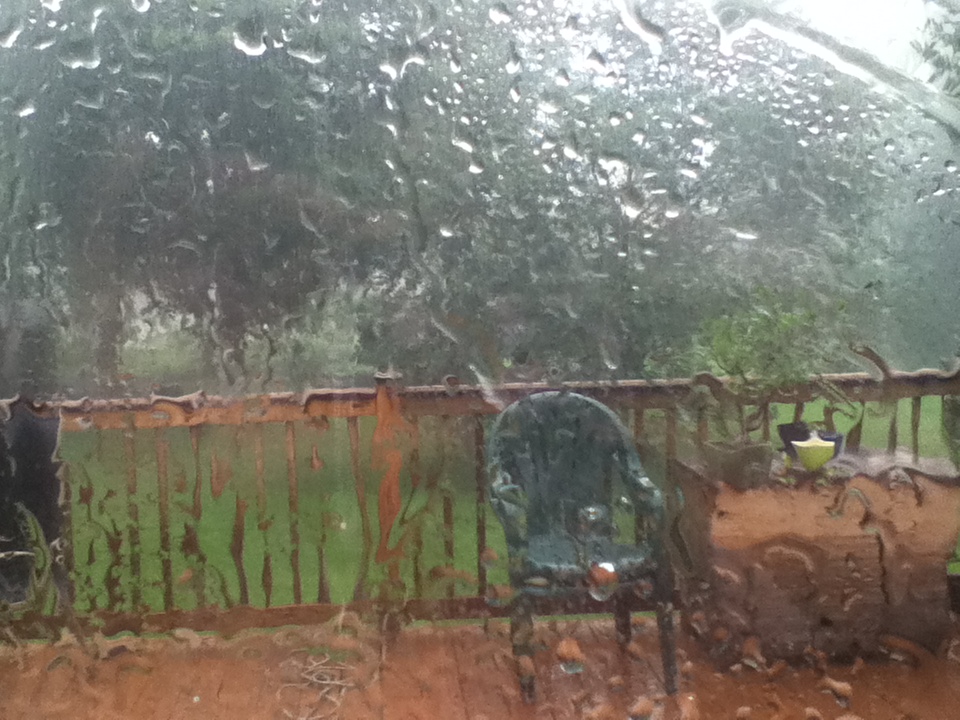
Outside I see it raining rain
Inside, to my frustration,
It yields an odd assortment
Of hearing aids and stuff
That I couldn’t have imagined.
I should be thankful; it’s enough —
The lost hearing aid was found
I’m not still crawling on the ground
Rain
For Peter:
Perhaps another explanation is that a wolverine
Creeps into the house at night, stealthily, unseen
And hides my father’s hearing aids
Tapes them to the ceiling
Whence they fall on Dad, while I am searching, kneeling.
A friend said, “Write a poem,” to help me start writing again.
So I pulled up a poem that had been sitting in my draft folder and tried to finish it. It’s not perfect but Brené Brown says that we should have the courage to be imperfect. With a little courage, I give you this —
“Tell me something good,” she said
“Please tell me something cheery.”
The corners of her mouth turned down;
Her eyes were slightly teary.
Teenage girling is the worst —
Well, that’s my working theory.
My mind returned to dark things thought
When I was still a teen
Of feeling that I just don’t fit
Of watching pretties preen
Of wishing I were different
Of people being mean
She said, “Tell me a good story —
A princess-dragon tale
With a female superhero
Who tries so hard and fails
Then with grit and perseverance
She finally prevails.”
I remembered watching her go out
And on our lawn just lie
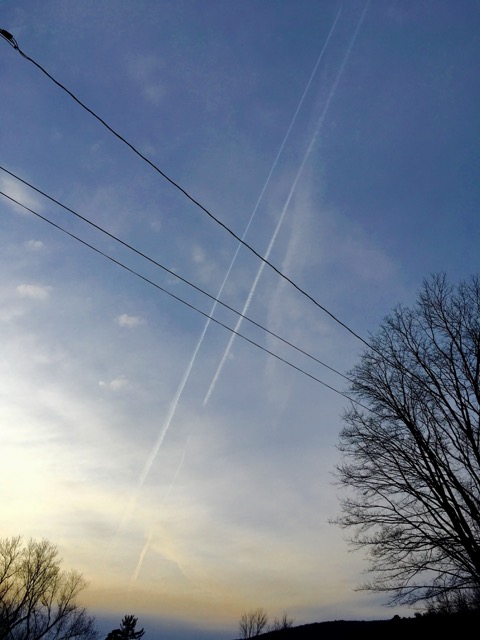
Watching jet trails drawing lines
Across a summer sky;
I imagined an adventure
Where she’s a secret spy
Who, by studying that one small thing —
The white smoke on the blue —
She deciphered secret messages
Most people wouldn’t view
Because they’re too busy doing stuff —
Do I do that? Do you?
The world is sometimes cold and cruel
And difficult to beat
But through stories we see bravery,
Learn ways we can defeat
The demon dogs who hound us
And the challenges we meet
“Tell me something good,” she said.
I thought, and then replied,
“Let’s look at something little —
Autumn leaves or dragonflies —
Let’s find the beauty, make a story.”
And so we walked outside.
“Oh, I see you’re a barefoot girl this morning,” my father said, looking at my feet.
I was indeed barefoot, as is often the case when I’m still in my pajamas.
“A barefoot girl with shoes on,” he continued, smiling as he said it.
My daughters are often barefoot in the summer — and he says the same thing to them.
A barefoot girl
“What’s he talking about?” one of them asked once.
“It’s a poem he memorized,” I told them.
I asked him about it — and he dutifully recited two verses:
‘Twas midnight on the ocean,
Not a streetcar was in sight,
The sun was shining brightly
For it had rained all night.
‘Twas a summer’s day in winter
The rain was snowing fast,
As a barefoot girl with shoes on,
Stood sitting on the grass.
More verses are available on the internet, all unattributed, but those are the two he remembers.
Poetry and music get stored in a different part of the brain, I think — one that survives longer unscathed by dementia. It’s fascinating to think about.
Yesterday, he said something about Laurel going to the skating rink when I was taking her to the pool. He pulls up the wrong word often.
I also had a tough time convincing him that R2D2 wasn’t a radar unit. He was working on a crossword puzzle. R2D2 was the clue and he needed a 5-letter word beginning with R.
“R2D2 is a robot, Dad,” I told him.
“Why doesn’t radar work?” he asked, in all seriousness.
“Because it’s a robot. Robot will work there,” I said.
He made his if-you-say-so face and went back to the crossword.
Maybe if I made up a poem about it and had him memorize it, he would remember.




 Hot Dogs and Marmalade