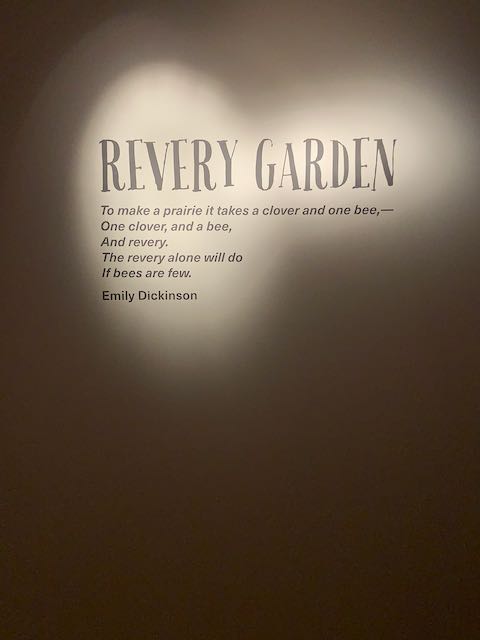
Find an Emily Dickinson poem – preferably one you’ve never previously read – and take out all the dashes and line breaks. Make it just one big block of prose. Now, rebreak the lines. Add words where you want. Take out some words. Make your own poem out of it!
When I saw Emily Dickinson’s Revery Garden on the wall at the Fenimore Art Museum, I want to give it a try. I added my own restriction of 23 words for the poem.
The following blather is brought to you by “Stream of Consciousness Saturday.” This is the day of the week I give myself permission to write more than 23 words.
Last Saturday, I promised a reverse poem (one that can be read top-to-bottom or bottom-to-top). Good golly, I stared at my scribbles too long. And then, came up with a reverse poem that’s too short and a little awkward. But, oh well. Here you go:
History is boring Some people actually think that All those dates and foreign-sounding names matter And eccentric people worm their way into Those stories where the world changes I find history fascinating
Meh — not the best, but I’m going to check the “Done” box and move on.
I spent a few hours yesterday in the research library.
I wrote a post called The Negative Split not too long ago. I think I research in negative-split mode.
I got to the library a few minutes after my scheduled appointment. (Yes, we have to schedule appointments at the research library now. And wear masks.)
I had given myself two hours. For the first 45 minutes or so, I leafed through photographs, not really finding anything I wanted. Or maybe I did. A few new names, therefore a few new rabbit trails. (Side-question for you: What could the nickname “Dell” be short for, for a man in the late 1800s or early 1900s?)
The librarian left to find a few more boxes for me. I feel a little bad. She’s new on the job, and I kept saying Joe (the former librarian) did this or brought me that. Comparison to a predecessor has to be the worst.
Anyway, she brought me some boxes that Joe had never brought me. Suddenly I was lost in old correspondence and organizational reports. I looked at the clock and saw that I had been there well over my two hours.
“Let me just look at one more thing,” I said to the librarian. I was in my groove — researching faster and stronger than I had been at the beginning.
“Do you think you have a photograph of this?” I asked her about a specific place in town. She started hunting.
I kept reading.
And searching.
And wishing time would just stop long enough that I could pursue these many lines of inquiry.
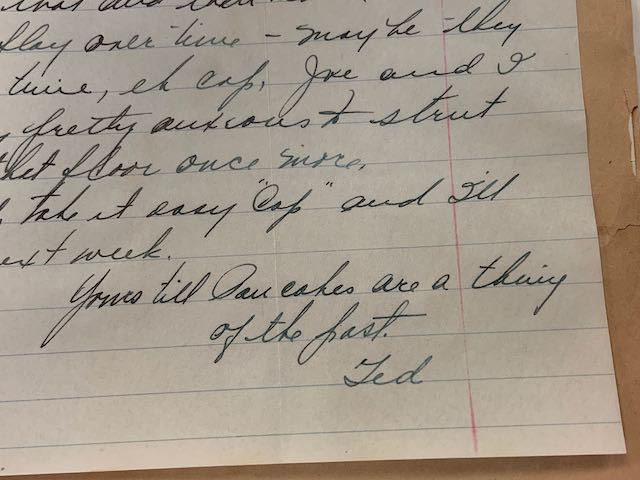
I snapped a photo of a bit of correspondence because it had made me laugh out loud in the quiet of the library.
“Yours till Pancakes are a thing of the past.”
I could have spent the next three weeks looking for the pancake story that inspired that closing sentiment, but I’ll almost bet it’s an inside joke between two men that I will never know. Plus, it was way past time for me to go.
But if I had those three weeks to spend, who knows what other little stories I would have uncovered?
A guy asked me this at the front desk the other morning. I’m not exactly sure what he had heard about me or where. I hesitated.
“Umm… I’ve done some writing,” I said.
“Do you have a blog? Do you have followers?” he asked.
Is that what makes a person a writer? A blog? Followers?
“I used to write every day,” I told him, “but once I dropped the habit, it was really hard to pick it back up.”
Is that true, or what? I don’t care what the habit is, but once you give yourself permission to break it, it’s all downhill.
Every diet I have ever tried has fallen prey to just-this-once permission.
Habits.
“I have a plan for writing next year,” I told the man. “I’m going to write 23 words every day.”
He looked at me like I had just said I was going to hop on one foot barefoot in the snow every single day. Problem #1: there’s no snow here in July therefore I couldn’t possibly do THAT every day.
“23?” he repeated back to me.
“Yes! I can write 23 words,” I said.
He looked puzzled. “But why 23? Is that like the 23rd Psalm or something?”
I laughed. “No, because it’s 2023. And 23 well-chosen words sounds like a good challenge, and one I can do.”
“Just 23?”
“That’s the challenge — don’t you see? To choose 23 words — just 23 — no more, no less,” I replied.
“What are you going to do with them?” he asked, clearly still bewildered.
“I’ll post them on my blog,” I said.
“You know, some people just write in a journal,” he said.
I sighed.
I DO write in a journal. Every day. Journalling is, for me, a form of remembering and processing. It’s not writing.
Not like 23 words.
Hopefully this will go better for me than my last personal challenge.
Anyone care to join me?
A sample —
23 words I wrote today after a busy, busy day at the gym where I work:
So many visitors! In that sea of unfamiliar faces it is nice to see a familiar one a smile a wave a friend ❤
I remember at Hutchmoot, in one of those first years, a musician/artist talked about his therapist and then said, “Everyone needs a therapist.” There was a smattering of laughter, so he said, “I really mean it. It’s one of the best things I ever did.”
Once, when someone told me they had started therapy, I asked, “What’s it like?”
“It’s like having a paid friend. One that you can say anything to,” was the response.
That’s a pretty apt description.
My therapist’s name is Rachel.
I apologize a lot to her. “I’m sorry that I blather so much,” I say.
“It’s okay,” she replies.
“I forgot where I was going with this,” I say. “I ramble too much, don’t I?”
“Tell me more,” she replies.
One day, she said, “What would you say to young Sally?”
I stopped blathering and rambling and tried to think. Later that evening, I wrote a poem — and promptly forgot about it. That’s how I am these days — scattered and forgetful.
But each morning, I get up and try again. I begin the day with reading. It’s funny how the themes circle around. The same thoughts emerge from vastly different places.
I began the year pondering a quote by Howard Thurman:
I see you where you are, striving and struggling, and in the light of the highest possibility of personality, I deal with you there.
This morning, I read this in J. Phillip Newell’s Christ of the Celts:
“Alexander Scott, the nineteenth century Celtic teacher, uses the analogy of a plant suffering from blight. If such a plant were shown to botanists, even if the botanists had never seen that type of plant before, they would define it in terms of its essential life features. They would identify the plant with reference to its healthy properties of height and color and scent. They would not define it in terms of its blight. Rather they would say that the blight is foreign to the plant, that it is attacking the plant.”
I am so blighted. So very blighted.
Who am I in the light of the highest possibility of my personality? Who am I in my healthiest sense of my existence?
I went back and re-read that poem I wrote.
What would I say to young Sally? I would tell her that she is seen — and that even the blights can shape us.
Here’s my poem. Sorry for my blathering. I forgot where I was going with this.
I see you. I see the dreams you’ve set aside Over and over For better dreams No — for better realities
Because who could have imagined You would be happy spending So many years of Reading Aloud
And singing silly songs Not just With Larry But with Philipowensamhelenjacobkarlmary (I don’t think Laurel liked to sing Or read, for that matter)
Of listening And probing For children’s dreams So they might become the realities That I missed
Once upon a time I wanted to be a veterinarian Because dogs and horses Were so much safer Than people
Then I wanted to make music -al instruments Because everyone knows You can’t make a living making music
And linguistics – To study languages And understand their structures “Anatomy of Language” Sounds fascinating to me
But is that even a class? Human anatomy is a much easier Class to find And I would have taken it In my last dream of being A physical therapist
But I married And became a mom
Yes, I see that young woman Who couldn’t stand on her own And didn’t have someone to say, Follow Pursue Be
Instead I had someone who said, “Come.”
And I went
I see you, and the dreams you’ve set aside I see the rich reality you’ve lived I see it all and, yes, I feel some pride — For what is Christ but to give and give
In the un-
ravel-
ing
perhaps
a (truer) story
is told
that may
(or may not)
include
roses
and warmth
essentials
remain
untouched
we die
are reborn
pulled apart
re-knit
by the sharp beak
and pointy talons
of a wee bird
Do I blame it on spring and the return of the birds —
These thoughts of “No Roses for Harry” —
Or is it
Simply the way my knowledge of Thomas Merton
Is unraveling —
Looping around
Traveling back
Covering the same themes
From different perspectives
Different times
Different media
i thank You God for most this amazing
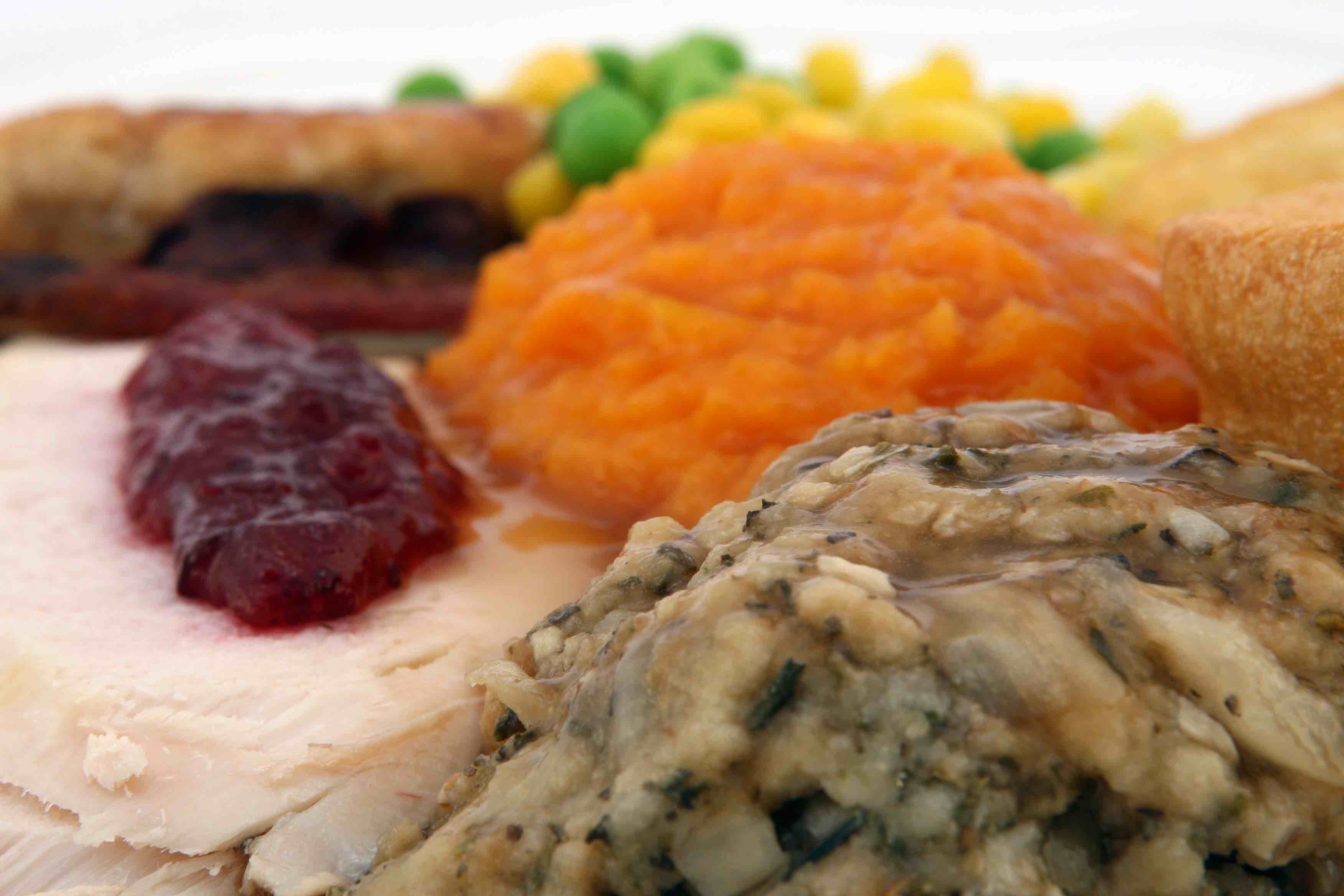
day: for the brownly roasting spirit of turkey
and a scarlet celebration of cranberries; and for everything
which is edible which is edifying which is yum
(we who are scattered gather today,
and this is thanksgiving; this is the wealth
of abundance of family and friends: and of the glad
long table illimitably mirth)
how should smelling tasting touching seeing
consuming any—lifted from the yuck
of all nothing—food becoming Eucharist*
not invoke Gratitude?
(now the tastebuds of my tongue awake and
now the fullness of my heart overflows)
*The word “Eucharist” is a transliteration of the Greek word eucharistia, which is itself a translation of the Hebrew word berekah. All three words have the meaning of thanksgiving, or praise for the wonderful works of God. (from: votf.org)






 Hot Dogs and Marmalade