family · Writing

A Large Family

Don’t get me started.

Family size is a personal decision.

I can’t tell you the number of rude things that have been said to me because of the number of children I have. I have eight.

“When are you going to stop?” — said to me by a woman at church when I was pregnant with #4. She later said to me after that baby was born — a daughter after three sons, “You got your girl, thank God. You can stop now.”

Another woman told me, “You have too many children.” This was when I had, I think, six. I responded by asking, “Which one should I get rid of?” I received no answer.

I haven’t gone to high school reunions, in large part because I didn’t want to spend my evening answering questions about my family size. That — plus the fact that while my classmates went on to pursue careers, I chose to be a stay-at-home mom. I didn’t really want to spend an evening at reunion answering the question, “What do you do?”

I chose to be a mom.

And it was, without a doubt, the right choice for me. It shaped me. It allowed me to be creative and loving and strong. I developed patience. I learned that I LOVE taking care of people.

So much so that I took care of my parents, too.

Did I resent doing that? Never. Not even for half a second.

Now, while my age-cohort is retiring, I’m just a few years into my first full-time job since 1984.

I have an office where I work. People stop in a lot to say hi, to talk, to complain, to suggest. I have an open door. Just the other day I was telling someone how being a mom prepared me for the constant interruptions of having an open-door policy in my office. When you’re a mom, you learn that your interruptions ARE your work. The same is true for me today.

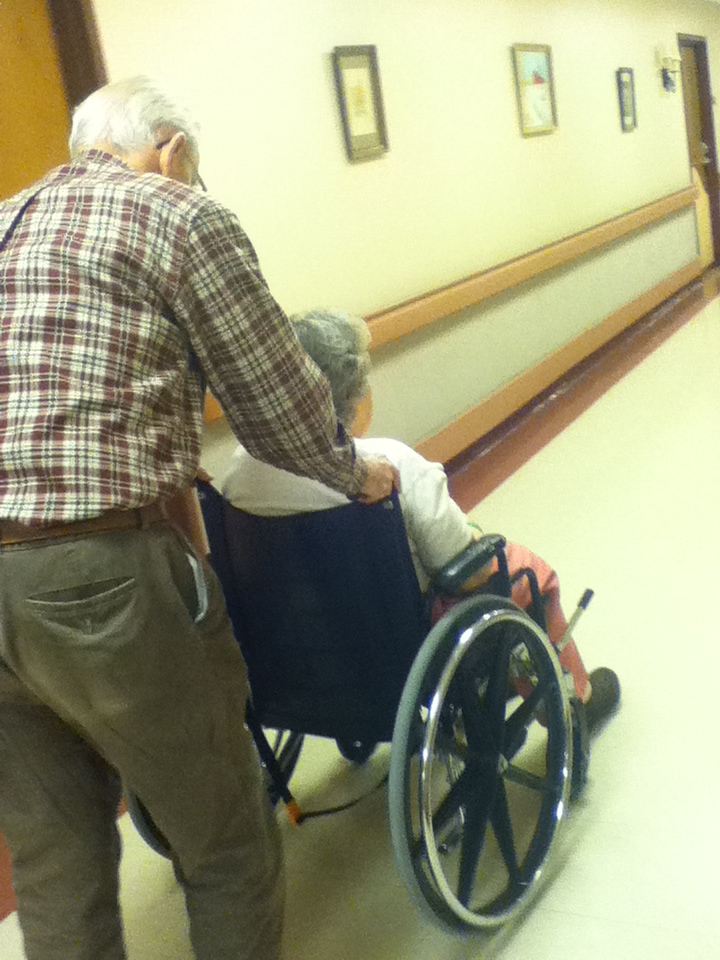
A man stopped in my office yesterday. He often pokes his head in to say hello. He was a caregiver for his disabled wife the last few years of her life. He used to bring her to the gym and wheel her around in her wheelchair so she could have contact with other people.

Then she died.

And it turns that by coming to the gym he was building his own support system. He comes every day — not to work out so much as to visit with people. He makes the rounds, and I’m on them.

Anyway, he poked his head in, chatted about nothing, and then asked about my necklace. My youngest daughter gave it to me and I always wear it.

It has three discs: one that’s a tree, and two progressively larger ones with the names of my children around the edge. When you have a large family, you have to be creative about mother’s jewelry.

I explained the necklace to him.

“You have eight children,” he said incredulously.

“Yes,” I replied.

“Did you adopt some?”

“No.”

“Did you have twins or triplets?”

“No,” I told, “they were born one at a time.”

I turned around to grab the photo I have of them on my bulletin board.

“There’re all adults now,” I said, showing him the photo.

“You have eight children?!”

“Yes, this is them,” I said.

He was shaking his head. “You have eight children?!?!”

“Yes –”

He was backing out of the doorway. I was feeling rattled and small and angry and sad.

“You have eight children?” he said again. “I need to process this.”

“I’m still the same person you’ve been talking to for a year,” I called after him, but I don’t think he heard me.

Don’t get me started.

There are so many things that can define a person. Mistakes made while young. How they invested their life over the past four decades. What they are doing today.

I have eight children. They are amazing people and I’m so proud of them.

Really. Don’t get me started.


This overly-wordy post is my response to the Stream-of-Consciousness prompt: don’t get me started.

Linda Hill got me started on a rant.

Alzheimer's · family

Where the Wild Things Are

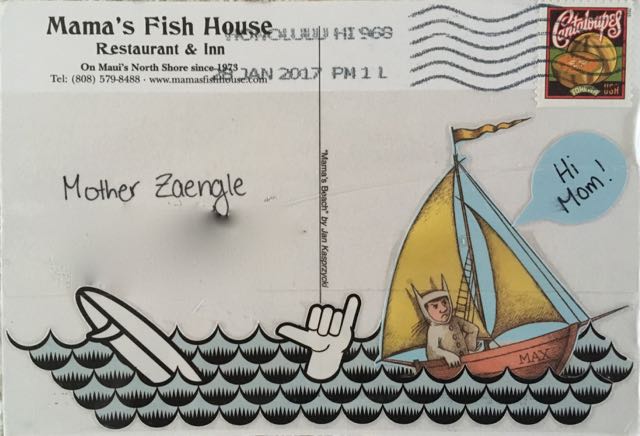
Partly because Sam just sent me this awesome collage postcard from Hawaii:

Is that me waving from the surf?

And partly because the Fenimore Art Museum recently announced that in April they are opening an exhibit called:
50 Years, 50 Works, 50 Reasons. Maurice Sendak: The Memorial Exhibition

And partly because the word of the day is “lovingly” and this post has that word in it —

I’m reposting something I wrote in May 2012.

As a side note — I DO do New York City now, very sparingly. By bus.


When I stopped to see my mother on Tuesday, she was in New York City.  Well, not literally, but, they were having another travelogue for the residents.  Instead of Hawaii, however, this week’s destination was New York City.

I don’t do New York City.  Every time I’ve driven someone to JFK, I’ve gotten lost, not getting there, but getting out.  I’ve ended up in downtown Manhattan on more occasions that I care to think about.  I am a country bumpkin through and through.  I don’t do big roads.  I don’t do big cities.

But my mother was in New York City in the safety and comfort of  The Manor.  Maybe I could handle that.

Anyway, I didn’t get to see her.  My kids said, “She won’t know the difference anyway.”

Maybe that’s true, but I know the difference.

Since Maurice Sendak died, I’ve been thinking about Where the Wild Things Are.  Little Max is so naughty that his mother calls him a wild thing.  He’s not even remotely contrite about his naughtiness, yelling at his mother, “I’ll eat you up!” So she sends him to his room.

And off he goes, not only to his room, but to where the wild things are, and where he’s king, and where there are wild rumpuses and such.  But he wants to be where someone loves him best of all.

Can you picture his mother tiptoeing into his room, after all his naughtiness?  No, wait, backtrack even further.  Can you picture his mother lovingly preparing a tray of food for him, things that smell good and are good to eat, making sure they are both delicious and hot?

She tiptoes into his room, but he’s not aware of it because he’s off where the wild things are.  She leaves him a tray of food, a tray that says I’ll always love you.

She didn’t do all that so that Max would see the tray and say, “Wow, my mother loves me.”  She did it because she loved him.

That’s what I want my children to know.  I don’t go visit my mother because she’ll understand.  I go because I understand, and because I love her.

So I stopped in to see my mother the other day, but she was off where the wild things are — New York City.  I should have left her a tray of food.

And it was still hot.


A to Z Blogging Challenge

Yuck

A few weeks ago I babysat my grandson and got to change his diaper.

When I first became the mother to a little boy, my mother had warned me to not leave a boy uncovered too long. Beware the fountain of youth. You know.

Even with that sage advice, my oldest son squirted me right in the face shortly after I brought him home from the hospital. I learned to get everything ready before the big reveal so I could be quick and cover it up in a jiffy if I needed.

With my grandson, I was prepared. I had my method down. Get the wipes ready. Unfold the new diaper. Take a deep breath, then take off the wet diaper.

Of course, he nailed me. In spite of. And laughing all the while.

I think this ritual of male creatures marking their territory starts very young.

PICT0853Cleaning bodily fluids is the yuck of motherhood.

Changing diapers.

Wiping noses.

Cleaning vomit.

Dressing battle wounds of wars fought with siblings or sidewalks.

It’s in those most intimate, personal, yucky moments that love takes root and grows.

My friend’s house became a crime scene when her husband was murdered there. A group of women went to the house and scrubbed the blood off the floor. Men patched the bullet holes in the wall. Cleaning the yuck became an act of love.

Jesus washed His disciples’ dirty feet on the night He was betrayed.

And Joseph of Arimathea wrapped His body — head bloody from the crown of thorns, hands and feet pierced by nails, his side opened with a spear — Joseph wrapped that bloody body in a linen cloth and laid him in a tomb.

The yuck of love.

In more ways than one.

Caring for aging parents is such a privilege. Laundering soiled garments, gently bathing fragile folds of flesh, cleaning unmentionables, because, you know, we are cultured and couth.

Those are the sacramental moments of life.

The farmers have been spreading the manure on the nearby fields this week. The aroma fills the air. Yuck.
But when the alfalfa grows, lush and green, nutrient rich because of the timely application of poo — we forget the yuck.

So it is with children.

And aging parents.


A to Z Blogging Challenge · poetry

Windchimes

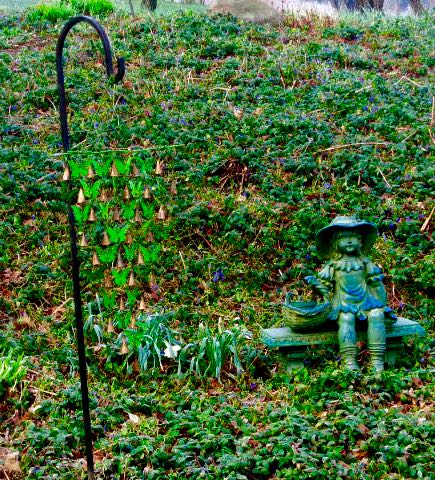
DSC05667“I wish your mother could see those windchimes,”
my father said,
looking at the green butterflies
and brass bells.

Their gentle tinkle
was beyond his hearing
like my mother was beyond …
I don’t know.

Beyond the day
when he could repay
for late nights
and house calls
and meetings
and reserve duty
and patients calling
and dinner waiting
and waiting
and waiting
for him to be home

She always had to share him
with the sick
the poor
the destitute

and with other physicians
and administrators
and nurses
and important folk
who received the same courtesy
as the unimportant

My mother may have felt
that she came last

So he bought the windchimes
last summer
and hung them
in the myrtle
where the gentlest breeze
could flutter through
and make
a plinkle-chinkle-tinkle
barely audible
wings brushing bells

My mother closed her eyes
from weariness
a few miles
and lifetimes
away

At the end
she had to know
that she was
always
first
as he spooned
the ice cream
into her mouth
and told her
that he loved her
time
and
again

the butterflies
could never speak
so clearly

A to Z Blogging Challenge · Alzheimer's

Vulnerable

“Fred” made the mistake of saying the words “crew cut” within hearing of the man with the clippers.

“Everybody has a bad haircut story,” I told him. “Now you have yours.”

What made the whole thing ironic is that “Fred” had just been to a conference from which he took away the importance of vulnerability.

“Failure is an event, not a person,” he told me, repeating a Zig Ziglar quote one of the speakers had used.

“Exactly,” I said, pointing to his head.

Every disaster, whether large or small, brings us to a crossroads. One path pretends the problem never happened and hides the challenge from all the other travelers. The other path is vulnerability and sharing the struggle.

My mother taught me the importance of vulnerability. I remember watching her after her breast cancer surgery. She had a full radical mastectomy back in the days when the plastic surgeons weren’t inserting inflatable boobs even before the radiation treatments.

Her prosthesis was external, a little mass of weighted jell that fit into her bra.

Which she got tired of and did without after some years.

My mother was not defined by her breasts.

Or her breast cancer.

She went to visit women who had had mastectomies before they left the hospital and faced the world.

“This does not define you,” she told them.

And she lived, a walking testament to life after breast cancer.

That open-ness, that vulnerability, helped me to start writing about her and her Alzheimer’s.

I think if she had fully understood, if her brain had not been fogged by dementia, she would freely given her blessing to the whole thing.

“Write about the incontinence,” she would have said. “Maybe it will help somebody else going through the same thing.”

She would laugh and say, “Write about that time when I tried to walk the two miles into town because no one would believe me that I needed to go to a meeting.” I walked with her, and Helen came to pick us up.

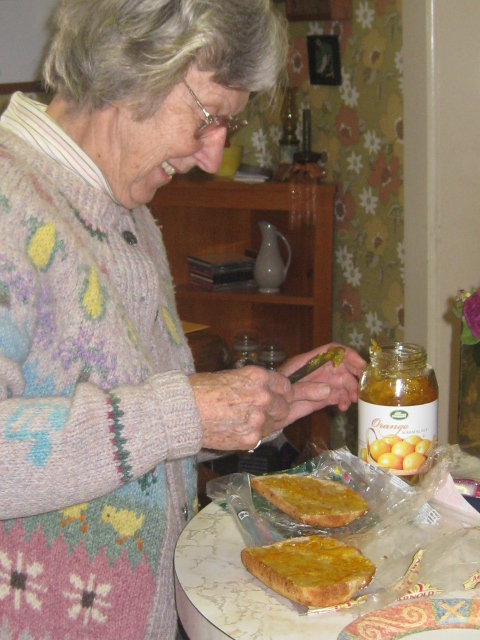
“Write about the funny things I said. And how you had to show me that underwear went on first, before the pants. Write about the marmalade.”

It’s not dishonoring to use tough situations so that others know they are not alone in what they are experiencing.

Quite the opposite.

It is most honoring.

I think she would be pleased.

Making the sandwich #1
Mom and her marmalade

A to Z Blogging Challenge

Rich

My father has told me a number of times, “You’re one of the richest people I know.”

I respond with, “Yeah, and maybe someday I’ll have money.”

Not this year, though. The money part, that is.

When I filed our taxes our income had gone down. It was the first time in many years that I didn’t have to file a Schedule C or SE for my swim officiating pay. Scholastic swim officials are paid, and I had been working for a number years at the modified, high school, and college level.

But, in the late fall of 2014, at the end of the girls’ season, I realized that I couldn’t commit to officiating during the boys’ season which runs November to February. I contacted the assigner and let her know. She emailed me for the next season, fall 2015, and again, sadly, I told her that I couldn’t do it.

Both times, I knew it was the right choice. As much as I love officiating swimming, it doesn’t compare with how much I love my family.

And, as it turned out, instead of scoring dives or disqualifying breaststrokers, during each of the seasons I have missed, I have had the privilege of caring for aging parents. No one can put a price tag on that.

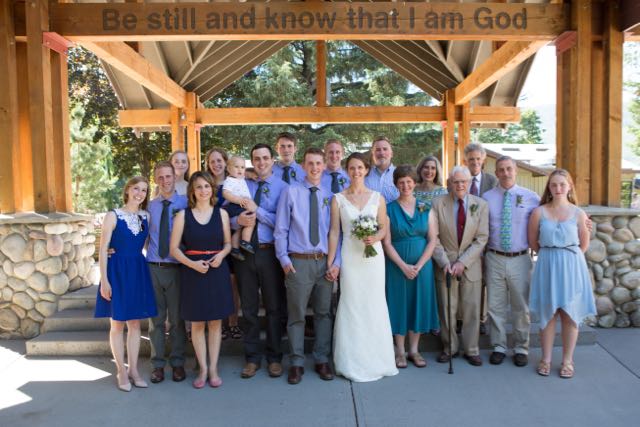
Here is an partial list picture of my assets.

Zaengles, Pollocks, and Uricks at Sam & Donna's wedding
Family at Sam & Donna’s wedding

I wish I had photographs, too, of the circle of friends who do such a good job caring me.

Patrick Meagher said, “Some people are so poor, all they have is money.”

I am rich indeed.


A to Z Blogging Challenge

Mary

About once a week I still try to go see I-can-do-it Mary. I wrote about her in “I Can Do It” and Leave Me Alone.

My father likes visiting people at the nursing home so I drive him over. While he’s visiting Linda, the lady who cuts hair, or Savannah, the bank window lady, I go down to Mary’s room.

She usually has her blanket over her head. When I see her like that, I just whisper a prayer for her in my heart.

The other day, though, her room was empty. The sun was out and I found her sleeping the sunshine of the courtyard. She loves being outside.

I stood beside her and laid my hand on her arm but she didn’t stir. When I removed my hand to leave, her eyes fluttered open.

“I brought you a present, Mary,” I told her. “It’s in your room.”

A dish garden with yellow tulips, miniature daffodils, and a pink hyacinth had beckoned to me from the flower kiosk at the grocery store. When my mother was alive, I tried to bring her flowers occasionally because I knew that she loved them. This week, I purchased some for Mary.

“Oh!” she said, reaching her good hand out to me. “Say, say, I can do it!”

“I can do it, Mary,” I said. I put my hand in hers and she kissed it.

“I love you,” Mary said.

“I love you, too,” I told her.

“Would you like to go see the flowers?” I asked and she nodded her head vigorously in response.

She hooked her good foot under her bad one and began pulling herself along using that one good foot.

“One. Two. Three. Four,” she said, counting her pulls. I had never heard her count before and she watched me to make sure I was seeing and hearing this new miracle.

By the time she reached “Thirteen,” she was at the door.

Clearly thirteen has gotten a bad rap. It was a beautiful number when she said it.

When we got to her room and she saw the garden, she said, “Wow! Wow!” She turned the dish slowly so she could see if from all angles, then she reached up and pulled me to her in a bear hug.

“I love you,” she said again.

“I have to go find my father,” I told her. “He’s visiting upstairs. Do you want to go back to the courtyard?”

She nodded.

As we walked back to the courtyard, suddenly Mary stopped. She grabbed my hand and looked at me. ” I en-,” she began, and then she frowned.

“I en-,” she said again.

I waited.

She frowned in frustration, then she waved her hand in the air, erasing the words that lingered there unfinished. “I can do it,” she said quietly.

When I got her settled back in the sun, she gave me one last bear hug. “I love you,” she said.

“I love you, too,” I told her.


*****

This is a video I took of Mary singing to my mother.

family

Lovable

Several years ago I was walking Maggie in our little town and ran into a woman who was walking Maggie’s twin, a mostly black dog with some white markings.

“What kind of dog is yours?” the lady asked.

“They told us that she was a shepherd-boxer-akita mix at the shelter where we got her. Basically, she’s a mutt,” I said.

The woman smiled and said, “Mine, too!”

We stood and talked for a few minutes about how similar our unrelated dogs were. Unrelated, yet entirely related.

“Don’t you think,” she said, “that if we took all the dog genes in the world, put them in a big bag, shook them up and then pulled out a dog, it would look like this?”

Yes, she has crooked ears.

I laughed and agreed.

Since that conversation I have noticed so many dogs that look like Maggie.

I suppose that would say that she’s a common dog.

But she isn’t.

Our neighbor who walks Maggie for us while we’re away — and sometimes, even when we’re aren’t — often comments on what a smart dog Maggie is. “I usually only have to tell her once and she minds right away,” she tells us.

Maggie is smart. And fun. And energetic.

She can sit, stay, shake, lie down, die, and come. She carries a fish on her walks, chases snowballs and squirrels, and howls at the noon whistle. When we come back from being away, she races around the house in a doggy-happy dance. What more does a dog need to do?

Catching a snowball
Catching a snowball
Balancing a dog biscuit

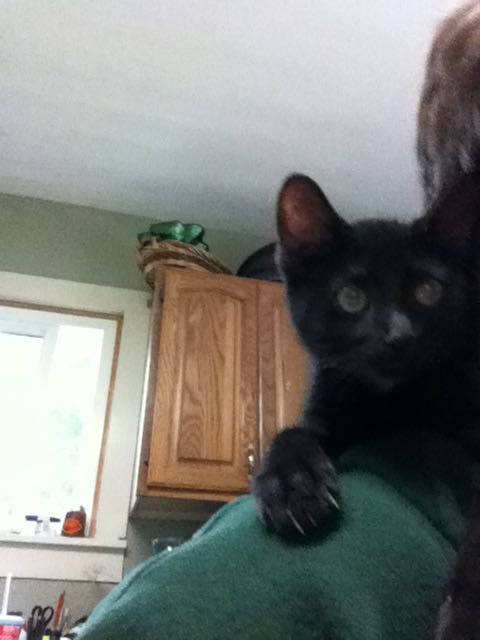
This past summer we got a kitten. She’s supposed to be a working cat, taking care of the mouse problem at my father’s house, but she’s still in training, slaying ladybugs and cluster flies in abundance.

She’s all black with a few white hairs like a little bow-tie.

Once we went on a field trip to a cat rescue organization and their shelter was full, mostly with black cats.

“They’re the hardest to adopt out,” the lady told us, “and seem to be the most common color.”

Our Piper was a freebie from a farm. When I took her to the vet, they asked for her breed.

“She’s just a cat,” I said.

I’m guessing that if you took all the cat genes in the world, put them in a bag, shook them up and pulled out a cat, it would be black.

But Piper likes to sit on my shoulder and lick my ears. She pounces on my feet from under the bed while I’m getting ready for bed. She snuggles on my lap in the morning, and rolls onto her back when my brother stops by so he can rub her belly. She is a special cat.

Perched on my shoulder
Sleeping in the sun
Sleeping in the sun
Conquering cluster flies

All this is to say that I think the least aspect of any creature is pedigree. Or color. Or any other externals.

What’s inside is unique and wonderful, waiting to be discovered and nurtured into maturity.

Lovable.

Faith · family

Isaiah 56: 3-8

“Here’s the thing,” says God.
“Don’t you go saying that you don’t belong to My family,
And don’t you go thinking that because you don’t ‘produce’ I’m going to throw you out.
I don’t work like that.
At all.
If you love Me
If you embrace activities and ideas that please Me
If you hold fast to the promises I have made to you
Then I will give to you something better than any fame, fortune, or power you might receive from the world for something you did
What I have to give you is better than a large family or even one successful child
What I have to give you is a name —
A name that will forever tie you to Me.”

“And if you think you don’t belong in My family,
let Me ask you this —
Do you love Me?
Do you serve Me?
Do you help others because you know Me?
Do you set aside time
when you aren’t working
and just think about Me?
Do you lay in a grassy field on a Sunday afternoon,
look up at my blue sky, and utter a simple thank-you?”

“My door is always open to you
because you are family.
Mi casa es su casa.”

“You are family.
You are welcomed with great joy
and big bear hugs
(even though you say you don’t like hugs).”

“Come.
Sit with Me in the quiet.
Whisper to Me.
I am always listening.”

“You may think that you’re an outcast,
but I am gathering you in My arms
and holding you close.”