About My Dad · family · Travel

New Memory

This morning I received a notification — “You have a new memory.” I laugh at those notifications. They seem so silly.

New memories — pshaw. Memories are, by their very nature, sort of oldish.

This morning, though, I paused to look at my “new” memory.

Two years ago today, I was in Normandy.

Two years ago today, I first heard the story of British gliders landing in Normandy to take the Pegasus Bridge — gliders whose pilots used stopwatches and compasses to navigate, some landing a mere 47 yards from their objective. I’m still amazed at that feat.

Two years ago today, I stood in the Canadian cemetery in Normandy, France, and grieved for those young men whose names were carved in the stones there. So brave. So young. But such a beautiful place.
Five years ago today, I was watching Karl play tennis. He and his partner, Michael, were killing it.

Five years ago today, at about the same time, 1400 miles away, my first grandson was born.

I didn’t need a photo app on my phone or Facebook to remind me of that memory. I woke up thinking of him. (HAPPY BIRTHDAY, HENRY!!)

On the other hand, my father needed the memory prompts.

“Remember our trip to Normandy,” I asked him.

“When was that?” he replied.

“Two years ago today we went on our first tour.”

I handed him the photo book and memorabilia I had put together from that trip.

His eyes grew misty as he leafed through it all. He carefully unfolded the maps of the cemeteries and of Paris, studied them, and then folded and placed them back in the pocket of the book. I couldn’t tell if he remembered or not.

“That was a good trip,” he said.

It was a good trip.

As we travel down this other road of forgetting who, what, and how, I often think, We’ll always have Normandy (and Paris, I suppose).


family · Stewart

Birthday post

Today is my birthday.

5 years ago on this day I was at Laity Lodge, enjoying the warm Texas sun, the beautiful Frio River, and one of my favorite places in the world, an art installation called Threshold. Since Laity Lodge has no cell reception and very limited wi-fi, I used a little landline telephone room to call home and speak with my family.

Threshold at Laity Lodge

My husband and children all wished me a happy birthday. Then Bud said, “Your brother Stewart called to wish you a happy birthday. I told him that you would call him when you got home.”

Ten days later — long after I had gotten home and had plenty of time to return that call — on Ash Wednesday, I received a call from my sister telling me that Stewart had had a heart attack and died.

Stewart – Thanksgiving 2013

I think about that every year on my birthday.

I never returned his call.

I never heard his voice again.

My kids have been asking what I want for my birthday, and, honestly, I couldn’t think of a thing. My father used to tell me that I was the richest person he knew. Then he would laugh and add, “And maybe some day you’ll have money.”

I am rich.

January 1, 2019

But this morning I was thinking about what I want most for my birthday.  I know what it is now.

I want you to make that call you’ve been meaning to make.

Stop in to visit that person you’ve been meaning to see.

Drop a line to an old friend.

Or relative.

Or neighbor.

Mend a fence.

Build a bridge.

Reach out.

Life is so short.

This morning, as I sat at the table with a cup of coffee and a cinnamon bun (my birthday treat for myself), I opened my computer to begin writing this post —

–when I heard a terrible crash from my father’s room.

I ran in and found him on the floor.

“Dad, Dad,” I called, as I patted his cheeks and tried to get a response, but his eyes were open and fixed, and he was unresponsive.

My husband and son carried him back to bed. When he came around and was semi-conversant, he wanted to go eat breakfast, but he barely made it to the door before he had a repeat episode.

And then a third one a little later.

I write this from the Emergency Room.

He has been awake, but he doesn’t remember anything that happened this morning.

They’re running tests.

And I’m spending my birthday with my father. I have no regrets.


Faith · family

Unwrapping

Every man, however matter-of-fact and prosaic, likes to receive his presents wrapped… He hesitates to cut the string; he prefers to untie the knot, to unfold the paper, and so to come slowly upon the fond surprise awaiting him. The contents element he will be able to enjoy for months, perhaps for years; the parcel element he can only enjoy for a few blissful seconds; he therefore lingers over it that he may taste its drawn out sweetness to the full.  It is part — and a striking part — of our human love of mystery.

Like so many other things that are pregnant with romance, brown paper and string look commonplace enough; yet, in reality, they embody all the wistfulness, the tenderness and the sacredness of Christmastide.

… I have an old hymnbook in which the words [to a classic Christmas hymn] are rendered:

“Wrapped in flesh the Godhead see,
Hail the Incarnate Deity!”

Wrapped in flesh! It is the phraseology of the parcel! The child’s eyes sparkle as he catches a glimpse of the present through the paper. Human eyes have been entranced as they have beheld the unspeakable gift ‘wrapped in flesh‘ — the Deity Incarnate!

From My Christmas Book, by F. W. Boreham

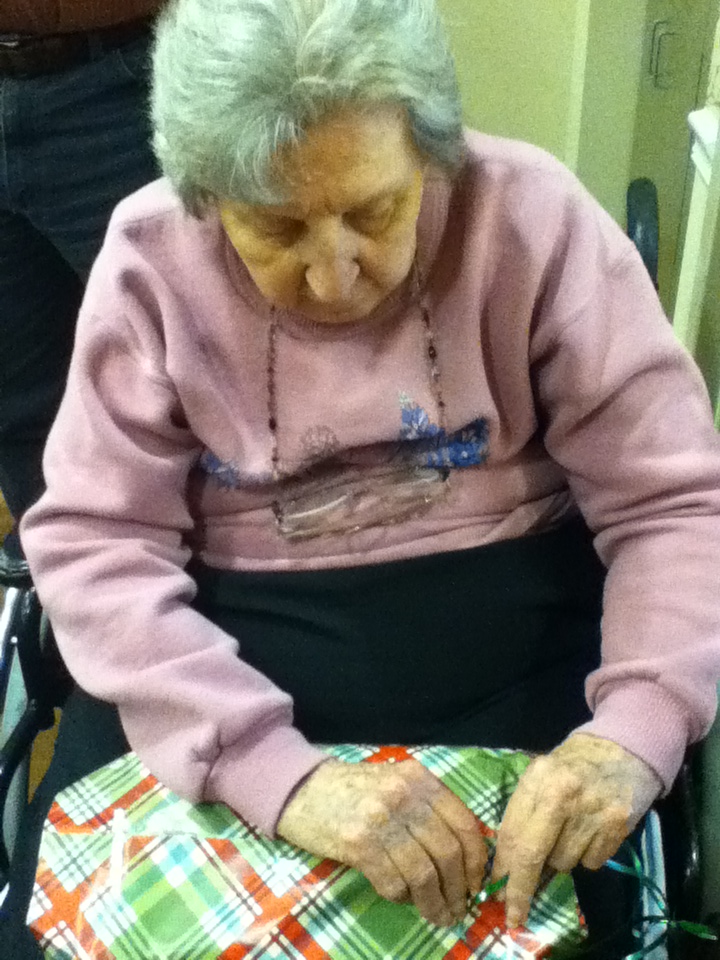
I read that passage the other morning and immediately thought of my mother. She could unwrap carefully with the best of them.

Below is a post I wrote in 2013 about my mom unwrapping a Christmas present.

“Mom, the suspense is killing me,” I told my mother yesterday.  She took, oh, I don’t know, close to twenty minutes to unwrap a single gift.

My mother has always been a careful unwrapper.  I would blame it on our Scottish heritage, except that’s my father’s side of the family.  Are the Danish thrifty too?  For as long as I can remember, though, she has carefully peeled the tape off packages so as not to tear the wrapping paper.  It can be reused, don’t you know.

Alzheimer’s hasn’t taken that trait away from her.  Old age has slowed her down.  When you combine the two, well, let’s just say, it can take a painfully long time to unwrap a gift.

“Here’s a gift from Donabeth,” I said, placing it in her lap yesterday.  She looked at me with watery eyes.  I wasn’t sure she understood.

“Open it, Mom.  Let’s see what’s inside,” I said.

She held it on her lap for a long time.  I suggested, cajoled, encouraged, prodded, goaded, urged.  Nothing seemed to work.  Finally I said the line about suspense.

“That’s the name of the game,” she said. “Suspense.”  Maybe she was more aware than I gave her credit.

She turned the package over and began picking at the tape.  Did I mention that this was a slow process?

So slow, in fact, that she fell asleep while doing it.  Fortunately it was just one of the doze-y little catnaps that lasts only a few minutes.

Once the pretty paper was removed we found that my sister had the nerve to also wrap the gift with a layer of bubble wrap.

I began the same “encouragement” process, but Bud came over and simply removed the bubble wrap.  None of this waiting around stuff.  The suspense was killing him, too.

Inside was a music box that played “Amazing Grace.”  My mother listened to “Amazing Grace” over and over.  When I thought she had lost interest, I put the music box on the table.  I went to do something else and heard it playing again; my mother had retrieved it and opened it again.  Over and over.

Music still touches something deep inside.

I’d say she liked it.

Merry Christmas, Mom.

family · Life · swimming

Encourager or Discourager

Last week, I sat at the timing table in my effort to learn how to run the computer for swim meets.

The woman on my right was the embodiment of sugar-and-spice-and-everything-nice. She was genuine, kind, enthusiastic, and, like me, new and a little overwhelmed by the goings-on at the table.

The woman on my left was a pro. She had been working the table for many years. She was calm and unflustered, even when things got crazy.

Pool acoustics are never great, so neither woman could not hear what the other was saying.

Sugar-and-spice nudged my elbow during the 50 Free. “See that boy over there?” She nodded at a swimmer in the far lane. “I wish I had taken a video of him on the first day of practice,” she said. “He could barely swim. Look at him go!”

I watched the boy thrashing at the water slowly making his way down the pool far behind the other swimmers.

On my other side Ms. Pro said, “Oh, God! I don’t know why they allow that kid to swim! He moves in inches! This is going to take forever!”

Behind her, a young woman echoed her sentiments. “His stroke is awful! Look at him. He’s not cupping his hands!”

Sugar-and-spice said again, “He’s doing so well!”

Ms. Pro groaned at his slow progress.

I felt like I was sitting with an angel on one shoulder and a devil on the other, one focusing on what the swimmer could do and the other focusing on everything he couldn’t.

I told Laurel about it on the car ride home. “I know which one I want to be,” I said.

Later that night — midnight to be exact — I was up with my father. He had changed mostly out of his pajamas and had his shoes on. That night’s self-donned wardrobe consisted of four layers of shirts, one-and-a-half layers of pants (don’t ask), three socks on one foot, and a single compression stocking on the other.

“Dad,” I complained, “what are you doing?!”

“I thought I was doing the right thing,” he said.

After getting him changed into his pajamas and back to bed, I lay in my own bed thinking about the swim meet, and how easily I became the person I didn’t want to be. I was frustrated with what my father.

“Lord,” I prayed, “help me appreciate the fact that he can still put on a compression stocking — because that’s hard. He can still tie his shoes. He can still walk. And talk. And feed himself.”

I fell back asleep counting his abilities.

Two hours later he was up again. And I forgot again.

“Dad,” I said, “you’ve got to get some sleep!” By which I meant I need sleep.

“I’m doing the best I can,” he said.

And I remembered again the boy with uncupped hands struggling down the pool. I remembered Sugar-and-spice cheering him on.

Again I prayed. “Thank you, Lord, for my father. Help me help him. Help me give back to him a little of the lifetime of caring he has given to so many. Thank you for the lessons that he still teaches me. And thank you that he’s back to sleep.”

For now, I thought, and smiled.

dementia · family · Life

2:30 AM

“I’m not doing this on purpose, you know,” my father says to me.

It’s 2:30 AM. I’m pointing at his clock, the new one we got that tells the time and the time of day. Above the 2:30 AM the word “PREDAWN” appears.

My father presses his lips together and narrows his eyes. He looks like the emoji with horizontal lines for both eyes and mouth. Exasperated. Frustrated.

I’m not sure what that emoji is supposed to represent. I’m terrible at reading emojis. My children try to teach me.

“I can’t believe you used the eye-roll emoji,” one of them said to me after I, guess what, used the eye-roll emoji. I thought it was more of a shruggy-I-dunno face. But what do I know?

“You use that smiley-face?” another one asked once. I use the basic smiley — no teeth, no open mouth, just a little upward-curved line.

“What’s wrong with it?” I asked.

“I read that as a snarky-teenager-if-you-say-so face,” she said.

Sigh. I dunno.

But at 2:30 in the morning, I’m not thinking about emojis. I’m thinking about redirecting.

I have a baby monitor in my room so I can hear him when he gets up. He often gets up to use the bathroom and then goes back to bed uneventfully. And I go back to sleep, because I haven’t left the warmth of my bed.

Some nights, though, I don’t hear the squeak of the hospital bed as he climbs back in. Instead I hear running water in the bathroom and know he’s planning to shave. Or I hear the creak of dresser drawers being opened followed by the sound of the hanging drawer pull as it drops down and hits the brass plate. I know then that he’s getting dressed and that it’s time to redirect.

I climb out of bed, turn the monitor off, and head downstairs. The overhead light is on in his room, its bright rays extending under the door. Sometimes, when I open the door, I find him in the bathroom. Sometimes, he’s at his dresser. Sometimes, he’s just standing in the middle of his room, like he doesn’t know what to do next.

“I’m not doing this on purpose,” he says to me, and it breaks my heart. He knows that what he’s doing isn’t right, but he also doesn’t know what the right thing to do is.

“Look at the clock, Dad. It’s 2:30 AM. You’re supposed to be sleeping.”

“I know that,” he says.

“Can I help you get back into bed?” I ask.

“You want me to go back to bed?” he asks. What I’m saying connects, but it’s like using a corroded battery where the connection isn’t a connection because of yuck that’s in the way.

“Yes,” I reply. “You need to sleep.”

And by that I mean that I need to sleep.

But it’s too late for me.

I help him get back into bed, then go upstairs to my bed, turning the monitor back on before I climb in. The silence on the monitor tells me that he’s back to sleep. My husband’s deep breathing tells me that he’s sleeping, too.

It’s 3 AM now.

I stare at the ceiling for an hour, wishing sleep would return to me.

When it doesn’t, I climb out of bed to begin my day.

dementia · elderly · family · Life

Buried Gold

It’s been a rough few days… make that weeks.

My father has been struggling with anxiety. Anxiety and dementia go hand-in-hand. The world doesn’t make sense. Memories jumble around. People telescope in and out. Switchbacks define the landscape.

“DON’T GO THROUGH THAT DOOR!” he cries whenever I leave him alone in his room. Waylaying me with his hand on my arm, he looks over his glasses and says in a confidential tone, “There’s nothing out there. Nothing. You can’t go there.”

But I must and I do. His world may be confined to one room. Mine is not.

If I coax him out to the sun porch, I struggle to coax him back in.

He’s leery of entering the dining room. He forgets that he sits at the head of the table and takes my seat.

Which, of course, is fine. Just odd.

“When I was in World War II, I was stationed by the Red Sea. I buried a lot of gold there. We need to go back and get it,” he told me the other day. Except he was in high school during WWII and was never stationed by the Red Sea. He went there on holiday when he was stationed in Ethiopia in the early 60s, but not WWII.

He told someone today that gold was buried in the back yard. Here.

The only gold we have here are little bits of dental gold that the dentist gave me after she removed some of his teeth. It’s gross, probably not worth much, and certainly not buried. That sounds like a good idea though because I don’t know what else to do with it.

I’ve been so tired because I’m up multiple times during the night with him. He can’t sleep. He’s so anxious.

Last night I made a to-do list so I could make sure I got done what needed doing today. Phone calls, shopping, and mail.

Mary added the part about rainbow sprinkles. Rainbow sprinkles make things better.

Karl added the great mom part. The pat on the back meant a lot.

Sometimes life gives more gut punches than pats on the back.

My father didn’t get to sleep last night until 11 PM — which meant that I didn’t either. He woke me at 5:05 AM.

Through the monitor I heard, “Sally! SALLY!”

I ran downstairs, my heart pounding.

“I’m having terrible chest pain,” he said. I called the ambulance.

The paramedic asked him about the pain.

“10,” my father replied. “Crushing chest pain,” he added.

By the time he got to the Emergency Room, he was fine.

“He has dementia,” I told the ER doctor.

“I got that,” she said, smiling.

“Can I get you something to drink?” she asked my father.

“I like beer,” he said. It was 6:15 AM.

He hasn’t had a beer since he ordered a flight a couple of months ago at his favorite restaurant. He was baffled by the four little beers served on a board. “What do I do with this?” he asked.

“You taste them,” I said.

He gave them to Karl.

We were home from the ER shortly after 7 AM. God bless the ER doctor who didn’t do a full cardiac workup.

Sometimes gold is in rainbow sprinkles and kind words.

Sometimes it’s in the not following protocol and using common sense.

Sometimes it’s buried in the backyard but I’m not going to count on that today.

family · Life · Travel

Why Norway

The place we used to stay in Myrtle Beach had no phones in the rooms. This was back in the 70s, when phones that fit in your pockets weren’t even a twinkle in a computer chip’s eye. Phones had dials and cords.

In those first few years in Myrtle Beach, if someone needed to reach my father at The Teakwood, they had to call the motel office. Someone from the office would find my father and he would have to go to the office to take the call or return the call. Things really advanced when they got a phone with a portable handset.

At the Teakwood

I asked my mother about the lack of phones. Somehow it made The Teakwood seem inferior to its phoned competitors.

“It helps Dad relax to get away from the telephone,” she said. I hadn’t thought about the tyranny of the telephone until that conversation.

I recently heard on a podcast that the presence of a phone at a meal — even if it’s facedown on the table — causes the conversation to be more shallow.

But this isn’t about phones.

It’s about why I went to Norway.

Last year I traveled to Europe for the first time since I was 5 years old. Twice.

The first trip was to take my father to Normandy, something he had longed to do for many years. I was excited for my father, but ambivalent for myself. I knew that I should be excited. I just couldn’t muster up the excitement on my own.

Then we went to Normandy and I loved it. I think I could live in Bayeux and be quite content there. The cathedral, the farmers’ market, the patisseries, the narrow streets, the old buildings — all of it lovely. I didn’t think anything could top Normandy.

Until Bosnia two months later. The land, the people, the hospitality. I came home from that trip quite full.

So when I was feeling depleted this year, and so many people kept reminding me that caregivers need to be sure to take care of themselves, I thought about what had pressed a reset button in my soul and given me rest and strength for the days ahead. Travel. Like the phoneless Teakwood did for my dad.

I applied and was accepted to a writer’s workshop with Ann Voskamp — but it was in the wilds of Alaska. When I realized how remote the workshop was, and how, if something happened at home, I would have a hard time making an emergency trip back, I asked to postpone my attendance for another year.

Then I considered a trip back to Bosnia, but nothing seem to fall into place with that.

Finally, I asked Karl — who had been saying that he wanted to travel — where he wanted to go.

“Norway,” he said.

So Karl, Mary, and I traveled to Norway. And Denmark. And Sweden.

If an emergency had come up, I was always near an airport.

Except for the day we kayaked in the fjords. But truthfully, that was the most renewing day of all.

dementia · family · Travel

While I Was Away

I can still see the woman’s face as she said the words to me.

She started off saying, “It’s such a good thing you’re doing — keeping your father home.” But then she stopped smiling and looked me in the eye, “You can’t do this forever, you know. There’s going to come a point when you have to place him somewhere that can take care of him.”

My dander rose a little when she said that. I thought, That day will never come.

It nearly came last night.

Ten days ago I took a trip with two of my children. Something changed with my father in the week that I was away. He started fearing certain doorways and needing certain doors to be closed. He started refusing to go down hallways in the house where he has lived for 50 years.

“You don’t understand, Sally,” he’ll say to me, gripping my arm and pulling me close to hear his words. “You don’t want to go there.” He’s emphatic. His words have an urgency evidenced by his tight grip as he says them.

When I tell him that I don’t understand, he says, “How can I explain this to you?” After a long pause during which he’s unable to come up with an explanation, he’ll simply say, “Please don’t open that door.”

Last night he turned off the baseball game and headed to the dining room, announcing that he was going to bed.

“Where are you going to sleep?” I asked.

“Here,” he said, and he pointed to his heart.

“Will you walk with me to your bedroom?” I asked, slipping my arm under his to support and guide him at the same time.

He planted his feet. “You don’t understand.”

After a bit of coaxing, loud arguing, pleading, and everything else I could think of, Bud and I, one on either side of him, forced him to take the steps he clearly didn’t want to take. Once he saw his room and his bed, he was fine (more or less). For a few minutes, though, it was ugly.

I lay in bed afterwards feeling discouraged and thinking, What would Penelope Lumley do?

Penelope Lumley is the plucky governess in The Incorrigible Children Of Ashton Place series (by Maryrose Wood). The motto for the school she attended, The Swanburne Academy for Poor Bright Females, was, “No hopeless case is truly without hope.”

I pictured the woman saying, “You can’t do this forever,” and I pictured the fictional Penelope Lumley reminding me that “No hopeless case is truly without hope.”

There has to be a solution.

In Norway (that’s where I went on my trip) we saw a house set up high overlooking a fjord.

Our guide told us that it has no road access. The old farmhouse had fallen into disrepair until a couple bought it and turned it into successful guest accommodations. Visitors arrive by boat at the base. They climb ladders and hike steep trails with switchbacks to reach Stigen Gard. It takes over an hour to make the ascent.

Some would have said the rundown farmhouse was hopeless, but no hopeless case is truly without hope.

The view at the bottom was beautiful.

I’m sure the view at the top is even better.

I just have to figure out how to do it.

family · Life

Rescues

I draw the line at worms. I don’t rescue worms in the driveway after it rains.

Mary does that.

One day this spring she went to my brother’s house to feed his puppies and take them out, and it took her much longer than usual.

“Was there a problem?” I asked, picturing some sort of puppy mischief.

“No,” she said, “I rescued a worm in his driveway. Then I saw another and another. I couldn’t stop.”

I rescue red efts when I see them.

They’re just so darn cute.

More often than not, though, I see eft fatalities (eftalities?) as I walk our road.

One day in May, Mary and I found a confused turtle on the lawn. It was heading up the hill, away from the river and the road, but it had a long way to go before it reached any shade.

I texted my brother. “Hey — would you like a turtle to take into the classroom?” He’s known as Mr. Science, and, in the spring, often brings nature-y things to school.

By the time he answered, though, the turtle was gone.

A few days later I saw what I think was the same turtle crossing the road.

“No!” I yelled to it, and turned to bring my groceries in the house. When I got back out, I was too late. The turtle had already been run over by a car.

Sadly, I picked up the poor turtle, its shell cracked and turtle blood oozing out, and carried it across the road to our compost heap. I nestled it down in a little shady spot, returning it to the earth — ashes to ashes, dust to dust, you know, but without a true grave.

The next day, when I brought compost over, the turtle was gone.

Honestly, I thought a predator ate it. Or maybe the crows who are always raiding the compost decided to have a little turtle meat with their moldy bread.

Fast forward to today. I was waiting to cross the road to get the mail while a steady stream of cars drove past in both directions.  After the last car, I took one last look down the road to make sure the coast was clear.

A turtle was crossing.

I sprinted to save that turtle.

The crack starts by its head and arcs left to its front leg

How it had made it as far as it did with all those cars was a mystery to me. When I carefully picked it up to carry it across, I saw it had already been injured in the past.

Was it the same turtle? The cracks in the shell were exactly where I remembered them.

I brought it across to the compost heap. It’s a safe place.

I visited it later in the day. It was in a different spot and had fresh injuries.

I guess turtles are slow learners.

Or the world is a dangerous place.

Or both.

Lately we’ve had a new visitor to our yard. I promise not to help it cross the road.