Among my “don’t likes” —
(cough, cough) this scent (so sorry)
— smoke de cigarette
This summer I hope to go on my very first every mission trip.
With a team from my church and beyond, I’ll be working alongside a family to help build a house for them. A Muslim family.
On the interest sheet, it says I need the ability to:
Carry heavy blocks (check)
Walk up hill (check)
Abstain from alcohol for the time in Bosnia (check)
Tolerate cigarette smoke (cough, cough – check)
I’m not a fan of cigarette smoke. There was a time in my life when it didn’t bother me, but sometimes now I feel almost hyper-sensitive to it.
It’s not just that it hangs in the room like low-lying cloud. It’s not just that it stings my eyes and makes me cough. But it sticks to my clothing and my hair. It lingers.
When my brother passed away, I had to stop at one of his friend’s apartments to get a key — and a cloud of smoke escaped when they opened the door to let me in. Once inside, in the smoke-filled the room, I felt my eyes burning. We talked in their tiny living room and I had to fight the urge to cough.
But I reminded myself that these were people who Stewart loved and that loved Stewart. Because of that, I could tolerate — I would tolerate — the cigarette smoke. Love makes so many things possible.
When I think about my trip, I find myself almost looking forward to that lingering smell, too. Afterwards, when I get back home, will I pull something from my bag that smells of cigarette smoke, put it to my nose, and smile because of some memory it evokes?
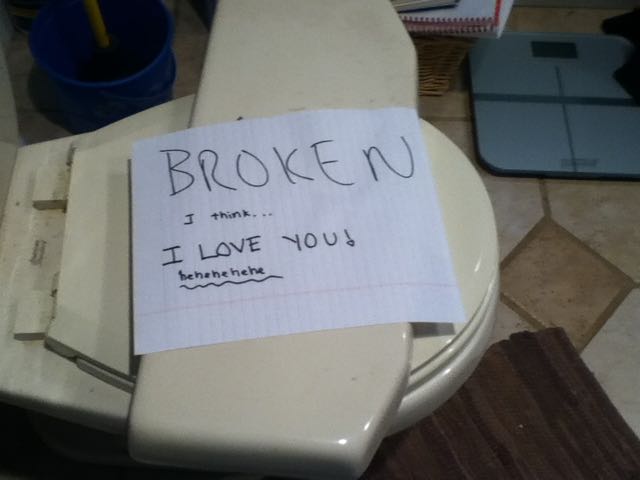
A few years ago, I came home and found this in the bathroom:
No one could accuse my daughter of not being resourceful.
The toilet wouldn’t stop running, so she repurposed a shoe.
Okay, maybe it was Aunt Jeannie’s shoe that she left at our house, but it was a shoe nobody was wearing and it did the trick. (Warning to visitors: don’t leave your shoes at our house.)
I’m not sure which I like more, the shoe holding the float up or the sign.
This post was originally written in April 2011 when my mother was still alive and still at home.
Question #1
I asked my mother one day, “Mom, do you know what Alzheimer’s is?”
She knew. “It’s a condition where people can’t think sensibly,” she responded.
It was a good answer. Alzheimer’s is not a condition where someone simply doesn’t think sensibly. They can’t. And yet, sometimes, they can. Like being able to answer that question with a pretty concise response shows sensible thinking. Question #2
Yesterday my mother handed me a sheet of address labels with her name and address printed on them.
“These are for you,” she said.
“I can’t use these, Mom,” I told her. “They have your name and address on them.” I tried handing them back to her, but she pushed them over to me again.
“That way you won’t forget me,” she replied.
I felt a little ache in my heart at those words. “Mom, I won’t forget you,” I reassured. “Will you forget me?” I asked it, even though I already knew the answer.
“Oh, no,” she said. “I’ll never forget you.”
But moments later, she forgot that she had even given me the address labels and took them back to her pile of things. She removed one and stuck at the bottom of a note she had written herself about dinner with a friend — a dinner that had taken place months or years ago. She had forgotten. But she stuck the address label on the bottom of the note.
“This will help me remember,” she said. Oh, if only it were that easy. Question #3
Alzheimer’s is a condition where people can’t think sensibly. The varying pieces of information that are coming at us and constantly being filtered in our mind are no longer being filtered correctly. It’s impossible for a person with dementia to make sense of it all.
One day we were going through some clutter and my father picked up a kitschy dog made out of golf balls. “We could probably get rid of this,” he said.
“Are you going to get rid of me?” my mother asked. With the filters missing, that was what she heard.
“You’re too valuable,” he told her. “We’re not going to get rid of you.” It was the perfect response. Question #4
So many people have shown kindness to my mother. Total strangers, long-time friends and family members have all pitched in to keep her safe and to make life easier for my father. I know my father appreciates it, but I often wonder if my mother is even aware.
Yesterday, she answered that unasked question. Are you aware of all the things people do for you?
She was looking for my brother. “He’s up at his house, Mom, right next door,” I told her.
“That’s right,” she said. “He has been so nice. Every night he brings dinner right down to us so I don’t have to fix anything.”
Yes, he does. And I’m so glad you recognize that. Even if you don’t always recognize me. I know it’s because you can’t think sensibly.
I ran into someone who has been promising to visit my father. When I saw her at the Post Office and she asked, “What can we do to help you and your father?” my answer was easy. Visit him.
I was telling Mary about it later. “Visiting is so easy to put off.”
“Yeah,” she said, “I don’t think I’d be very comfortable with it either.”
Visiting isn’t hard, though.
I wrote a list of ten things to do when visiting an elderly person — to make visits easier, if you don’t know how.
1. Listen — Listening is a slow-paced skill that has gotten lost in our rush-rush society. My father struggles to find words. Finding the patience to listen is so good for me.
2. Ask questions — I once heard someone suggest asking elderly people to talk about a time they got in trouble as a child. It brings out some funny stories. My father likes to talk about important days in history and the early days with my mother. Sometimes a question or two is all it takes to get a conversation rolling.
3. Look at photo albums — My mother always had a few small photo albums in her room at the nursing home. My father has some by his chair. She worked at identifying the people. He recalls past adventures.
4. Read — Sometimes I read to my mother. I discovered that picture books worked especially well. Reading to someone with dementia, though, is not unlike reading to a toddler. Her attention span was sometimes short and we would skip pages to reach the end.
5. Listen to him (or her) read — My father reads to me. When he chooses books to read, he often chooses thick books with small print. “Why don’t you choose an easier book?” I asked him once.
“I like to challenge myself ,” he replied.
So he ends up reading passages out loud. I think it helps him process. He is not unlike a 3rd or 4th grader, following the words with his finger, moving his lips all the while, often whispering aloud — and then going back and reading it to me.
Right now he’s reading The Bounty Trilogy — a fat book containing all three of the Bounty books by Charles Nordhoff and James Norman Hall.
“Captain Bligh was a bad guy,” he told me about six times yesterday.
“Yes, that’s why the crew mutinied,” I replied. “Spoiler alert.”
We would repeat the conversation about an hour later.
Someone visiting him could easily ask about what he’s reading, and I’m sure my father would be happy to tell him and read to him.
6. Write a letter — My father has wanted to write a few letters but, in addition to the struggle for words, the fine motor skills required for writing are lacking. Recently I’ve taken dictation from him to try to help.
Helen and Fred
7. Do puzzles or play games — My father still does the daily jumble and crossword, but more and more he needs a little help. He transposes letters or gets the down and across mixed up. I usually help him with a few answers and then let him keep working on it.
Helen used to play rummy with an elderly man. He cheated constantly and accused her of cheating — and they both laughed about it. It was a great way for them to visit.
8. Walk — One person that came to visit my father asked about the house. He gave her a walking tour, talking about the changes we had made to the house. It was a slow process because he stopped to talk about different pieces of artwork etc. He likes to walk outside, too, when the weather is nicer. But he needs someone with him.
One of the twice daily visits which were always at mealtime.
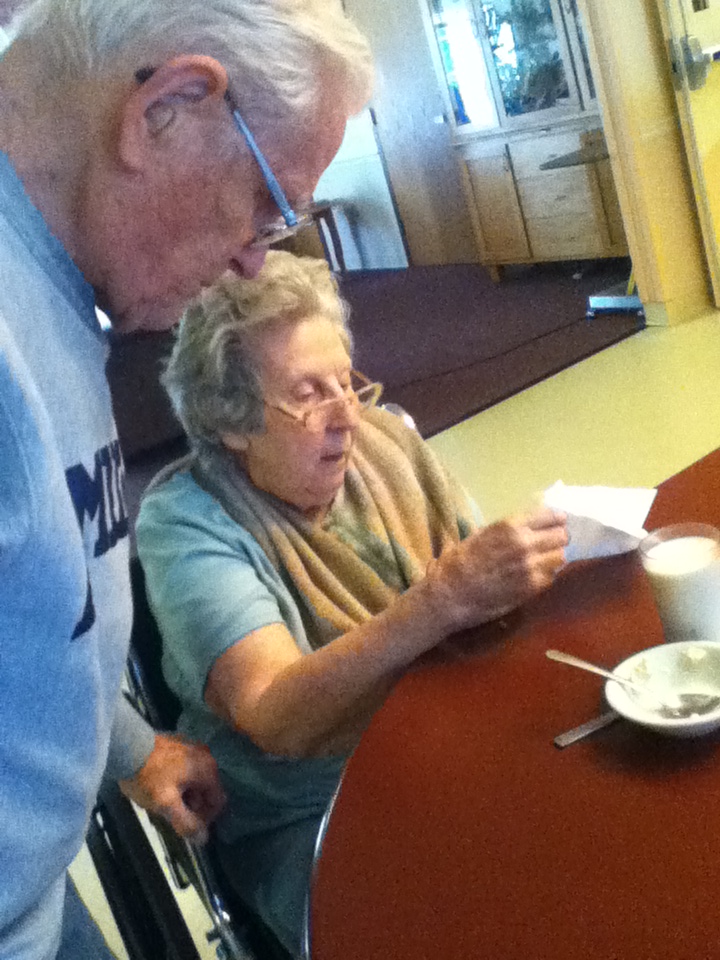
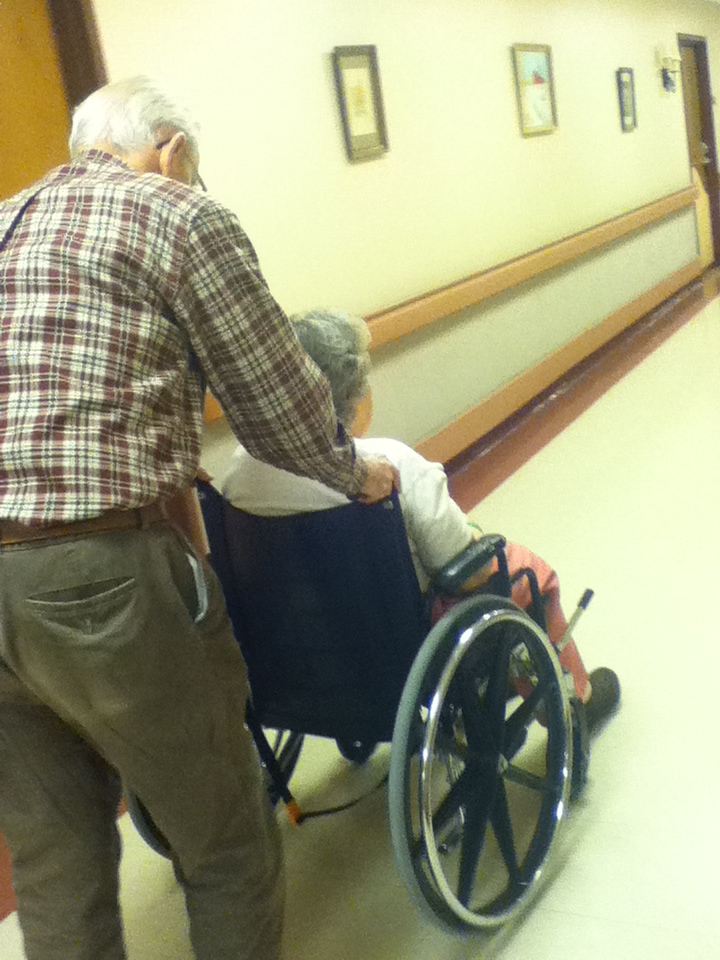
9. Sit — For several years, I watched my father visit my mother every day twice a day. She couldn’t carry on a conversation toward the end so he just sat with her.
Now I sit with him most evenings while he watches television. Wheel of Fortune, Jeopardy, a baseball game, whatever.
10. Share a meal — My father could win prizes for being the world’s slowest eater, but we sit together every night to eat. I’m so thankful that my daughters patiently wait until he’s done. No devices. Just conversation. It is good.
The sad thing about a list like this is that the people involved in elder care will see it and nod in agreement, but most other people (myself included in years past) will just gloss over it.
But then, again, Karl applied for a job at a retirement home. Maybe this will be helpful…
A friend who is helping care for an elderly relative told me about one evening when she went to visit her aunt and she found her wearing no pants. It reminded me of a poem I had written when my mother did something similar.
Here’s my poem:
My mother had no pants on
When she came down the stairs.
The funny thing about it was
It seemed she didn’t care.
The Emperor’s New Clothes became
The Grandmother’s New Pants –
Invisible clothes or missing –
I took another glance.
My children both politely
Turned their backs to her.
Modesty would dictate
Their behavior be demure.
“Mom, you need some pants on!”
“I know,” was all she said.
She settled in the kitchen,
Looking to be fed.
“Go put some pants on now,”
I commanded best I could.
“I will,” she said, but sat there,
So I didn’t think she would.
My father finally got her
To get up and find some pants.
I thought (but didn’t do)
A little happy dance.
Sometimes I let my toddlers
Run around with legs quite bare.
A child in only diapers
Would never get a stare.
But a grannie wearing panties,
Well, that’s a different sight.
Embarrassing for all involved —
It simply isn’t right.
So, help me, Lord, to understand
What is it I should do
When my mother comes down pantless
And doesn’t seem to have a clue.
It took some work for me to find the poem for my friend. I’ve started and stopped a number of blogs under various names.
Once I went through and started systematically deleting everything I had ever written — a self-inflicted devastation.
A lot of my writing is lost forever.
Meh.
Honestly, who cares? They’re just words.
I console myself with that fact that far more important words — words written by Jesus Himself in the dirt (John 8) — are forever gone.
Yesterday, on a forum, someone asked this question: “…what are the favorite blog posts you have written? Perhaps not the ones that have generated the most traffic, though it could be that, but the ones that reveal you.”
Believe it or not, I thought of this little poem. Actually, I thought of a few little poems I’ve written. I still can’t find one of them.
But when words and life are hard, poetry — dumb little rhyming poems — give a structure and a lightness to my thoughts.
The other day a friend posted on Facebook a rejection she had received for poetry submitted for publication.
She is a wonderful poet and writer, and I ached because a rejection feels like, well, a rejection — a failure — and she is not a failure.
How do we measure success? I asked myself — and, in a flash, I saw the scene that I wrote out below. It’s a totally made up story, kind of like a nightmare — but here it is for what it’s worth.
“Thank you for filling out the questionnaire,” the doctor said, studying the paper in front of him. He was checking off my answers with a pencil. I felt like it was more a quiz, than a get-to-know-you form for the first visit.
“You prefer to be called Sally?” he asked, looking up at me.
“Yes, I do,” I replied. I smiled at him, but he was already looking back down at the paper.
“Height, okay… Weight,” he looked up at me again. “You might want to lose a few pounds.”
“I know,” I said, “but things have been stressful lately, and I stress-eat…” My voice trailed off. I was hoping for a bye, but he just kept going down the list.
“You noted that you’re a writer,” he said, looking up again.
“I did?!” I said, questioningly because I didn’t remember putting that down.
He picked the paper up and turned it toward me, his finger pointing at a fill-in-the-blank mid-page. In my handwriting, next to the word “employment,” was the word “writer.”
“Oh,” I stammered, “I’m not really a writer. I don’t know why I wrote that.”
“Do you write?” he asked.
“I guess,” I said.
“Have you submitted pieces for publication?” he asked.
“A few, I guess, a long time ago.”
“How many times have you been rejected?” he asked. It was more of a demand.
I squirmed uncomfortably. What was this all about? I wondered.
“I don’t know,” I said. “I don’t understand. Why do you need to know this?”
He glared at me.
“Can I change my answer?” I asked.
“Real writers have a pile of rejections,” he said. “I think changing your answer would be wise.”
He picked up a pen and neatly crossed out my response, then sat with pen poised waiting for my new answer. “Employment?” he asked.
“Umm.. I’m mostly a mom,” I said.
“How many children do you have?” he asked.
“Eight,” I told him. I found myself sitting a little straighter in the chair now. Surely this would impress the man.
“How many times have they broken your heart?” he asked.
“What?!” I asked.
“You know, how many times have they fallen, made bad choices, or failed?” he said.
“I thought you would want to hear about their successes. They’re doing pretty well,” I said.
“Real mothers have their hearts broken on a regular basis. They start off putting bandaids on skinned knees and move on to bruised egos and hurt feelings. They ache with their children. I’m trying to determine if you are a real mother,” he said, and then he repeated his question. “How many times have they broken your heart?”
I thought of the many emergency room visits, the hospitalizations, the times I stood outside a bedroom door and prayed for the child inside. I thought the listening and the insufficient advice I tried to give. I thought of skinned knees, skinned hands, stitches in the head, broken bones, tears, tears, tears, and more tears. I thought of driving when called for help and crying all the way, dropping kids off for college and crying all the way home, and watching them get married and crying for joy.
“How many times have they broken your heart?” he asked for the third time.
I debated about using photos of my children in sports.
Swimming, tennis, soccer, and diving all have their graceful moments.
graceful bubbles?graceful kick?
I also have little ballerina pictures. Ballerinas are the embodiment of grace.
Mine is the one trying to curtsey.
But I knew immediately which photo spoke grace to me. The trouble was finding it.
It was a picture of my father taking care of my mother.
Not this one
He visited her every day. Twice a day. He fed her. He pushed her wheelchair on walks.
or even this one
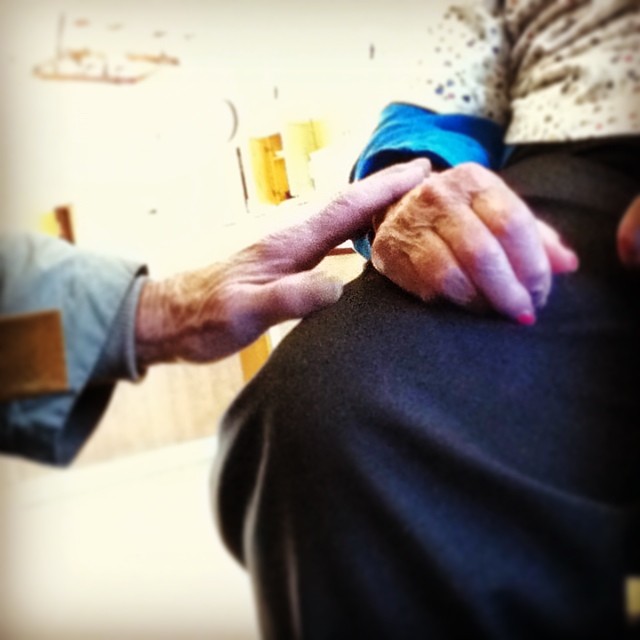
This was after my brother passed away. He went to tell her the news that her oldest child had died of a heart attack. Because of her dementia, she couldn’t understand, and he had to repeat the painful words over and over. It broke my heart. His grief was doubled because she was unable to share it.
But her bore it.
The graceful picture I thought of was this one. It may not be the best picture, but it was a special moment.
My mother was in the hospital and my father brushed her hair for her.
Mothers brush other people’s hair all the time — sometimes even adding a little spit to do the trick. Of course, I never did that — added spit, I mean.
But this was new territory for my father. He was a little clumsy doing it. But he wanted her to be cared for, and he wanted to be the one to do it.
So he did the best he could to brush her wayward hair into place.
And it was an act that was full, very full, of grace.
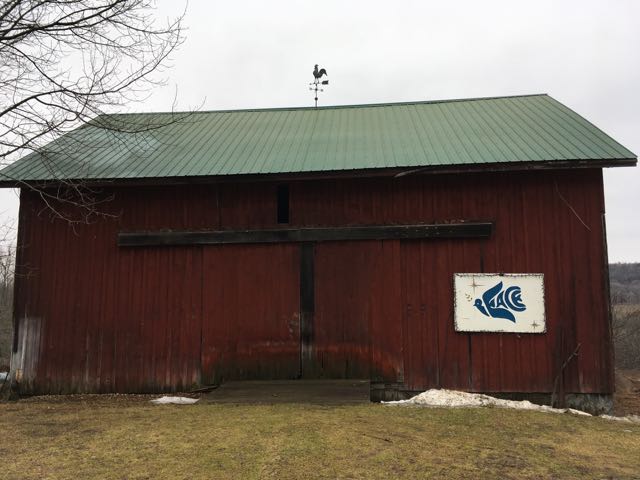
The side facing the road is red, the traditional color of many barns. My mother painted the Peace Dove around 40 years ago on a sheet of plywood. Bud found it in the barn this fall and decided to hang it for the holidays.
The northern side bears remnants of the red. Also a few broken windows.
And a tree with a cool twisty trunk.
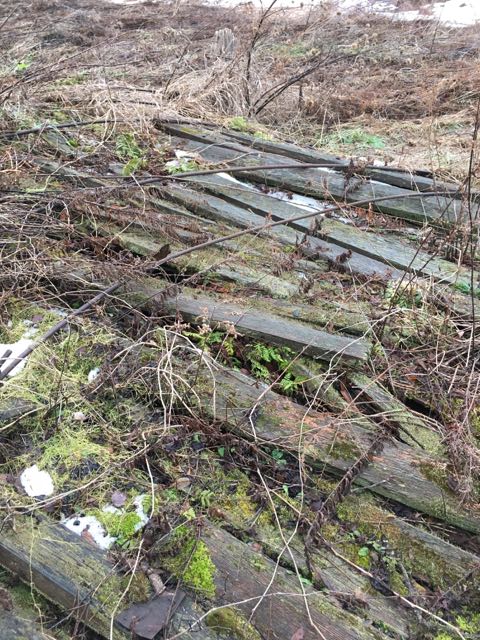
The messy back side is a mish-mash of red, green (discolored plywood), and black, where the silo used to stand.
Here is what remains of the old silo — metal bands and wooden staves becoming one with the earth.
The southern side is all gray, discolored in the one corner where a truck cap leaned against it for years.
I think this side is the prettiest.
I took a picture of it during the summer just because I liked the way it looked.
It’s lovely, don’t you think?
Exposure to the elements and weather brings about changes — like the trials in our lives. We end up with some scars and a few broken parts.
But if we lean in, we might find some beauty there.

![IMG_5087[1]](https://hotdogsandmarmalade.com/wp-content/uploads/2014/11/img_50871.jpg) When I think about my trip, I find myself almost looking forward to that lingering smell, too. Afterwards, when I get back home, will I pull something from my bag that smells of cigarette smoke, put it to my nose, and smile because of some memory it evokes?
When I think about my trip, I find myself almost looking forward to that lingering smell, too. Afterwards, when I get back home, will I pull something from my bag that smells of cigarette smoke, put it to my nose, and smile because of some memory it evokes?












 Hot Dogs and Marmalade