elderly · Travel

The Lucky One

I was sitting at the train station in Charleston, South Carolina.

The evening was a balmy 60-something — balmy in comparison with the 30-something I left behind in New York that morning. The station was clean, well-lit, and sparsely populated. I sat on a blue bench playing word games on my phone while waiting for Mary’s train to arrive.

“Last time I rode this train, it was an hour and a half late,” a man said. I looked up to see a wiry African-American man with gray bristle-y hair poking out from the edges of his Kufi. “Folks waiting for me in Savannah had to change their plans all around because of this train.”

I just smiled at him. My train experience is pretty close to nil.

A few minutes later my daughter texted me from the train. “Conductor says we should be in Charleston around 8 – 8:15.” Over an hour late.

Image result for north charleston train station
North Charleston train station, photo from abcnews4.com

The man was pacing the train station. On his next pass near me I told him what Mary had said.

He shook his head and sat down beside me. “This train never runs on time,” he said.

How we got from there to where our nearly hour-long conversation took us, I don’t know. Before I knew it, he was telling me about “Mama.”

“I was the lucky one,” he told me. “I took care of Mama. They was eleven of us, and I was lucky number nine.”

He shook his head and smiled, a gesture he repeated often as he remembered his mother.

“Mama was smart. She got her degree in journalism. You better believe we learned how to write. She and Daddy sent us to parochial school in New York — all eleven of us.”

I thought of how my parents valued education. My grandfather, my father’s father, never went to high school, but each of his children went to college and graduate school.

“Mama worked for Richard Nixon. She helped with his campaigns in New Jersey and he gave her a job with the federal prisons there.”

My father loves to tell people how he met Haile Selassie. Rubbing shoulders with the mighty.

“When my daddy was dying, he called me to his bedside. ‘Ali,’ he says, ‘Ali, you take care of your mama.’ I said to him, ‘Daddy, of course I’ll take care of Mama.’ But he says, ‘No, I mean it — you really take care of Mama.'”

He shook his head and smiled. “I was the lucky one.”

My father outlived my mother — but I watched him take care of her and I helped where I could. Making sure my mother was well-cared-for was a priority.

“I moved in with Mama.”

I moved in with my father.

“Mama fell and broke her femur. The doctors wouldn’t operate. They said nobody would operate on her. She was too frail. 90 years old. 90 pounds. All they give her was morphine to ease her pain. That was her last month alive. I kept her in her own home.”

We aren’t there yet. I try not to think about my father’s last days.

“I give the eulogy at Mama’s funeral. I look over at my brothers and sisters boohooing, and I said, ‘What you boohooing about? You didn’t come see her. You didn’t take care of her. You just feeling sorry for yourself.’ I said that to them. And they was mad. Hoo-boy! They was mad.”

He chuckled a little to himself. “But, you see, I was the lucky one. I got to care for my mama. When she died, I didn’t cry. I had given her everything I had.”

No regrets living — I could relate to that, too.

I’m thankful that my family pulls together. My siblings help — but I know that I’m the lucky one, too.

The train pulled in to the station and we both stood.

“Been real nice talking to you,” he said, and he extended his hand to me. “I’m Ali.”

I already knew that.

“I’m Sally,” I said, and shook his hand.

“Been real nice talking to you,” he said again.

It had been real nice listening.


Faith · family

Unwrapping

Every man, however matter-of-fact and prosaic, likes to receive his presents wrapped… He hesitates to cut the string; he prefers to untie the knot, to unfold the paper, and so to come slowly upon the fond surprise awaiting him. The contents element he will be able to enjoy for months, perhaps for years; the parcel element he can only enjoy for a few blissful seconds; he therefore lingers over it that he may taste its drawn out sweetness to the full.  It is part — and a striking part — of our human love of mystery.

Like so many other things that are pregnant with romance, brown paper and string look commonplace enough; yet, in reality, they embody all the wistfulness, the tenderness and the sacredness of Christmastide.

… I have an old hymnbook in which the words [to a classic Christmas hymn] are rendered:

“Wrapped in flesh the Godhead see,
Hail the Incarnate Deity!”

Wrapped in flesh! It is the phraseology of the parcel! The child’s eyes sparkle as he catches a glimpse of the present through the paper. Human eyes have been entranced as they have beheld the unspeakable gift ‘wrapped in flesh‘ — the Deity Incarnate!

From My Christmas Book, by F. W. Boreham

I read that passage the other morning and immediately thought of my mother. She could unwrap carefully with the best of them.

Below is a post I wrote in 2013 about my mom unwrapping a Christmas present.

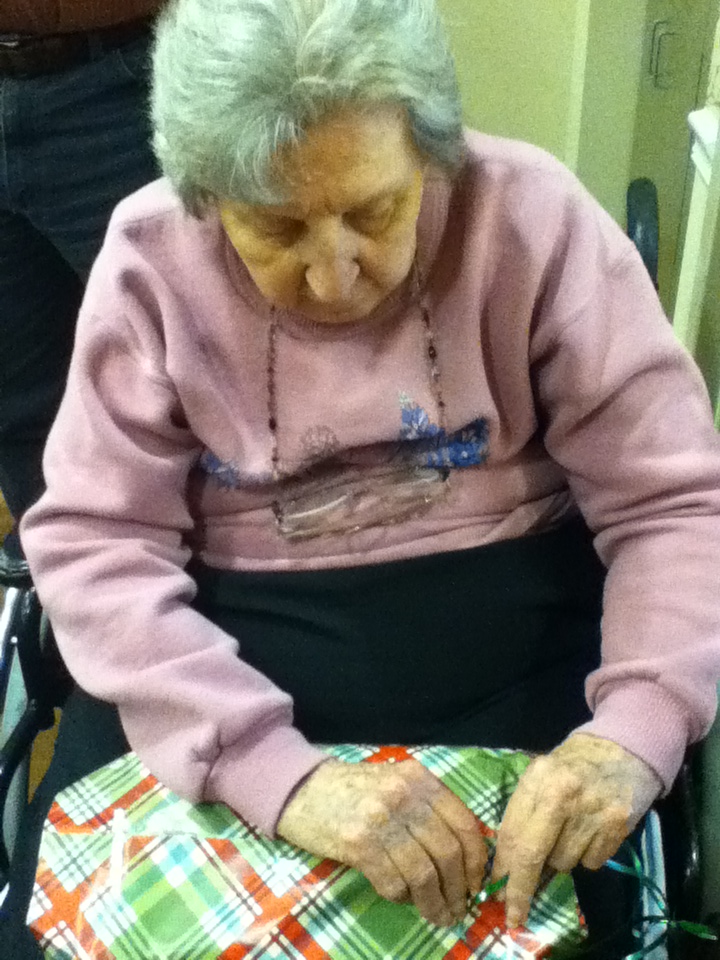
“Mom, the suspense is killing me,” I told my mother yesterday.  She took, oh, I don’t know, close to twenty minutes to unwrap a single gift.

My mother has always been a careful unwrapper.  I would blame it on our Scottish heritage, except that’s my father’s side of the family.  Are the Danish thrifty too?  For as long as I can remember, though, she has carefully peeled the tape off packages so as not to tear the wrapping paper.  It can be reused, don’t you know.

Alzheimer’s hasn’t taken that trait away from her.  Old age has slowed her down.  When you combine the two, well, let’s just say, it can take a painfully long time to unwrap a gift.

“Here’s a gift from Donabeth,” I said, placing it in her lap yesterday.  She looked at me with watery eyes.  I wasn’t sure she understood.

“Open it, Mom.  Let’s see what’s inside,” I said.

She held it on her lap for a long time.  I suggested, cajoled, encouraged, prodded, goaded, urged.  Nothing seemed to work.  Finally I said the line about suspense.

“That’s the name of the game,” she said. “Suspense.”  Maybe she was more aware than I gave her credit.

She turned the package over and began picking at the tape.  Did I mention that this was a slow process?

So slow, in fact, that she fell asleep while doing it.  Fortunately it was just one of the doze-y little catnaps that lasts only a few minutes.

Once the pretty paper was removed we found that my sister had the nerve to also wrap the gift with a layer of bubble wrap.

I began the same “encouragement” process, but Bud came over and simply removed the bubble wrap.  None of this waiting around stuff.  The suspense was killing him, too.

Inside was a music box that played “Amazing Grace.”  My mother listened to “Amazing Grace” over and over.  When I thought she had lost interest, I put the music box on the table.  I went to do something else and heard it playing again; my mother had retrieved it and opened it again.  Over and over.

Music still touches something deep inside.

I’d say she liked it.

Merry Christmas, Mom.

Faith

Boreham’s Introduction to Advent

I hate the saying “It’s easier to ask forgiveness than permission.”

And yet… I’m going to do that.

If F. W. Boreham was alive, by all means, I would ask. “Could I please, please, please, put your introduction to My Christmas Book on my blog? I promise to give you credit and direct people to where they can buy the book. It’s just so relevant to today.”


But he died in 1959, before I was even born.

I wish I could remember how I stumbled across Boreham. I read one of his books earlier this year — A Bunch of Everlastings.

Then I did that other thing that I hate for people to do. I bought something for myself that was on my Christmas wishlist. I bought a second Boreham book — My Christmas Book: A Handful of Myrrh, Aloes and Cassia.

I was going to wait for Advent to start reading it — but I couldn’t. Since reading the intro about a week ago, his hope-filled words have been running through my mind.

From Boreham’s “My Christmas Book”:


By Way of Introduction

A Child is Born! That is Forever and Forever
The Message of Christmas.

A Child is born!  In the early days of the nineteenth century, men were following with bated breath the march of Napoleon and waiting with feverish impatience for the latest news of the wars. And all the while, in their own homes, babies were being born. Just think of some of those babies. Why, in one year, lying midway between Trafalgar and Waterloo, there stole into the world a host of heroes! During that year, 1809, Mr. Gladstone was born at Liverpool; Alfred Tennyson drew his first breath at the Somersby rectory; and Oliver Wendell Holmes made his initial appearance in Massachusetts. On the very self-same day of that self-same year, Charles Darwin made his debut at Shrewsbury and Abraham Lincoln in Old Kentucky. Music was enriched by the advent of Frederick Chopin at Warsaw and Felix Mendelssohn at Hamburg.

But nobody thought of the babies. Everybody was thinking of battles. Yet, viewing that age in the truest perspective which the years enable us to command, we may well ask ourselves which of the battles of 1809 mattered more than the babies of 1809. When a wrong wants righting, or a work wants doing, or a truth wants preaching, or a continent wants opening, God sends a baby into the world to do it. This is why, long, long ago, a Babe was born at Bethlehem.


You may not agree with his list of heroes, (or the comment about “opening continents”) but you get the gist.

Hope is here. It’s born every day. An echo of the ultimate Hope born in Bethlehem.


family · Life · swimming

Encourager or Discourager

Last week, I sat at the timing table in my effort to learn how to run the computer for swim meets.

The woman on my right was the embodiment of sugar-and-spice-and-everything-nice. She was genuine, kind, enthusiastic, and, like me, new and a little overwhelmed by the goings-on at the table.

The woman on my left was a pro. She had been working the table for many years. She was calm and unflustered, even when things got crazy.

Pool acoustics are never great, so neither woman could not hear what the other was saying.

Sugar-and-spice nudged my elbow during the 50 Free. “See that boy over there?” She nodded at a swimmer in the far lane. “I wish I had taken a video of him on the first day of practice,” she said. “He could barely swim. Look at him go!”

I watched the boy thrashing at the water slowly making his way down the pool far behind the other swimmers.

On my other side Ms. Pro said, “Oh, God! I don’t know why they allow that kid to swim! He moves in inches! This is going to take forever!”

Behind her, a young woman echoed her sentiments. “His stroke is awful! Look at him. He’s not cupping his hands!”

Sugar-and-spice said again, “He’s doing so well!”

Ms. Pro groaned at his slow progress.

I felt like I was sitting with an angel on one shoulder and a devil on the other, one focusing on what the swimmer could do and the other focusing on everything he couldn’t.

I told Laurel about it on the car ride home. “I know which one I want to be,” I said.

Later that night — midnight to be exact — I was up with my father. He had changed mostly out of his pajamas and had his shoes on. That night’s self-donned wardrobe consisted of four layers of shirts, one-and-a-half layers of pants (don’t ask), three socks on one foot, and a single compression stocking on the other.

“Dad,” I complained, “what are you doing?!”

“I thought I was doing the right thing,” he said.

After getting him changed into his pajamas and back to bed, I lay in my own bed thinking about the swim meet, and how easily I became the person I didn’t want to be. I was frustrated with what my father.

“Lord,” I prayed, “help me appreciate the fact that he can still put on a compression stocking — because that’s hard. He can still tie his shoes. He can still walk. And talk. And feed himself.”

I fell back asleep counting his abilities.

Two hours later he was up again. And I forgot again.

“Dad,” I said, “you’ve got to get some sleep!” By which I meant I need sleep.

“I’m doing the best I can,” he said.

And I remembered again the boy with uncupped hands struggling down the pool. I remembered Sugar-and-spice cheering him on.

Again I prayed. “Thank you, Lord, for my father. Help me help him. Help me give back to him a little of the lifetime of caring he has given to so many. Thank you for the lessons that he still teaches me. And thank you that he’s back to sleep.”

For now, I thought, and smiled.

poetry

apologies to e e cummings

i thank You God for most this amazing
day: for the brownly roasting spirit of turkey
and a scarlet celebration of cranberries; and for everything
which is edible which is edifying which is yum

(we who are scattered gather today,
and this is thanksgiving; this is the wealth
of abundance of family and friends: and of the glad
long table illimitably mirth)

how should smelling tasting touching seeing
consuming any—lifted from the yuck
of all nothing—food becoming Eucharist*
not invoke Gratitude?

(now the tastebuds of my tongue awake and
now the fullness of my heart overflows)


(e e cummings original poem)

*The word “Eucharist” is a transliteration of the Greek word eucharistia, which is itself a translation of the Hebrew word berekah. All three words have the meaning of thanksgiving, or praise for the wonderful works of God. (from: votf.org)

Faith · friendship · Life

Treasure

At church on Sunday, the visiting pastor asked people to share “God moments” during a time when people usually share prayer requests. I knew exactly what I would say if only I were brave enough.

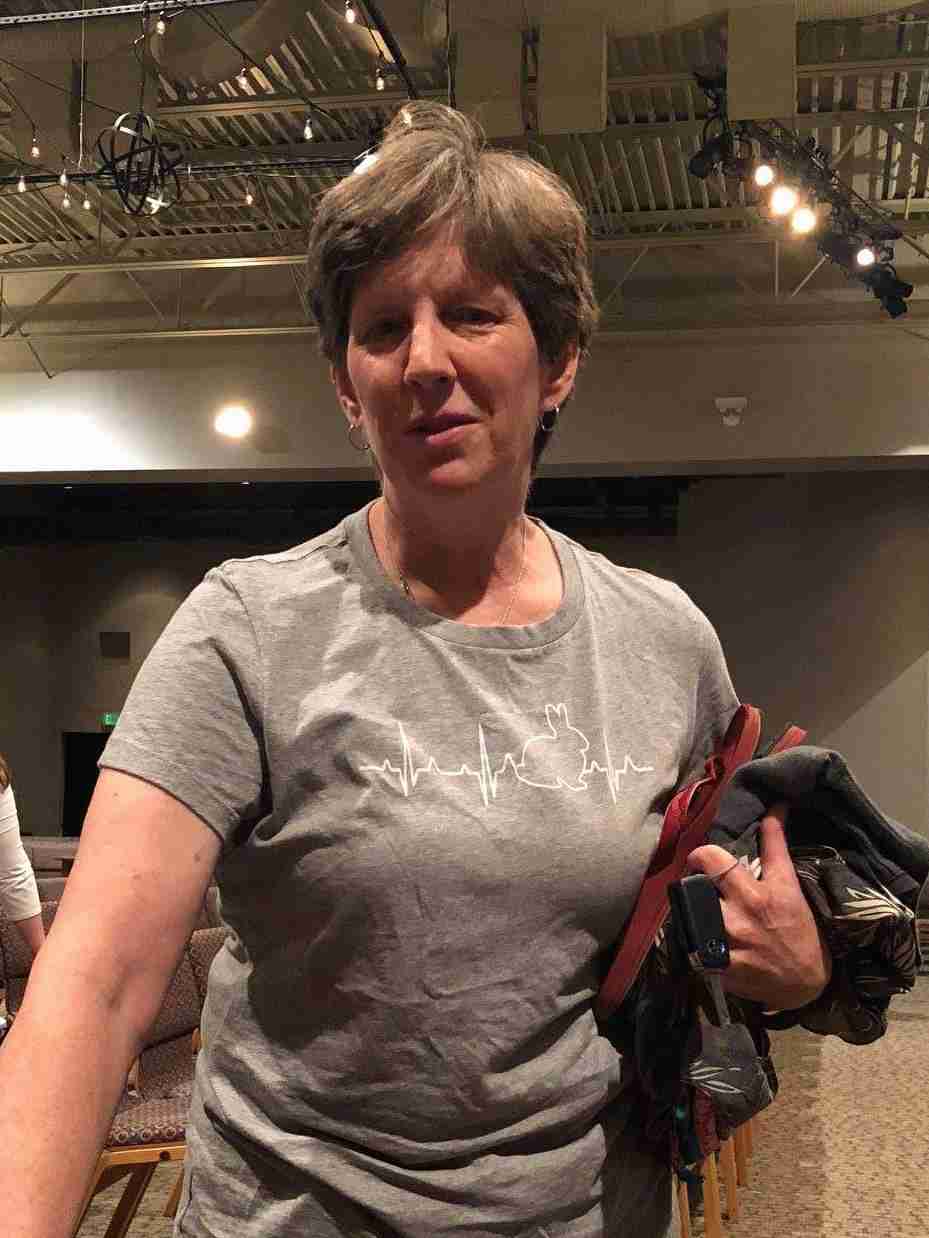
My God moment had started at the end of September, when my anxiety was at an all time high. I received an unexpected package in the mail that contained a t-shirt and coffee. Coffee is one of my love languages — and the t-shirt, soft and gray, with a rabbit and the rhythm of a beating heart, was perfect. I pressed it against my cheek and thought of the dear friend from Indiana who had sent it.

wearing the shirt at Hutchmoot (photo credit Lisa Eldred)

St. Teresa of Avila said, “Christ has no body now, but yours. No hands, no feet on earth, but yours. … Yours are the hands with which Christ blesses the world.”

In that moment, my far-away friend was Christ to me, soothing my anxieties and reminding me that I was loved.

A few days later, another Indiana friend unexpectedly pressed a little package into my hand — a tiny clay rabbit she had made for me. Rabbits are another my love languages.

In the weeks that followed, as I dealt with a lot of interrupted sleep because of my father, my husband being quite ill with what we now know to be Lyme’s Disease, and my youngest daughter suffering a concussion, other packages showed up at my house.

A hand-crocheted hat and scarf.

Mary borrowing my new hat.

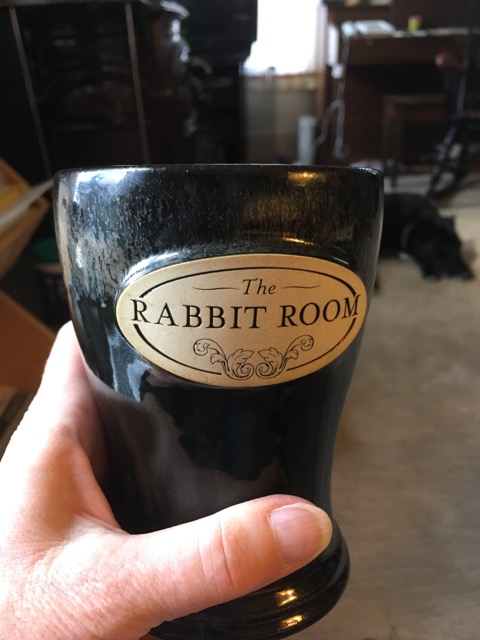
A mug to replace one I broke years before and never thought I would hold another like it.

A FreeWrite — a portable smart typewriter that I had off-and-on looked at wistfully for a couple of years.

The packages came from Alabama, Florida, and Michigan.

On a day when I was feeling overwhelmed, one would arrive.

I sat one morning drinking good coffee from my new mug, feeling very rich indeed, and a story came flooding back to me. It was a Dr. Purple story that I stumbled across when I was researching this 19th century physician from the village of Greene.

In 1826, Dr. Purple has acted as clerk for a trial in the village of Bainbridge, a nearby town. Joseph Smith (yes, that Joseph Smith) was on trial. He claimed to have a stone that could reveal to him where treasure was buried. For a fee, he would tell the landowner where to dig. When the man started digging, the treasure would recede and never be actually found. The landowner would be disappointed. Until, of course, Joseph Smith with his seer stone claimed to have found the treasure again in a different spot on his land. For a fee, he would tell the landowner where to dig.

I thought about the disappointment of that treasure that could never be grasped — and the depth of the treasure I held in my hand in the form of a mug sent by the generosity of a friend.

All that ran through my head when the pastor asked for a God moment — I had had a whole month of God moments, and then some.

The riches we have in Christ are riches indeed.

Sometimes they come in the form of rabbits and hats and typewriters.

And sometimes it’s a mug full of coffee.

Yes, definitely coffee.

dementia · family · Life

2:30 AM

“I’m not doing this on purpose, you know,” my father says to me.

It’s 2:30 AM. I’m pointing at his clock, the new one we got that tells the time and the time of day. Above the 2:30 AM the word “PREDAWN” appears.

My father presses his lips together and narrows his eyes. He looks like the emoji with horizontal lines for both eyes and mouth. Exasperated. Frustrated.

I’m not sure what that emoji is supposed to represent. I’m terrible at reading emojis. My children try to teach me.

“I can’t believe you used the eye-roll emoji,” one of them said to me after I, guess what, used the eye-roll emoji. I thought it was more of a shruggy-I-dunno face. But what do I know?

“You use that smiley-face?” another one asked once. I use the basic smiley — no teeth, no open mouth, just a little upward-curved line.

“What’s wrong with it?” I asked.

“I read that as a snarky-teenager-if-you-say-so face,” she said.

Sigh. I dunno.

But at 2:30 in the morning, I’m not thinking about emojis. I’m thinking about redirecting.

I have a baby monitor in my room so I can hear him when he gets up. He often gets up to use the bathroom and then goes back to bed uneventfully. And I go back to sleep, because I haven’t left the warmth of my bed.

Some nights, though, I don’t hear the squeak of the hospital bed as he climbs back in. Instead I hear running water in the bathroom and know he’s planning to shave. Or I hear the creak of dresser drawers being opened followed by the sound of the hanging drawer pull as it drops down and hits the brass plate. I know then that he’s getting dressed and that it’s time to redirect.

I climb out of bed, turn the monitor off, and head downstairs. The overhead light is on in his room, its bright rays extending under the door. Sometimes, when I open the door, I find him in the bathroom. Sometimes, he’s at his dresser. Sometimes, he’s just standing in the middle of his room, like he doesn’t know what to do next.

“I’m not doing this on purpose,” he says to me, and it breaks my heart. He knows that what he’s doing isn’t right, but he also doesn’t know what the right thing to do is.

“Look at the clock, Dad. It’s 2:30 AM. You’re supposed to be sleeping.”

“I know that,” he says.

“Can I help you get back into bed?” I ask.

“You want me to go back to bed?” he asks. What I’m saying connects, but it’s like using a corroded battery where the connection isn’t a connection because of yuck that’s in the way.

“Yes,” I reply. “You need to sleep.”

And by that I mean that I need to sleep.

But it’s too late for me.

I help him get back into bed, then go upstairs to my bed, turning the monitor back on before I climb in. The silence on the monitor tells me that he’s back to sleep. My husband’s deep breathing tells me that he’s sleeping, too.

It’s 3 AM now.

I stare at the ceiling for an hour, wishing sleep would return to me.

When it doesn’t, I climb out of bed to begin my day.

friendship · Hutchmoot · Life

Burnt Steak and Key Lime Pie

Hutchmoot has been described more than once as a feast — and people are not talking about the food, although the food is amazing.

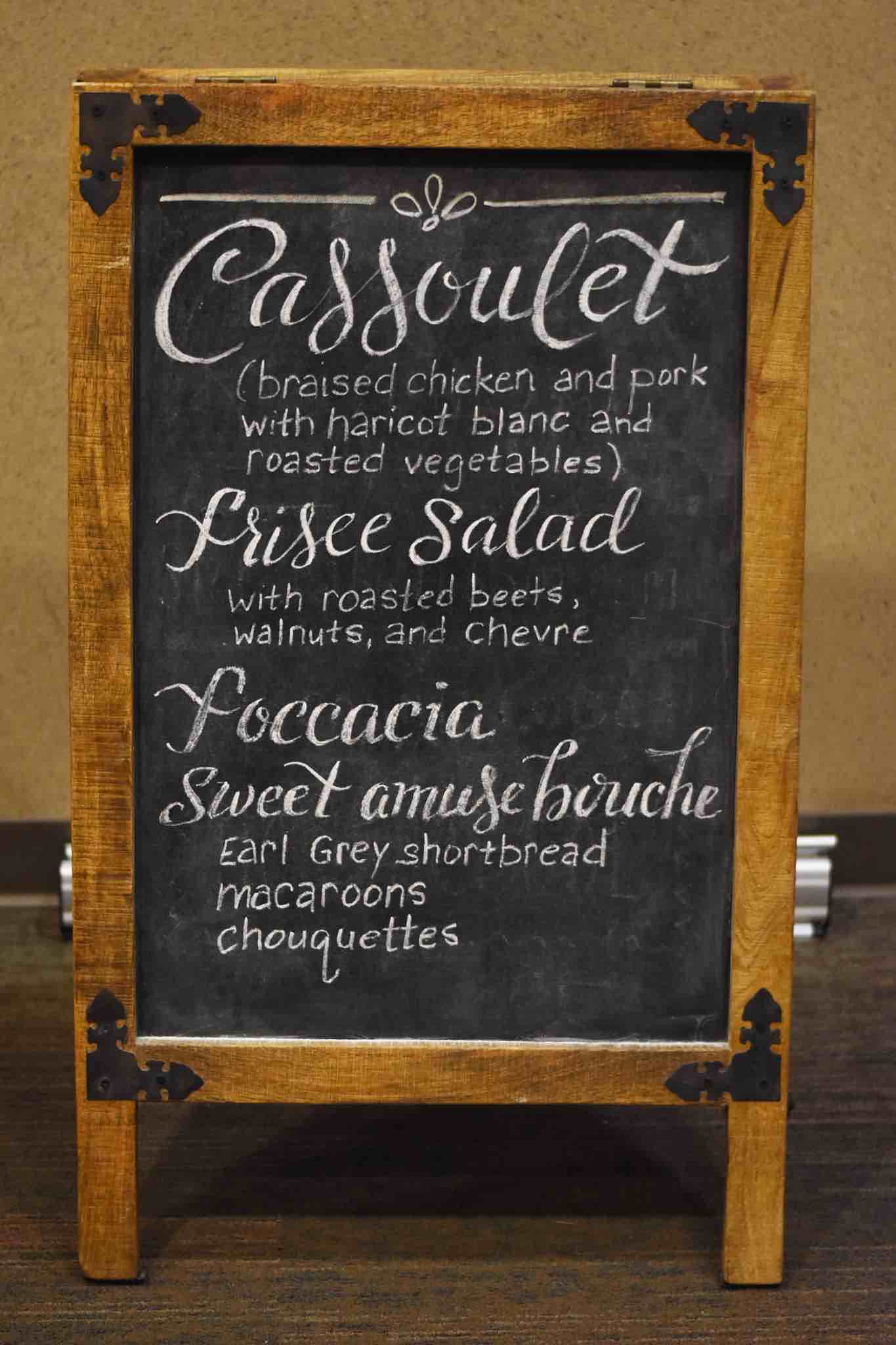
But each night our chef, John Cal, would introduce the evening meal with a story that related to the food. On the first night he talked about showing his father around New York City. For dinner each night as they ate at a nice restaurant his father would order the same thing — steak, burnt and grey. One night while dining out, he saw a plate pass by their table that looked amazing. Upon inquiry, he learned that it was cassoulet and decided to be adventurous and order it. When he asked about getting rice on the side and the waiter offered rice pilaf, John’s father got flustered and switched his order to steak, burnt and grey.

Thursday night menu at Hutchmoot.  Photo by Mark Geil
The Otesaga Hotel

In Cooperstown, fine dining at its finest takes place at the Otesaga. Years ago, when I was still in high school, my parents took our family there for Easter brunch, which was usually the best of the best, table after table of delicious food.  My youngest brother, after perusing all the food, sat down with a single piece of Key lime pie.

“There’s nothing good to eat,” he announced, which translated meant — I couldn’t recognize all the fruit in the fruit salad. I worried that they had added sour cream to the mashed potatoes. The seasonings looked weird on the vegetables. There were olives in the tossed salad.

All that food, and he ate Key lime pie. I think he ended up eating 4 or 5 pieces of it. That was his burnt steak, his comfort food that he knew he could trust and enjoy.

At Hutchmoot, I watched plates of cassoulet pass by in the form of conversations between people who hadn’t known each other until that day and they were saying to each other, “What! You, too?” The delight of finding new friends. The delight of meaningful conversation. The delight of laughing and crying together over joys and sorrows and longings.

At Hutchmoot this year I chose the familiar over the adventurous. I didn’t meet many new people. On Sunday, I sat at a Cracker Barrel (can you get any more predictable than that?) in Franklin and ate lunch with two dear Hutchmoot friends. I reveled in sinking roots a little bit deeper and strengthening already existing bonds rather than forming new ones.

I am John Cal’s father. Okay — not literally. Obviously, not literally.

But often I choose the familiar over the adventurous, especially days when I am weary.

I think sometimes that’s what we need.

I know sometimes that’s what I need.

Burnt steak and Key lime pie.

Already, though, the conversations have begun with new people. The conversations that happen over the internet from the comfort of my home, when I have time and place to relax into forming a new friendship.

I’m looking forward to the next Hutchmoot when the old and familiar may include some of them.

Hutchmoot

News Storms

“Are you feeling better?” my father asked me Monday morning.

“What do you mean?” I asked.

He looked at me, perplexed. “You’ve been sick,” he said.

I laughed. “No, Dad, I’ve been in Nashville at that conference I go to every year.”

“When I didn’t see you,” he replied, “I thought you must be sick and in the hospital.”

His world consists of a failing mind and body. To explain my absence, he made up a story that fit his world.

While I was in Nashville, I didn’t read the news. Not a once. For four whole days.

No news may not be good news, but sometimes it’s just good.

Oh — I thought about it. People talked about it. The news felt like a rip current that threatened to pull us under and drown us in our differing opinions.

But at Hutchmoot, grace, tenderness, and humility surrounded us like a warm blanket. Our commonalities pulled us close and the day’s political controversies didn’t drive us apart. In fact, when, one evening at Hutchmoot, that rip current threatened in a particularly diabolical way, Andrew Peterson, our proprietor and host, showed us how to handle even the most treacherous waters — reaching out like the very best of lifeguards to pull us to safety.

The Brett Kavanaugh – Christine Blasey Ford controversy is mostly over, ending while I was away. It was an earthquake followed by a tsunami — and now America moves on – battered, skeptical, self-protective, and uglified by debris.

I couldn’t help thinking about how my father truly believed his own story of me being in the hospital. It fit his world.

And I daresay people who could insert themselves into Christine Blasey Ford’s story, who knew what it was to be sexually assaulted, found themselves making their story her story. Perhaps they remembered how they couldn’t tell anybody because of the shame they felt. Perhaps they remembered how they wanted to move far far away and start over in a new place without the reminders of that terrible act.

On the other side, people who had been falsely accused, who had been doing their best to do their best, working hard and keeping their nose clean for decades, who suddenly had been falsely blindsided by some incident from 30 years ago — perhaps they watched Brett Kavanaugh and asked themselves, how would I handle this? Perhaps, they told themselves, This is so unfair. Perhaps they know that they, too, would have gotten a little testy under that questioning.

But we don’t take the time to stand in someone else’s shoes. We put them in our story and force it into a narrative that may or may not be true. We make it make sense in a way that makes sense to us.

Like my father putting me in the hospital.

At Hutchmoot, I found a tranquil haven from the current current-news storm.

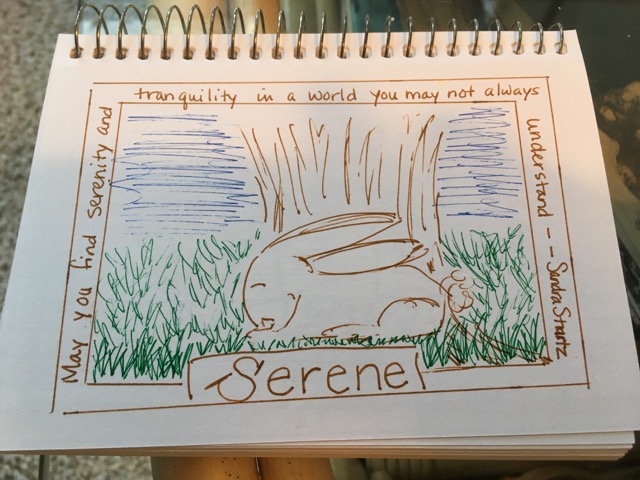
My October 2 Inktober attempt. “May you find serenity and tranquility in a world you may not always understand.” — Sandra Sturtz Hauss

Thinking ahead to the next storm and the next — because we seem to be in a political hurricane season in the US — I’m going to try to do more listening, less trying to inject my assumptions into the news stories. More trying to understand the fraught emotions on both sides, less knee-jerk judgmentalism. More compassion, more looking for common ground.

I would rather be a safe haven than a whitecap on this stormy sea.


Life

Denying the Doughnut

Laurel started in the public school this year as a sophomore. Had I known that last year was to be my last year homeschooling, I may have grieved.

Or not.

Life is busy and full and rich and keeps moving along.

I wanted to take one of those “First Day of School” photos that I see people post. But “ain’t nobody got time for that” is an accurate double negative. Some people DO have time for that — just not me.

Anyway, Laurel was rather nervous about starting school, and, therefore, rather uncooperative about a First Day of School photo. This was all I got:

So we have a new normal and a new morning routine.

Every weekday morning I join the throngs of parents driving their child(ren) to school. I follow the precise hand gestures of the sometimes-meter-maid police officer as he directs car past the elementary school. I wait in the line of cars to reach the drop off spot at the high school.

After I drop Laurel off and I start driving home, I think about the bakery.

Seriously.

This is a true confession here.

I love Schneider’s Bakery in Cooperstown.

They have the best doughnuts in the history of doughnuts. Their old-fashioned doughnuts are my favorite.

So I drop Laurel off, and think about swinging past the bakery to buy a doughnut for myself.

Comfort food for my grief, you know.

Every day, though, I turn to head back home instead of going to the bakery.

It’s an empowering moment — knowing I could make an unhealthy choice, but am choosing to make a good one.

Last Friday, I made my healthy choice, patted myself on the back, and went home.

Two hours later I had a meeting to attend. When I walked in the office at the pool I saw a box from Schneider’s Bakery sitting on the desk.

“Would you like a doughnut?” one of the guys asked and opened the box to reveal its contents.

“No, thanks,” I said, and looked longingly in the box.

We had our meeting. An hour later, he opened the box again to offer doughnuts to us.

I could smell them. I looked. And looked.

Finally, I pulled one doughnut out of the box and broke it in half.

“When you break them in half, the calories fall out,” I told him.

He laughed.

I took a small bite of my half-doughnut.

It was so good. Not too sweet. Not too doughy. Crisp on the outside and tender on the inside. Heaven in a doughnut.

I write all this to tell you two things:

One — Denying the doughnut at the beginning of the day is a great way to start. One good choice leads to another good choice and another good choice.

And, two — Eating a doughnut is not a terrible thing. It’s a thing to be savored and enjoyed. Just not every day.