On Sunday the pastor announced that anyone who wanted Poinsettia or cyclamen was welcome to take plants home. The front altar had been filled with plants for the holiday season — so, so lovely.
The cyclamen on the piano had caught my eye. It was looking droopy and sad, kind of worn out. I understood how it felt.
We are invariably among the last to leave. Bud loves to visit with people and I try to wait patiently (albeit awkwardly). I watched plants leave the sanctuary, one by one, but so many still waited to be adopted. The cyclamen on the piano drooped even more. I grabbed it and a poinsettia to take home before we left.
For my mother — you know? She loved plants. When she was alive, she always had Poinsettia at Christmas. Her Christmas cactus burst into bloom on cue with the season, as did her Crown of Thorns at Easter. It was magical.
Here is part of a post I wrote nearly 5 years ago:
At the tower of Babel, God scattered the languages of the world, “so that they may not understand one another’s speech.” (Genesis 11:7) But He left us some universal languages.
Music crosses cultures and generations.
Art speaks and moves me, though I may know not a word in the native tongue of the painter.
And flowers — God Himself uses this language to speak to us through their beauty.
Flowers may have been the language my mother understood best. She worked tirelessly in her garden, weeding, tending, making it beautiful for all to enjoy. Inside the house there was always something blooming — Poinsettia, Christmas cactus, Amaryllis, the crown of thorns, Easter lilies, mums. She understood the language of the flowers and plants, and they understood her and responded.
As my mother descended into dementia, the plants in the house looked more and more sickly. Nearly all the plants eventually died. Her huge Christmas cactus and Crown of Thorns are gone.
As I left the sanctuary on Sunday holding my sad cyclamen, Bud noticed a healthy one in the vestibule. “Do you want this plant instead?” he asked.
“No,” I told him. “I want to try to revive this one.”
It’s amazing what a little water and sunshine will do.
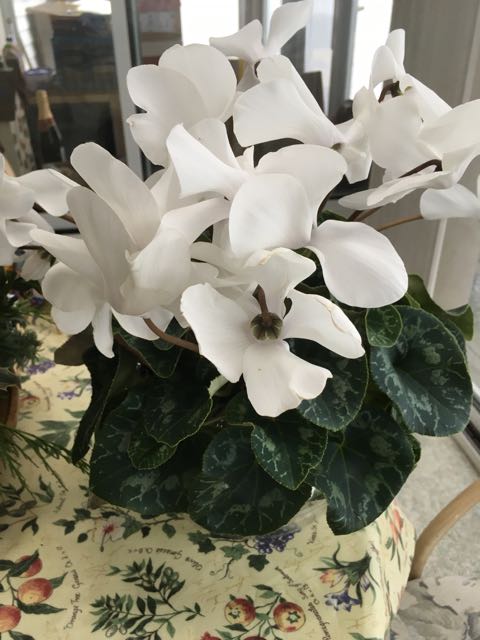
I used to tell myself that I had a black thumb and that I could never grow plants the way my mother did, but I understand better now. It’s not the color of my thumb, it’s the care and attention.
It holds true with plants.
It holds true with people.
 This is usually in response to something she doesn’t believe to be true. Like, she’ll be preparing a meal for, say, 150 people. (150 is her favorite number.) I’ll say to her, “Mom, there are only going to be five of us for lunch today — You, me, Dad, Mary and Laurel.”


 (3) Eliza made a quick run


 She was a little girl who loved to catch snakes and would stand up to bullies.
 Cleaning bodily fluids is the yuck of motherhood.
 The farmers have been spreading the manure on the nearby fields this week. The aroma fills the air. Yuck.
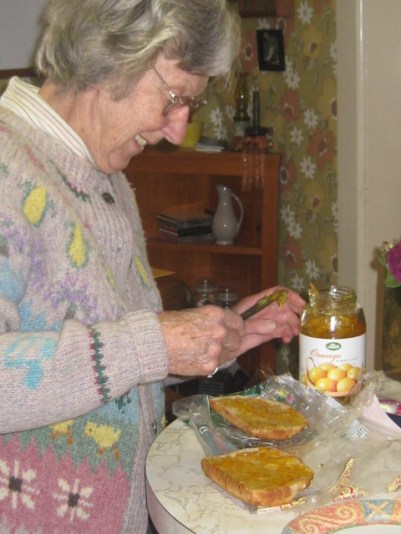
 The way my mother ate orange marmalade reminded me of Russell Hoban’s Francis in Bread and Jam for Francis.