A to Z Blogging Challenge

Obscurity

O is for Obscurity.

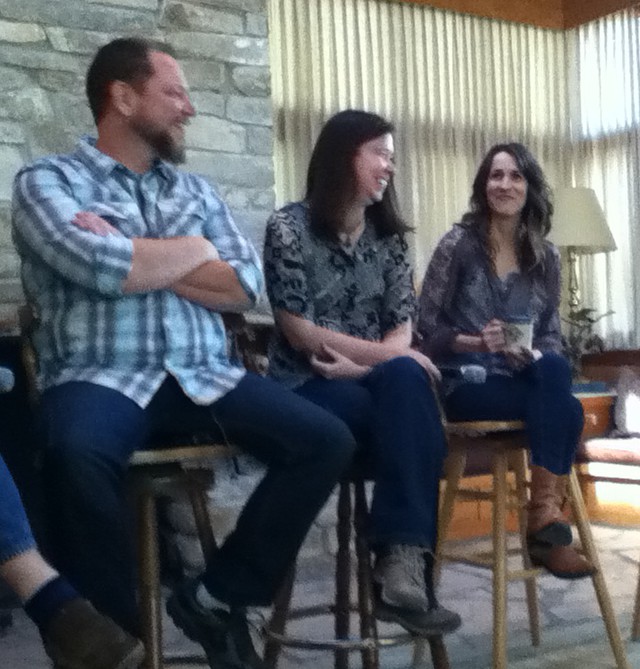
At Laity Lodge -- Jill is on the right.
At Laity Lodge — Jill is on the right. (I’m leaving the others in obscurity for now.)

Jill Phillips gave a devotion one morning at Laity Lodge and spoke about the book Forgotten Among the Lilies by Ron Rolheiser, a Catholic theologian.

Rolheiser talks about “The Martyrdom of Obscurity”, saying that ordinary life is enough.

The human heart is full of longings — but Rolheiser says that longing is our spiritual lot.

Today we are called as Christians to the martyrdom of obscurity. Christianity always invites its adherents to martyrdom. To be a follower of Christ demands that one lay down one’s life. But this takes various forms. … In our culture meaningful self-expression is everything; lack of it is death. Yet it is this death that paschally we must enter.

Whoa.

That stops me every time I read it.

Ordinary life is enough.

Yes, enough.

To live in a small town and attend a small church.

To grow green beans in my garden.

To color pictures with crayons with my children.

To watch a high school tennis match or an age-group swim meet.

To make macaroni and cheese for dinner — again.

To fold towels and clean toilets and wash dishes and sweep up the dog hair on the floor.

To be Niggle, in Leaf by Niggle, and have one leaf to show at the end of my life, because I helped my neighbor and put aside my longings for more.

All these things are enough.

To live in obscurity is not such a bad thing.

Indeed, it may be the best thing.

A to Z Blogging Challenge

Niggle

DSC03846
Reading at LaGuardia

N is for Niggle, the main character in Leaf by Niggle, a short story by J. R. R. Tolkien.

Recommended reading for the retreat at Laity Lodge, I read it on my way there. At LaGuardia.

I’ve always loved the word “niggle”. Niggles are those gentle proddings — not nagging, just nudging.  They are the post-it notes hanging in the back of your mind to remind you of something you should do.

And such is the main character of the story. Niggle is an artist so caught up in his work that he doesn’t always want to do the things he should, like preparing for his journey, because he would rather finish the tree he is painting.

But he stops to help his neighbor, albeit a little begrudgingly, because

He was kindhearted, in a way. You know the sort of kind heart: it made him uncomfortable more often than it made him do anything; and even when he did anything, it did not prevent him from grumbling, losing his temper and swearing (mostly to himself).

Ralph Wood, in one of his talks on Tolkien at Laity Lodge, said this, “It is extremely difficult to be an artist and a parent.”

How well I know that! For years whenever I would sit down to write, or even think, and I would be interrupted to tend to someone else.  Most of my children are grown now, so it happens rarely — and, truth be told, long ago I learned to embrace Henri Nouwen’s sentiment that my interruptions are my work.

Niggle, though, represents that tension — between creating and tending to the mundane, between painting and fixing the roof, between art and helping a neighbor in need.

The most important job I have ever been given was being a parent.  If I had to choose between writing and parenting, parenting would win easily.

These days, it’s the writing part that niggles at me.

Funny how that works.

Faith

Bridget

Yesterday, my friend Laura Lynn Brown launched a new site: makesyoumom.com.

I have previously written about how I met Laura at Laity Lodge.

I was honored that she asked me if I would be willing to submit a piece for her new site, so I found an old piece I had written, dusted it off a little, and sent it to her.  I was even more honored when she decided to include it in her launch.

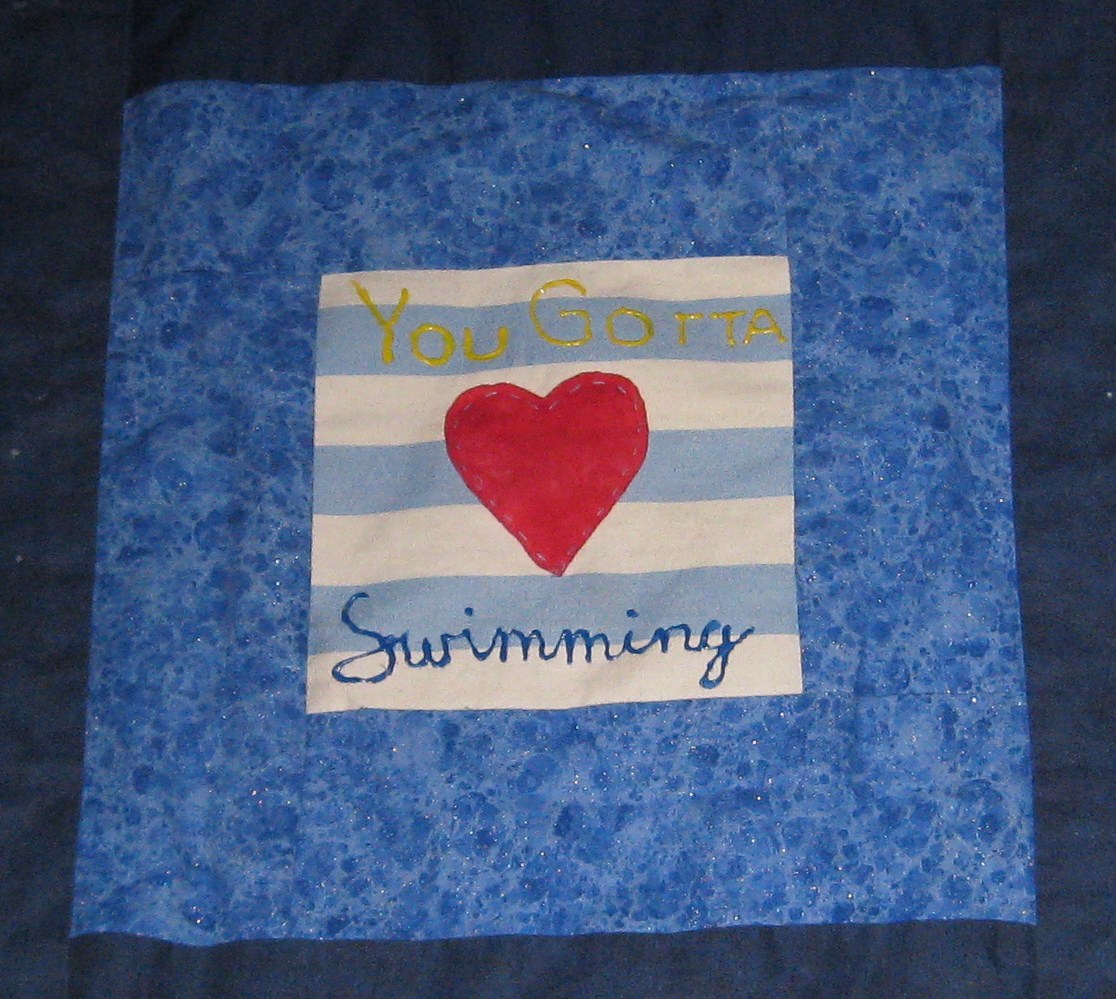
quiltsquareMomswimcoach” was written about my time coaching the Cooperstown Girls Varsity Swim Team.

Feeling nostalgic, I pulled out another piece written about that era and read through it.

Gosh, those were the days.

No, they weren’t, really.  They were hard and stressful. I was in my forties, pregnant for some of it, working outside the home for the first time in decades, trying to homeschool, and still in the wake of the storm I mentioned yesterday.

But Bridget — Bridget was a gift to me.

She was a high school girl with a sunny smile, a giving soul, and Rocky Balboa’s work ethic.

When I started coaching, I had no experience coaching anything ever. Yes, I was a swimmer.  Yes, I was a swim official.  Yes, my children swam.  Did that make me a coach?  No.  Yet there I was, on deck, being called “Coach” by eighteen girls, one of them named Bridget.

I threw myself into coaching to the best of my ability.  I used workouts that the previous coach had left me, started watching videos on teaching the different strokes, researched swimming on the internet, and shamelessly asked other coaches how they did things.

The girls knew I was new. Some used it to get out of work.  The most common technique was to negotiate during practice.

Negotiations would go something like this.

Swimmer:  Coach, do we really have to do 10 100s of freestyle?

Me: Is that what I wrote on the board?

Swimmer:  Yes, but I was thinking, maybe I could just do 5 50s of butterfly since that’s what I’ll be swimming in the meet.

Pushover me:  Sure, I guess so.

Or,

Swimmer:  Coach, do we really have to do a 200 kick?

Me:  I was thinking we need to work on our kicking.

Swimmer:  I have this blister on my foot from some new shoes and kicking hurts.  Can I just do a 100 pull?

Pushover me:  Sure, I guess so.

Eventually, I started to catch on.  Only certain girls asked me and without exception they were negotiating for something easier.  Also, as I planned out the practices, I became more and more keyed into what I wanted to work on and what I wanted the team to accomplish over the course of the season.

The more I grew as a coach, the more the negotiating irked me.  I started to say no to all negotiations.

One day, when the chief negotiator began to propose her own sets, I said no, but she continued whining and wheedling.   Something in me snapped.  I took off my whistle, handed it to her, saying, “Apparently you know more about coaching than I do,” and walked off the deck.

Bridget came and found me in the locker room. “Mrs. Zaengle, I’m so sorry,” she said.

I looked at her – Bridget, who never gave me a problem, never questioned anything I asked her to do, was apologizing to me.

She followed up that verbal apology with a letter that she had every girl on the team sign.  In the letter they thanked me for my time and my efforts; they apologized for not respecting me; they promised to work hard for me.

I think that was the day I realized what a gift Bridget was to me.

She worked so hard at every practice.  Sometimes, in my quest for sets, I went to college sites and selected sets that were probably too hard for the girls.  One of those times, I looked at Bridget’s flushed cheeks mid-set, realizing how hard the practice was.

“Let’s change the interval, Bridget, or shorten the set,” I said.

“No, Mrs. Zaengle,” was her reply.  “I can do it.”

And she did.

She worked, and her work was a joy to me.  Even when I messed up.  Even when what I asked was unreasonable.  Bridget was a gift.

Bridget’s attitude was infectious, too.  I noticed more and more of the girls adopting her positive ways.

In the end, the team and I had the relationship described in Momswimcoach. That was a gift, too.

And Laura Brown? She’s also a gift. Encouraging me to keep trying.

We’re surrounded by people who are gifts. I’m quite sure of that. We just don’t always recognize them.