family

Chickens

Egg. The answer is egg.

I was 8 or 9, maybe even 10, when I went off to 4-H camp. There I took an embryology class.

I remember walking into the dim classroom in the old building at the camp. An incubator on a table held several dozen eggs. A few had the cracks started where the chick was starting to peck its way out.

When I stop and think about it now, eggs are a pretty marvelous invention. The hen and the rooster do their thing and a fertilized egg is laid. In that egg is everything a chick needs to grow for the next 3 weeks. The egg just has to be kept warm. Mammals are so much more taxing on their mothers, right?

Anyway, I was at 4-H camp where day after day we watched the miracle of chicks hatching. They would emerge kind of wet and sticky, but their little feathers would quickly fluff out. They would run around their little enclosure peeping and looking very cute.

At the end of the week, the 4-H leaders asked if anyone wanted to take chicks home. We had an unused chicken coop on the property, so I called my dad on the big green rotary dial phone in the camp office and asked if I could bring home some chickens.

He thought I said “a” chicken, so he said I could.

When I arrived home with 19 little chicks, he was quite surprised — but he got to work on the chicken coop, cleaning it out and fixing the fenced-in run behind it.

It turned out they were Polish chickens, black with a white topknot of feathers. It also turned out that of those 19 chicks, 13 were roosters.
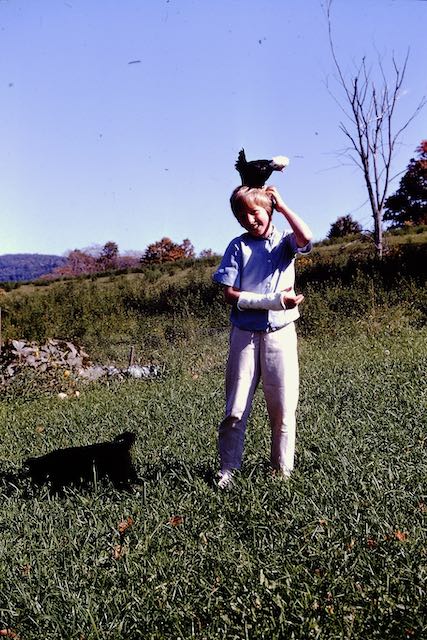
Me — with a chicken on my head and a cast on my arm. Typical.

I hauled water up to the chicken coop every day, and scattered chicken feed in their pen. I learned what a pecking order is in real life, not middle school. The six hens started to lay and I collected the eggs.

One Sunday afternoon, my parents took me to town to watch a movie at one movie theater in town. This was a rare treat, and I didn’t stop to question why.

However, when I got home the roosters were gone. Well, kind of gone. Let’s just say that they became chicken soups over that winter.

I experienced the full circle of life with those chickens.

My father then took up the hobby and raised chickens for many years.

But the egg — at 4-H camp — definitely came first.


This is in response to Linda Hill’s Stream of Consciousness Saturday prompt: Chicken or Egg
poetry

To a 4-H Summer Assistant

Do you remember that teenage girl
You talked to years ago?
Instead of oyster, you saw pearl –
She was a tough one though!
She pushed against all that you said
When you tried to reaffirm
That she had value –No! Instead
She tried to worm and worm
Her way away from your kind words
Why didn’t you give up?
Why not say, This is for the birds?!
But no, you filled her cup —

And now my life reads like a long and wondrous book
If he wants to know the good he did, dear God, let him look


This is in response to the W3 prompt for this week — to write a memory poem. Here are the instructions:

  • Imagine a person from an old memory looking in on you through an open window;
    • You’d all but forgotten about this person, but today their presence has given rise to this memory;
    • What do you see? What’s going on?
  • Write this as a Memory Poem:
    • Purge this memory out of your system; allude to the memory; banish the memory; 
  • Poem length: 100 – 300 words;
  • The poem must end with these words: “Let him/her look”

I don’t know if I did the whole memory poem thing correctly. First, it’s only 98 words.

But — true story — in my early teens, I was a pretty mixed-up kid. I was part of a perfect family, but I was pretty less than perfect. One summer, when I was making all sorts of bad choices, these two guys came from Cornell to spend the summer working in our county with the 4-H program. One of them started a summer band.

Indirectly, I suppose, music saved me. I got involved with the summer band and then got roped into other activities with a different group of kids and a more wholesome focus.

I think I was 14 years old. I remember swearing at the one guy in a long tirade about I-don’t-know-what and he just took it. He didn’t scold me. He didn’t kick me out. He just took it.

And continued to treat me nicely.

Of course, I didn’t keep in touch with those guys. I was a kid. They were Cornell students. At the end of the summer, they went back to Cornell. Honestly, I can’t even remember the band guy’s last name.

But, what a difference he made in my life!


About My Dad · Blather

A Ramble about Ice Cream and Little League

About 15 miles from where we used to live was a seasonal ice cream shop called Humdinger. In March, when we would see the “Opening Soon” sign go up, we waited with eager anticipation.

I suppose every area has their own hidden gem ice cream store. Humdinger was Binghamton’s.

Blue Cow in Roanoke, Virginia is another such treasure.

Honestly, I don’t know if Cooperstown has one anymore. I would have said Pop’s Place but they closed. When I was a kid, Cooper Cabin had the best ice cream. They are long since closed.

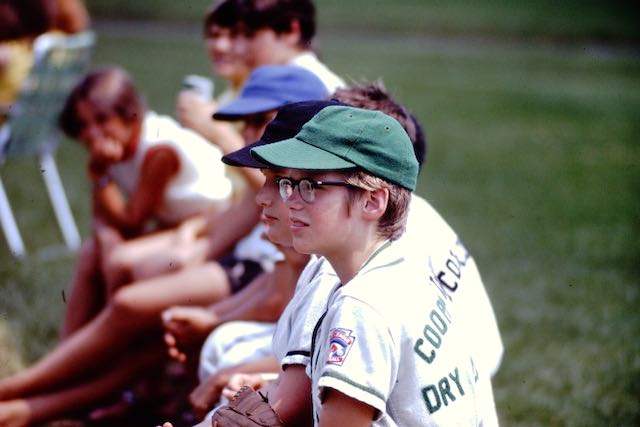
My father would take his Little League team there after a winning game. The Cooperstown Dry Cleaners — the name of his team because they were sponsored by, well, I’ll let you guess — was not the winningest team, so it was quite a treat to go there. My father believed in every player playing, regardless of skill level and whether we were winning or losing the game.

I say “we” because I was a part of the team. I begged to play but there were two issues. One — I threw like a girl, a fact I was reminded of regularly when I tried to play catch. Two — girls had NOT broken into Cooperstown Little League at that point.

I remember reading about a girl my age in Pennsylvania who was allowed to play, but when she took the position of catcher, other coaches insisted that she wear a “cup” because it was in the rules that catchers had to wear cups to protect themselves. She pinned a toy teacup onto her uniform. I bet she didn’t throw like a girl. Catchers have to have a pretty good arm.

But I digress. I was part of the team because I learned to keep score and my father had me be his official scorekeeper. I learned the numbers for the positions. I tallied the strikes and balls in the little boxes. I knew to write 6-3 if the shortstop threw the ball to the first baseman to get the batter out. I checked with my dad on errors, because, God forbid I should make that all-important determination. At the Little League level.

The occasional ice cream at Cooper Cabin was my reward. That, and spending time with my father.

Yesterday was the anniversary of his passing.

I should have had an ice cream in his honor. His favorite was vanilla, same as mine.


The ramble is brought to you by Stream of Consciousness Saturday. The prompt was “hum” – Find a word that starts with “hum” or use the word “hum” itself. 

All I could think about was Humdinger Ice Cream — but I meandered.

About My Dad · family · Travel

New Memory

This morning I received a notification — “You have a new memory.” I laugh at those notifications. They seem so silly.

New memories — pshaw. Memories are, by their very nature, sort of oldish.

This morning, though, I paused to look at my “new” memory.

Two years ago today, I was in Normandy.

Two years ago today, I first heard the story of British gliders landing in Normandy to take the Pegasus Bridge — gliders whose pilots used stopwatches and compasses to navigate, some landing a mere 47 yards from their objective. I’m still amazed at that feat.

Two years ago today, I stood in the Canadian cemetery in Normandy, France, and grieved for those young men whose names were carved in the stones there. So brave. So young. But such a beautiful place.
Five years ago today, I was watching Karl play tennis. He and his partner, Michael, were killing it.

Five years ago today, at about the same time, 1400 miles away, my first grandson was born.

I didn’t need a photo app on my phone or Facebook to remind me of that memory. I woke up thinking of him. (HAPPY BIRTHDAY, HENRY!!)

On the other hand, my father needed the memory prompts.

“Remember our trip to Normandy,” I asked him.

“When was that?” he replied.

“Two years ago today we went on our first tour.”

I handed him the photo book and memorabilia I had put together from that trip.

His eyes grew misty as he leafed through it all. He carefully unfolded the maps of the cemeteries and of Paris, studied them, and then folded and placed them back in the pocket of the book. I couldn’t tell if he remembered or not.

“That was a good trip,” he said.

It was a good trip.

As we travel down this other road of forgetting who, what, and how, I often think, We’ll always have Normandy (and Paris, I suppose).


Life

Rabid Chickens

My memory of the wall is tinged with blue-green. A very pale blue-green, mind you.

I honestly don’t know if it’s real, or hopelessly colored and skewed by more than half a century.

I scoured old photographs this morning looking for it. Surely this white-washed cinderblock wall, with a hint of aqua, so prominent in my memories of Kagnew Station would show up in some pictures.

Stewart, Peter, Donabeth, Sally — Kagnew Station Christmas

When I was 2 years old until I was just barely 5, my father was stationed at an army base in Ethiopia. My earliest memories are from there, but have been reduced largely to color.

Kagnew Station was blue-green.

Fort Devens was red-brown, like the color of bricks. Our address there was drilled into me, 84D Walnut Street.

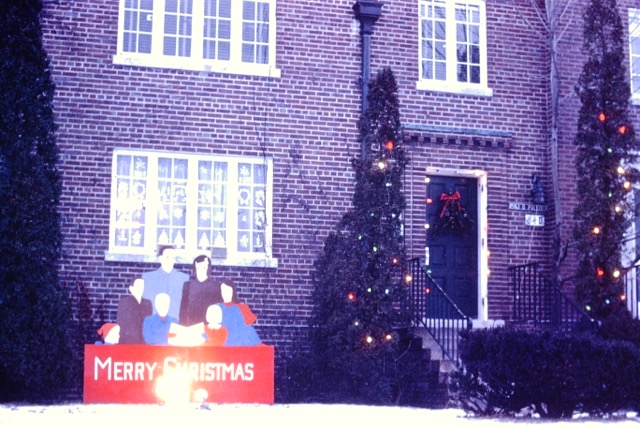
84D Walnut St, Fort Devens Christmas

Similarly, the distance between the earth and the sun was drilled into my youngest brother after we moved to Cooperstown.Why he needed to know that distance was beyond me, but my parents and older siblings made sure he could recite it, asking him often, “How many miles to the sun?” My tow-headed little brother would answer, “93 million miles,” and we would cheer.

That’s a memory draped in the lush green of Cooperstown and farm land and maples in summer.

My youngest brother and me — Cooperstown summer

But the wall around Kagnew Station — I remember my mother warning me about it. “Don’t go beyond it,” she said, “because there are rabid chickens on the other side.”

In my head, now, I know that’s ridiculous. I’m sure she never said a word about rabid chickens.

For one thing, rabies only affects mammals. I learned that as an adult when a veterinarian friend gave a presentation on rabies to our homeschool group. When he made that statement – rabies only affects mammals — I blurted out, “But what about chickens?” He looked at me long and hard, waiting to see if I was serious. Unfortunately, I was. The seed had been planted decades before.

For another, I don’t think the wall around the base was very high. A chicken could have flown over it.

My working theory is this: my mother warned me to stay away from the wall. I had heard my father talking about the dangers of rabies.  At some point I saw a chicken fly over the wall. It all mashed together, like when bits and pieces of life swirl together into the implausible reality of a bizarre dream.

I probably inserted the chicken into my mother’s words. I’ve always liked chickens.

A rabid chicken sounds so dramatic, too. Picture an innocuous chicken. Add some drool and a deadly virus. Like Chanticleer meets Old Yeller. Maybe that was the scariest image 4-year-old me could conjure up.

The memory is covered in a pale blue-green haze.

In the meantime, I have an assignment to write about a place (#sorryLaura) and this is what came out.

Strange.

Almost scary.

Like a rabid chicken.

A to Z Blogging Challenge · family

J is for Journey

“I ran away once and you didn’t even notice,” one of my children told me accusingly.

It brought back a flood of memories.

I ran away once. Slighted once too often by my siblings, unappreciated by my parents — I knew it was the only thing I could do. So I put a loaf of bread in my backpack, along with a flashlight, a jacket, and a pack of matches, and headed up the hill behind our house.

The first bit was steep and prickly with wild raspberry bushes. I huffed with exertion and didn’t stop to enjoy a single berry.

I hiked past the little spring-house that had been the source of water for the house before my parents dug a well.

Finally I reached a grassy knoll and sat down to rest.

I waited for someone to come looking for me. Surely someone would notice I was gone.

I waited, imagining the shock and the worry. My mother would ask each sibling, “Have you seen Sally?” and the worry would grow.

They would look all around the house and the barns. She’d probably make Peter or Jimmy climb into the hayloft to see if I was there.

But they wouldn’t find me.

The tall grass on the hill was perfect for putting between my thumbs and whistling — but I stopped myself. Someone would hear it. Then they would know where I was.

The grassy knoll, it turned out, was also an ant hill so I moved to a little mossy spot near a tree.

I pulled out my loaf of bread and ate a slice — not because I was hungry, but because I was bored. Plain bread is also boring, I discovered. I wished I had brought a jar of peanut butter. I put the bread away because I knew it would have to last me at least a week.

As I started to stretch out in the moss for a little rest, I nearly placed my hand in a pile of animal droppings. Abruptly I sat up again. Hugging my knees, I started to cry. Surely I was the most unloved child ever.

House with the garden behind it

But down the hill was my house.

And my family.

And my dog.

And our passel of cats.

I climbed to my feet and headed back.

My mother was working in the garden, picking beans or peas.

“I ran away,” I announced to her as I got closer, “and you didn’t even notice.”

She straightened up and looked at me. “You need to be gone more than 20 minutes if you want me to notice,” she said.

And she went back to work.

All that passed through my mind when my own child told me about running away.

I bit my tongue so I wouldn’t repeat my mother’s words.

“I’m sorry,” I said.


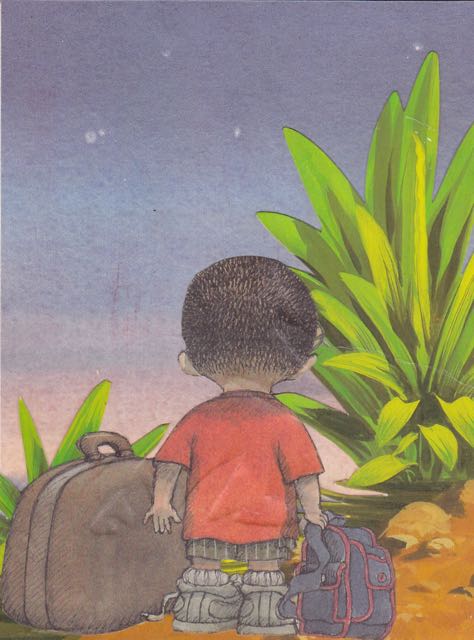
Child with suitcase and backpack from Hello Muddah, Hello Faddah! by Allan Sherman and Lou Busch, illustrated by Jack E. Davis

Plants from a broken pop-up book