family · swimming

The Record Board

Whenever I go to a pool, my eyes are drawn to the record board.

It’s kind of funny, because I haven’t always been a fan of the record board. Helen still holds over 20 age-group records at the pool in Cooperstown — the earliest from when she was 8 years old, and the latest from when she was 13. Then we moved, and she started racking up high school records in Greene.

Margaret in the middle

A couple of years ago, I caught one of the swimmers in my group staring at the record board in Cooperstown.

“Do you know Helen Zaengle?” she asked.

“I do,” I told her. “She’s my daughter, and she’s Laurel’s sister.”

“Wow,” Margaret said. “She has a lot of records. I’m going to break some of them.”

That was the moment my feelings about the record board changed.

Helen was very good at swimming from a young age. She loved winning races — although there was one time when she asked me why she couldn’t get a rainbow ribbon (the ribbon handed out for participation); all her ribbons were blue.

The record board wasn’t posted at the time, and, quite frankly, I think Helen and I were both unaware of all the records. When the record board went up, part of me felt a little embarrassed because I never sensed that Helen was swimming for the glory of the record board or all the accolades. She swam with the truest sense of the amateur — a love of the sport.

But I worked in the pool these last few years with all those records at my back, and I tried not to look at them. Don’t misunderstand — I am very proud of Helen, but not because she rules the record board. I just think she’s wonderful.

Margaret helped me to see that the records are goals for other swimmers, not to induce pride, but to produce hard work.

Michael Phelps said, “Goals should never be easy,” and Margaret took that to heart. She’s 10 years old now and continues to push herself harder than her peers. She still hasn’t made it to the record board, but I have no doubt that she will.
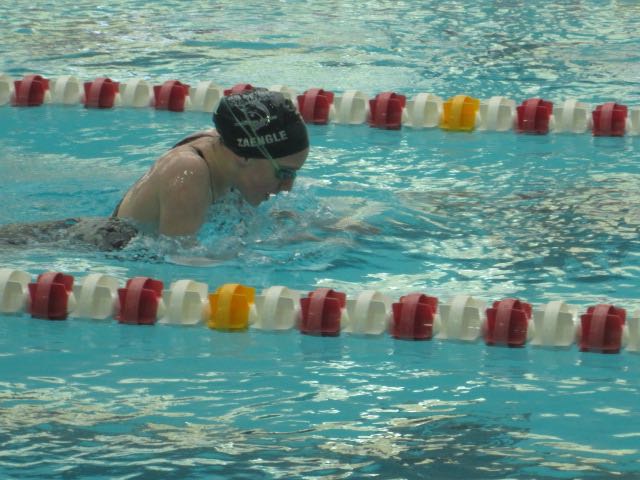
Laurel swimming breaststroke

Last year, Laurel made it to the record board, by breaking a record that had been up there since before Helen was even born. 11-12 100 Breaststroke.

This year Laurel was studying the records to see if there were any she was close to.

“How about that one,” I said, pointing to 13-14 200 Breaststroke. “I think that one is do-able, maybe not this year, but next.”

The name next to the record: Helen Zaengle.

Helen called me right up. “I heard you told Laurel to break my record,” she said.

“Heck, yes, I did,” I replied.

“I think that would be great,” she said.

She holds her records with open hands, bidding other swimmers to take them, and I think that makes me even prouder than all the records combined.


Life

Water in the Basement

One early morning a few weeks ago, I was sitting in my usual spot at 5:30 AM, snuggled up on the chair in the corner surrounded by my books. Just as I was settling in,  I heard the sound of running water.

I left my little sanctuary and went to the kitchen. We filter our drinking water in a Brita pitcher and I often put it under the tap but then forget about it. But I hadn’t forgotten to turn the water off. This time.

I returned to my chair and looked out the window at a wet driveway.  The weather had been a few unseasonably warm the past few days with some rain mixed in. It had undoubtedly rained again last night.

Once again, as I looked for the silence to surround me, I could hear the low murmuration of running water. Once again I left my comfy chair in search of running water. This time I went into the basement.

Of course today when I went to take a picture of the little stream in our basement, it was only a drip,

but that morning, it had been a steady stream pouring out of the pipe and into the gravel.

It bothered me.

I went upstairs to try to finish my morning reading and that laughing water was like Poe’s Tell Tale Heart. It seemed to get louder and louder until it was the only thing I could hear.

I could picture all sorts of water-related disasters. As soon as it was a reasonable time I called the contractor we use for work on the house.

When he came over, I showed him the basement stream. He shone his flashlight all around the basement, at the walls, at the stream, on the dirt floor, and back again at the corner where the water was pouring in. “This really isn’t in my wheelhouse,” he said. “I’ll send my plumber over.”

When the plumber came, he looked all around the basement too. “This is an old house,” he said, “and the water is going somewhere. You could do this, or this, or this,” and he laid out a few options that may or may not fix the problem, “but to be honest with you, I’d just leave it.”

“But I can hear it,” I insisted.

“It’s okay. The water is going somewhere. It’s not filling your basement,” he said. He mentioned again the other options, emphasizing their pros and cons, adding, “If it was my house, I wouldn’t do anything.”

I opted to do nothing.

And I sat there for the next several mornings, listening to the gurgle one floor beneath me.

Morning after morning, I murmured my prayers while the water murmured below.

It became part of the background music of early morning.

Then, it just disappeared. I can’t even tell you when.

But I’m sure it will be back, with the next thaw and/or heavy rain.

When it returns, I won’t panic. I’ll just listen.


elderly · Faith · family

What Will You Bleed?

The patterns for our personalities are set early on.

My friend, Susan, used to talk about someone she knew who, in the delirium of a high fever, mumbled out Bible verse after Bible verse. When she had been poked, she bled the Bible.

“I want to be the kind of person who does that,” Susan said to me thirty-some years ago.

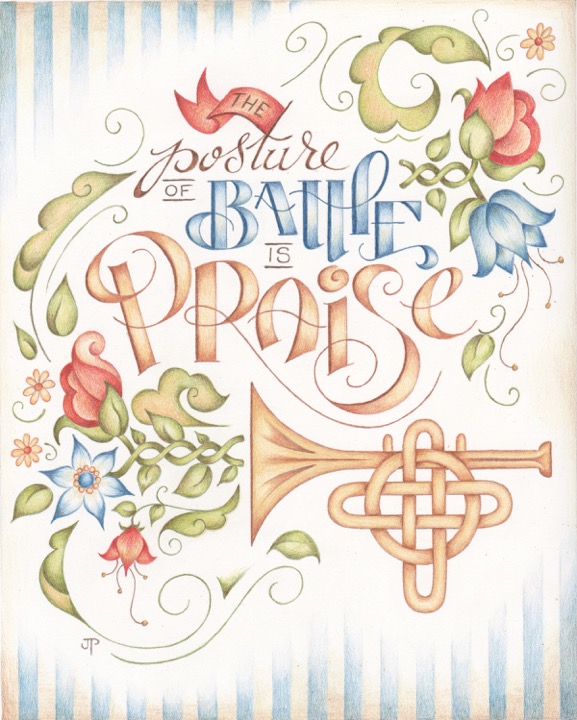
Years later, when Susan was poked, she bled praise. She suffered a stroke in her 40s and I have never heard her utter a bitter word about it. After seeing Susan last June, I asked another friend, Jennifer Trafton Peterson, to make this custom artwork for her. The words are ones I have heard Susan say many times.

The other day I was wearing a new-to-me shirt and my father noticed.

“That’s a nice shirt,” he said.

“I got it at the thrift store,” I told him.

He grinned, fist-bumped the air, and said, “Hurrah!”

My father has always liked a bargain. It’s the Scotsman in him, I think. My mother had to live with it and work against it.

She was also very frugal, but, at the same time, she wished she could do some of the things that the other doctors’ wives got to do. After he retired, he yielded to her and they went on a trip to Hawaii.

It was life-changing. He still talks about it.

“I’m so glad that I listened to Mom and we made that trip to Hawaii,” he often says.

“Everyone should go to Hawaii. When are you going?” he asks me, when he’s thinking about that trip.

But my father bleeds frugality. As dementia takes hold little by little, I see a deeper austerity emerging. He sometimes wears corduroy pants that are nearly threadbare. “There’s still some wear in these,” he says when I suggest he change.

“How much is that going to cost?” he asks, when I suggest a necessary home repair or appliance replacement, in a can-we-possibly-do-without-that sort of way.

The pattern, I think, was set early on.

My sister’s mother-in-law was a fairly passive woman. In her elderly dementia, she became more and more withdrawn into a unresisting submissiveness. When she was poked, that was what she bled — utter compliance.

My mother — I had to think about her for a while to come up with what she bled — I think she bled marmalade, both sweet and sour, involving food, and serving others. She wanted to help, but she got frustrated with the muddle in her mind.

And I can’t help thinking, What are the patterns being laid in my life? When I am poked, what will I bleed?

Life

The Fall

Bud told me that a woman at church had mentioned seeing me out for a run. “She doesn’t run,” he told her, “she just walks really fast.”

I was out for a walk the other day when I took a tumble. I do walk at a pretty fast clip, so when the toe of my sneaker caught on a bit of uneven sidewalk, I went down hard. Right onto my left knee.

I limped back to my car, about 3/4 of a mile away, stopping to rest on the stone bridge and take pictures of Tuga. On this day, no man was talking on his cell phone there so I didn’t feel self-conscious.

I kept reaching down to feel my knee through my jeans. I could barely touch it without severe pain, but I couldn’t see what the damage was. The wound was painful but, without seeing it, still abstract.

When I got home, I went into the bathroom to inspect my knee. The egg on my knee reminded me of the egg on Karl’s head the time “Fred” talked him into stepping into a spackle bucket with a rope on the handle that he had hanging over the edge of the cellar stairs.

“Let’s play Paul-in-a-basket and I’ll lower you down over the city wall,” he said.

It did not end well.

I iced my knee and put my leg up. Look up knee injury on the internet and the advice is nearly always the same — RICE: Rest – Ice – Compression – Elevation. I didn’t compress my knee though; I could barely touch it.

Mary and Laurel were a huge help, cleaning up the dinner stuff and fixing my father his nightly bowl of ice cream.

I took two ibuprofen and went to bed early. The injury knocked the wind out of me.

I really don’t have time for this, I told God as I fell asleep. He listened. In the morning, I felt completely better.

Not really — but the egg was gone from my patella. I could still see the redness and the abrasion where I had hit, but the real swelling was now in big circle around the patella.

It has now been three days since the fall. Bruising is settling in below my knee.

I find the whole thing fascinating — the way my patella absorbed a huge impact, then dispersed a cushion of fluid around the point of impact, and now even that is settling. The tenderness is minimal and only around the outskirts of my knee. Okay — I still can’t kneel, but I can do everything else.

The human body is a pretty amazing piece of self-healing machinery, don’t you think?

And that silly fall is not going to prevent me from walking today or tomorrow.

Snow may take care of that.

Life

The Rabbit in My Pocket

Stadiums fill up with rabbits to see what’s going to happen between the lines.

But life isn’t only about visible realities.
There are invisible and unseen nuances
things that shape us into who we are.

Orel Hare-shiser

Like a rabbit in my pocket.


With apologies to Orel Hershiser.

Travel

More Croatian

Helen looked at my Bosnian-Croatian-Serbian textbook sitting on the table.

“Do you really think you’ll use this?” she asked when I told her it was mine. “When I went to France, even though I was taking French at the time, I was too afraid to try to say anything.”

I understood what she was saying. “I think there are some useful phrases,” I replied. “In my last set of words, I learned ‘I understand’ and ‘I don’t understand’ — it’s like, hmmm…” I tried to remember. “Rooma-zooma….?”

“Ramen noodles?” she asked.

“No, it’s roomy-something. I have time to practice though. I just learned it.” I replied.

I practiced it later on my walk. Razumijem — pronounced ra-zoo-me-yem. I guess it’s sort of like Ramen noodles.

Ne razumijem — means I don’t understand. That one will come in handy, I’m sure.

Also, Gdje je kupaonica? — Where’s the bathroom? — very important. Except that one is pretty hard for me to pronounce.

Try it, English-speaking friends, say “guh-duh-yay yeh coo-pa-on-itz-ah” really fast. It rhymes with pizza, in case I’m not writing it phonetically correctly.

Last night as I walked, I practiced my Croatian, ruminating on the rhyming words. I came up with a poem.

Cesta, ulica
Gdje je kuaponica
Kada?
Sada.
Kava?
Hvala.
Oprostite.
Sviđa me se.
Dječak, djevojčica

Road, street
Where is the bathroom?
When?
Now.
Coffee?
Thank you.
Excuse me.
I like it.
Boy, girl

The more I practice, the braver I’ll be when I get there.

Hopefully I won’t say something stupid.

swimming

The Role of Timers

misc 0048 & Under swimmers swarm around the pool deck like ants on a sidewalk. Some are aimless, while others seem to know where they are going.

Clueless. That’s often the word I use to describe 8-and-unders.

Mama can’t hover on the deck. Only those who are supposed to be there can.

Guards — aka Meet Marshalls — protect the entrances. Most coaches and officials wear their credentials on a lanyard.  Swimmers enter through the locker-rooms; their suits and goggles are their credentials. The other support staff — the timers, the timing table, the meet marshals themselves, the ribbon writers and heat winner awarders — are either known to the people running the meet or wear a lanyard identifying their role.

Of these, my heart always goes out to the timers.

Timing is the first role most parents get to play to help at a meet.

“What if I do it wrong?” new parents ask.

“We’ll train you,” is the usual response.

Start – Stop – Reset. Those are the only three buttons that really matter on the stopwatch for the timers.

Start the watch — not at the sound of horn but when you see the strobe. It’s important for parent/timers to understand this for two reasons — 1) since light travels faster than sound, it may be slightly more accurate, and 2) the strobe is why no flash photography is allowed at the start of a race. Swimmers who learn to watch for the strobe may react to a flash from a camera and be charged with a false start.

Stop when you see the hand touch the pad. That means you have to stand where you can see that happen which isn’t behind the blocks.

Reset. Write the times on the clipboard as fast as you can and reset; the next race starts almost immediately.

One of the officials I work with loves to tell the story of how he decided to become an official. “I couldn’t write fast enough,” he says, laughing. “After I got yelled at one too many times, I said, ‘Hang this — I’m going to become an official!'”

Timers are the unsung heroes of swim meets. They are moms and dads who come out of the stands and work the deck. Their feet get wet. They miss their own child’s finish because they have to watch the lane assigned to them. They get yelled at and blamed for all sorts of stuff. They are expected to make sure swimmers are in the right heat and the right lane, get up on the blocks, and have their goggles on. And all of that is mostly the swimmer’s responsibility.

Which brings me to yesterday.

I was standing on the side of the pool as a stroke official. That means I walked along the side watching the strokes to make sure everything was in accordance with the rules of that stroke. No flutter kick during butterfly, stay on the back for backstroke, toes pointed out for breaststroke kick, and so on.

The referee blew the whistle for 8 & Under girls 50 backstroke. Seven girls hopped in the water and grabbed hold of the wall. One lane was empty.

I looked at my program to see who was missing. It was a little girl from a team in our league. I could see her standing behind the timers, wrapped in her towel, shivering, looking clueless. I wished with all my heart that the timers would turn around and see her, but they were talking.

The starter said, “Take your mark.”

Then, “WHHHHHAANK.”

After the horn, the timers parted and saw the little girl. I watched them look at the clipboard and start talking. I shifted my attention to the swimmers in the water.

“What just happened?” her coach asked.

“She was right there behind the blocks,” I told her. The coach bustled over to the meet referee to see if they could get her in another heat, but no dice.

The ruling was that it was the swimmer’s responsibility to get in the water. The timers didn’t prevent that. The swimmer didn’t try to get through.

She was clueless as to what was going on probably because other people are always looking out for her.

Which is part of why I love the sport of swimming.

From an early age, swimmers learn to take responsibility for themselves. They have to pay attention.

It’s small stakes when they don’t. A missed race. A possible missed ribbon.

But the world keeps spinning and another race will come.

Or you can blame the timer and teach kids that they are never responsible for the things that happen.

It’s those blasted volunteers with wet feet who sacrificed something who are at fault.


Faith

Discomfort

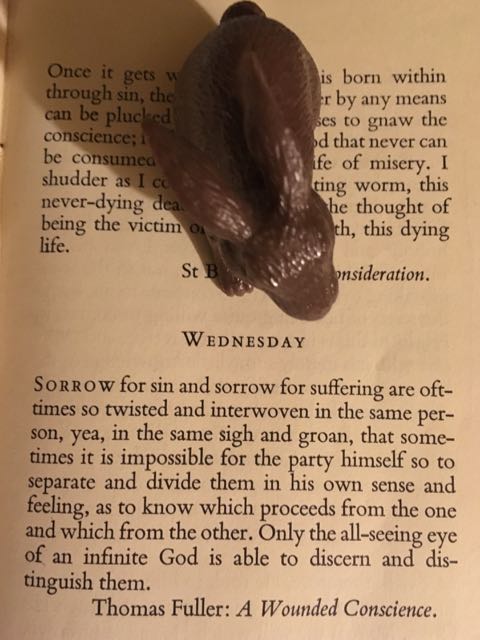
While still in my pajamas yesterday morning, I carried the laundry downstairs, holding Tuga in my hand.  His rigid little ears poked into my fingers and palm. I tried to shift him to a better spot but it was impossible to carry the basket and the bunny without a little discomfort.

“Could you just not?” I asked him, but he didn’t answer.

The lesson was easy to see. Sorrow is uncomfortable.

In today’s society, we are fairly averse to discomfort. We desire to be always at ease.

Have a headache? Take some ibuprofen.

Are you cold? Grab a blanket or a sweater, or turn up the heat.

Too hot? That’s why God invented A/C.

Plastic rabbit ears poking your hand? Put the silly thing down. It’s a dumb exercise anyway.

C.S. Lewis, in The Problem of Pain, said,

Everyone has noticed how hard it is to turn our thoughts to God when everything is going well with us. We ‘have all we want’ is a terribly saying when ‘all’ does not include God. We find God in an interruption.

Tuga is an interruption. He interrupts my day to remind me that there are people in pain all around me, if I would only open my eyes to them. Maybe this discomfort of my own will remind me.

I set Tuga on top of the dryer while I threw the clothes in the washer. An hour later I remembered him. See how I am?img_1312

Tuga is a mindfulness prop.

I know people who carry special coins in their pocket and I’ve given my own children fidget-toys to carry, but Tuga isn’t just for fiddling with when I’m bored. He’s there to remind me of the sorrow in this world, the sorrow people carry unseen in their hearts, the sorrow I carry in my own heart.

I’d say he’s doing a good job.

Faith · Grief

Lessons from Tuga

“I suppose I should take a picture of you,” I said to Tuga, pulling him out of my pocket yesterday while I walked around town.

He said nothing, which felt almost like a dare. I dare you to take pictures of a plastic rabbit. Won’t you look foolish!

Ah, but I knew better. I was on the last leg of my walk, going down the path. Nobody walks on the path, especially after it rains because of the mud and it had just rained. I doubted anyone would see me photographing my plastic bunny.

I set him in a dry patch of grass.
img_1299

He laid his ears back and didn’t look happy.

Oh, wait, his ears are always back.

He’s not supposed to be happy.

“Tuga,” I said, “you’re supposed to teach me something this Lent.”

I was hoping for a little more cooperation.

“How about you look out at the river?” I said, moving him a little and stepping back. I was thinking of the scene from Watershed Down where the rabbits must escape across the river.

But the blue sky with its big puffy clouds reflected so beautifully in the water that I took another step back to include it. Tuga, my little sorrowing bunny, all but got lost in the shot.

img_1300

It struck me — isn’t that the way it is with sorrow? In the bigness and busy-ness of life, the sorrowing one can get lost.

I picked him up and tucked him in pocket, knowing I would have to ponder that a little more.

When I reached the stone bridge, I set Tuga on a parapet.img_1301

He looked rather lost in there, too. So small.

That’s when I saw the man on the stone bridge talking on his cell phone. We briefly made eye contact before I grabbed Tuga and stuffed him in my pocket again, hurrying on down the path.

Once again, I was struck by the picture of sorrow. How often do sorrowing people stuff their emotions away because they’re embarrassed or self-conscious?

If nothing else, Tuga is teaching me an awareness for the sorrowful. In my own busyness, I may pass them by, or, in their self-consciousness, they may hide their feelings.

Lord, make me more aware!