A man is not idle because he is absorbed in thought.
There is a visible labor and there is an invisible labor.
~Victor Hugo
I begin and end each day lost in thought, although I think Hugo more aptly describes is as “absorbed in thought.”
The busyness of the day comes too quickly upon me. Sometimes I have no time to think, just do, do, do.
But to gather my thoughts at the beginning of each day, and run them through the sieve of scripture and Pascal and, this morning, William Law, I can’t tell you how much that helps.
The Croatian word for fast or quick is “brz”. I laughed when I saw it. It made me think of a bee — zip-zip-zipping from flower to flower.
But even the bees pause on each flower, taking time to gather.
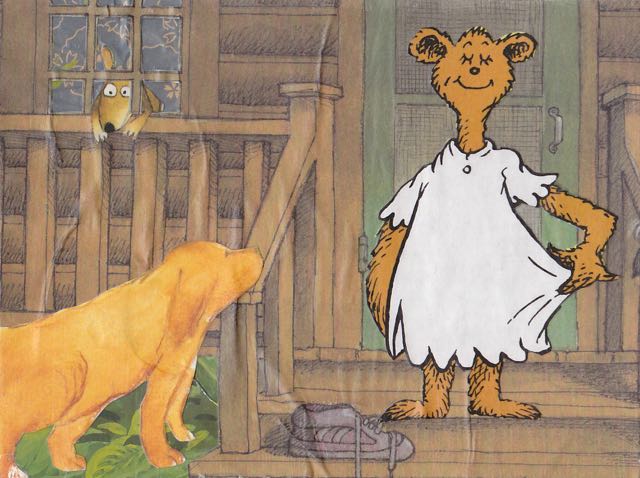
Woman from The Art of Lounging by Cooper Edens
Rabbit from The Easter Egg Artists by Adrienne Adams (I’m pretty sure)
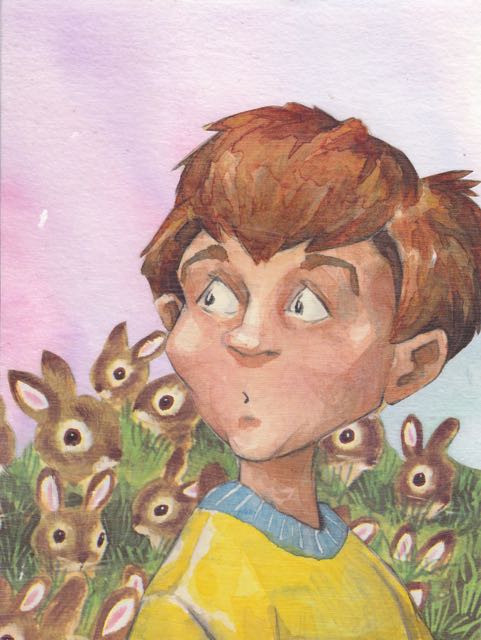
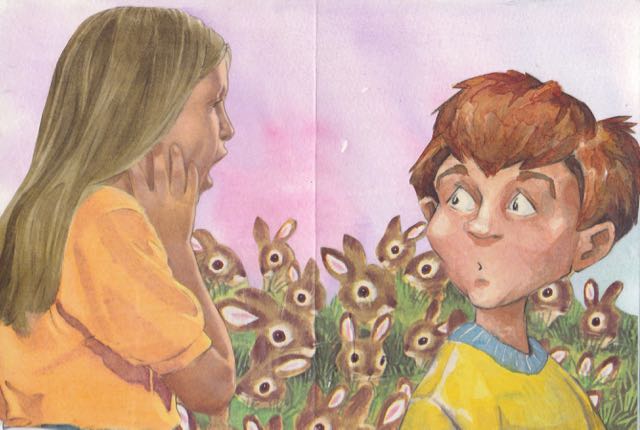
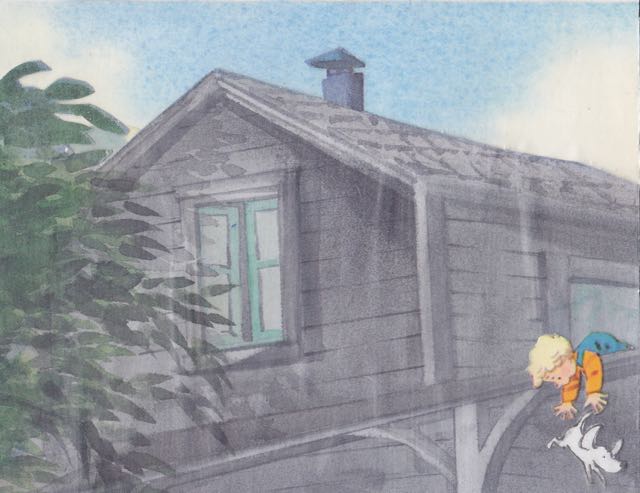
(1)Boy is from My Dad’s Job by Peter Glassman, illustrated by Timothy Bush
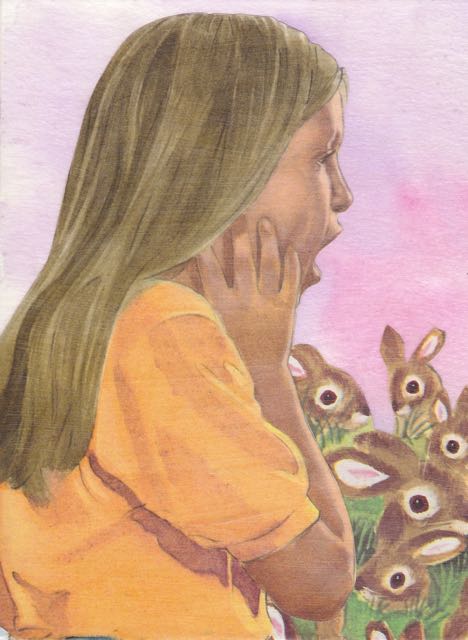
(2)Girl is from Misty: The Whirlpool (from Misty of Chincoteague by Marguerite Henry) excerpted and adapted by Joan Nichols, illustrated by Stephen Moore
(3)Rabbits are from The Bunny Book by Richard Scarry
“Rabbits have large families” (3)
“Maureen felt a stab of fear” (2)
“Dad talked about buying futures” (1)
In rabbits? That wasn’t clear…
Can three divergent books
Be joined in harmony?
Each must accept the others
— And a little absurdity.
Above is a partially “found” poem using lines from the pages from which I borrowed the pictures. Wikipedia says, “Found poetry is a type of poetry created by taking words, phrases, and sometimes whole passages from other sources and reframing them as poetry (a literary equivalent of a collage)…
I often don’t know how to describe my collages, so I use the word quirky. How else could explain this odd conglomeration using a couple of dogs and a Dr. Seuss character?
from The New Century Dictionary, 1948, — a 2 volume set found in the free box at the Endicott library.
A quirk is a sudden twist. I was surprised to read that in the dictionary, because I think of quirks as “unique-nesses” — those things that make you you.
We currently have a cat that loves belly rubs. I consider that a quirk.
Last week our cat disappeared.
The first day, I didn’t think much of it. She’ll be back, I told myself.
But when I went for a walk, I scanned the ditches on either side of the road, just in case she had darted out in front of a car and met her demise.
The second day, I started mentally running through the list of predators in the vicinity. I hear coyotes howl at night. Do they like cats? My brother told me that large owls prey on cats. I hadn’t seen any large owls, but he said there were some in the area. Our neighbor once told us that foxes prey on cats. I know foxes live around here. I was pretty sure that the bald eagles prefer fish from the river, so I ruled them out — hoping I was right about that.
I walked the road again looking for our little black cat, calling her, looking in the fields for her — but the only black I saw were crows.
The third day came and I was worried. I asked my brother, didn’t we used to have cats that would disappear for a week at a time?
Ishibon (1967)
“Ishibon would go off two to three weeks,” he said.
Ishibon had been our first cat. I remembered Ishibon going off and coming back. I felt better.
A little.
But by the fourth day, I felt like I needed to brace Mary for the inevitable.
“If Piper doesn’t come back,” I told her, “we’ll need to get another cat to keep the mice at bay.”
“I don’t want another cat,” she said. “I want Piper.”
Piper, with all her little quirks, was our cat.
It was Good Friday, and I found myself thinking about Jesus’ disciples watching Jesus die on the cross. They had so hoped that He was the Messiah.
“There, there,” the Pharisees undoubtedly said. “We’ll get another Messiah.”
And one of the Marys would have replied, “I don’t want another Messiah. I want Jesus.”
Because for all His quirks — picking grain on the Sabbath and speaking with a Samaritan woman, all those times He behaved in unexpected ways, and then, at the end, to die like that — He WAS the Messiah.
The people simply couldn’t see it at the time.
If He had behaved like everybody else, He wouldn’t have been God.
I know I’m not saying it well, but the quirks made the Messiah.
Your quirks make you. My quirks make me.
And our quirky little cat returned on Saturday, an early Easter gift for us.
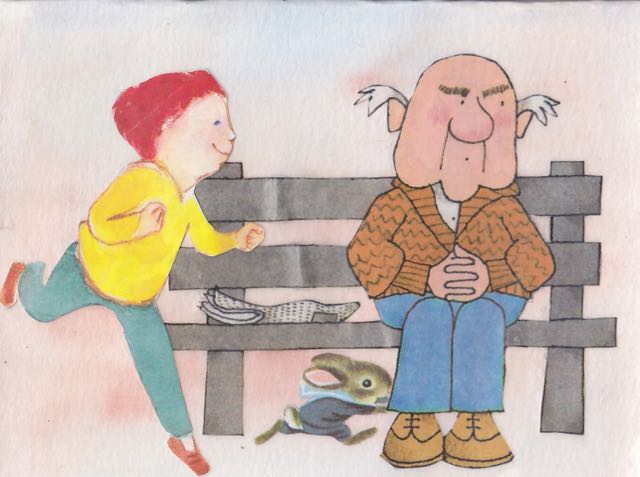
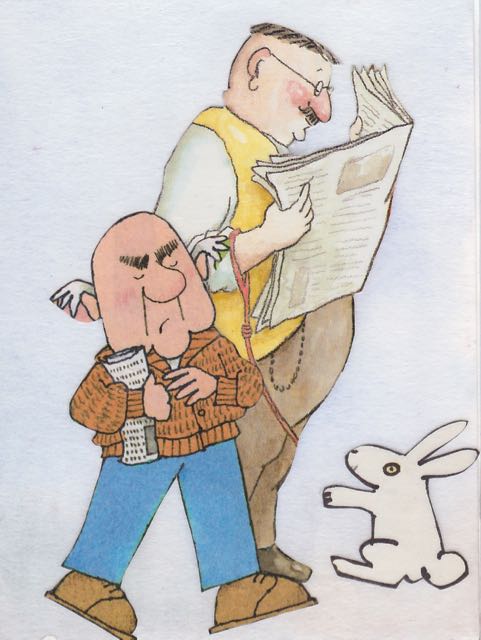
I sent this one to my son, Sam, because it fit his sense of humor. The caption went something like this — “He was so busy watching the man with the parachute that he didn’t notice the birds perched above his lemonade.”
Last night, before I went to bed, I found myself looking through all my cards, considering ways to shuffle my A-to-Z plans in order to avoid using this one.
I’m really not happy with it.
This was an early card and has so many problems. Would you like me to point all the mistakes?
First, there’s no background. The characters are just kind of plopped into nothingness, a pale haze of watercolor that’s barely noticeable.
Then, the man reading the newspaper is holding a leash that leads nowhere. Where’s his dog? Why didn’t I include it?
Third, the old man’s right ear — I can’t believe that I never finished cutting around it.
When I’m aware of the mistakes, they become the only thing I see. It’s awful. I need to take a step back.
The story I had in mind for this was one of obliviousness — both the man reading the newspaper and the grumpy man clutching his newspaper are oblivious of the rabbit that’s right in front of them.
And, golly, isn’t that true?
I see the mistakes in the picture — but the “rabbit” that’s in front of me, the one I’m not seeing immediately, is that on this journey of collage, I’ve actually travelled quite a way. It was a bit of a jolt to realize that.
Compare “Newspaper” with this, the most recent collage I made —
The card is laid flat to show that I finally got smart enough to write the books I use right on the back of the card.
Interestingly, the story in this collage was also supposed to be about obliviousness. The boy is so taken with the tiny chicken perched on the piano that he doesn’t notice the baby polar bear sleeping beneath it.
The picture still has problems — but the problems are different. Overall, it seems more complete than “Newspaper.”
Sometimes it’s good to look back and see how far you’ve come.
It’s like a rabbit in the path. Good to notice.
Sort of.
Man reading the newspaper from Wheels on the Bus (a Raffi Song to Read book) illustrated by Sylvie Kantorovitz Wickstrom
Grumpy man from The Old Man and the Afternoon Cat by Michaela Muntean, illustrated by Bari Weissman
I had such big plans at Christmas. I was going to make teeny collages for all my friends.
Anna loves cows so I made her a cow collage (a cow-lage?). It ended up being one of only two that I mailed out.
She sent me a picture of it on her refrigerator.
I love that it’s right beneath the note telling her that she is an amazing student teacher. I bet she is.
A while ago, while trying to work on using metaphor, I wrote a poem about cows, using Billy Collins’ poem, Litany, as a model.
Bovine
You are the map and the Atlas,
the Big Mac and the shake.
You are a javelin held aloft by a strong arm,
and a smooth wet stone in the hand of a little boy.
You are the fresh-mown grass after summer rain,
and the thunder that preceded the shower.
However, you are not the purr of a kitten,
the wag of a dog’s tail,
or kraa-coo-coo-coo of a mourning dove.
And you are certainly not the whisper of butterfly wings.
There is just no way that you are butterfly wings.
It is possible that you are the flock of sheep,
maybe even the laying hen,
but you are not even close
to being the eagle hang-gliding overhead.
And a quick look in the mirror will show
that you are neither the towering pine
nor the creeping myrtle.
It might interest you to know,
speaking of the plentiful imagery of the world,
that I am the garbled voice in the drive-through speaker.
I also happen to be the blistered toe in a new shoe,
the frayed pink leash on the dog,
and the unmailed letter waiting for a stamp.
I am also the fuzzy blanket tucked around a child
and the hand-thrown mug filled with coffee.
But don’t worry, I’m not the map and the Atlas.
You are still the map and the Atlas.
You will always be the map and the Atlas,
not to mention the Big Mac and–somehow–the shake.
I felt the need to apologize.
Dear Billy Collins,
I’m sorry that I ripped off your poem. It’s just that I don’t put enough metaphor into my poems and this little exercise is such good practice.
I was thinking about the cows down the road. Cows that aren’t cows because I know cows are female and I’m pretty sure these are male, although I haven’t ventured in to confirm my suspicions.
The chief “cow”, a cranky fellow, comes to the fence and shakes his horns at me when I pass. He wants me to know that he’s tough and armed and that I shouldn’t mess with him.
Years ago, when cows complete with udders grazed in that field, they would nibble grass out of my hand and I loved to feel their smooth wet noses.
So I was thinking about cows (that aren’t cows), and the things they are and aren’t, and wrote this.
Part of my morning quiet time includes a creed — to remind myself of those things I believe to be true. It started with the basic Apostles’ Creed, but has grown. One part that I added is this:
I believe that the trials in my life are ultimately God’s good for me. They are like the grains of sand in an oyster that God uses to produce pearls.
The world is an unkind place. It’s full of people who thumb their noses and stick out their tongues.
Yesterday, in the checkout at the grocery store, the young woman behind me, obviously upset by something that had happened, said to her companion, “I just want to punch her in the face.”
With violent words, we betray the frustrations in our hearts.
This past Sunday, I was especially frustrated by a situation I knew that my father would encounter, where he would be excluded and pushed aside. The mama-bear in me raised her hackles and lashed out with words — words I didn’t entirely regret but wish I had said with a little more kindness.
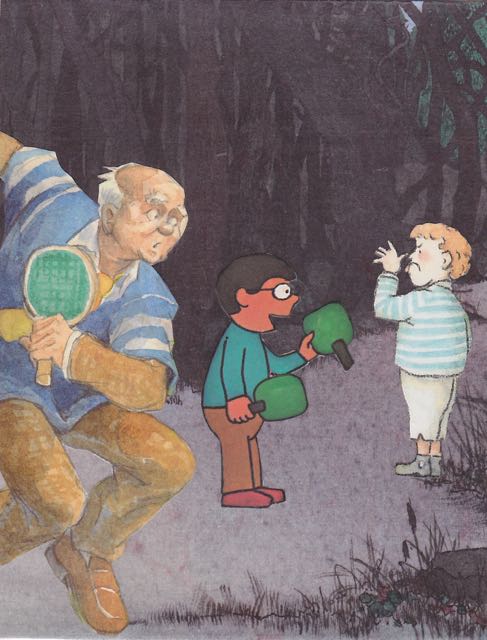
When I put together this collage, I wasn’t entirely sure what it was saying, but when looking for a “K” collage, I paused on it. Yes, I think I know now. It’s about right responses. It’s about kindness. So timely for me today.
The one boy is obviously the bully. He’s not nice. He’s not being nice.
The man is ready to rush in and give him a good smack.
But the other boy, he’s still extending the ping-pong paddle.
In kindness.
“Come and play,” he seems to be saying.
It’s Jesus. He constantly says, “There, there. I see. I know. Come unto me, you weary, heavy-laden, frustrated, overwhelmed child. I still love you. I still want to play ping-pong with you.”
And as I yield to Him, He adds another layer to the grit in my life, working to create a pearl.
Background from The Little Old Lady Who Was Not Afraid of Anything by Linda Williams, illustrated by Megan Lloyd
Man from My Dad’s Job by Peter Glassman, illustrated by Timothy Bush
Ping-pong paddle boy from My Fun With Words by James Ertel, illustrated by Geoffrey Brittingham, Seymour Fleishman, Vernon McKissack
Bully from Wheels on the Bus (a Raffi Song to Read book) illustrated by Sylvie Kantorovitz Wickstrom
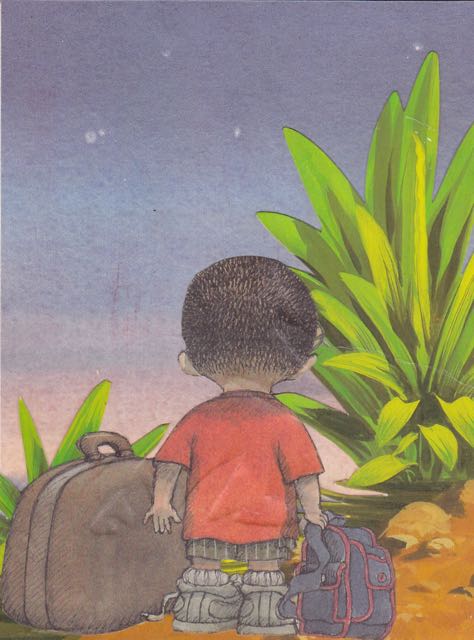
“I ran away once and you didn’t even notice,” one of my children told me accusingly.
It brought back a flood of memories.
I ran away once. Slighted once too often by my siblings, unappreciated by my parents — I knew it was the only thing I could do. So I put a loaf of bread in my backpack, along with a flashlight, a jacket, and a pack of matches, and headed up the hill behind our house.
The first bit was steep and prickly with wild raspberry bushes. I huffed with exertion and didn’t stop to enjoy a single berry.
I hiked past the little spring-house that had been the source of water for the house before my parents dug a well.
Finally I reached a grassy knoll and sat down to rest.
I waited for someone to come looking for me. Surely someone would notice I was gone.
I waited, imagining the shock and the worry. My mother would ask each sibling, “Have you seen Sally?” and the worry would grow.
They would look all around the house and the barns. She’d probably make Peter or Jimmy climb into the hayloft to see if I was there.
But they wouldn’t find me.
The tall grass on the hill was perfect for putting between my thumbs and whistling — but I stopped myself. Someone would hear it. Then they would know where I was.
The grassy knoll, it turned out, was also an ant hill so I moved to a little mossy spot near a tree.
I pulled out my loaf of bread and ate a slice — not because I was hungry, but because I was bored. Plain bread is also boring, I discovered. I wished I had brought a jar of peanut butter. I put the bread away because I knew it would have to last me at least a week.
As I started to stretch out in the moss for a little rest, I nearly placed my hand in a pile of animal droppings. Abruptly I sat up again. Hugging my knees, I started to cry. Surely I was the most unloved child ever.
House with the garden behind it
But down the hill was my house.
And my family.
And my dog.
And our passel of cats.
I climbed to my feet and headed back.
My mother was working in the garden, picking beans or peas.
“I ran away,” I announced to her as I got closer, “and you didn’t even notice.”
She straightened up and looked at me. “You need to be gone more than 20 minutes if you want me to notice,” she said.
And she went back to work.
All that passed through my mind when my own child told me about running away.
I bit my tongue so I wouldn’t repeat my mother’s words.
“I’m sorry,” I said.
Child with suitcase and backpack from Hello Muddah, Hello Faddah! by Allan Sherman and Lou Busch, illustrated by Jack E. Davis









 Hot Dogs and Marmalade