A to Z Blogging Challenge

Exercise and Ego

This is my own A-to-Z Challenge for the month of June — likes and dislikes. If you want to join me, just add a comment naming something you like and something you don’t like that begin with the letter E.


It’s a good thing I work at a gym. I love exercise.

I think it has to do with endorphins, another “e” word. Over the course of a good workout, your body releases neurotransmitters called endorphins. They reduce pain and improve mood.

So many people come into the gym grumpy and leave laughing. I’ve learned to send people to their workout before we talk business at the front desk, especially if they seem irritable.

They sometimes come in asking about their bill. “Go work out,” I’ll say. “I’ll pull your file and take a look. Then when you’re done, we can figure it out together.”

It’s pretty amazing what a spin class or yoga class will do for the affect. (Psychology definition for affect: an experience of feeling or emotion, mood)

Kinds of exercise I like: walking, swimming, climbing. Mostly I walk these days, though. I still don’t trust my shoulder.

Scottish Gaelic: Is toil leam eacarsaich. (I like exercise)


I don’t like big egos. We see those at the gym too.

Some guys come in so full of themselves that I’m amazed they fit through the door.

Blech. I don’t even want to give them the time of day.

But I work at the front desk, and, if they asked, I suppose I would.

Scottish Gaelic: Cha toil leam egos mòra, (I don’t like big egos.)


I almost wrote this about envelopes. My daughter spent last week making envelopes out of pretty papers. I really like her envelopes.

Here are just a few:


How about you? What do you like that begins with E? What do you dislike?

A to Z Blogging Challenge · friendship · Life

Dentist

This is my own A-to-Z Challenge for the month of June — likes and dislikes. If you want to join me, just add a comment of something you like that begins with the letter D and something you don’t like.

Also, today’s post is my submission for Stream of Consciousness Saturday’s prompt — irony.


“You invite your dentist to your family weddings?” someone asked one of my children when they were being introduced to Dr. Kate.

I think it was Laurel that I was talking to about it, because she said, “I never really thought it was weird until they said that.”

We don’t invite Dr. Kate to weddings because she’s a dentist. We invite her because she’s a friend. She’s been a nearly lifelong friend to me.

I can still picture her when we were kids with her jaw wired shut and her head with a halo screwed into it to keep her neck in traction. I would go visit her every day after school at the hospital before getting a ride home with my father.

It was probably close to three months that she was in the hospital — so that’s a lot of visits! A friendship grows over something like that.

To be totally honest, I’m pretty terrible at keeping in touch with people, so we lost touch during the years that happened between high school and parenting. She went off to the dental school and Navy. I went off to Wyoming. Eventually we both ended up back in Cooperstown.

And yes, she comes to our family weddings. I love my dentist, Dr. Kate.

Helen, Dr. Kate, and Mary all dancing

So I suppose there’s a little irony in the fact that I hate going to the dentist. It ranks right up there with having a gall bladder attack, another not-fun repeated experience in my life, but I’ll save that story for another day.


In Scottish Gaelic:
Is toil leam am fiaclair agam.
(I like my dentist.)

Cha toil leam a dhol dhan fhiaclair.
(I don’t like going to the dentist.)


How about you? What do you like that begins with D? What do you dislike?

A to Z Blogging Challenge

Collaboration/Condescension

This is my own A-to-Z Challenge for the month of June — likes and dislikes. If you want to join me, just add a comment of something you like that begins with the letter C and something you don’t like.


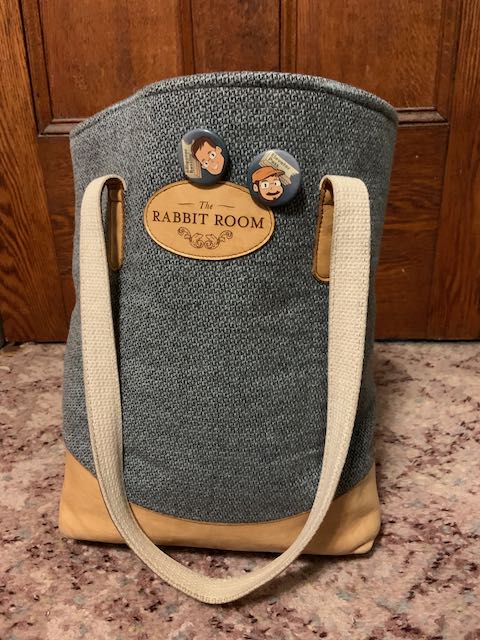
The other day I was at TJ Maxx returning a few things I had purchased at the same time as my mother-of-the-bride dress when the checkout clerk asked me, “What’s the Rabbit Room?”

I was, at first, startled by the question. Why would she be asking me that? Then I saw her looking at my bag, a lovely spacious bag that I carry everywhere.

My bag has everything I could possibly need if I was stranded in a snowstorm — lots and lots of pens, a blank mini-journal, several other journals, a book (sometimes two), cough drops, scissors, a key fob to get into work, scraps of paper with little reminders on them, a few receipts, an empty glasses case, my wallet, a couple of notes from people I love to remind me who I am, hand sanitizer, a flashlight, and a tic-tac box with one mint left. There’s more, but I’ll stop now.

The sales clerk was looking at my bag as I was shuffling through it trying to find my wallet. On the outside, it says “The Rabbit Room.

My Rabbit Room bag, complete with Rabbit Room personalities pinned to the front

I fumbled for words to answer her. It was like being asked to define family.

I think I said something like this, “The Rabbit Room is a gathering place for creative people. It’s named after a room in a pub in London where JRR Tolkien, CS Lewis, and some other writers met to encourage each other. It’s both a virtual and a physical space for encouragement, collaboration, and community among artists.”

She looked at me and nodded like she understood. “I had just never heard of it before,” she said.

Once I was back in my car, I tried to rethink my answer. The Rabbit Room is so hard to explain. Community is at its heart. Collaboration is an outworking of that.

Condescension, however, can shut down collaboration with just a word or two.

John Steinbeck said, “There are no ugly questions except those clothed in condescension.”

Unfortunately, there are far too many answers clothed in condescension too.

Condescension is a smothering blanket on any discourse. Can you tell that I don’t like it?

Collaboration allows questions and answers to be exchanged without condescension shutting the whole process down.

The Rabbit Room is place where that happens


How about you? What do you like that begins with C? What do you dislike?

A to Z Blogging Challenge

Z is for Zen

Where there is carrion lying, meat-eating birds circle and descend. Life and death are two. The living attack the dead to their own profit. The dead lose nothing by it. They gain too, by being disposed of. Or they seem to, if you must think in terms of gain and loss. Do you approach the study of Zen with the idea that there is something to be gained by it?… Where there is a lot of fuss about “spirituality,” “enlightenment,” or just “turning on,” it is often because there are buzzards hovering around a corpse. This hovering, this circling, this descending, this celebration of victory, are not what is meant by the Study of Zen…

Zen enriches no one. There is no body to be found. The birds may come and circle for a while in the place where it is thought to be. But they soon go elsewhere. When they are gone, the “nothing,” the “no-body” that was there, suddenly appears. That is Zen. It was there all the time but the scavengers missed it, because it was not their kind of prey.

Thomas Merton, Zen and the Birds of Appetite


Circling, circling, circling — riding the currents high above the Frio River


More than any other quote, I struggled with this one — probably because I struggled with Merton’s interest in Zen and eastern mysticism. It seemed like a betrayal of Christ.

John Coleman, in his article “Thomas Merton and Dialogue with Buddhism“, said,

Merton who early on in his career showed a keen interest in dialogue with the religions of Asia (Hinduism, Sufism as well as Buddhism) tended to think such dialogue should, primarily, focus on practice and experience and less on doctrine or beliefs, as such.

Yes, that’s what I was hoping. As part of Thomas Merton’s search for contemplative experience, he stepped outside Christian tradition, but not Christian faith. It wasn’t about doctrine; it was about experience.

Goodreads said about Zen and the Birds of Appetite, “Never does one feel him losing his own faith in these pages; rather one feels that faith getting deeply clarified and affirmed. Just as the body of ‘Zen’ cannot be found by the scavengers, so too, Merton suggests, with the eternal truth of Christ.”

Below are two pages from Day of a Stranger, a book where Merton tries to describe a typical day in his hermitage. The book contains musings, thoughts, an imaginary conversation, and, best of all, some of his photographs. If you read these two pages, though, you’ll see that he doesn’t directly answer the questions regarding Zen — and it makes me think that, like the scavengers not finding the carrion because it wasn’t the right prey, perhaps we aren’t asking the right questions.

from Day of a Stranger by Thomas Merton


A to Z Blogging Challenge

X is for eXactly

The monastic body is held together
not by human admirations and enthusiasms
which make men heroes and saints before their time
but on the sober truth
which accepts men
exactly
as they are
in order to help them become
what they ought to be.

Thomas Merton, The Silent Life


Can you imagine if we all lived like that — accepting people as they are, in order to help them become what they ought to be ?


from the Franciscan Monastery in Dubrovnik


A to Z Blogging Challenge

W is for Worship

Is Christian worship to be communion in correctness or communion in love?

Thomas Merton, Seasons of Celebration


Art work created in community at a conference called Hutchmoot (2016). There, people from many different Christian faith traditions worship in love. It’s a beautiful thing.

Sometimes we’re so concerned about being right, that we forget:

In essentials unity
In non-essentials liberty
In all things charity

(not Thomas Merton, likely not Augustine, maybe Rupertus Meldenius or Marco Antonio de Dominis)

A to Z Blogging Challenge · About My Dad

V is for Value

We are so obsessed with doing
that we have no time
and no imagination left
for being.
As a result,
men are valued
not for what they are
but for what they do
or what they have
for their usefulness.

Thomas Merton, Conjectures of a Guilty Bystander

(Emphasis mine)


Although sometimes what a man has
— homemade shortbread sent for a birthday —
is because of who he is
and not because of what he has done.
While he has done a lot in his life,
more importantly he has been
kind,
loving, and
generous.

A to Z Blogging Challenge

U is for Utter

God utters me like a word containing a partial thought of Himself.

Thomas Merton, New Seeds of Contemplation


To say that I am made in the image of God is to say
that love is the reason for my existence,
for God is love.
Love is my true identity.
Selflessness is my true character.
Love is my name.
Thomas Merton, New Seeds of Contemplation

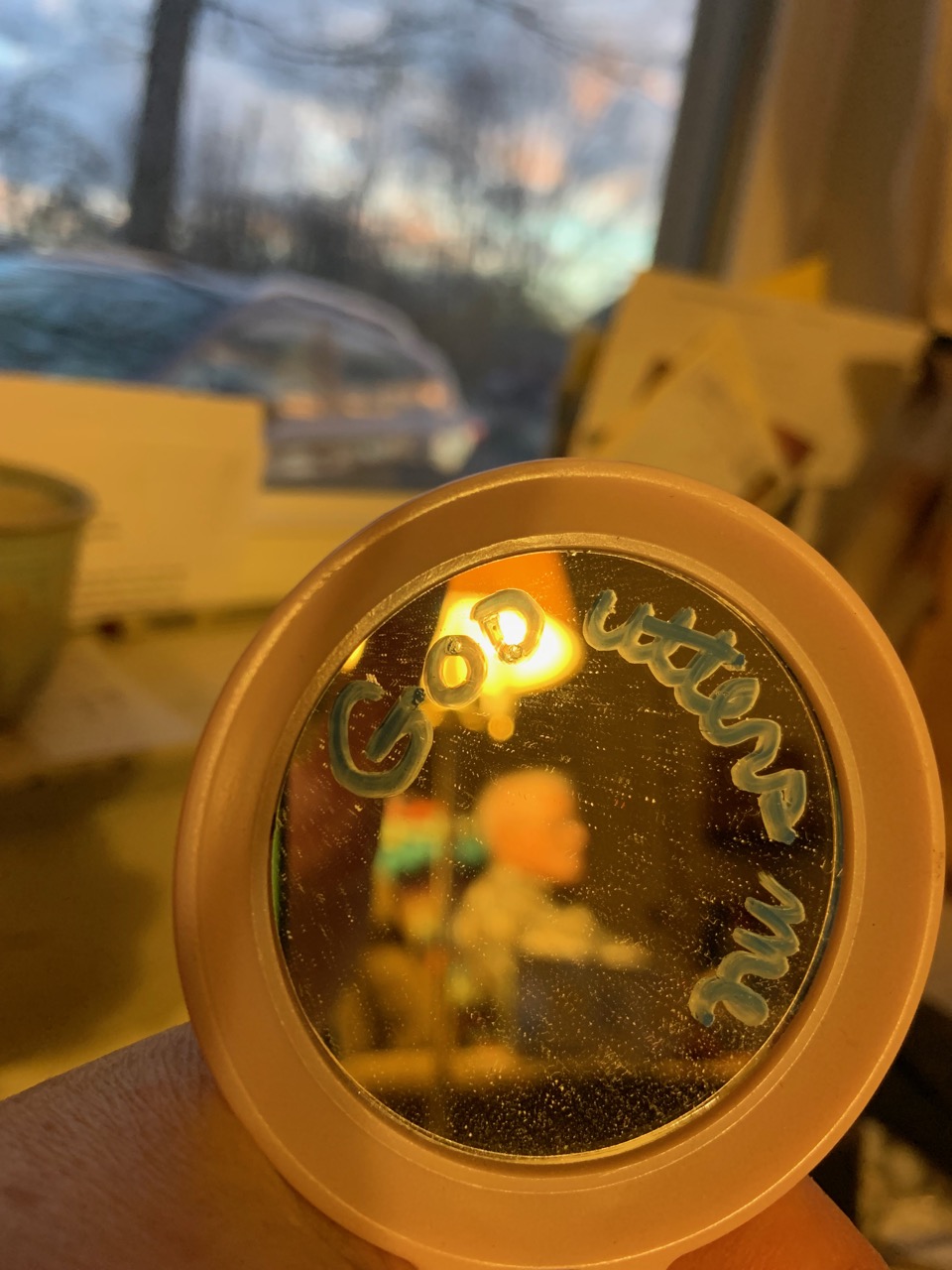
The pocket mirror I carried during Lent (and my father’s reflection in it)

For the past several years during Lent, I have carried a mindfulness object to remind myself of something Christ-centered during that holy season.  This year I carried a little pocket mirror on which I had written the first three words of today’s quote by Thomas Merton.

And these were some of my thoughts about his words —

What if, instead of the four Greek words for love, or instead of the five ways to say “I love you” in Mandarin, or instead of the nine ways to say it in Russian — what if, at any given time on the planet Earth, there are over 7 billion words for Love, uttered by God Himself, and they each have a face, and hands, and feet?

What if each time God utters a person into being, He’s saying another word containing a partial thought of Him — and that word is Love?

What if I am a word for love? Am I living my life in such a way that others can see that?


A to Z Blogging Challenge

T is for True

Therefore, if you spend your life
trying to escape from the heat of the fire
that is meant to soften and prepare to become your true self…
you will be destroyed by the event
that was meant to be your fulfillment.

Thomas Merton, New Seeds of Contemplation


New Seeds of Contemplation (Thomas Merton) — the sealing wax analogy

So often I pray not to be brittle.