I want to use this letter to tell you about some of the abundance in my life. In your most recent message to me, you asked me about my girls. Talk about abundance! I’m so proud of each one of them.
My oldest daughter has her master’s degree in nursing. She works for an organization that cares for low-income elderly, trying to keep them living independently. Her career path was inspired by both my parents. The other day, one of the other kids said something about Helen pursuing law school. That may have been just idle conversation and have absolutely no substance to it — or maybe it’s true. I could see her doing that — arguing on behalf of people who cannot. She’s strong, strong-minded, and compassionate.
And she’s getting married — to a kind, compassionate man who knows how to handle someone who is strong and strong-minded. I’m so very happy for her.
My middle daughter just finished her first semester at an all-women’s college in Virginia. I was driving her to Syracuse yesterday to catch her flight back to Roanoke when she got a text from the airlines that one of her flights was canceled. She had gotten an email the day before from the school that a water main had burst in one of the residence halls. We had been watchingbracing for news that they would go remote because of COVID but that didn’t happen. Last night, though, she heard that in-person classes are being postponed for a week. In my heart, I rejoiced. I LOVE having her home.
She has blossomed so much at school. During the fall semester, she would call or text things like, “Guess what I learned today?!” and it made me so happy. My father would have been thrilled to see someone so excited about learning. Heck, I was excited about her excitement.
My youngest daughter also finished her first semester at college — a straight A student, but she’s not going back. Instead she’s going to pursue dental hygiene. It’s an interest she has had for a long time. Maybe I didn’t encourage it enough in recent years because the thought of working in people’s mouths all day was so YUCK! It’s the right path for her, though.
Today she came to visit me at work. “What a beautiful girl!” my co-worker remarked — and she is. Absolutely lovely.
I realize as I write this that abundance may have been a better word to describe my sons since I have five of them. But I’ll save that for tomorrow when the word is generosity. I have a generosity of sons. God’s generosity.
I also have an abundance of blessing — three daughters.
I’m not really sure why, but that word makes me think of my mother. She liked to use words like that, but I’m not sure I ever heard her say gobbledygook.
Words are fun though, aren’t they?
I like that you like the word blithering — a word which rather aptly describes me and my writing style.
I was trying to remember when we first met. Was it Hutchmoot 2012? I think so. I remember seeing you sitting in the front row at Church of the Redeemer — watching, watching, watching, because that’s how you gathered the words that the rest of us so easily picked up through hearing.
My mother was still alive then. She didn’t have hearing problems. In fact, sometimes her hearing was too good. But she had the processing problems of dementia — and I think she knew that she was not grasping everything that was going on around her. It made me sad. It made her frustrated — because her reality wasn’t making sense and she couldn’t get us to understand what her reality was. Instead, at that point, I kept trying to bring her up to speed, orient her, help her understand truth. Over the next few years I had to learn to meet her where she was — in her strange netherworld of place and time.
But I saw you sitting in the front row and I remember thinking, I could try to help her. I tried sitting with you and taking notes that you could read but my handwriting is terrible and I couldn’t write anywhere near fast enough.
When someone would say something funny from the back of the room and everyone would erupt in laughter, you would look at me, questioning, what just happened? I would try to write it, but other things were being said that were meaningful or funny and I couldn’t keep up. I just couldn’t keep up with it all.
It gave me the tiniest glimpse into your world.
The funniest thing about that whole experience was that I thought I would help you, but you have ended helping me ever so much more.
Over the past nine years of our friendship, you have been the steadiest and most encouraging of friends. I have notes from you taped to my door where I can see them and think of you. I have books on my shelf from you, a mug in my cupboard, a small pottery pitcher with a rabbit on it, and a dress that you made for me — remember that? I wore that dress for two weddings!
There’s so much more.
But enough blithering. Enough gobbledygook for today.
You’re the best. I am so blessed to have you in my life.
Gah — It’s New Year’s Day and I really want to get back into writing.
“I resolve to write every day in 2022.”
That sounds so pretentious. And lofty. And ridiculous. Yes, that’s it — utterly ridiculous because I barely posted anything in 2021 and I probably made the same resolution.
That’s where you come in, Kim. As I sat here squirming in my chair, feeling knots in my stomach — knots of both of anticipation and dread — I thought, what if I just wrote a letter to Kim every day?
I can picture you reading it. I know you’ll be kind in your responses. I owe you so much.
I think that‘s it, too. I owe you so much. So many thank you’s. So many responses to your faithful checking in on me. You know the road I’m walking — and you know how to encourage me on it. Have I ever thanked you for all that?
And here you are — unbeknownst to you at the time of my writing this — helping me again.
For the month of January 2022, I resolve to write to Kim every day. I’m going to use the prompts from Linda G. Hill’s blog. She calls Saturdays “Stream of Consciousness” and I’m not allowed to go back and edit. This may explain some of the blather in this post. I would ordinarily cut some of it out. But, then again, I probably wouldn’t end up posting because I would say, This is total blathering. Or blithering as the Scots might say.
Wednesdays are “One Liner Wednesdays.” Not exactly sure what happens there, but I’ll jump in and give it a go. At least for January.
All the other weekdays will have a prompt. So if I write to you about gobbledygook or unicorns, just know that that may be the prompt and I’ll try to work it into something meaningful I’d like to say to you.
Because I do have so many things I want to say to you — most of them centered around gratitude. You’ve been a good friend.
And if I fail to write you any of the days of January, just know that the failing is mine, not yours.
Thank you that I have a job that gets me up early enough to see it. As I drove to work at 4:50 am, I looked at the sliver of moon and said to it, “How pretty you are!”
Thank you for my co-worker who asked me if I saw the eclipse. “I saw the moon,” I said. “It’s eclipsing,” he replied, and we walked to the window together where I saw a half-moon with a rounded edge between the black and white. If it had been a cookie, it might have been a reject; but it was the real moon and it was lovely.
Thank you for the big windows where I work. I walked to them frequently over the next 45 minutes and watched the moon wax. (Or is it wane? Or is there another term for the changes during an eclipse?)
Thank you for the camera that I carry in my pocket, a.k.a. my phone. Twenty years ago I wouldn’t have been able to easily photograph moments like these.
Thank you, too, that I forgot about the camera in my pocket, so I stayed in the moment. This morning I didn’t snap a photo until it was almost too late.
Thank you for lousy photos that still help me remember a magical moment.
Thank you for the eclipses I see in people, like the grumpy man who growled at me that one morning when he first walked in and came back to apologize after his workout. Endorphins pushed the shadows back for him.
Thank you for endorphins, those neurotransmitters that trigger positive emotions. They relieve pain and stress. Exercise helps release them. So does chocolate.
Thank you for chocolate.
Thank you for co-workers who share their chocolate.
Thank you for the chocolate side of half-moon cookies, which I like slightly less than the vanilla side, but the chocolate makes me appreciate the vanilla.
Thank you for contrasts like that.
Thank you for the eclipse, for dark and light, earth and moon, people, chocolate, and life itself.
I have a full-time job with benefits for the first time since 1984.
Gosh, it sounds funny to even write that. As a stay-at-home mom and then a caregiver to my dad, I’ve worked full-time forever.
And I’ve had great benefits. The kind “real” employers can’t possibly offer.
But that’s probably a post for another day.
I have a full-time job.
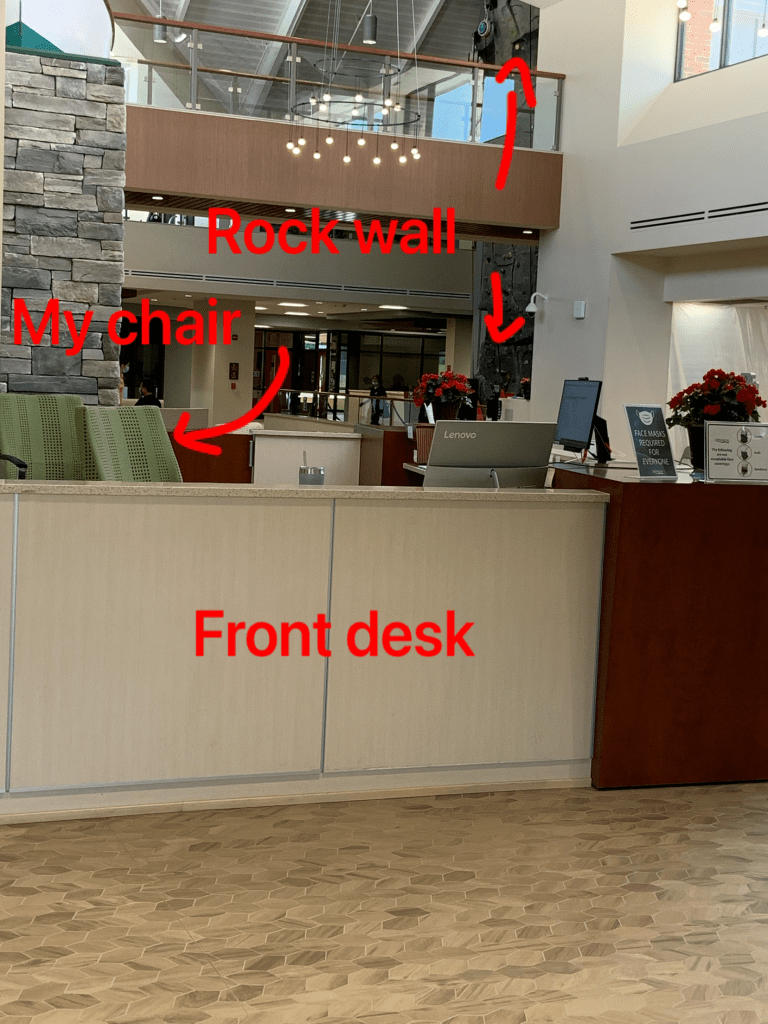
A little over a year ago, I started working at the front desk at the same sports facility where I’ve worked many years in aquatics. Part-time, of course.
the front desk
It is so much fun. I look forward to going to work every day.
When a woman retired in June, my boss asked if I wanted to come on full-time.
“Um, letmethinkaboutthat-no,” I said, all too quickly, clearly not thinking about it, because, seriously, I haven’t worked full-time outside the home in 37 years.
They hired someone else who left within a few months for a better job.
I mean, really, who wants to be part-hostess, part-policeman, part-retail sales clerk, part-telephone operator, part-let-me-help-you-with-_________(fill in the blank)?
Yesterday I was reminded all over again why I love this job.
One of the perks is paid work-out time. Yep, I get paid to go swimming if things are quiet. Yesterday I took advantage of that.
As I was changing back into my work clothes after a swim and a shower, I heard a woman crying. We were the only two people in the locker room. She was sitting on a bench in the shower area, her head in her hands, weeping.
“Are you okay?” I asked. (Dumb question — clearly she was not.)
“No,” she said, looking up at me.
“Can I do anything for you?” I asked.
“No,” she said, and she proceeded to tell me her story. Her husband was very sick. He was waiting to be transferred to a hospital in New York City. The helicopter had been arranged but then the weather didn’t cooperate. The bed that was being held for him in New York was given up. Then the helicopter was able to fly but there was no bed for him. Then there was a bed and a helicopter but his condition had deteriorated so that he needed a procedure to stabilize him. “He’s in the OR now,” she said, “and I just walked down here to take a shower and clear my head.”
“I’ll pray for you,” I said, but it sounded trite. I think she needed a hug.
“I’d hug you,” I said, “but it would be weird. I mean, you’re wearing just a towel, and social-distancing, and all that.”
She looked down at her towel and laughed. “You’re right.”
“Are you sure there isn’t anything I can do for you? Have you eaten today?” I asked again.
“No, no. I’m fine. I need to get going back to the hospital,” she said.
So I left her and went back to work.
At the front desk.
Suddenly, I remembered something in my bag. I ran to my staff locker and found it — a new little journal and a good pen.
When she came out, I handed her these two items.
“I know this seems weird,” I said, “but I want you to have these. While you’re sitting and waiting, write your feelings. It may help. Or write down the times and places you need to remember. Or scribble angrily. It’s okay. Putting it down on paper may help.”
She took them and thanked me. I thought she was going to cry again.
The front desk phone rang and I hurried back to answer it.
While talking on the phone, I watched the woman pull on her coat and her pom-pom hat. She waved as she walked out the door.
In that moment I knew why I love this job so much — it’s because I get to meet people like her.
On the morning of September 11, 2001, Francesca decided, “Today will be the day that I start taking care of myself.”
She slept in a little that morning. She had put in a 12 hour day the day before at her job on the 99th floor of the World Trade Center’s North Tower and was just leaving the house around 8:45 when her sister called.
Now she plays her cello every 9-11 at the time of impact. She remembers and she weeps.
My partner for the ropes course was a cautious woman. She never fell.
I, on the other hand, plunged — literally falling three times — quickly through each element.
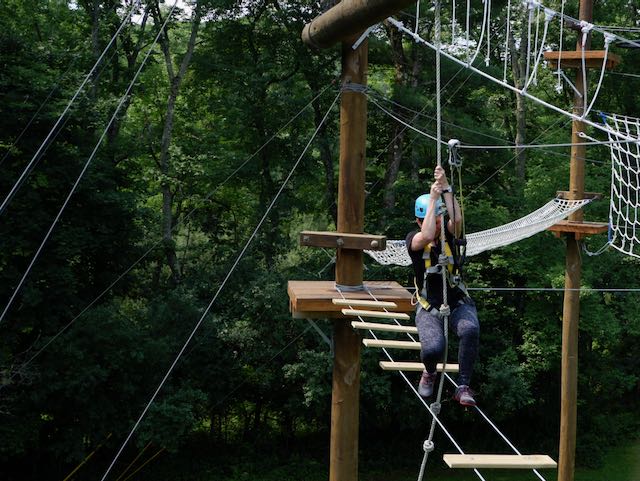
She cautiously walked across the wobbly steps. I just — boom-boom-boom — hastily crossed the bridge.
Wobbly steps
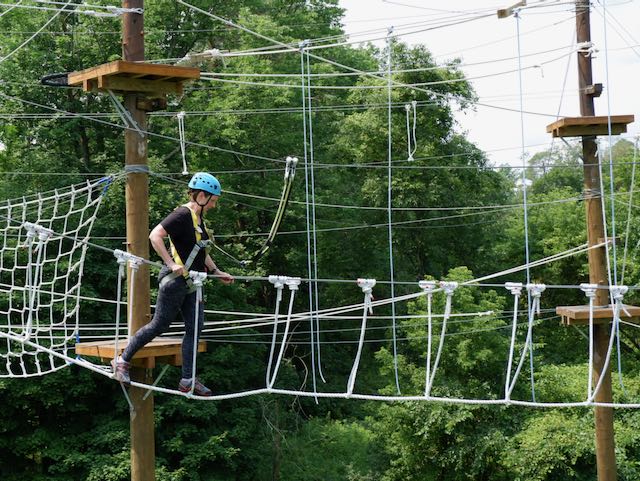
She edged her way across the first tightrope. I grabbed each successive support rope and was across in no time.
Tightrope
On the second tightrope, her cautious approach proved better than mine. I fell (caught by my harness, of course) and bore a bruise on my thigh for weeks afterward as a reminder that it’s important to be a little patient.
And so we made our way through the ropes course, each cheering the other on. I recognized her fear. She recognized my foolish haste.
“I wish I had done the Tarzan rope,” she told me later. It was the one element she had skipped.
Tarzan swing
“I wish I had taken my time on more of it,” I confessed, thinking specifically of a net that I should have crawled across instead of trying to just run across it. It was another of my falls.
Before the fall
The element I keep thinking about, though, was one she helped me cross. It was a rope bridge. At this point, she had already seen me fall multiple times.
“Take your time,” she said, as I climbed down onto it.
“One step at a time,” she said, as she saw me looking too far ahead.
“Step on the knots,” she said, and that advice made all the difference.
I went knot-to-knot across the whole thing, one step at a time, focused not on the far goal, but on where I needed to place my foot next.
Sometimes life can feel so overwhelming.
I don’t know about you, but my life is chock full o’ knots. Some days I want to run past them all and pretend they don’t exist. Some days I just want to sit and do nothing.
The other day five men came into the sports center together, one of them spinning a shiny new Spalding basketball between his hands.
“Is anyone playing basketball right now?” he asked.
“The gym is available,” I said. “I don’t know if anyone is playing basketball right now though.”
“I think there’s one guy shooting hoops,” my co-worker said.
The guys looked at each other. They looked at what they could see of the facility from the front desk.
Where I work
“You’ve got a rock wall? Can we climb?” one asked.
“Yep,” I said. “It opens in half an hour.”
“How much does it cost?” another asked.
I explained our day pass system and the two different passes they could purchase — $10 for the facility or $15 to include our fitness center.
“Huddle!” one of them said, and they huddled. Right there in the lobby.
“Okay, we’re going to do it,” they said when they broke their huddle.
“Ten dollars or fifteen?” I asked.
“Fifteen. We’re going to do it all,” said the spokesman.
As they stood at the counter filling out the obligatory paperwork — emergency contact information, waiver forms, etc — I learned a little about them. They were all mid-30s. The five of them had lived together in college. This was a bachelor party.
“Let me tell you about what’s available here,” I said as I collected their papers and their money.
I launched into my spiel. “Our fitness center has two levels. The main floor is traditional equipment, free weights, ellipticals, steppers, treadmills. The upper level has things like kettlebells, ropes, those weight bags that people run up and down stairs with, and other machines. We have the rock wall you can see and a bouldering wall in the gym. There are three pools but you probably don’t have your swim suits with you. There’s racquetball, squash –“
One interrupted — “Do you have racquets we can use?”
“Yes, right outside the courts,” I said, and continued, “There are bowling alleys downstairs –“
“Bowling!” I saw a few high fives. “And that’s open?”
“Yes,” I said, laughing. I loved their excitement.
They headed for the gym first and played a little basketball. Over the next few hours, though, we heard shouts, hurrahs, and bursts of uproarious laughter coming from various parts of the building. We watched them try the rock wall before heading into the fitness center.
When they left before closing, I asked how their day had been.
“Great! Best $15 I’ve ever spent one!” one said.
“We did it all,” said another. “Basketball, bowling, ping-pong –“
“Oh! I forgot to tell you about ping-pong!” I said.
“It’s okay. We found it,” he said.
“And had a great time,” another added.
Their delight became my delight. I still smile when I think about that group of men playing, laughing, having fun, enjoying the time spent together.
I’ve reflected back on this many times. Why did I find it so gratifying? I think it’s because the world has become a meaner place over the last few years. Our laughter is usually at someone else’s expense. Camaraderie tends to devolve into bickering. We don’t listen. We don’t enjoy time together. Everything feels like jockeying for position.
So when two Olympic high jumpers agreed to tie for Gold, it’s an anomaly.
And when five guys, from different places and different walks of life, enjoy each other’s company for a full afternoon, it fills my cup.
I remember at Hutchmoot, in one of those first years, a musician/artist talked about his therapist and then said, “Everyone needs a therapist.” There was a smattering of laughter, so he said, “I really mean it. It’s one of the best things I ever did.”
Once, when someone told me they had started therapy, I asked, “What’s it like?”
“It’s like having a paid friend. One that you can say anything to,” was the response.
That’s a pretty apt description.
My therapist’s name is Rachel.
I apologize a lot to her. “I’m sorry that I blather so much,” I say.
“It’s okay,” she replies.
“I forgot where I was going with this,” I say. “I ramble too much, don’t I?”
“Tell me more,” she replies.
One day, she said, “What would you say to young Sally?”
I stopped blathering and rambling and tried to think. Later that evening, I wrote a poem — and promptly forgot about it. That’s how I am these days — scattered and forgetful.
But each morning, I get up and try again. I begin the day with reading. It’s funny how the themes circle around. The same thoughts emerge from vastly different places.
I began the year pondering a quote by Howard Thurman:
I see you where you are, striving and struggling, and in the light of the highest possibility of personality, I deal with you there.
This morning, I read this in J. Phillip Newell’s Christ of the Celts:
“Alexander Scott, the nineteenth century Celtic teacher, uses the analogy of a plant suffering from blight. If such a plant were shown to botanists, even if the botanists had never seen that type of plant before, they would define it in terms of its essential life features. They would identify the plant with reference to its healthy properties of height and color and scent. They would not define it in terms of its blight. Rather they would say that the blight is foreign to the plant, that it is attacking the plant.”
I am so blighted. So very blighted.
Who am I in the light of the highest possibility of my personality? Who am I in my healthiest sense of my existence?
I went back and re-read that poem I wrote.
What would I say to young Sally? I would tell her that she is seen — and that even the blights can shape us.
Here’s my poem. Sorry for my blathering. I forgot where I was going with this.
I see you. I see the dreams you’ve set aside Over and over For better dreams No — for better realities
Because who could have imagined You would be happy spending So many years of Reading Aloud
And singing silly songs Not just With Larry But with Philipowensamhelenjacobkarlmary (I don’t think Laurel liked to sing Or read, for that matter)
Of listening And probing For children’s dreams So they might become the realities That I missed
Once upon a time I wanted to be a veterinarian Because dogs and horses Were so much safer Than people
Then I wanted to make music -al instruments Because everyone knows You can’t make a living making music
And linguistics – To study languages And understand their structures “Anatomy of Language” Sounds fascinating to me
But is that even a class? Human anatomy is a much easier Class to find And I would have taken it In my last dream of being A physical therapist
But I married And became a mom
Yes, I see that young woman Who couldn’t stand on her own And didn’t have someone to say, Follow Pursue Be
Instead I had someone who said, “Come.”
And I went
I see you, and the dreams you’ve set aside I see the rich reality you’ve lived I see it all and, yes, I feel some pride — For what is Christ but to give and give
Rory: Welcome to the Scottish podcast by Scottish people about Scottish things. We’re three lifelong friends and displaced Scotsmen who like to get together to talk about our homeland, the weird stuff that happens there, and to remind us why we are the way we are. Welcome to “Thistle Do Nicely.”
Hello, everybody, and welcome to today’s Story with Rory, or is it going to be a song with Rory? I am joined by my backing vocalists, Jonathan and Christopher.
Jonny: Hello
Chris: Hi
Rory: I was really hoping you were going to sing in harmony there.
Jonny (laughing, then singing): Helloooooooo
Chris (singing harmony): Hellooooooo
Rory (singing bass): Hellooooo …. Ah, yes
Jonny: We’ll fix it and post. Don’t worry
Chris (singing the tune of “The Wellerman”): Rory is Heather’s man’s son. He wanted a pod so we played along.
Rory: Ah, yeah, well. We’re a bit punchy because it has been a busy week, but also we’re going to be talking about songs of Scotland today. So, we’ve been listening to some incredibly patriotic traditional Scottish songs for the past 24 hours and we’re excited to talk to you about them. I think before we do that —
Jonny: We’re, like, the past 24 minutes, I think, in some instances.
Chris: If that
Rory: I am trying to create a theater of the mind, Jonathan
Jonny: Sorry, I’d like the listeners to know how close it was to this episode not happening.
Rory: I —
Jonny: We made it.
Rory: I would like the listeners to believe that we spend weeks and weeks researching each episode ahead of time, but —
Chris: It was remarked by my other half that Rory successfully guilted me into doing the episode after a particularly frantic coming-home period.
Rory: Yeah, but — you’re going to come out of it feeling better. I know that. This is going to be — I think that’s what men in their thirties do now instead of going to therapy. We just get a podcast. So…
Chris: I think you might be on to something.
Rory: I think this is going to make you feel better. Yeah. Before we start talking about songs of Scotland, let’s take a wee rumble in the sporran. Wee rummage.
Chris: Yeah, if you like. Absolutely.
Rory: Absolutely. So I discovered the other day that we get reviews on other websites outside of Apple podcasts, and, you know, if you have a moment right now, go and review us. It’s very helpful.
But… uh, yeah… I discovered that we get reviews on things like Amazon and Audible and stuff like that and I found this amazing one from Mary Elizabeth — I’ll leave your last name out just in case child services get involved.
So her title: Here’s a F—ing Five Star Review!
Chris: Not our words, mums.
Rory: No, no — I’m quoting here — “Loving this podcast boys and enjoy the banter and swearing. Even my 12 year old enjoys it.” So, uh, Mary, you’re obviously raising a well-rounded child there. Congratulations. And shout out to Mary’s child.
Chris: I’ve got an aggressive one as well. Real aggressive tones in these. This is from Danny Boy and Lovely Laura, which starts, “Alright, ballbags —
Rory: Nice. Love it.
Jonny: Great
Chris: (reading) “How are youse doing? It’s Danny Boy and the birds here. That’s Laura.” Of course. As if we would know who that is. “And the birds.“ Obviously Laura.
Rory: Do you think she’s writing it over his shoulder?
Chris: (imitating Laura’s voice) “Tell them who I am! Tell them my name! I’m not a bird! I’m Laura!” Hang on. I’ll get there. That’s the wrong accent for her. “We’ve been listening from near enough the start and loving it. We’re from EK—“ for our readers, that’s East Kilbride which is famous for its roundabouts and cinema —
Rory: Yeah
Chris: And that’s it. Nothing else. “Laura is from Tyrone in Ireland and we’ve been living in Aus for 3.5 years.” I’m assuming Australia, not Austria.
Rory: Quite the cosmopolitan couple.
Chris: Could be Austria. That’s the spy capital of the world. A Scottish and an Irish spy in Vienna.
Rory: It could be that early 90s prison with just incredible violence.
Chris: No, it’s spelled A-U-S so —
Rory: So it’s not the HBO mini-series
Chris: Or the fantastic emerald wonder
Rory: Oh yes that
Chris: With munchkins as well. Um… “It’s class to listening to boys from home talking shite.” I think that’s offensive.
Rory: It’s a different podcast.
Chris: “No nonsense, of course.” He acknowledges that we are no-nonsense podcast. “Seeing as we are so similar — the Scottish and the Irish — we’d love to hear a podcast of Scottish v. Irish. Obviously, Scotland would be the better side.” So that’s one option, chaps. I mean, we’re going to have to do Scotland v Ireland at some point.
Rory: Yeah. We’ve talked about this a couple of times… erm….
Chris: We just have to get around to it.
Rory: But it was more we’ve talked about doing Scotland v Ireland — which was better or explaining to people the difference between Scotland and Ireland
Chris: I don’t think we need to do a debate episode of which is better, just one explaining why Scotland is better.
Rory: Right. Yes.
Jonny: But we’re sort of, in a way, kindred spirits with the Irish, are we not? You know it’s a bit different relationship than between us and the British
Rory: Oh, god, yes, of course.
Chris: They’re the other side of the same coin, but that other side is really scratched up, like a cat has got to it.
Rory: And just slightly more drunk than us.
Chris: Hah
Chris: Other thing he wants to mention is — and this might be up your street, Jonny — Baker Street, if you will — “one of the things we don’t debate on is Gerry Rafferty being a weapon of an underrated Scottish musician. I would love to hear a podcast on the legend. If you haven’t listened to him much, we highly recommend the album ‘City to City’ and ‘Night Owl’
Rory: Agreed
Chris: Must love that. “Love, hugs, and kisses, Danny Boy and Lovely Laura, you bunch of posh pricks.”
Rory: Accurate. Great. Also, excellent use of the word weapon there. Haven’t heard that in a wee while. That was brilliant.
Chris: Yeah. Yeah. And we’ll do a — Rory alluded to Gerry Rafferty in our Billy Connolly episode.
Rory: Yes.
Chris: It remains one of our best downloaded episodes every week. It’s always in the top three for some reason.
Rory: yeah
Chris: I noticed that
Rory: Well, he’s just a legend and I think people are downloading it mistakenly because they think Billy Connolly is actually on it so
Chris: We probably shouldn’t have headlined it “Exclusive Interview”
Rory: I’m kind of tempted just to label every one of them
Jonny: You could put his name in brackets at the end of every title.
Rory: Yeah
Jonny: “Scottish Music [Billy Connolly]”
Chris: I mean, yeah, if we cornered the SEO market on Billy Connolly, that might be it.
Rory: Well, Billy, thanks for writing in. Laura, more effort next time. Be less Irish, I guess.
Chris: It wasn’t Billy. It was Danny.
Rory: Oh, god. Uh … I’m dyslexic. They’re basically the same thing. Sorry, Danny.
Chris: Sorry, Danny, you ballbag.
Rory: Uh, Jonny. You got anything in the sporran?
Jonny: Uh, do I? No, I don’t think so. Do I? Am I supposed to? I thought it was just that!
Rory: This is YOUR sporran!
Chris: I’ll read another one, if you want. I’ve got the sporran in front of me.
Rory: Go for it.
Chris: This one is from Susannah. She said, Hi —
Rory: Oh, I read this one! This one is chaos.
Chris: It is chaos. Yes. “From what I’ve heard, you long for new listeners to give a shout-out ” – this is true – “and tell the world about this new inspiring pod you’ve been listening to” – this is also true – “so here I am although nobody but the three of you can hear me” – well, not any more — “I haven’t been through all your material yet, but getting there” — lazy — “Some brilliant stuff. Always at least four laughs every episode.” Just four.
Rory: Only four. Yeah.
Jonny: I think that’s okay going, to be honest. Four really long extended laughs.
Rory: It sounds, it sounds bad. Like an hour long episode.
Chris: Yeah, considering it’s an hour long episode, that’s a laugh every fifteen minutes, but she does say “at least” so I’d like to know which episode she just was like, “no.” Although I do have an inkling of what that episode is from a Facebook message I’m about to read out. So she says, “I’m not so much into tennis but still almost all of Andy Murray has passed my ears. Perhaps your humorous tone helps get it done. Like a ‘spoonful of sugar’.” Then she sent a cartoon as well but I’m not going to click on that because it’s probably going to make my phone crash to be honest.
Jonny: Uh… thanks, Susannah.
Rory: I liked that email. It was kind of a chaotic, all-over-the-place email. I really enjoyed it.
Chris: Uh, yeah. So that was from Danny Boy.
Rory: Or was that Billy?
Chris: Yeah, Billy as well. And then where would be without a rummage in the sporran without a message from Sally
Jonny: Sally! She’s back!
Rory: Yeah
Chris: I mean, you’re going to have to do a song for Sally at this rate.
Jonny: Could we do a mega-mix of all the Sally-songs in one episode?
Chris: Do you remember last week we briefly alluded to the fact that the Scottish football episode, we said that that was probably our most self-indulgent episode so far? Well, we were wrong apparently. Sally tells us that the most self-indulgent episode was neither football nor rugby. Hands down winner for that would be the Drew McIntyre episode.
Rory. Yep. Accurate.
Chris: It was very early on in our running. I think episode 4 about the WWE wrestler. Sally, I’m actually wearing my Drew McIntyre t-shirt as we’re talking about this right now, so
Chris: Also — she’s very honest, Sally
Rory: Yeah, she called you out and she is correct.
Chris: I mean, I’m not going to take it too personally considering one email called out Andy Murray for being boring and this one called out Drew McIntyre for being self-indulgent, and they were both episodes that I led. But, you know that’s —
Rory and Chris: Neither here nor there.
Chris: I’m not a leader of this podcast. I’m here for reactions, okay? So anyway, she says, “I listened to it a few weeks ago because I was going back to listen to episodes I hadn’t heard yet. Let’s just say that, if that had been the first episode I had listened to, you would have one less fan.”
Rory: I love it. That’s amazing honesty. I love that so much.
Chris: Then, I think she realizes that she’s maybe gone too far here — you know, I sent her lots of pictures of me crying — then she says, “It wasn’t that bad. Just not my cup of tea.” Then she says, “I think I’ve sent links to episodes to all of my children now and made one daughter listen to hours of Thistle Do Nicely while we were on a college-hunting trip. So there’s that.” Whoever your daughter is, Sally, I’m so sorry that you had to listen to hours of this nonsense.
Rory: Yes!
Chris: Um — it’s not fair on you and if it’s put you off any colleges going forward in life, you know there’s other things to do. You don’t have to go to college. You know, you can make a lot of money as a plumber.
Rory: Sally’s daughter – if you are in danger, email us. We will try and help because it sounds like you’re being trapped and forced to listen to absolute nonsense.
Jonny: driving around the country listening to only this
Rory: Yeah, clawing at the door, trying to get out.
Chris: Later on, she says, “One last question – am I allowed to say butterscotch or do I have to call it toffee?” I explained to her that they are two different things.
Rory: No! Oh — you know what she’s calling out? The fact that we were complaining about the word ‘scotch’ and scotch whisky — was that last week or a couple of weeks ago? That’s what she’s saying. Oh — that’s very sweet of you, but no, it’s okay.
Chris: I explained to her that they’re not the same thing so it doesn’t matter.
Rory: Yeah, but she doesn’t want to say the word ‘scotch’ because we find it offensive.
Chris: Well, what would you call butterscotch otherwise?
Rory: Nothing. That’s why we’re saying it’s alright to say it.
Chris: Butter-pieces. Butter-whisky.
Rory: Butter-Scottish person, or Butter-scottish candy.
Jonny: Butterjock.
Chris: Then she wrote, “I just saw your sporran request and none of this is sporran worthy.” Then I told her that we were going to read out everything. (Pause) Then she said, “I was just kidding about the—“
Rory: Oh my god! It’s still going!
Jonny: She’s just driven off the road.
Chris: Yeah, her daughter has actually taken her phone right now. Anyway, Sally, I know you’re probably embarrassed by all this but we love you, love all your messages, love the fact that you keep coming back for more. And, uh, yeah, there’s no other Scottish wrestlers as far as I’m aware so we’re not going to do any other episodes on that.
Rory: Sally — the fourth member of this podcast. Love it. Absolutely love it.
Chris: Ringo. Ringo of the podcast
Jonny: She’s like our George Martin — to us, the Beatles
Rory: I mean, thank you everybody for getting in contact…









 Hot Dogs and Marmalade