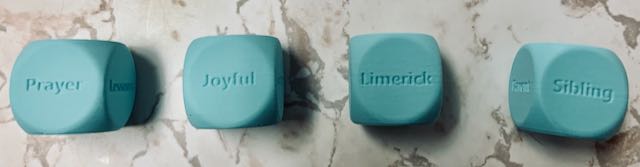
Two cats share an old chair by the woodstove An orange tabby and a calico They stretch and bask, sometimes paws interwove One wakes and grooms the other, licking slow
They eat their food together from a bowl Or crouch together watching some poor bird Sometimes they argue ’bout who gets the mole Mostly they don’t care who gets the last word
Companions would be an inadequate Description for this cat-relationship So bonded in a way that’s not clearcut Expressing joy wtih purr and lick and nip
They are true friends — someone with whom they can Just be themselves without ulterior plan
This is my submission for the W3 prompt this week: write a sonnet on the theme of friendship.
“Just hold out the grass on the palm of your hand,” Mom said, demonstrating the open palm to Iain.
Timidly he did it, taking baby steps forward until the heifer snuffled her warm wet snout onto his hand, licking the grass off. He laughed at the sensation: the smooth snout, the strong rough tongue.
“I grew up next to a dairy farm,” Mom said. “It’s where that housing development is now.”
“You were so lucky,” Iain said. “Why do we have to live in a city?”
“Your father has a good job there,” his mother replied.
“Are they [tipping his head toward the heifers] really where we get our milk?” he asked.
“Yup,” she replied.
“But I don’t see the thing they squeeze to get the milk out,” he said.
“These are heifers,” she explained, “young cows that haven’t had their own calf yet. They don’t have full udders until after they calve.”
He puzzled on it and bent his head sideways to try to look underneath. Sure enough, there were teats but no udder.
“Where’s the dad?” he asked. “We learned at school about babies. It takes a mom and a dad, right?”
“Bulls are dangerous,” she explained. “They use AI.”
“ARTIFICIAL INTELLIGENCE?!?” he said incredulously. “Like aliens??”
She laughed. “No! Artificial insemination.”
“What’s that?” he asked. “How does it work?”
She gulped and reddened. “A picture would be easier,” she said.
Back home, she looked up the following picture on her computer.
“Ewwww!” he said.
This is my submission for the Unicorn Challenge. Just write no more than 250 words based on the photo prompt.
Several years ago, I wrote a poem about growing up next to a dairy farm and the experience we had when our pet heifer wandered over. Here’s the poem:
When my parents bought the farm (literally) Pa Jackson was over the hill (euphemistically and literally)
He milked the cows by hand While the barn cats tumbled in the hay (euphemistically and literally) I watched with wide eyes (the milking, not the euphemistic tumbling)
The Jacksons had a bull To do the job of the artificial inseminator And when our pet heifer, Sock-it-to-me-Sunshine, Wandered over To get to know the Jacksons’ cows (literally) The bull also got to know her (euphemistically)
Then, our heifer Was in the family way (euphemistically) She was loaded on a truck And sent to a home For unwed cows
The next summer The Jackson’s cows Were also loaded onto trucks And sent to auction Because Pa Jackson was Extremely Over the hill (euphemistically)
A few years later We read in the newspaper That he had bought the farm. (euphemistically)
And here’s the pet heifer with one of my brothers.
The howling Ah-rooyip, yip (no growling) Wakes me. Or does it? So near! Hear?
And owling hoo-HOO hoo-HOO (no growling) Out my window, I hear life Rife
With wildness Foxes scream – WRAAAAGH! – no mildness (Or growling) Look at the dark! Hark!
It’s early But day is alive, surly Lonely, looking, using sound Found
In darkness Life not visible, starkness Yet teeming, streaming. New day — Yay!
This is my response to this week’s W3. POW Lesley Scoble challenged us to: Create a poetic scene, based on this imagery: It is early morning. You get out of bed and go to the window.
Here’s the thing, though — I go to work at 5 AM, so I get up at 3:30 AM. When I get out of bed and look out the window, I’m mostly looking at darkness. Or the moon. I have written a poem or two about the moon.
For this, though, my getting-out-of-bed moments of late are full of sounds, so I wrote about them.
The coyotes have been so active and loud. And the owls. Fortunately, I don’t heard the fox scream often, but I did the other morning, as I lay in bed thinking about getting up.
Morning — even early early morning when it is still dark — is my favorite time of day.
The poetic form is an unpronounceable Irish form: Deibide Baise Fri Toin. Quatrains. 3-7-7-1 syllables. Rhyme scheme aabb: lines 1 and 2 rhyme on two syllables, lines 3 and 4 rhyme on one.
Two roads diverged in a wood, and I (I should be telling this with a sigh) Stood at that fork and took it Hey Yogi! Hey Raffi! Look it! Look it! Look it! You know what came next? (What came next?) A knife and spoon! (clink, clink) So I kept on walking down the road With a fork-knife-spoon as my load
On Saturday I was supposed to go to a poetry reading. Mind you, I have done that only once before in my life and it was a terrifying experience. Thankfully an excuse presented itself and I bowed out. The friend who had invited me offered to read my poems for me. I gave her two — neither of which had been the poem I planned to read.
She messaged me later, telling me that the poems were well-received, that I was a rare talent.
To prove her wrong, I’m going to go ahead and publish last week’s tripe, my response to the W3 prompt. The POW gave a lovely challenge: to use 1-2 lines from Robert Frost’s “The Road Not Taken.”
Unfortunately Yogi Berra infiltrated my brain regarding that poem. Yogi once said, “When you come to a fork in the road, take it.” It’s one of many Yogi-isms for which he is famous. Like, “It ain’t over, ’til it’s over,” and “You can observe a lot by watching.”
Suddenly, too, while writing, I was doing battle with Raffi, who kept singing at me (in my head) about a time he went for a walk.
Sheesh.
Sometimes the muses either just aren’t there or are a couple of clowns.
Earlier today, I had had a conversation with someone who remarked how he still remembered and leaned on that rule.
“Kind of weird,” I said.
He didn’t get it.
Weird is such a great word — and it’s weird that it doesn’t follow the rule, even when the rhyme is completed — “or when sounded ay as in neighbor and weigh.” We don’t pronounce it wayrd. Weird.
I looked the rule up to make sure I was saying it right. There is funny stuff out in internetland.
How about this one: “I before E unless you leisurely deceive eight overweight heirs to forfeit their sovereign conceits.”
Weird, right?
Ooh, ooh! Here’s another: “I before E except when your foreign neighbors Keith and Heidi receive eight counterfeit beigh sleighs from feisty caffeinated weightlifters. Weird.”
I had to look up the word beigh: a provincial governor in the Ottoman empire. I suppose an alternate spelling to Bey.
Or maybe they meant beige.
Or maybe I misread it — I am, after all, trying to do stream-of-consciousness writing, not look-up-funny-things-and-copy-them writing.
Good golly, there are a lot of them. They refer to overweight reindeer and beige sleighs involved in heists.
I kind of stream-of-consciously wrote this last night and meant to post it, but I fell asleep.
“Boys, Mrs. Feola invited us over for dinner,” Mom said.
“Who’s that?” asked Johnny.
“She’s the lady that drove her pig around town on a bike,” said Michael.
Mom nodded. “That’s right! She had that special bike made so she could give it rides around town.”
“It had that big platform on it,” said Michael.
“Remember how she huffed and puffed going up the hill?” Johnny imitated the heavy breathing of the exhausted bike rider.
“Remember the time the pig fell off and she chased it into our yard? We trapped it by the fence for her,” said Michael. “That’s when I learned her name.”
“I was so busy scratching Piggy’s chin that I didn’t pay attention,” Johnny said. “That pig really liked when I did that.” He smiled remembering. “Under the chin. Behind the ears. That was one happy pig.”
“I haven’t seen her lately,” said Michael.
“What do you think happened to the pig?” Johnny wondered.
“We can ask her tonight at dinner,” Mom said.
That evening as they sat around the table beautifully set with linens, china, and candles, they ate their dinner.
“I suppose you’re wondering why I invited you here,” Mrs. Feola said. “I wanted to thank you for the time you helped me catch my pig.”
The boys looked at each other and smiled. “We were wondering what happened to that pig. We haven’t see you out with it lately,” Michael asked.
She smiled at them, fork in hand. “This is it,” she said.
250 words exactly.
This is my submission for this week’s Unicorn Challenge. The rules are simple: no more than 250 words based on the photo.
Years ago, my brother gave a piglet to my sons. It lived in the pig sty with the other pigs he was raising, but we would bring table scraps and whatnot to feed the pig. They may have even named it.
Anyhow, one day some cousins were visiting and the family was brought out to see the pig. Their aunt looked at it and asked my boys what were they going to do with a pig?
Very matter-of-factly my oldest son answered. “We’re going to kill it and we’re going to eat it.”
It went to a butcher eventually and we DID eat it, but I’ll never get over the horrified expression on my sister-in-law’s face.
“Somebody isn’t doing their job,” he growled, staring out the window.
“Sir?” she said.
“That is the black and white lot,” he said, jabbing his finger in the direction of the parking lot below them. “Black. And. White. Blackandwhite.”
She looked at him and blinked her eyes.
He continued. “I only allow black and white cars to be parked in that lot. I conceded to allow gray. THIS is too much, though.”
“But sir –” she started to say.
He interrupted. “It’s MY lot. I make the rules. Black and white. That’s it.”
“But –“
“No buts. Get those red cars towed out of there. And that stupid yellow car should just get crushed.”
She stared at him, unsure what to do next.
“CALL THE DAMN TOWING COMPANY. Do I make myself clear?” he barked.
An hour later, he watched with a satisfied smile as the final red car was towed away.
“I do like black and white,” he said to himself, looking around his office suite with its white walls and black-and-white tiled floors.
He heard a brisk knock on the door and turned to see a well-dressed woman enter. Her jet-black hair was pulled up and held in place with shiny black combs. Her dress bore black and white geometric designs.
“Darling,” she said. “Look who came to visit! My mother and her sisters. I told them they could park in the lot while we had lunch together.”
His face went white as three women entered wearing red dresses.
This is my response to the Unicorn Challenge. The simplicity of the challenge is deceiving: write a story of no more than 250 words based on the photo prompt.
“I’m sorry,” she said. “I can’t see you tomorrow.”
“You’re calling off our Wednesday date?” he asked. “We’ve been having dinner every Wednesday for eight months!”
“I know,” she said. Her voice was small. “I just can’t tomorrow.”
They walked in silence.
“Are you going to tell me why?” he finally asked.
She didn’t answer. “I’ve got to go,” she said abruptly and turned around.
He watched her walk away and pressed his lips together.
He started to call her that night, but changed his mind.
He thought about her all the next day. He knew that he shouldn’t, but he went to her house after work and stood in the shadows of the alley across the street, trying to think what to do.
She came out, dressed in a stunning dress. She didn’t see him as she walked past the alley, but he could smell her perfume. She had only worn perfume one other time that he could remember. Clearly, this was a special occasion.
He followed from a distance, walking up the hill to the cemetery. He lost sight of her, then heard her voice. “I miss you so much. I love you.”
But he found her alone. She was startled.
“Who are you talking to?” he asked.
“M-m-my husband,” she stammered and started to cry. “He was in New York on business on 9/11. I never got to say good-bye. Every year I try to.”
He wrapped his arms around her.
“I still can’t,” she said.
This is my submission for the Unicorn Challenge. It’s a simple challenge — write a story of no more than 250 words based on the photo.
Do you remember that fish? The one that got away? Yeah — that humongous one That amazing summer day
Oh yeah — do I remember! That battle ‘twixt you and it? You were so gol’darn mad You said that you could spit
[He laughed a hearty laugh] Oh, man, yes, you are right! The one that got away ’cause it put up such a fight!
[So, the both of them chuckled As they stared into the sky And nibbled on summer timothy, Then heaved a mighty sigh]
Yes, this is my own submission to my own W3 prompt.
A few weeks ago, I went with a friend to the Arkell Museum in Canajoharie, New York. They had at least 20 Home Winslows as part of their collection!
If you’ve never been to (or heard of) Canajoharie, let me tell you, it’s a tiny town on the Mohawk River in upstate New York. When I was a kid, we went on a field trip to the Beechnut factory there, where baby food was processed and made. Some summers later, I worked at a camp in Middleburgh, New York, where I passed Beechnut fields coming and going — beautiful, rich, farming field of whatever produce Beechnut needed.
Honestly, the whole area was/is as idyllic as a Winslow Homer painting.
In Canajoharie, as part of their village library, they have an art museum called the Arkell Museum. That’s where they had this collection of Winslow Homer paintings.
Anyhoo — I had just seen (and been blown away by) Winslow Homer, up close and personal. He made (and makes) my heart ache. Hence the prompt.
Honestly, I love that grew up in, and now live in, rural upstate New York. I don’t think there’s any prettier place in the world.
As far as the big one that got away? — boy conversation since the beginning of time. Right?
“Five… aw, dang, Mom! You messed me up,” he said. “I was counting the waves. Oliver said that the seventh wave is always the biggest.”
“I never heard that, but, okay, I’ll help you count,” she replied.
She stared at the sea and the waves licking the shore. “How do you know which one is one?” she asked.
Rory explained, “I wait for a big wave, then I start counting.”
“There!” his mother shouted. At the next wave, Rory called, “One!”
“Two… three… four,” they counted together.
“Wait,” said Rory, “that was another big one.”
“The biggest?” Mom asked.
His shoulders slumped. “I don’t know. Let’s try again.”
They watched and waited.
And waited.
And waited.
“They’re all small now,” Rory whined.
His mother nodded understandingly.
“There’s a big one!” his mother said, then Rory counted, “One!”
“Two… three… four… five… six… seven… eight… nine,” they both counted.
Rory looked at his mother. “It’s not seven,” he said.
“Where did you hear this again?” his mother asked.
“Oliver,” he replied. “His uncle told him. He’s a surfer so he knows.”
“Hmm,” his mother said. “Let’s try once more.”
After the next big wave, they both counted “One!”
Then together, “Two… three… four… five… six… SEVEN!”
Oliver jumped up and down. “It’s true! It’s true! Every seventh wave is a big wave!”
His mother questioned, “EVERY seventh wave?”
“Yes! Yes! You saw it, right?” Oliver said.
This is my response to the Unicorn Challenge which calls for a 250 word response to the photo prompt.
I’ve been listening to this Skipinnish song on repeat for a while. It’s so hopeful. The name of the album is “The Seventh Wave” and the song references in its lyrics “the seventh wave” so, of course, I looked it up.
Basically it’s not true.
Except when it is.
Go figure.
If this story is fiction but sort of science-y, does that make it science fiction?