A to Z Blogging Challenge · family

Benevolence

My father and I went to dinner at the Council Rock Brewery last night for their Friday night fish fry. If you should ever be so fortunate as to spend a Friday night in Cooperstown, by all means, go to Council Rock for dinner and a beer.

Chardonnay and beer
Chardonnay (for me) and beer (for my dad)

The what’s-on-tap list was long and my father hadn’t looked at it before the waiter came to take our order.

“I’d like a beer,” my father said.

“Would you like a dark ale or something lighter?” the waiter asked, his pen poised over his pad.

“Yes, that sounds great,” said my dad.

One of my father’s hearing aids isn’t working right now.

The waiter looked at me, unsure what to do next so I pushed the list over to my father and repeated the question.

“He wants to know which of these beers you want,” I shouted so he could hear me above the pub hubbub.

The waiter bent over the table and put his finger at the bottom of the beer list. “These ones are dark,” he said, “and they get lighter as you go up.”

My father furrowed his brow as he studied the list. He finally pointed to the second beer from the top. “I’ll try this one,” he said.

When it was served, my father said, “That’s the right color.” He took a sip and pronounced it good.

I was glad he was happy with what he had ordered.

When my mother was early in her Alzheimer’s, I remember going to restaurants with her. She wasn’t hard of hearing, but she did struggle to order. She studied the menu, chose something, announced her choice to us, but then would have forgotten it by the time the server was taking her order.

Sometimes she ordered what the person before her had ordered.

Sometimes my father or I ordered for her or prompted her with what she had intended to order.

Drinks were a different story. When ordering drinks, she usually declined — which was fine. But when the server brought out drinks for people and brought nothing to her, she grew indignant.

“Where’s mine?” she would demand.

The flustered server would apologize and ask again what she would like.

We would offer our drinks to her.

Anything to make her happy.

Because the maxim, “If Mama ain’t happy, ain’t nobody happy” is still true when Mama has dementia and is at a restaurant.

At the neurologist’s office one day, after a failed clock assessment, a sign of dementia, I asked the doctor, “What can I do? How can I help?”

He said, “Be patient. Be understanding. Be kind.”

We all need to live by those B’s,  even without the presence of aging or hearing loss or fogged thinking.

So B is for beer.

And benevolence.

And the above-listed B’s.

Not just in restaurants, but everywhere — at home, in the store, at church, on the road, in political discourse.

Be patient.

Be understanding.

Be kind.

Be benevolent.


A to Z Blogging Challenge

Ache

My mother and father -- when they really were going to a dance.
My mother and father — when they really were going to a dance.

The day my mother got ready for the dance was a hard day in her dementia. She tried to dress in nicer clothes, but her fashion sense had gone awry and nothing really matched. Her lipstick looked garish. She perched on the arm of the wicker sofa, like a teenager would have, and kept glancing toward the driveway.

Occasionally, she would go out the sliding door and walk to the end of the driveway to peer down the road. Then she would come back to the house and wait.

It was a hot summer evening and I hoped she would grow tired of it or forget it or snap back to semi-normal.

“What are you doing, Mom?” I asked several times.

“I’m waiting to go to the dance,” she said, petulantly, with her chin at a teenager’s tilt. “They should be picking me up any time.”

“Who?” I asked.

“The others that are going.” These others never had names. These others never materialized.

Finally I offered to give her a ride. She gratefully accepted, not seeing the absurdity of her adult daughter giving her a ride to a high school dance. We drove into town and around the empty parking lot of the high school.

“See? There’s no one here, Mom,” I told her.

She just looked at the building with a blank expression.

So I drove around some more and finally ended up at my go-to for such situations — the local garden nursery. We got out of the car and walked around the greenhouse, admiring plants and forgetting dances.

My heart ached after that adventure.

A is for aging.

And Alzheimer’s.

And ache.

Not the ache that comes from working out.  As an on-again/off-again fitness person, I know too well the ache of walking down the stairs the morning after doing squats and lunges for the first time in two years.

Not the ache the comes from putting off an appointment to the dentist.

Not the ache that comes from lack of sleep or forgetting your glasses or drinking too much wine the night before.

All these aches are temporary.

The ache of a caregiver is a heartache that has nothing to do with EKGs or echocardiograms.

It’s a soul ache because a loved one is vanishing, like a wisp of smoke that cannot be caught.

And when that loved one is finally gone, the ache remains, but it’s not getting stirred up anymore and aggravated by phantom dances.

It settles — like dust.

And we remember that we are dust, and to dust we shall return.


Faith · prayer

Resurrection Branches

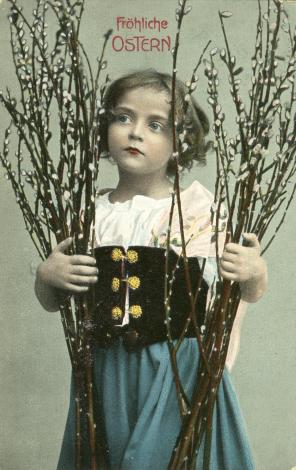
OsterpostkarteI was delighted to learn that the pussywillow is waved on Palm Sunday in many Eastern and Slavic churches.

“The Pussy Willow is also our Easter symbol,” said Father Czeslaw Krysa, rector of St. Casimir’s Church in Buffalo, in a 2013 article. He said that it is “one of the most prominent Easter symbols, because of the fact out of this dry, kind of twig all of a sudden bursts forth this beautiful flower of life, and it is the first bush that blooms.”

They call them “resurrection branches.”

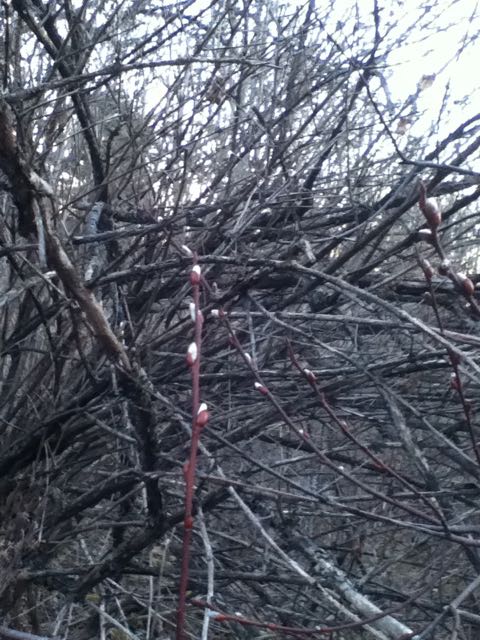
Reading about them reminded me of a poem/prayer that I wrote back in January.

Oh Lord
I need a pick-me-up
For I am feeling down
Outside the snow is glittering, cold,
Inside my heart is brown
And dry and brittle, mostly dead,
Like last month’s Christmas tree
Weeping prickly needles
Which need be swept by me

IMG_8480I know You can’t restore the tree
To vibrant verdant green
— Well, yes, You could
And yes, You did
When Aaron’s rod was seen
Budding,
Blossoming,
Bearing fruit
— Can You do that with me?
Of course, You can —
but would You, Lord?
Miraculously use me?

For, Lord, You know I have this fear
I’m one of the eleven
Sticks that stayed quite dead and brown
Not bearing fruit for heaven

I fear I too am dead inside —
Like Lazarus, I stink —
Roll back the stone –
Call out my name –
Pull me from this brink

Of hopelessness
Of deadfulness —
I need to be made new
Please water me
Sunshine me
And let me grow in You.

Today the rocks and stones and pussywillows are crying out “Hosanna!”

swimming

Swimming Posters

I loved the idea of reenacting a piece of art for this week’s photo challenge: Life Imitates Art

But what to do?

I asked Laurel if she would sit on my lap and put her hand on my cheek, like a Mary Cassatt painting, but she said no. It probably would have looked kind of strange anyway. She may be my baby, but she’s taller than me now.

So — swimming. I decided to ask my swimmers to recreate some swimming posters.

This one — Michael Phelps doing streamline — I just wanted them to see. Streamline is such a foundational skill. We work on it from Day 1 of swim season — and still, about half look nothing like this, hand over hand, squeezing the head.

Michael Phelps — Streamline

I stood on the balcony and took pictures of each swimmer leaving the wall in streamline. For you photo-geeks, all I have is a little Sony Cyber-shot that I bought on sale at Target for $59. I guess you get in clarity what you pay for.

DSC05572 (1)
Streamline

Still, it was a great learning experience for the kids. I showed each one the picture I had taken of them and we talked about how they could make their streamlines even better.

For fun, at the end of practice, we tried to recreate another swim poster.

I pulled our little Kodak PlaySport out of retirement (it can take underwater photographs), charged it up, and prayed that it would work.  Laurel was the photographer as each one of my swimmers did a cannonball off the diving board. This was the best shot.

Cannonball!
Cannonball!

Or this one.

Cannonball!!
Cannonball!!

So — thank you Daily Post for the photo challenge. I may not be much of a photographer, but this was fun.

family

Lovable

Several years ago I was walking Maggie in our little town and ran into a woman who was walking Maggie’s twin, a mostly black dog with some white markings.

“What kind of dog is yours?” the lady asked.

“They told us that she was a shepherd-boxer-akita mix at the shelter where we got her. Basically, she’s a mutt,” I said.

The woman smiled and said, “Mine, too!”

We stood and talked for a few minutes about how similar our unrelated dogs were. Unrelated, yet entirely related.

“Don’t you think,” she said, “that if we took all the dog genes in the world, put them in a big bag, shook them up and then pulled out a dog, it would look like this?”

Yes, she has crooked ears.

I laughed and agreed.

Since that conversation I have noticed so many dogs that look like Maggie.

I suppose that would say that she’s a common dog.

But she isn’t.

Our neighbor who walks Maggie for us while we’re away — and sometimes, even when we’re aren’t — often comments on what a smart dog Maggie is. “I usually only have to tell her once and she minds right away,” she tells us.

Maggie is smart. And fun. And energetic.

She can sit, stay, shake, lie down, die, and come. She carries a fish on her walks, chases snowballs and squirrels, and howls at the noon whistle. When we come back from being away, she races around the house in a doggy-happy dance. What more does a dog need to do?

Catching a snowball
Catching a snowball
Balancing a dog biscuit

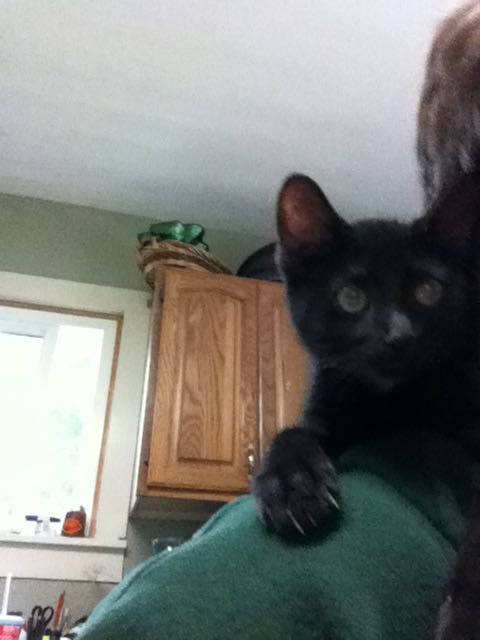
This past summer we got a kitten. She’s supposed to be a working cat, taking care of the mouse problem at my father’s house, but she’s still in training, slaying ladybugs and cluster flies in abundance.

She’s all black with a few white hairs like a little bow-tie.

Once we went on a field trip to a cat rescue organization and their shelter was full, mostly with black cats.

“They’re the hardest to adopt out,” the lady told us, “and seem to be the most common color.”

Our Piper was a freebie from a farm. When I took her to the vet, they asked for her breed.

“She’s just a cat,” I said.

I’m guessing that if you took all the cat genes in the world, put them in a bag, shook them up and pulled out a cat, it would be black.

But Piper likes to sit on my shoulder and lick my ears. She pounces on my feet from under the bed while I’m getting ready for bed. She snuggles on my lap in the morning, and rolls onto her back when my brother stops by so he can rub her belly. She is a special cat.

Perched on my shoulder
Sleeping in the sun
Sleeping in the sun
Conquering cluster flies

All this is to say that I think the least aspect of any creature is pedigree. Or color. Or any other externals.

What’s inside is unique and wonderful, waiting to be discovered and nurtured into maturity.

Lovable.

family

Presence

I did it again, grasped hand after hand, received hug after hug in a receiving line.

Few things are more draining for the introvert than the receiving line. We do it — I do it — for people I love.

Like my brother, Stewart.

Like my mother.

The receiving line for my mother’s memorial service stretched out and curved into another section of the building so I could never see how long it was or if the end was near. I stood near my father who insisted on standing even though a chair was placed right behind him.

The neurons in my brain don’t fire well in the facial recognition area. I struggle to remember people. Thankfully, many people began with their name — “I’m so-and-so. I knew your mother from such-and-such.”

Even people I knew fairly well helped me out by saying their name — and it was such a help. My mind was overbooked and understaffed; everything was hard.

How long had I been there? An hour? More? Over and over I repeated, “Thank you so much for coming.” “Thank you.” “Thank you.”

A woman took my hand in that two-handed clasp of sincerity.

“Jane Forbes Clark,” she said, and I looked up, immediately recognizing her.

One cannot grow up in Cooperstown without knowing the name and face of the woman who is now at the helm of so many organizations in our area. She sits on the stage at the Baseball Hall of Fame induction ceremony with the Hall-of-Famers and welcomes everyone to our town. Her picture is often in the newspaper, accompanying stories about grants given by the Clark Foundation or expansion happening at Bassett Hospital or the Clark Sports Center or the Baseball Hall of Fame. And that is just a tiny, tiny tip of a very huge iceberg.

My eyes met hers, and I felt tears stinging mine. “I know who you are,” I said. “I can’t believe you’re here.”

“I wouldn’t have missed this,” she said, and she moved on to speak with my father.

She had met my mother, I think, through my father’s work on the Board of Trustees for Bassett.

But she came to my mother’s memorial service.

It’s kind of crazy how much that meant to me.

My mother was a nurse who gave up her career to raise a family. She volunteered in many community organizations, and when my youngest brother was independent enough, she worked a few days a week for the Red Cross.

At the end of the day, though, my mom was a mom.

Like me.

It’s not a glorious job.

People don’t ooh and aah over your accomplishments. It certainly doesn’t pay well — in money, that is.

(Side note: When we were in North Carolina, mining for gems at Doc’s Rocks Gem Mine — my husband, all eight of my children, three spouses, and one grandchild — a woman who worked there told my father that I was rich. When he told me that, I laughed, and said, “Yeah, and maybe some day I’ll have money, too.” I am very wealthy, though.)

But Jane Clark saw fit to honor my mother by coming to her memorial service and waiting forever in line to offer condolences to my father. She was warm and gracious.

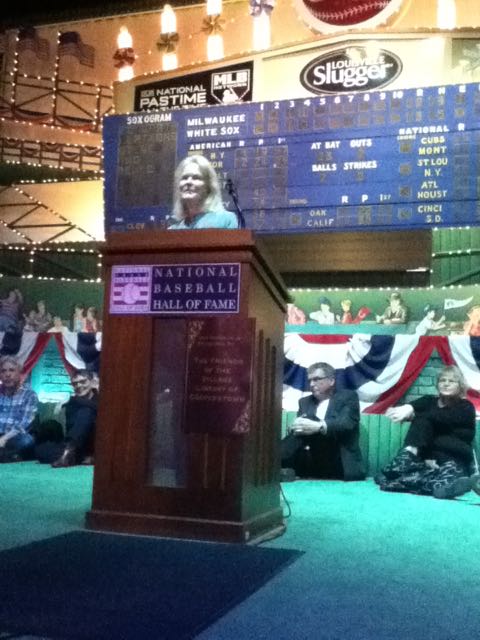
IMG_8226Last night, Jane Clark spoke at the Baseball Hall of Fame’s Grandstand Theater about her family’s legacy in Cooperstown.

I was part of the crowd that got in to hear her. My husband and I volunteered to sit on the floor so that others could have seats as they tried to squeeze as many people in as they could. Still, over 100 people were turned away.

She spoke for about 20 minutes, methodically explaining the history of the three main Clark organizations involved in Cooperstown:  the Clark Foundation, the Scriven Foundation, and Leatherstocking Corporation. She rattled off some astounding facts and figures, most of which I don’t remember because once someone is talking about millions or billions my brain shuts off  — that kind of money is incomprehensible to me.

Over 11,000 students, though. I remember that number because that’s how many students have been given college scholarships (totaling millions) by the Clark Foundation — and I was one of them.

In the Q & A that followed, a less-analytical, less-statistical Jane Clark emerged. She laughed and told stories. Here was the woman I had seen at my mother’s memorial service – warm and friendly.

Many people didn’t ask questions; they simply said thank you.

“Thank you for the scholarship. My family was poor. Without it I could not have gone to college.”

“Thank you for the emerald necklace of open space around Cooperstown.” ’tis true — we have the Clark family to thank for the adjectives of bucolic and pastoral used to describe Cooperstown.

“Thank you for the Clark Sports Center.” This woman went on to tell of how her son (or was it grandson?) wondered what children in other towns did without a Clark Sports Center.

She told stories of how the Baseball Hall of Fame came to be in Cooperstown and why Kingfisher Tower was built. Fascinating lore — even better hearing it from her lips.

When it was over, I approached her to give her my own thanks. Not for the scholarship, not for the green belt which borders my father’s land, not even for the Clark Sports Center where I work — I thanked her for coming to my mother’s memorial service.

“You’re very welcome,” she said. “Please give my best to your father.”

Some things are worth so much more than money.

Faith · family

Isaiah 56: 3-8

“Here’s the thing,” says God.
“Don’t you go saying that you don’t belong to My family,
And don’t you go thinking that because you don’t ‘produce’ I’m going to throw you out.
I don’t work like that.
At all.
If you love Me
If you embrace activities and ideas that please Me
If you hold fast to the promises I have made to you
Then I will give to you something better than any fame, fortune, or power you might receive from the world for something you did
What I have to give you is better than a large family or even one successful child
What I have to give you is a name —
A name that will forever tie you to Me.”

“And if you think you don’t belong in My family,
let Me ask you this —
Do you love Me?
Do you serve Me?
Do you help others because you know Me?
Do you set aside time
when you aren’t working
and just think about Me?
Do you lay in a grassy field on a Sunday afternoon,
look up at my blue sky, and utter a simple thank-you?”

“My door is always open to you
because you are family.
Mi casa es su casa.”

“You are family.
You are welcomed with great joy
and big bear hugs
(even though you say you don’t like hugs).”

“Come.
Sit with Me in the quiet.
Whisper to Me.
I am always listening.”

“You may think that you’re an outcast,
but I am gathering you in My arms
and holding you close.”

family

Best Numbers and Peas

“Hey, Mom, do you know what the best number is?”

Karl asked this at dinner because we were discussing numbers.

For the record, I did not know what the best number was, nor did I even know there was a best number.

I mean, I do have a soft spot for primes and squares. Doesn’t everybody?

But I don’t have a favorite number.

And I didn’t know there was a best number.

The discussion had started with the number four.  I don’t remember who said it, but someone brought up the fact that four is considered unlucky in certain countries like Korea or China.

“It’s like thirteen in this country,” I said, “but I don’t think thirteen is that bad. It is, after all, prime.”

That’s when Karl asked the best number question.

“Seven?” Bud guessed.

A lot of people really like seven. It’s a prime. And considered lucky.

“Nope,” Karl answered. “But it has a seven in it.”

I started mentally running through the numbers ending with seven. “Seventeen?” I guessed.

“Nope.”

I knew it couldn’t be twenty-seven. It is a cube number which makes it interesting, but not the best.

“Thirty-seven?” I guessed.

“It’s seventy-three,” Karl said. “It’s the twenty-first prime and the mirror of thirty-seven which is the twelfth prime. Twelve and twenty-one are mirrors.”

Kind of cool. For someone who likes prime numbers. And symmetry.

How we got from there to spitting peas I don’t know.

Laurel and Karl
Laurel and Karl

Really. The next thing I knew Karl was challenging Laurel to a pea-spitting contest.

They each took a few peas from their dinner plate and headed to the back deck to see who could spit them farther.

“Mom,” Mary pleaded, “they’re spitting peas.”

“I know,” I said, “but Karl leaves for college soon.”

Would I have allowed this years ago when Philip was heading off to college? Probably not.

But I’ve learned.

At the end of the day, the things we remember aren’t the quirky discussions of numbers but the spitting of peas and the accompanying laughter.

I so want my children to look back at their growing up years and be able to laugh.

Faith · family

The Milk House Window

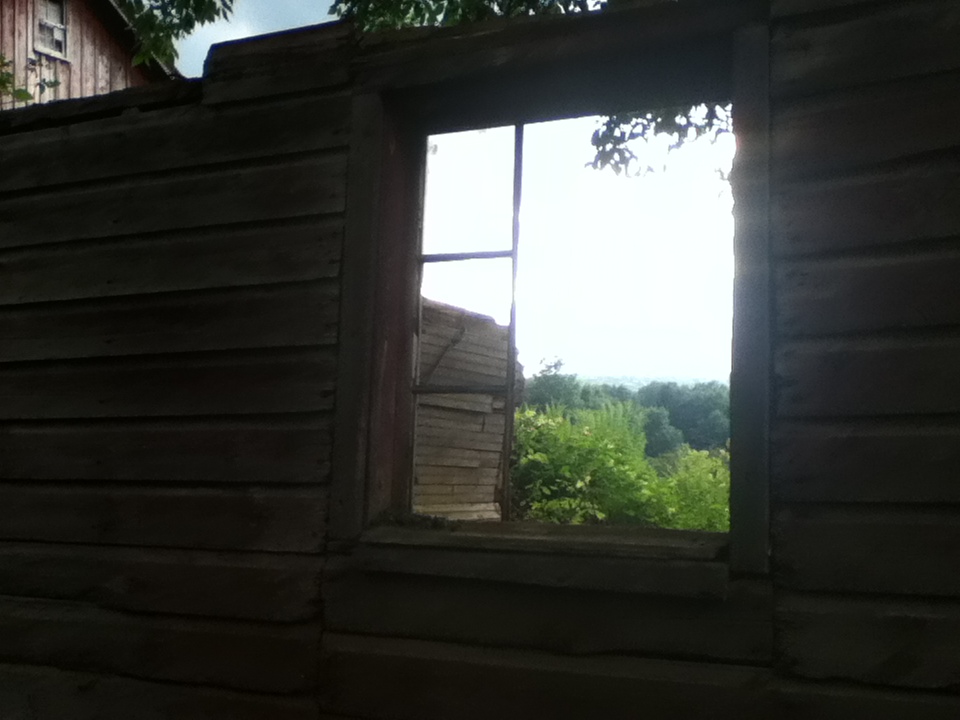
Across from my parents’ house a little building we called the milk house used to stand.  I don’t know that it was ever used for milking animals. We incorporated it into the pig pen at one point and later, when we had no pigs, used it for storage. The milk house was filled with shutters and windows and bee hives and rusty things and broken things and stuff.

And then the roof caved in.

My brother-in-law and my sister drove up from Florida with two carpet cleaners.  After cleaning some of the carpets in my parents’ house, Gil went to work on the old milk house. When they drove back to Florida, they left behind the carpet cleaners and had in their car a cast iron pig trough and an old gate. It was the family version of the trading-up game.

Three walls of the milk house are still standing, one with a window facing the road.

A lonely pane of glass remains in an upper corner, dirty and dusty, care-worn. It’s my new favorite place to view the world.

My window in the world
My window to the world

If it weren’t so close to the road, and if trucks didn’t drive past not following the speed limit, roaring like monsters and shaking the earth, I might sit on the bank for hours and watch the spider weave its web and the leaves change color through that window.

I’m quite sure that somewhere in that window is at least one deep spiritual truth.

The Trinity framed out.

Trinity

The light pouring through.

Light

Now I see through a glass darkly, but with a slight shift of my eyes I see face to face.

a darkened glass

The undeniable brokenness, no matter how neatly it is stacked.

Broken
Broken

What treasures lie in broken things!

My sister and her husband got a rusty pig trough which I have to admit was pretty cool, but I think I got the better treasure — a window to the world.

family · Grief

Howard Talbot

My first job was at the National Baseball Hall of Fame and Museum in Cooperstown. Ticket and souvenir sales were rolled into one department. One lucky girl, often my sister, got to sit in the private ticket booth and read books when she wasn’t busy.  The rest of us worked the ticket window and the souvenir counter.

Howard Talbot hired me.

“Well, hello, young lady,” he said whenever he greeted me, a big smile on his face. He was a genuinely happy man who intimidated me only because he was my boss.

I saw him a couple of weeks ago and he still greeted me the same way.

“Well, hello, young lady,” he said, and smiled that same smile. He was stooped over a walker and I have some gray hair now, but I was transported to the old BBHofF, before they added on and made it big and fancy.

His office was right around the corner from the souvenir shop so we saw him often.

That same summer that I worked for him for the first time, I also had a part-time job working for a researcher at Bassett Hospital. Dr. Ashford was looking at temperature changes in patients in the days before their death. My job was to pull charts of patients who had died in the hospital and retrieve the data about their temperature from the vitals recorded by the nurses.

Between my work at the Hall of Fame and my work at the hospital, I kept busy which was always a good thing for me. By the end of the summer, though, I was tired of working. Both jobs could continue into the school year, although both employers acknowledged that my hours would be less.

The introvert in me loved the aloneness of the research job, so I decided that I needed to tell Mr. Talbot that I wouldn’t be available to work at the Hall of Fame during the winter. The next time I worked, I asked him if I could talk with him for few minutes.

I had mentally rehearsed everything I wanted to say to him. Still, I fidgeted nervously in the chair opposite his desk after he called me into his office.

“Well, young lady,” he said with a smile, “what can I do for you?”

“I’ve really enjoyed working at the Hall of Fame this summer,” I told him.

He nodded at me encouragingly.

“And you know I’ve also been doing some work for Dr. Ashford,” I said. Dr. Ashford lived just around the corner from the Talbots.

He nodded again.

“So the summer has been ludicrous,” I said.

He stopped nodding. He looked at me. I thought that maybe he didn’t understand the big word I had used.

“You know, I made a lot of money,” I explained.

A smile played at the corners of his mouth. It’s a wonder he didn’t burst out laughing.

“I think you mean lucrative,” he said quite seriously, though his eyes twinkled as he watched me.

I’m sure I blushed. I can still feel the redness in my face. I forgot the rest of my speech, and, as a result, ended up working at the Hall of Fame for the next two years.

It really was a fun job.

Howard Talbot passed away a few days ago. Yesterday I went to his calling hours. I told his wife and his children how much I loved the way he always greeted me and called me “young lady,” whether I was 15 or 55.

I couldn’t bring myself to tell them this story. It still makes me blush. And laugh.

But today it might make me cry.

Good-bye, Mr. Talbot. Thanks for the job and the memories. I’m glad I knew you.