family · patience · people

What’s Your Goal?

(Warning: Long, rambling, and probably pointless)

Yesterday, I talked with a friend who had been a guidance counselor. I had asked his advice regarding one of my kids who needed a little direction.

“What’s your goal?” he asked.

I answered with the goal I have for the child in question.

“No,” he said. “That’s your goal for your child. I want to know your goal for Sally.”

“I don’t understand,” I said.

“Just think about it,” he said, and waited about 2.5 seconds before he moved on. But he circled back to that question a couple more times.

“This feels like a guess-what-I’m-thinking question,” I said one of the times.

“What are you looking for?” I asked another of the times.

In the end, I felt incredibly frustrated.

What’s my goal? Sheesh. (I wrote that just before bed last night, still trying to process the whole conversation. Then I wrote about another 250 words expressing the same sentiment.)

What are we even talking about? Are you asking about my goal as a parent — which has been my primary job for the past 38 years? Are you asking about my goal at the gym? Or at the house where I still have a thousand things to do? Is it my goal for today? This week? This month? This year?

To be kind? To be a lifelong learner? To love my family?

What’s my goal? Seriously? I don’t know.

This is going to make me crazy.

I walked to the post office this morning. It’s about two and a half miles there. I thought and thought and thought while I walked.

Karl once told me that one of the doctors he works with has three goals for every day: to learn something, to teach something, and to laugh. I wish I was clever enough to come up with three succinct goals like that. Even if I had, I don’t think it would answer the question being asked by my friend.

Anyway, my three would be something like to listen, to see, and to be kind.

Again, I’m sure it’s not what he was looking for.

I copied another Thomas Merton quote into my journal the other day. “Therefore if you spend your life trying to escape the heat of the fire that is meant to soften and prepare you to become your true self, and if you try to keep your substance from melting as if your true identity were to be hard wax, the seal will fall upon you and crush you. You will not be able to take your true name and countenance, and you will be destroyed by the event that was meant to be your fulfillment.”

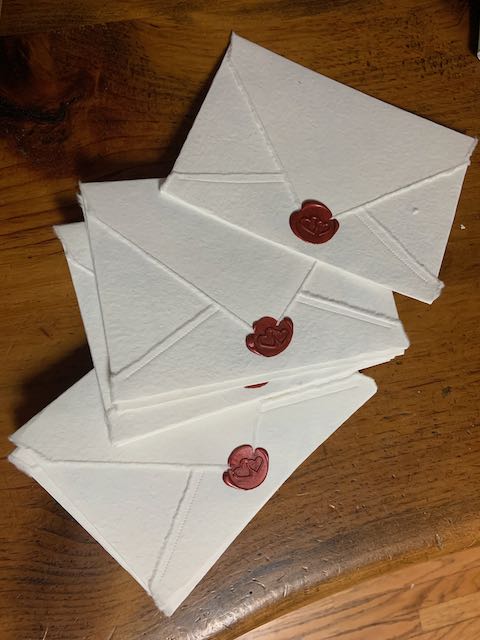
Merton was talking about sealing wax and the way it will crumble if it’s not adequately prepared for the stamp. Mary had just sealed a bunch of envelopes with wax. In fact, that’s what I had walked to the post office to mail. The seals were beautiful because the wax had been melted and was ready to receive the imprint.
But to say that preparing my heart for God’s imprint on it is my goal doesn’t sound right either. Plus, I don’t think it’s what my friend was asking.

Walking is such good therapy, especially walking on a country road, where the deer bound off into the woods when they see me coming and the ducks fly out the giant puddle in the cornfield in groups of 6 or 8 quacking and complaining at the inconvenience of my passing. A deer skeleton lay in the ditch. Last week, it had probably been covered with snow. A small collection of broken car parts were strewn about the ditch a little further down the road. A lone Lexus symbol at least told me what kind of car it had been. I wondered if the deer and the car parts came from the same mishap.

In the churning of thoughts about all these things — the deer, the ducks, the skeleton, the Lexus, the hawk circling over the field, the winter’s worth of garbage now revealed in the ditches — I kept circling back to the question: What is my goal?

Career goals for a stay-at-home mom are not a thing. Some days feel like survival. Some days feel like you won the lottery.

When my oldest son was born, what was my goal? To see him grow up, become independent, productive, happy. To help him discover what he loves and what he’s passionate about. In the late ’90s, he loved computers and knew he wanted to do something related to them. We had dial-up internet and I told him that if he wanted time on the internet, he would have to get up at 6 AM because I didn’t want him tying up the phone line all day. Doggone if he didn’t get up at 6 every morning so he could have his hour on the internet. Now it’s his livelihood.

For each of the kids, that has been the puzzle. I would watch them and ask them, “What do you love?” Two have gone into nursing. One works in the realm of outdoor recreation. Three are currently in college or graduate school. One is still figuring it all out.

I feel immense gratitude at the fact that most of them have found their way.

I love talking to them all on adult levels. I love when they call me. Or come visit. I love family Zoom calls and game nights.

I think my goal, maybe, has always been to have adult children who still love me in spite of the thousand mistakes I have made as a parent, to have children who are settled and happy with the choices they have made with their lives, to have children who still occasionally want my advice, to have children who share their lives with me.

I’ll try that goal on my friend and see if it works.

I doubt it.
Faith · Grief · people

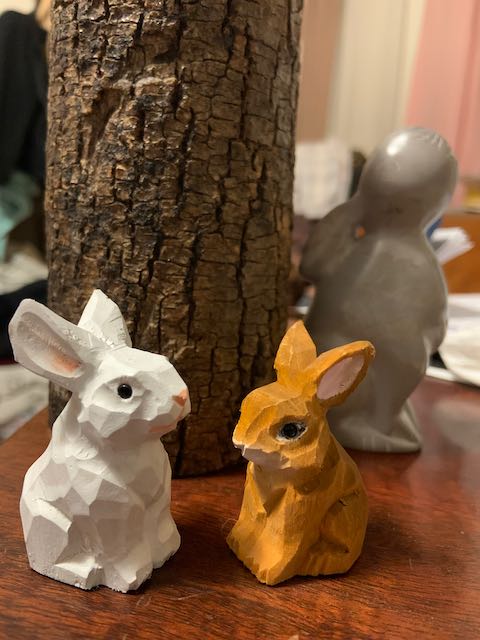
Lenten Rabbits

Five years ago for Lent, I carried a rabbit in my pocket as a tool for mindfulness. I wanted to remember that people are often smiling on the outside but hurting on the inside. I know, I know — this may not make much sense to you unless you followed my Lenten journey in 2017. If you want to read about it, here’s a semi-explanatory post from that year: Tuga and Aleluja.

Tuga is the Bosnian word for sorrow. Aleluja is the Bosnian word for — can you guess? — Allelujah.

This year I have two more little rabbits. Meet Dòchas and Bròn.

Dòchas is the Scottish Gaelic word for hope. Bròn is the Gaelic word for grief. I gave them last names, too. Dòchas a-Maireach and Bròn an-Diugh. Hope Tomorrow and Grief Today.

I carry them both in my pocket — separate pockets, of course.

For this Lenten season, I want to become friends with Bròn. Bròn an-diugh. (Pronunciation — and I may not have this totally correct — Bròn is like our word “brawn” but you need to roll that “r” a little. An-diugh sounds like on-jew, because the “di-” in Gaelic is our soft “g” sound as in giraffe, and the -gh at the end is silent.) Grief today.

I listened to a woman last week go into a long tirade full of conspiracy misinformation. She had told me weeks before that wearing a mask was the equivalent of the Nazis requiring Jews to wear yellow stars. Another gym member had started the whole confrontation by shouting at me about the masks — “This is BULLSH-T! This is BULLSH-T!” After the Nazi comment, I had turned and walked away from the desk.

Later that same day I put a check-in note on the woman’s membership — that if she checked in again, I wanted to speak to her. She finally came back on Friday — and I spoke to her a little and listened to her a lot. She has such deep fears and hurts.

“Tell me about despair, yours, and I will tell you mine.
Meanwhile the world goes on.”
Mary Oliver, Wild Geese

While she was talking, I reached in my pocket and held Bròn. I don’t know if hers was grief or just unhappiness at our world today. She needed to talk, though.

And I listened.

At the end of her diatribe, she extended her hand across the counter. “What’s your name?” she asked. I told her. “It was so nice to meet you,” she said.

“What just happened?” my co-worker asked after the woman had headed to the pool. She had been sitting there listening to the whole thing.

“I’m not sure,” I told her.

But I stuck my hand in my other pocket — and there was Dòchas, hope.

Blogging Challenge · family · Life · people

Generosity

Dear Kim,

Yesterday at work, a little boy wandered in front of the desk and finally stopped to ask if he could borrow a pencil.

(Months ago I brought in a small stash of Blackwing pencils which are the greatest pencils ever made and I wanted to have them on hand for moments like this. “Where did these cool pencils come from?” some of my co-workers asked, but I’ve never fessed up.)

“I have to write a sentence using the word ‘pact’,” the boy told me.

“Pat?” I asked. I had trouble hearing him.

“Pact,” he replied.

“Like you packed your bag?” I asked.

“No. Pact. P-A-C-T,” he said. “It means agreement.”

“What grade are you in?” I asked.

“Third,” he replied, and hurried off to write his sentence.

I turned to my co-worker. “That’s not a 3rd-grade word. I didn’t learn that word until I don’t know when.”

She laughed at my irritation.

When he brought the pencil back, I asked him what sentence he wrote.

“My brother and I found a pact,” he said confidently. “It means we found an agreement.” I like that he felt the need to explain it to me.

A pact, to me, is a more abstract kind of agreement and a 3rd-grader lives in a concrete world. In his 8 year old mind, he found a tangible something with his brother. He probably packed it in a pack. I wondered what his teacher would think of the sentence.

But this is supposed to be about generosity, the prompt for the day.

Generosity is also an abstract idea. I can’t pick up in my hands and hold a generosity.

I was thinking, instead, of coining a new phrase for a group. You know, like, a pride of lions or a murder of crows — except it would be a people group. A generosity of sons.

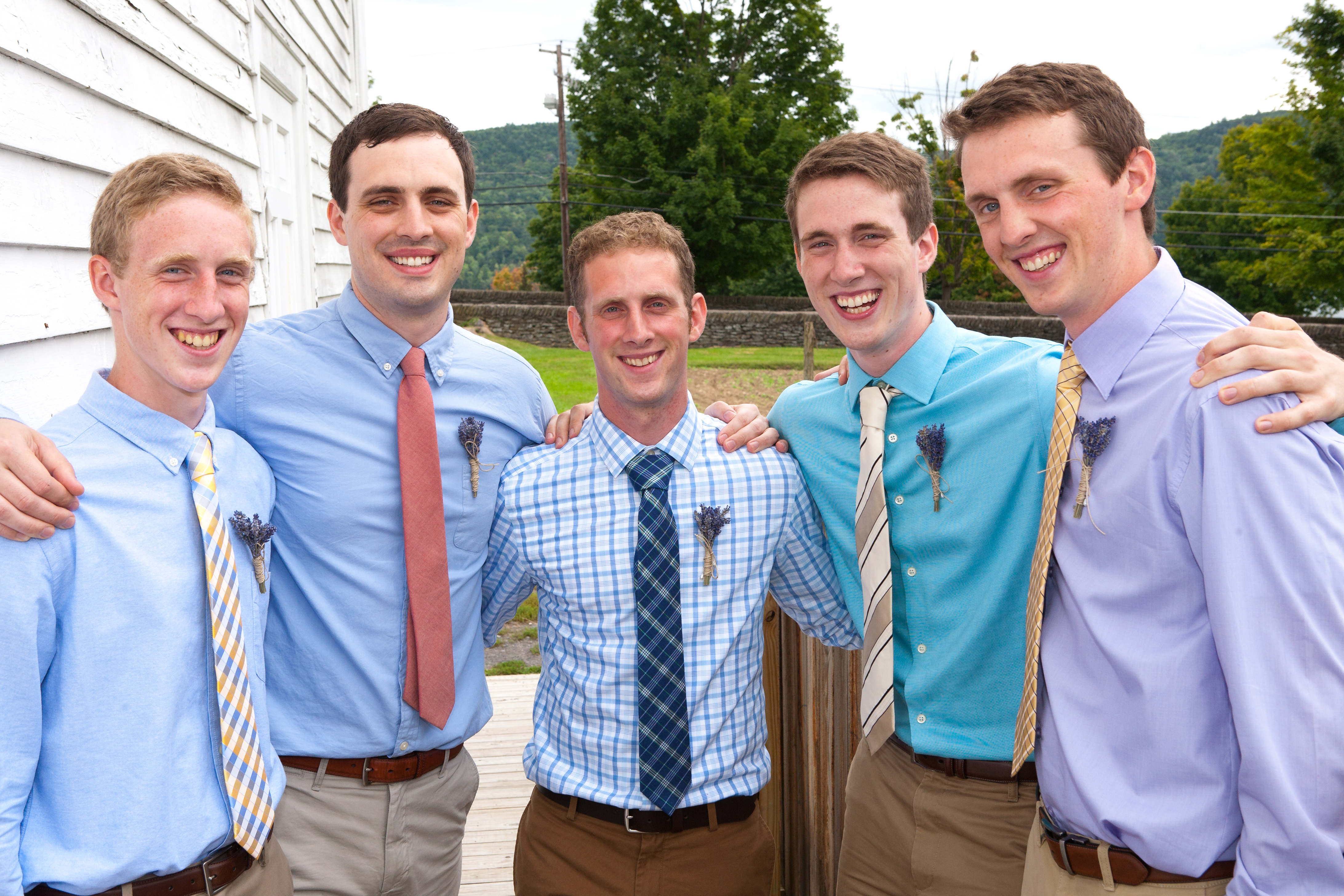
I have five sons, all of whom are now amazing men. It’s a marvel. A gift that I don’t deserve. A generosity.

My father used to tell me that I was the richest person he knew, and then he would add, laughing, “And maybe someday you’ll have money.”

To fill you in on what my sons are doing, I’ll give you a few clues, like one of those logic-grid puzzles. Two are still in school. Three are gainfully employed. One owns his own company. One lives in Canada. One lives in Florida. Three live in New York state. Three are married. Two have children. I”m proud of every single one of them.

Maybe in a future letter, I’ll tell you more details.

But I did want to say, in closing, that the very first person I think of and associate with the word generosity is you. You are such an amazingly generous person. You could win prizes for it if someone gave out prizes — but you’d probably give your prize away if I know you.

And I’m so glad that I do know you.

Love,

Sally

My five sons (2014)
Life · people

Life Update (and a story)

I have a full-time job with benefits for the first time since 1984.

Gosh, it sounds funny to even write that. As a stay-at-home mom and then a caregiver to my dad, I’ve worked full-time forever.

And I’ve had great benefits. The kind “real” employers can’t possibly offer.

But that’s probably a post for another day.

I have a full-time job.

A little over a year ago, I started working at the front desk at the same sports facility where I’ve worked many years in aquatics. Part-time, of course.

the front desk

It is so much fun. I look forward to going to work every day.

When a woman retired in June, my boss asked if I wanted to come on full-time.

“Um, letmethinkaboutthat-no,” I said, all too quickly, clearly not thinking about it, because, seriously, I haven’t worked full-time outside the home in 37 years.

They hired someone else who left within a few months for a better job.

I mean, really, who wants to be part-hostess, part-policeman, part-retail sales clerk, part-telephone operator, part-let-me-help-you-with-_________(fill in the blank)?

Yesterday I was reminded all over again why I love this job.

One of the perks is paid work-out time. Yep, I get paid to go swimming if things are quiet. Yesterday I took advantage of that.

As I was changing back into my work clothes after a swim and a shower, I heard a woman crying. We were the only two people in the locker room. She was sitting on a bench in the shower area, her head in her hands, weeping.

“Are you okay?” I asked. (Dumb question — clearly she was not.)

“No,” she said, looking up at me.

“Can I do anything for you?” I asked.

“No,” she said, and she proceeded to tell me her story. Her husband was very sick. He was waiting to be transferred to a hospital in New York City. The helicopter had been arranged but then the weather didn’t cooperate. The bed that was being held for him in New York was given up. Then the helicopter was able to fly but there was no bed for him. Then there was a bed and a helicopter but his condition had deteriorated so that he needed a procedure to stabilize him. “He’s in the OR now,” she said, “and I just walked down here to take a shower and clear my head.”

“I’ll pray for you,” I said, but it sounded trite. I think she needed a hug.

“I’d hug you,” I said, “but it would be weird. I mean, you’re wearing just a towel, and social-distancing, and all that.”

She looked down at her towel and laughed. “You’re right.”

“Are you sure there isn’t anything I can do for you? Have you eaten today?” I asked again.

“No, no. I’m fine. I need to get going back to the hospital,” she said.

So I left her and went back to work.

At the front desk.

Suddenly, I remembered something in my bag. I ran to my staff locker and found it — a new little journal and a good pen.

When she came out, I handed her these two items.

“I know this seems weird,” I said, “but I want you to have these. While you’re sitting and waiting, write your feelings. It may help. Or write down the times and places you need to remember. Or scribble angrily. It’s okay. Putting it down on paper may help.”

She took them and thanked me. I thought she was going to cry again.

The front desk phone rang and I hurried back to answer it.

While talking on the phone, I watched the woman pull on her coat and her pom-pom hat. She waved as she walked out the door.

In that moment I knew why I love this job so much — it’s because I get to meet people like her.

Life · people · swimming · Travel

Top Fives

Three Top Fives of 2018.

Top five books — Les Miserables, The Hate U Give, Imitation of Christ, Conscience, and the whole series of The Incorrigible Children of Ashton Place.

Top five places I visited — Ales Stenar (the sun-ship in Sweden), Troldhaugen (Edvard Grieg’s home in Bergen, Norway), kayaking in a fjord (Gudvangen, Norway), Laity Lodge (with my husband!), and Charleston, SC (with Mary).

Ales Stenar

Edvard Grieg’s composing house

Kayaking in a fjord

Threshold at Laity Lodge

Mary and her French toast at Toast! in Charleston

Top five encouraging moments. (I want 2019 to be the year where I practice encouragement, so I’m trying to learn from looking back.)

1. Andrew Peterson — at Laity Lodge (which is the nearest place to heaven I know in the United States). After insulting Andrew (I think I told him that he looked nerdy in his glasses — and then I wondered why on earth I said such a thing), I finally bolstered the courage (thanks in large part to my friend, Kim) to ask him about the possibility of a caregiving session at Hutchmoot.

“I think that’s a great idea,” he said. “Check in with Pete (his brother) in a couple of months when we’re starting to plan out the sessions.”

I’m an idea person — and I can’t tell you how many times I’ve had ideas shut down right from the start. It can be crushing. Even if an idea is totally wacky, encouragers can see the glimmer of good in it and water the seed a little. Andrew did that for me.

I already knew that Andrew was an encourager. At my very first retreat at Laity Lodge, when I was saying my good-byes, Andrew touched my arm and said, “You have important things to say. Don’t ever doubt that.”

2. Rachel Speer Donahue — Well, I did the session at Hutchmoot.

I was so full of doubt about my tiny portion of it. I had sent the written text of it to my friend, Alyssa, who also is an encourager. Her words helped me go through with the whole thing. (Seriously — up to the last minute, I considered politely bowing out.) Afterwards, my mental replays of my portion were all of me babbling. (Side note: I saw a book recently called, “Your Inner Critic is a Big Jerk” and I wished I had read the book before Hutchmoot.)

Enter Rachel. After Hutchmoot, the guy who puts together the photo book put out a call for quotes. Rachel was an early responder — and she quoted ME. I was horrified and honored at the same time. The horror has long since subsided, and I go back to that moment over and over. Rachel sat in on my session and valued what I said enough to quote me. It was a HUGE encouragement.

3. Jonathan Rogers — I’ve taken a number of writing classes from Jonathan Rogers. The best thing about his classes are the critiques he gives to the submitted assignments. He is blunt and honest. Jonathan has told me when things I have written are unclear or, worse, boring. He’s always right on the money.

Jonathan recently started a subscription website of writing advice called Field Notes for Writers. I HIGHLY recommend it.

He asked me if he could use one of my pieces for an exercise he calls “Line Edits.” With great fear and trepidation, I gave permission, but when I watched the video of his edits of my piece, “Old Porch,” I was so touched. Seeing my writing through his eyes was such an encouragement.

You, too, can receive encouragement from Jonathan by taking any of his upcoming classes or attending his free monthly webinar.

4. Elizabeth Dunn — We’ve been attending Methodist churches for five or six years now (maybe more). I am NOT a cradle Methodist and honestly don’t understand the inner workings of the Methodist Church. I had never been to a “Charge Conference” until this year.

At the Charge Conference, Bishop Webb came and heard the reports from the various committees in the church. Then he asked for people to share what good things were going on in the Cooperstown Methodist Church. The first person to speak was Elizabeth. She said, “Sally Zaengle has been playing her flute during church and it really adds something special.”

Let me back up to say, yes, I play the flute, but not terribly well. It’s something I do for fun — and more, it’s something that helps me worship. I believe music is a language God speaks.

When Elizabeth acknowledged my playing and that it blessed her — that was so encouraging. Even with all my bloopers, it adds something positive to the worship.

5.Lisa Birdsall and Kristen Griger — My role changed with the swim team this year. With my father declining, I couldn’t commit to coaching again. It made me a little sad, but Lisa (the Aquatics Director) and Kristen (the head coach) found a new role for me — team registrar. As team registrar, I handle all the athlete registrations as well as all the meet entries.

I love my new job! I love learning new things and I can do much of the work from home. Additionally, I’ve been working to educate the new parents on the ins and outs of swimming by holding informational meetings and sending out regular newsletters.

Lisa arranged for me to have an email address with the facility. While that sounds like a small thing, it really isn’t. I’m the only part-time person with a Clark Sports Center email and the recipient of the last email address available on their server.

Not only that, but Lisa started referring to an empty office there as my office. My office. Of course, it’s not my office yet. Someone else needs it while some work is being done outside her office. But I’ve never had an office before. I may still never have the office. You never know.

But the thought of an office is an encouragement. And the email address is a reality — a real work email.

You really never know where encouragement will come from.

In 2019, I hope a little encouragement will come from me.

people

Small

One day
I found myself
Staring at the clear blue water
Of the pool
And marveling at the fact
That I could not see
A single drop

All that liquid
In front of me
And my eyes could not distinguish
One single drop —
Just water
En masse

So I did some calculations
Using my phone
And my head (only a little) —

I thought,
This pool is 25 yards long.
There are 3 feet in every yard.
Therefore, the pool is 75 feet long.

I figured,
I don’t know the width of each lane
But I know from swimming rules that
Each lane must be at least 7 feet across.
We have 8 lanes
So this pool is approximately 56 feet wide.

And I further reasoned,
The depth of the pool varies.
In the shallow end, it’s 4 feet deep,
And in the deep end it’s 8 feet,
But I’ll use 4 feet —
Just to be conservative.

So, I multiplied 75 x 56 x 4
To arrive at the number that
Minimally expresses the volume,
The number of cubic feet in the pool.

That’s 36,000 cubic feet of water —
Although I know there’s really more
Because of the way the depth changes.

Then, I looked up
How many drops of water
Make up one cubic foot:
566,336.93

So a conservative guess
At the number of drops of water
In that one swimming pool
Is

36,000 x 566,336.93 =
20,388,129,480

Let’s just call it 20 billion drops

And I still can’t see a single one.

Out of curiosity,
I looked up the population
Of the world

According to
The most recent United Nations estimates
In May 2018
There are 7.6 billion people in the world

If people were drops of water
My pool would be little more than 1/3 full

The pool at 5:15 AM

It made me feel small
And large
All at the same time
And I’m not sure why

Life · people

Bruce

Seven years ago Bruce sat next to me on a flight out of Nashville. We both changed planes in Detroit and there I frantically wrote down as much of our conversation as I could remember. His heavy southern drawl forced me to listen to him carefully so I could mentally translate what he was saying as he spoke.

I remembered him, but my notes from that day sat unread — until this week when I pulled that notebook off the shelf while shelving last year’s journals. I leafed through and stopped on the page where I had written the heading “Bruce – Flight from Nashville to Detroit”. His story, even his voice, flooded back.

We had done the perfunctory small talk while waiting for take off. He told me he worked in aircraft manufacturing. I told him that I was a mother eight. I stared out the window at the other airplanes on the runway.

“I got me a Cessna,” he said, nodding toward a small plane that was in view. “One time I flew it out of Atlanta. That thang was like a wasp among eagles.”

I liked the imagery and smiled at it. Our plane took off. It’s my favorite moment of every flight — wheels leaving pavement.

“Lemme show you somethin’,” he said, pulling his wallet out of his pocket. He flipped through the pictures and stopped at a well-worn picture of a smiling little boy. “That’s my boy,” he said proudly.

“Very nice,” I said.

He tapped on the photograph. “17 years ago someone ran a red light and hit our car. He was six years old. Died instantly.”

“I’m so sorry,” I murmured, but it felt inadequate.

He flipped to another picture, that of a pretty young woman. “That’s my daughter. She’s a bad ‘un.”

“I’m so sorry,” I said again.  I didn’t ask for details and I couldn’t help thinking that 17 years before, she had been a little girl who lost her brother. Life is hard and sad — and we rarely know the other person’s story.

Bruce chatted with people across the aisle and in front of us. He was traveling with several people from his work.

He turned back to me. “You know, I just got done cancer treatments. Thyroid cancer. If I hadn’t taken this new job, probably wouldn’t have found it for a while. They found it on my pre-employment physical — and they still gave me the job.”

“That’s pretty amazing,” I said.

“My father died of lung cancer, you know. So the cancer — it’s kinda scary.”

Talking about his father led him to talking about him growing up. “We was dumb-ass poor growin’ up. Used to go haying with no driver in the pick-up.”

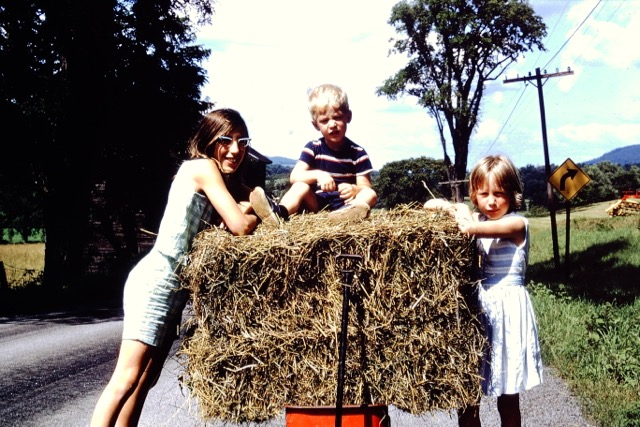
I used to help with haying here in New York, but it was purely for the fun of helping the neighboring dairy farmer. I loved riding in the hay wagon, but someone was always driving the tractor. I tried to picture haying with no driver.

Taking a few hay bales home. I’m the tough cookie on the right.

“You know what the Mason-Dixon line is?” he asked. I was worried that he was testing my knowledge as a northerner.

“Didn’t it divide the slave states from the free states?” I asked.

“Nah,” he said. “It’s the line that separates y’all and you guys.”

He laughed like he had just told a good joke. I laughed because I hadn’t expected a linguistics lesson from this burly southerner.

“You like sweet tea?” he asked, but he said it “swait tay.”

“I’m not much of a tea drinker,” I confessed.

“Northerners don’t hardly know how to make sweet tea. I once had a waitress tell me that I could just add sugar to my tea, like she didn’t understand that the sugar gits cooked right in with the tea.”

Frankly, I didn’t know that either.

In Detroit, I wrote it all down — about his son and his daughter and his cancer and his poverty and sweet tea. I tried to write the phrases exactly as I had heard him say them. Our flight had been less than two hours but he had shared so much with me.

I once heard Christian singer Jason Gray tell a story about a mentor that he had. Jason respected his mentor and wanted to be like him.  Jason asked him, “How did you become you?” His answer: pain.

The hardships in our life shape us but they don’t define us. Bruce had known deep sorrow and in our brief encounter had shared some of the difficult times he had known, but he also knew how to embrace life.

I’m thankful I got to sit next to him for that flight and listen to his story.