I won the award for best speller in 4th grade, beating out Jack Harvey (aka Merritt Harvey). Does that inspire me to do better? No, I’ve learned that there are people for whom spelling comes naturally or for whom it is an obsession — and I am neither.
The messiest room in my house, which I will change to the messiest SPACE in my LIFE is my desk. At work and at home, my desk is messy beyond messy — and yet it is MY space which I covet and love.
The contrast between these things — of being a good speller and having an incredibly mess desk — is that I am slowly figuring out what is REALLY important.
What inspires me to do better — daily reading, daily contemplating, daily trying to look beyond me to the world.
This is my response to a bunch of prompts, namely
You won an award at some point in your life. What was it for?
Write a blog post inspired by the messiest room in the house.
The Friday prompt for Stream of Consciousness Saturday is “contrast.”
There once was a life full of twists Opportunities taken (some missed) Zig-zagging around Fulfillment was found [can you finish my limerick for me?]
Those darn zig-zaggy roads of Ethiopia
Arial view of the switchbacks in Ethiopia
Another view of the Ethiopian roads
I was startled awake in the midst of a dream last night.
In my dream, I was at an event, a concert of some sort. I was distracted by some severely handicapped people there — not in a bad way, just wondering where they would sit and how the music would affect them. I was seated near the front so I had close-up view of the performers. I watched them usher three of the handicapped people down to the front and seat them — one at a grand piano, one at a keyboard, and the third at a drum set. A handler placed the man’s hands on the keys of the piano and he began to play. It was beautiful, until he lost his place on the keys. The keyboardist began playing. The drummer began playing. The pianist was growing more and more discordant as he banged his hands on the keys; he had lost his way. I couldn’t tell what triggered it, I feel like it was the pianist listening to the others, because suddenly the music of the three musicians blended into something beautiful.
Then I woke up.
I had been thinking about this post — my zig-zaggy road post– but couldn’t come up with a focus. I think the dream helped me.
Sometimes we lose our way, and life becomes discordant. The switchbacks on the roads cause us to lose our sense of direction.
But then we arrive somewhere — it may be the destination we started off for, or it may be someplace totally different.
Regardless, life is beautiful if we look for the beauty.
Think of what you love to do Jot those things down, one or two
Think of skills where you excel Not half-bad, but really well
Think of things for which you’re paid Perhaps in money or in trade
Now think of what the world needs most — Is something there of which you boast?
Where those things meet is ikigai* Find that thing; your soul will fly
*ee-kee-guy
This is my response to this week’s W3 prompt, which is to:
Write a poem in rhyming couplets (two lines that rhyme) that gives instructions for making something.
Requirements:
Use rhyming couplets throughout
Give clear steps or instructions
Be creative with what the“recipe” is for
Think of it as turning instructions into something memorable and playful through rhyme.
I’ve been thinking a lot about Ikigai this week. I have a version of that graphic posted in my office.
Too often, I feel that we, as a society, shove people into a job that meets only one or two of those criteria. Find something that meets all four and you’ll find fulfillment and happiness.
From the time I was young, I had trouble waiting Always-late-people? So irritating! Delayed planes and buses — very frustrating I wished I could be easygoing!
Yes, I was impatient — but wanted to change So I started to pray (does that sound somewhat strange?) I thought that I knew what God could/would arrange Truth is — I asked without knowing
Well, God sent me teachers — one at a time For a total of eight — tiny, helpless, sublime This slow learner experienced shift paradigm While all of my children were growing
Sereneness is seeing the blue of the sky Feeling the sun, watching bees fly Being in moments ‘stead of letting them by Not going faster, but slowing
So I learned to slow down from my children eight Little knowing, indeed, what was my next fate Aging parents, dementia, at the next gate No regrets — just love overflowing
For eight I witnessed their very first day For two I was present as they passed away Each one a miracle in its own way Listen — do you hear the wind blowing?
Poet of the Week, Nigel Byng, challenged us to “Write a paean about a moment of personal triumph. This can be something from your past, something you are currently experiencing, or something you envision for your future. The moment should feel meaningful—something that changed you, clarified something essential, or marked a quiet or dramatic victory.”
Overheard Malicious whispers Between two Co-workers My heart grew cold at their words Squeezing in my chest
Breathing stopped Blackness obscured sight My fists clenched And unclenched Thoughts swirled like a tornado Unholy and wild
Office chair Calmed me in this storm I held on Took a breath Straightened my back and went out “I heard what you said”
This is my response to this week’s W3 challenge: to write shadorma poems.
The shadorma is a compact Spanish syllabic form built from a six-line stanza with a strict syllable pattern: 3 / 5 / 3 / 3 / 7 / 5 (26 syllables total). It is typically unrhymed, and a poem may consist of a single stanza or a series of stanzas.
For this challenge, the theme is Sensory Details.
Write a close-up study of a single inanimate object or a very specific moment. Think small and focused rather than narrative or expansive. The power of the poem should come from sensory observation—what can be seen, heard, touched, smelled, or felt.
Yes, this actually happened. It was a specific moment and I tried to write the sensory details of it.
Amelia’s knights neighed Her black pawn had tea with my white Our bishops talked “What are they talking about?” I asked “Hello,” she said, bobbing one up and down “How are you?” she said, bobbing the other similarly She giggled “This is more fun than checkers,” she said Amelia is in third grade “The pieces are people,” she stated “Can our queens be friends?” she asked I paused “That’s not how the game works,” I told her She pressed her lips together Then she reached over and touched her pawn The one that was head to head with my pawn “But they can still have tea, right?” she asked
When I read the Stream of Consciousness prompt for today — the word “distance” — this song is the first thing that came to mind.
I have a love-hate relationship with the lyrics. Allow me to — stream-of-consciously — dissect them.
On the surface, yes, it’s all so true:
From a distance, the world looks blue and green And the snow-capped mountains white From a distance, the ocean meets the stream
Yep — those pictures taken of the earth from space show our planet as green and blue. We can see water, land. We have to start zooming in, though, to see ocean meeting stream. We have to really zoom in to see the last line of that verse:
And the eagle takes to flight
If we were to really really zoom in, we would see that eagle swoop down and grab a living creature — a fish, a rabbit, or even someone’s pet. Hmmm…
From a distance, there is harmony And it echoes through the land It’s the voice of hope It’s the voice of peace It’s the voice of every man
Well, not EVERY man. I’m so disturbed by the words of our Secretary of War/Defense this week. He initially acknowledged the fallen troops, but then they became a PR problem to him. He accused the press of trying to make the president look bad. Seriously??
From a distance, we all have enough And no one is in need And there are no guns, no bombs, and no disease No hungry mouths to feed
From a distance, it may look that way, but it’s not true. It’s just not true.
From a distance, we are instruments Marching in a common band Playing songs of hope Playing songs of peace They’re the songs of every man
I actually like this verse. Music is a uniter. I think about the story from WWII of Germans and Americans singing Silent Night together, in their respective languages, on Christmas Eve. (I think that’s how the story goes.)
God is watching us God is watching us God is watching us From a distance
Umm…. the Christmas story is that God was born in a stable. The Lenten story is that after a dusty, dirty itinerant life — walking with us, eating with us, teaching, listening, healing through touch — God in human form died for us. God bridged the distance.
From a distance, you look like my friend Even though we are at war From a distance, I just cannot comprehend What all this fighting’s for
I’ll go back to that Christmas Eve story and I’ll say this, You, Iranian mom, are my sister. In 2017, I went to Bosnia and shared meals with people of a different faith. I learned they were also my friend/family. I’ll also go back to those powerful people in the world who move us around like chess pieces. I just cannot comprehend what all this fighting’s for.
The rest of the song is pretty repetitive of what’s already been sung.
It’s a lovely song. It really is.
I just wish it didn’t lean so heavily on God watching “from a distance”.
Perhaps it’s simply saying that God has the best perspective — “from a distance”. Hmm… I need to ponder that.
Smooth <— that’s the Saturday Stream of Consciousness prompt.
Honestly, I got nothin’.
The only thing that comes to mind — and KEEPS coming to mind — is the sarcastic “Smooth, real smooth” that I’ve heard when I’ve goofed up. Again.
Have I ever mentioned the fact that I’m a little awkward at times?
For my work, I have to call people, and it stresses me out. I think ahead to what I want to say when I have to leave a message — “Hi, this call is for [insert name]. This is Sally calling from the Membership Office.”
Sometimes, I get through the point of the call seamlessly.
Other times, though, someone will walk past my open door, wave, and I get distracted. That’s when I start babbling.
I think that as I grow older, it’s not just my body that loses some of its flexibility, but my brain also loses elasticity. I don’t multitask like I used. I forget names and/or words.
I had put out a request asking for seniors who would be interested in playing games after school with the children who come to the facility where I work.
A man stopped in my office. “I’d like to teach kids to play chess,” he said.
He had a magazine that showed a large group of children playing chess on the cover.
“In a lot of places,” the man said, “kids start learning chess at the age of 6.”
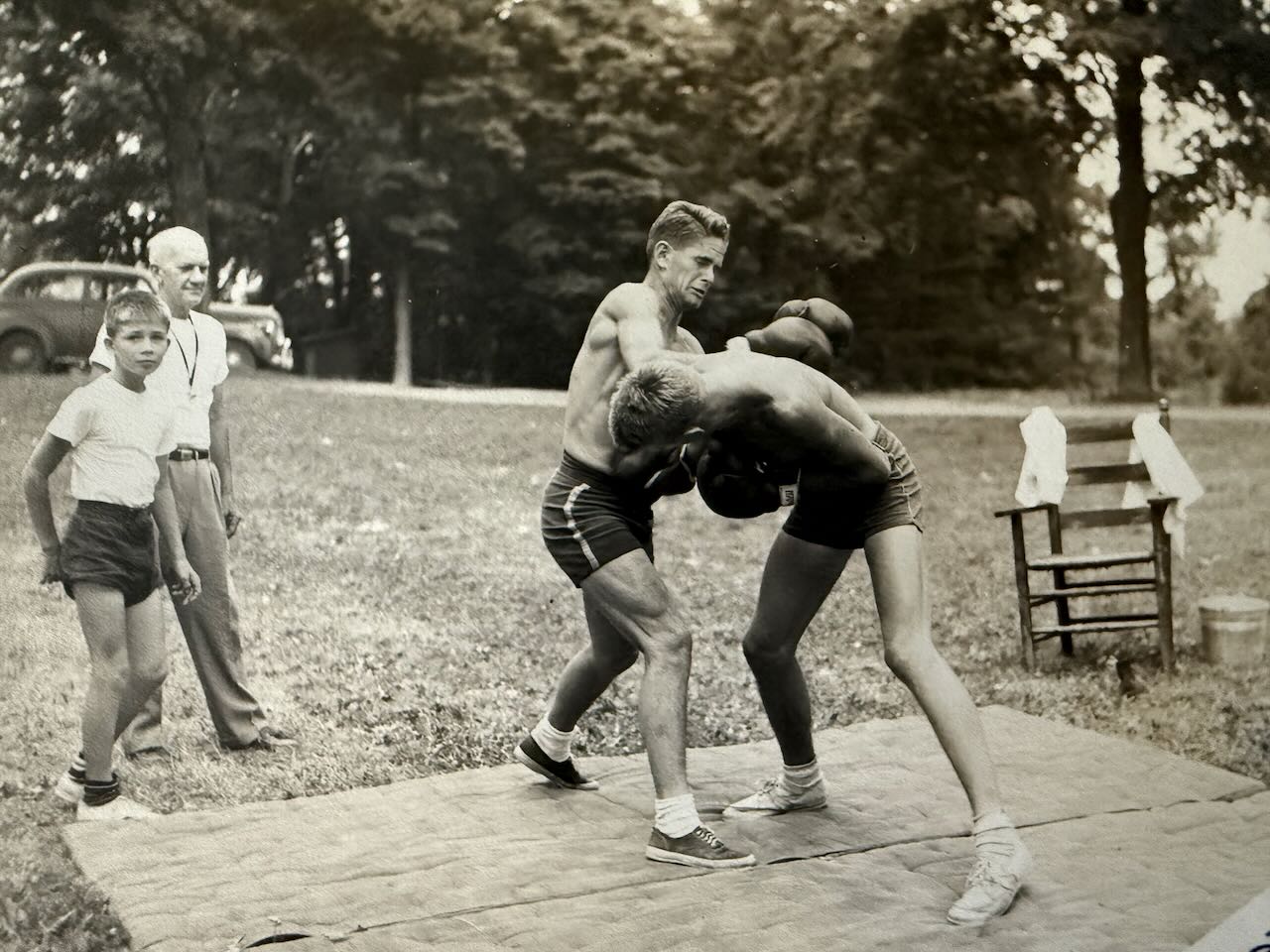
I immediately thought of this series of photos of my two older brothers. It’s from 1963 or 64, which would mean my brothers were probably 6 and 9.