Frederick Buechner, in his book, The Remarkable Ordinary: How to Stop, Look, and Listen to Life, explained the haiku better than I have seen it explained before:
The whole genius of the haiku is that they don’t mean anything. People who try to figure out what a haiku means are beating up the wrong path… The haiku settles for doing, as I read it anyway, one very simple but very crucial thing — it tries to put a frame around the moment. It simply frames a moment.
Since I was a child, I can recall pausing and thinking, “If only I can remember everything about this moment forever.” My everythings ranged from listening to my mother cook in the kitchen, seeing the rainbow circles around the lights in the pool after swimming without goggles, the raucous cawing of crows for no apparent reason, the smell of freshly cut alfalfa, the toad in the garden that startled me when I was weeding, and so on. If I had known that the haiku served that purpose, I might have worked harder on my haiku-ing.
Today’s prompt, Planet, got me thinking about all the times I tried to see the planets as my brother pointed them out to me. He can read the night sky so well. (He even knows zombie and wolverine constellations that nobody else does.)
I would squint and try to follow his finger to the tiny red dot that he said was Mars. Sometimes I saw it, but often I didn’t.
How could I write a haiku about that time I didn’t see Mars?
Squinting in darkness
His finger pointing at stars
I couldn’t see Mars
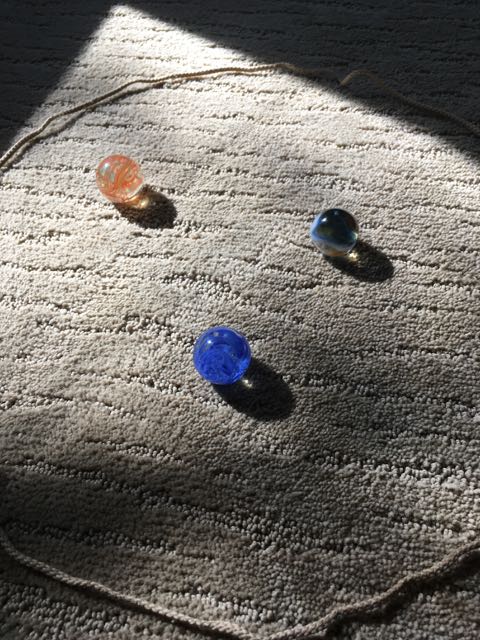
Then I remembered his favorite marble, a small blue glass orb that resembled planet Earth.
When we played marbles, I could barely balance the shooter marble on my thumb in order to plink it into the ring. If his Earth marble was in play, though, that was the target. Winning that one meant winning everything.
Pretty glass marbles
Inside a corral of string
(flick) – plink – Earth is out
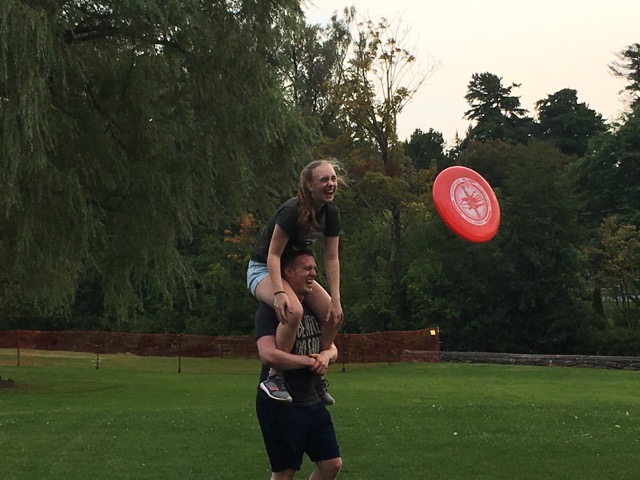
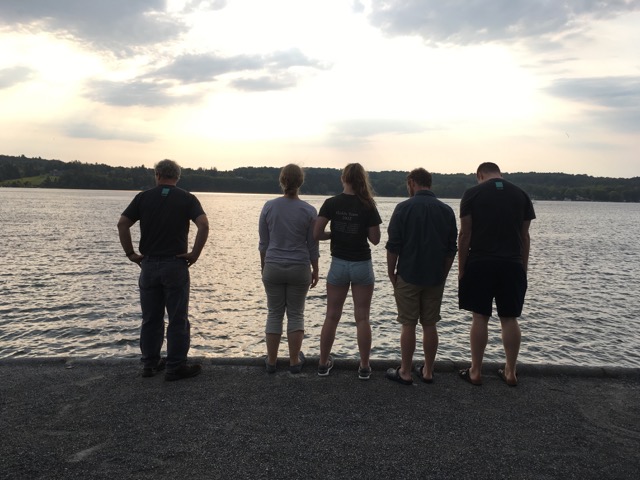
It was a partial family get-together that involved food, frisbee, and talking.
Five out of eight children — that’s more than half the family.
A kind of weird conglomeration of food that included deli meat (but no bread), watermelon, fresh mozzarella salad, chips, and blueberry pie — I suppose that constitutes a picnic. We were eating at a picnic table.
I stopped at the Farmer’s Market
Early Saturday morn
Heard some vendor’s talking
(They both look tired and worn.)
“Went to the tractor pull,”
One guy said to his friend.
“Didn’t get home ’til 2 AM.
Helluva start to the weekend!”
“Damn rooster woke ME at 4 AM,”
His friend to him replied
And he passed him some maple syrup
To carry the jugs inside.
Oh, this glorious country life!
With tractors and roosters the only-est strife
Stars in the night, sun in the day
Cows in the field, newly mown hay
So thankful I live here every day
So thankful I live here every day
On Sunday at the Harvest Fest,
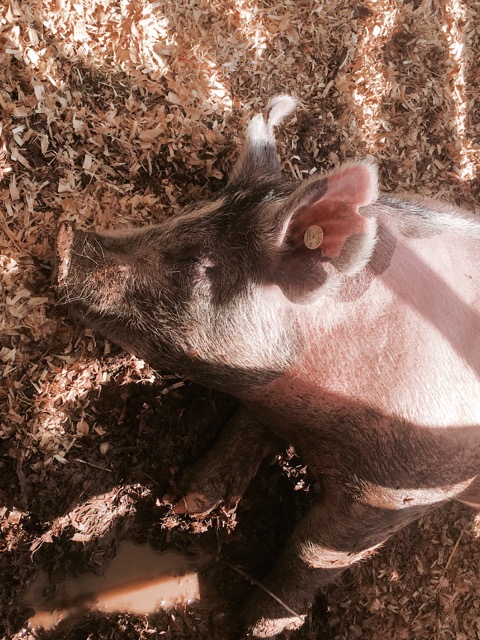
We visited the pig —
Half in wood shavings, half in mud
My goodness, the sow was big!
She had been the champion
At July’s livestock show
For this festival’s Parade of Champions
They wouldn’t let her go
So her owner brought a steer
To parade in her stead
While she wallowed – half sun, half shade
Mud on her snout and head
Oh, this glorious country life!
A parading steer lest the sow run rife
Stars in the night, sun in the day
Cows in the field, newly mown hay
So thankful I live here every day
So thankful I live here every day
I sat in an exam room with a new health care provider last week. As she worked her way through the list of get-to-know-you questions, she came to medications. The form had said, “List all medications,” but I left it blank.
“Do you take any medications?” she asked.
“Nope,” I said.
“Vitamins or supplements?”
“Nope.”
“Anything over-the-counter that you regularly take?”
“Nope.”
“Nothing at all?” she asked one last time, looking up at me.
“Do you count coffee?” I asked.
“No,” she replied. “That’s a food group. Coffee and chocolate — both are food groups.”
I knew then that we would get along famously.
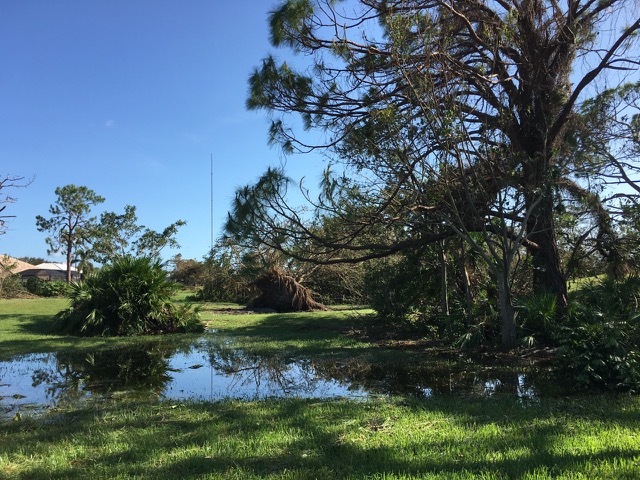
My sister survived Irma. The morning after the storm, she reported that they were fine but didn’t have electricity. To the best of my knowledge, they are still without electricity. She texted me pictures of trees down and debris in the road, then added,
The real problem: NO COFFEE 😬😱😡
I read a joke that made me think of her and her situation.
Q: How do you feel when there is no coffee?
A: Depresso
The other day when I made my coffee, the filter folded over and the coffee didn’t drain properly into the pot. When I went to pour my first cup, I got watery grounds and a mess in my coffee maker. I read that spilling a cup of coffee is the adult equivalent of letting go of a balloon. My situation was the equivalent of multiple balloons disappearing into the sunrise. I felt like crying.
Thankfully, I live in a land of plenty — plenty more beans to grind, plenty more filters, plenty of water.
And plenty of electricity.
Still, I hope my sister’s electric comes back soon — if for no other reason than for the sake of coffee.
Ayla’s English was impeccable. Well, nearly impeccable.
When we first met, someone asked her how old she was.
“Twenty,” she said, without batting an eye.
“Twenty?” someone else questioned.
She flushed and giggled a little, realizing her mistake. “No, twelve.”
I turned to Amina, our official translator. “Are twelve and twenty similar in Bosnian?” I asked. It would make sense, because they’re pretty similar in English.
“Yes,” she replied.
It reminded me of words that I hesitated to use in Croatia. I had learned over 350 Croatian words using an app before I traveled. Some words, however, I consistently confused.
For instance — zabranjen, which means forbidden, and začinjen, which means spicy. It would have been kind of funny if I pointed to a food asked “Zabranjen?”
apricots(?) and plums
It turns out that Bosnian food really isn’t terribly spicy, just delicious. Everything is fresh. The bread was baked fresh for us every day. We had fresh plums, apricots, watermelon. A salad made with fresh tomatoes and cabbage, lightly seasoned with salt, oil, and vinegar was served at several meals (I even got to help make it once.)
They made a most delicious soup called čorba. The secret ingredient, I learned, was okra. Not fried okra like one would find in the south, but okra that had been cut into little pieces and dried and strung. I’d like to make it here, but I’m not where to find the okra.
Yes, that’s me slicing tomatoes, but Anna, next to me, is eating čorba
Back to Ayla — as I said, her English was excellent. When Amina wasn’t available, I would ask Ajla for help communicating and she was fantastic.
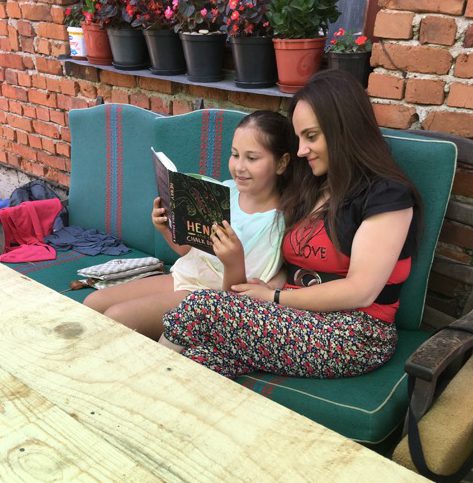
I had brought along a friend’s book to read, a children’s book called Henry and the Chalk Dragon, and finished it on my flight to Dubrovnik. I quickly realized that Ajla had the language skills to read the book — if she was interested. She was.
Ajla and Amina
Some things get lost in translation, though. Mary and I were talking yesterday about the time when Mary was telling a story she made up with talking and flying animals, Ajla said, “You are a great storyteller — in the lies.”
How could we explain the difference between imagination and lies?
Henry and the Chalk Dragon is a very imaginative book, with chalk creatures coming to life — but it’s also full of truths. I hope Ajla can see them.
She wants to be an artist, and here’s one truth from Henry that she needs to understand:
You have to be brave to be an artist…. It takes a fearless knight to imagine something and then let it out into the world.
Jennifer Trafton Peterson, Henry and the Chalk Dragon
Hospitality is certainly part of Muslim culture… It is a reminder of the importance of hospitality in understanding people and allowing them to know you. In our American culture we don’t place as high of a premium on it, and we kind of expect that we can just tell people what we think, and they’ll just accept it because we told them. We don’t have that element of hospitality anymore that allows us to really get to know people on a heart level.
Amy had warned us about Bosnian hospitality before we traveled — but mostly it was in terms of coffee drinking. I thought, That’s not such a problem. I like coffee.
And it was true — we were offered lots of coffee. Served in tiny cups and often with sugar cubes. Made the Turkish way.
It turns out I prefer my large American mug of coffee with half-and-half in it.
But Bosnian hospitality – oh my goodness!
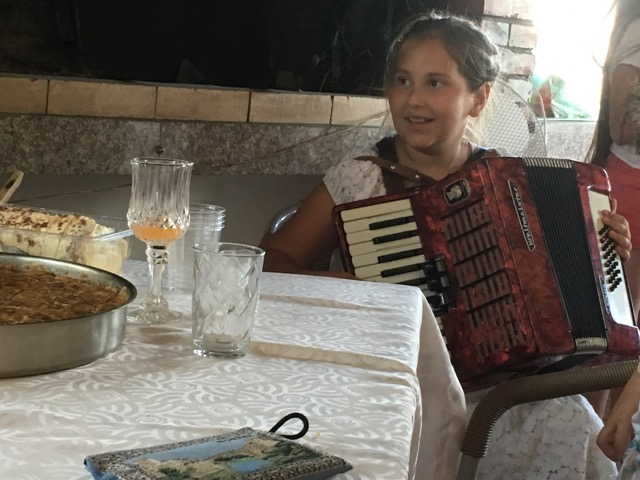
Ajla, our junior hostess, playing the harmonica (aka accordion) for us
The coffee was such a tiny part of their hospitality. On two nights we were welcomed into homes for veritable feasts. The first of those meals I would place in the top ten meals of my life. The food was absolutely amazing, especially the baklava.
Bosnian hospitality also includes music. At that first feast, Ajla started the musical segment off playing the “harmonika” (aka accordion), but then there was singing and dancing that went on late into the night. Such a celebration!
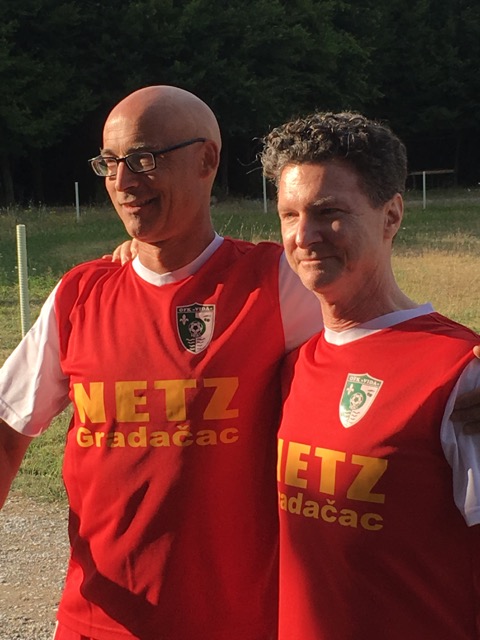
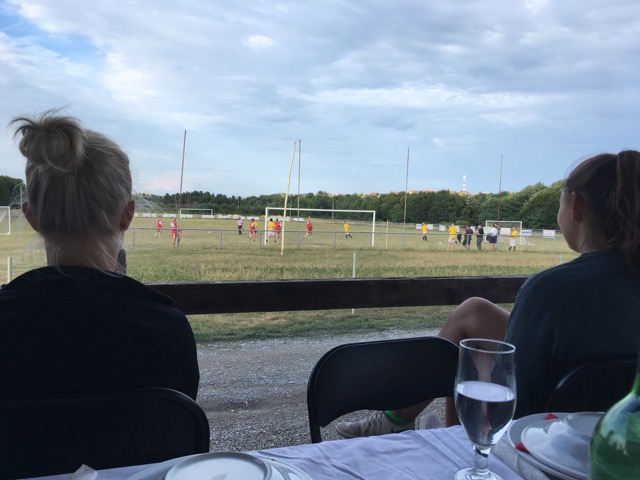
Two nights later we dined at a fudbal (soccer) club and watched a game that included the two men from our group.
Bill-2 and Bill-1 dressed for soccerWatching the game before dinner
After the game and dinner, someone got out an accordion again and the men sang. The best men’s choirs in the world had nothing on this group. It was wonderful.
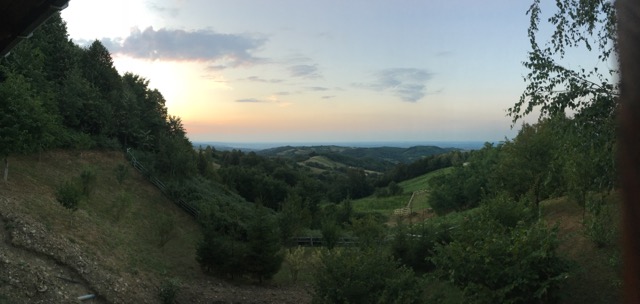
The second dinner in a home was on our last night in Gradačac. We drove and drove on winding country roads until we came to the house. We dined on a large porch that overlooked a valley. Once again, an accordion came out after dinner. The food was great, the singing fun, and the view spectacular.
More accordion!What a view!
If I could do one thing in the Bosnian way, it wouldn’t be making coffee or bread or pie or even baklava — although all those things were amazing — if I could do one thing the Bosnian way, it would be to practice hospitality.
The panorama of the valley is my day two entry for the photography challenge I’m doing. It involves posting nature photos (taken by me) for seven days.
I’m going to tag some of my favorite bloggers to take up the challenge too. If you’re tagged and don’t want to do it, that 110% fine with me. I totally understand.
One — because when I was looking for hospitality quotes I found one that said “Be a flamingo in a flock of pigeons.” I’m not entirely sure why that’s a hospitality quote, but it made me think of you and your flamingo series back in February (which I loved).
Two — your last post included a picture of a turtle. My last post included a picture of a turtle! Total kismet. (Plus, turtles amble, and that’s the word of the day.)
Three — You haven’t written much lately, my friend. (nudge, nudge)
During our down time in Bosnia, Leah starting asking, “Tell me a story.”
It was so open-ended that I struggled with it.
I asked her if she got the idea for that from La La Land. Those words were the lead-in to my favorite song from the movie.
Leah assured me that, no, she had been asking that question for years. I’m pretty sure that La La Land got the idea from her.
So, sitting in the shade one day, she said, “Tell me a story.”
“I can’t,” I told her. “I need some parameters.”
“Okay. Tell me a story about when you were in grade school,” she said — and I did. I told her about a day in 3rd grade when I experienced agony and ecstasy, as best a 3rd grader can.
In short, our class had gotten back from a trip to the library. I had checked out Mark Twain’s “The Prince and the Pauper.” My teacher, Miss Bliss, held up the book (and me, figuratively) as an example of a student choosing good literature to read. Later in the day, I couldn’t find my math paper in my desk — I’ve been a messy for as long as I can remember — and she dumped the contents of my desk on the floor in the middle of the classroom. I can still remember that shame. Same day.
Later, Leah asked Mary to tell a story, and Mary launched into an imaginative story with dragons and little girls. Ajla, one of the Bosnian girls, listened wide-eyed and delighted.
“You are a great storyteller,” she told Mary, “in the lies.”
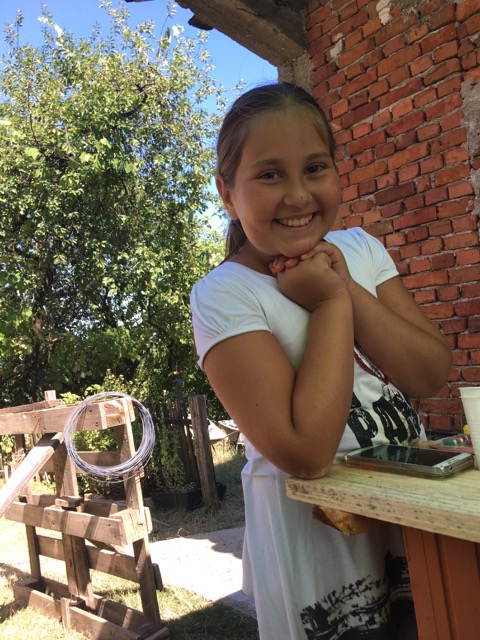
Ajla
Ajla’s English was excellent. Except when she didn’t know the right word.
Yesterday, I spent some time at the emergency room with my father.
As we waited and waited, I grew fidgety. An excellent PCA named Roy helped turn my attitude around.
Roy had stopped by my father’s hallway bed several times. He was always cheerful. On one of his check-ins, he looked at me and said, “Tell him a story.”
I was busily mentally drafting complaint letters and griping to my sister via text. I didn’t respond to Roy, so he repeated it.
“I’m talking to you,” he said. “Tell him a story.”
“I can’t,” I said. “I need some parameters.” It was a deja vu moment — and I was back in Bosnia.
“I’ll get you started,” Roy said. “‘Once upon a time in a castle far, far away…’”
I laughed, and took up the story.
“Dad, did I tell you about the castle where we stayed in Bosnia?”
“A castle?” he asked.
the castle
“A real castle,” I repeated, “from the Ottoman Empire.”
Telling him about the castle took our minds off the fact that we were waiting in the emergency room.
With Leah, it took our minds of the heat and lethargy of the day.
While I was in Bosnia, I began thinking of things that I would do differently next time.
First, I would bring my computer. I intentionally did not bring my computer on this trip, so I could “unplug” a little. I had my phone which I thought would be adequate.
I learned something about myself, though. When I journal with a notebook and a pen, I tend to write little notes to myself. Reminders of the day. Conversations occasionally, but with minimal extras. When I write on my computer, I write complete sentences. Or complete thoughts. (<– see what I did there?) I edit, delete, rewrite, and write a little more — because the process of writing helps me to unfold my thoughts more completely.
In Bosnia mosques and churches – side by side — something I’m still pondering
For two weeks, I didn’t do that. Now I am left with a hopelessly tangled knot. I try to write about an experience I had there and I can tell something isn’t right about what I just wrote, but I’ve lost the moment. Sigh.
So — next time, the computer travels with me, and journalling will be worked into the schedule.
Second, I would bring more gifts. I was overwhelmed with the generosity of the Bosnian women. They gave us clothes, jewelry, hand-made lace items, plums — not because we needed them, but because they wanted to express things that only a gift can express — Thank you. I appreciate you. I want you to remember me. I was thinking of you and I wanted you to have this.
Group photo — I’m holding some clothing given to me as a gift
Quite frankly, I wasn’t prepared at all for that. I had thrown a few things in my bag to give, and gave them on our last day. (Stay tuned for a future post about that.) But I really wished I had more, much more, because I wanted to say all those things that only a gift can express. (See previous paragraph.)
Third, skip the brick brigade.
Passing bricks
Ostensibly, we were there to help build a house. I was a little skeptical of my part in that from the get-go, but figured there must be something I could do. A prerequisite for the trip was the ability to carry bricks uphill. Well, we carried them downhill. And not even that. We formed a brick brigade and passed them down the line in the many-hands-make-light-work spirit. Moving a palette of bricks took, maybe, 20 minutes. It just felt like, um, fluff — well, as fluffy as brick-moving can be. Later in the week, I saw a truck deliver bricks much closer to the work site. It made me wonder how much of the original delivery site was so that the Americans could feel useful. I didn’t want to feel useful; I wanted to be useful.
Which is why, fourth, I would have volunteered more in the kitchen. On the last day, I went into the kitchen with the Bosnian women. Perhaps I should have stuck with moving bricks because I was pretty terrible at scraping potatoes. Had I started earlier in the week, by this point, I might have gotten the hang of it. Had I known I would be doing that before we left, I would have brought some peelers. As gifts. To say, I want you to remember me — every time you peel potatoes.
Cutting cabbage
But peeling potatoes and cutting cabbage were the highlights of my week. We communicated through hand gestures (when the translator stepped out) and demonstration. We laughed at my clumsiness – ineptness needs no translation and neither does laughter. The women asked if I wanted to make the traditional pie, but, if I couldn’t peel a potato well, I was afraid what I would do to the pie.
Our hostess making pie
Next time, though, I would head straight for the kitchen. I would help with the daily bread-making and soup-making. And I would learn the Bosnian way of rolling out pie dough. (It was pretty amazing!)
Last, I would leave the photography to other people. If I had left my computer home so I could be unplugged, I should have left the camera off so I would stay in the moment. I’m not the greatest photographer. One girl on the trip was truly gifted in that area. My pictures are adequate at best.
In addition to shoveling cement, Nicole took fabulous pictures
Once, when we went out on a boat, Amina, our translator, asked me to take a picture of her. The first three or four pictures that I tried to take were so bad that she turned to someone else. I should have warned her that I was lousy photographer.
As the week went on, I took less and less photographs. I tried to memorize the things I was seeing, smelling, tasting and feeling. All the pictures in the post were taken by someone else — proof that I didn’t need to take any.
A number of people have asked if I will go back to Bosnia.
I hope Leah doesn’t mind, but we’re going to spend some of our evenings dashing off postcards from the former Yugoslavia.
Mary found my postcard list in my travel folder. It has names, addresses, and boxes to check off, so I can have that sense of accomplishment.
“I don’t know who some of these people are,” she said as she read through the names.
“They’re people I met on the internet,” I told her.
I know, it goes against all the internet safety rules, but I didn’t respond to phishing letters or meet these people in sketchy chat rooms — they’re fellow bloggers. I think I’m allowed to use a little common sense.
I sent one an email the other day, worrying all the while that I would seem like a stalker. Her response was so heart-warming. “Thank you SO so much for contacting me – you’ve rather made my day,” she said.
A few years ago at Laity Lodge, during an informal conversation around the fire pit, one woman shared how special it makes her feel to receive a hand-written note from someone.
“I’m holding something in my hands that they held in their hands,” she had said. “They took the time to write something for me. They wrote my name and signed their name. It’s a gift of time and thought.”
During the A-to-Z Challenge this year, I stumbled across a blogger who daily posts snail mail that she has sent or received. I look forward to seeing Hawwa’s Mail Adventure‘s in my inbox every day.
I contacted her to see if she wanted a postcard from Bosnia or Croatia, and she replied that she had never received a postcard from Bosnia — so I put her on my list.
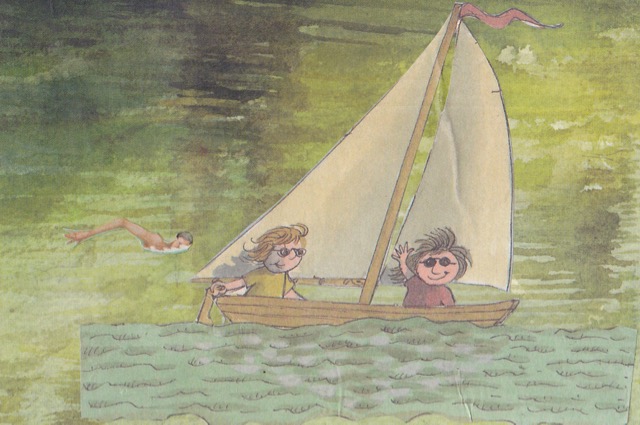
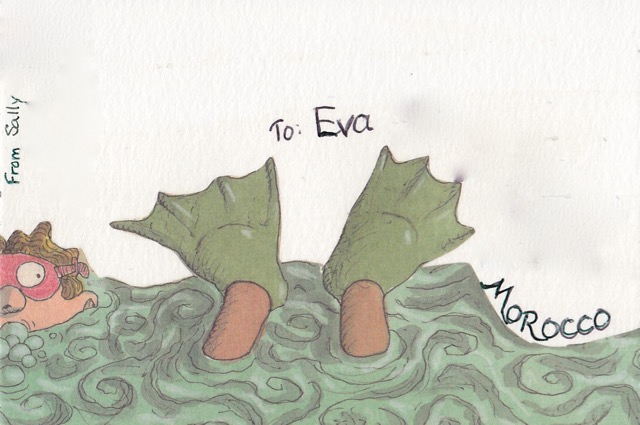
I sent a trial run postcard to her — just a collage I had made.
The swimmer is my favorite part.Before I put on the stamp.
I held a postcard that she had held in her hands. She took the time to write something for me. She wrote my name and signed her name. It was a gift of time and thought.
Bud said that he woke up in the middle of the night wondering if it was the right decision.
I reminded him all the reasons why — the catalytic converter, the exhaust system, the timing belt, the short circuits in the electrical system.
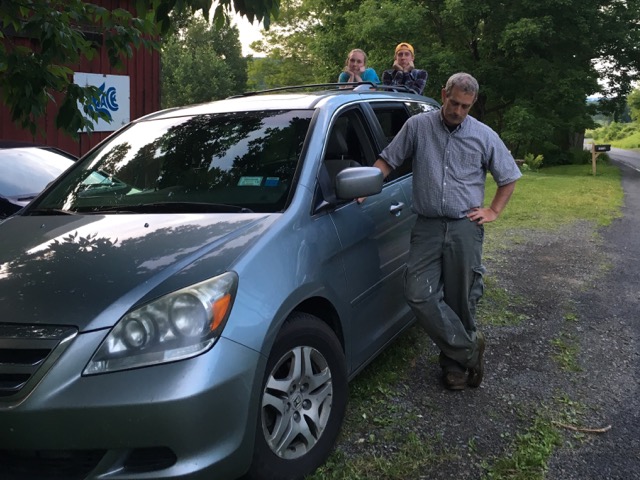
Still, our Honda Odyssey had taken us many miles — well over 200,000. Many trips to Florida, to South Carolina, to North Carolina, to Washington, DC, as well as the hundreds, maybe over a thousand trips between Cooperstown and Greene.
It’s almost as old as Laurel.
It has served us well.
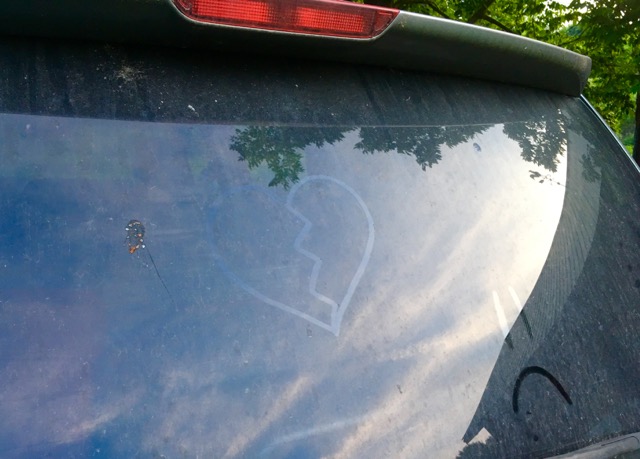
When Philip was a little boy and we traded in one of our cars, he drew sad faces in the dirt on the windows. Laurel did the same last night with the Odyssey. My bookend children think the same.










 Hot Dogs and Marmalade