Overheard Malicious whispers Between two Co-workers My heart grew cold at their words Squeezing in my chest
Breathing stopped Blackness obscured sight My fists clenched And unclenched Thoughts swirled like a tornado Unholy and wild
Office chair Calmed me in this storm I held on Took a breath Straightened my back and went out “I heard what you said”
This is my response to this week’s W3 challenge: to write shadorma poems.
The shadorma is a compact Spanish syllabic form built from a six-line stanza with a strict syllable pattern: 3 / 5 / 3 / 3 / 7 / 5 (26 syllables total). It is typically unrhymed, and a poem may consist of a single stanza or a series of stanzas.
For this challenge, the theme is Sensory Details.
Write a close-up study of a single inanimate object or a very specific moment. Think small and focused rather than narrative or expansive. The power of the poem should come from sensory observation—what can be seen, heard, touched, smelled, or felt.
Yes, this actually happened. It was a specific moment and I tried to write the sensory details of it.
Amelia’s knights neighed Her black pawn had tea with my white Our bishops talked “What are they talking about?” I asked “Hello,” she said, bobbing one up and down “How are you?” she said, bobbing the other similarly She giggled “This is more fun than checkers,” she said Amelia is in third grade “The pieces are people,” she stated “Can our queens be friends?” she asked I paused “That’s not how the game works,” I told her She pressed her lips together Then she reached over and touched her pawn The one that was head to head with my pawn “But they can still have tea, right?” she asked
When I read the Stream of Consciousness prompt for today — the word “distance” — this song is the first thing that came to mind.
I have a love-hate relationship with the lyrics. Allow me to — stream-of-consciously — dissect them.
On the surface, yes, it’s all so true:
From a distance, the world looks blue and green And the snow-capped mountains white From a distance, the ocean meets the stream
Yep — those pictures taken of the earth from space show our planet as green and blue. We can see water, land. We have to start zooming in, though, to see ocean meeting stream. We have to really zoom in to see the last line of that verse:
And the eagle takes to flight
If we were to really really zoom in, we would see that eagle swoop down and grab a living creature — a fish, a rabbit, or even someone’s pet. Hmmm…
From a distance, there is harmony And it echoes through the land It’s the voice of hope It’s the voice of peace It’s the voice of every man
Well, not EVERY man. I’m so disturbed by the words of our Secretary of War/Defense this week. He initially acknowledged the fallen troops, but then they became a PR problem to him. He accused the press of trying to make the president look bad. Seriously??
From a distance, we all have enough And no one is in need And there are no guns, no bombs, and no disease No hungry mouths to feed
From a distance, it may look that way, but it’s not true. It’s just not true.
From a distance, we are instruments Marching in a common band Playing songs of hope Playing songs of peace They’re the songs of every man
I actually like this verse. Music is a uniter. I think about the story from WWII of Germans and Americans singing Silent Night together, in their respective languages, on Christmas Eve. (I think that’s how the story goes.)
God is watching us God is watching us God is watching us From a distance
Umm…. the Christmas story is that God was born in a stable. The Lenten story is that after a dusty, dirty itinerant life — walking with us, eating with us, teaching, listening, healing through touch — God in human form died for us. God bridged the distance.
From a distance, you look like my friend Even though we are at war From a distance, I just cannot comprehend What all this fighting’s for
I’ll go back to that Christmas Eve story and I’ll say this, You, Iranian mom, are my sister. In 2017, I went to Bosnia and shared meals with people of a different faith. I learned they were also my friend/family. I’ll also go back to those powerful people in the world who move us around like chess pieces. I just cannot comprehend what all this fighting’s for.
The rest of the song is pretty repetitive of what’s already been sung.
It’s a lovely song. It really is.
I just wish it didn’t lean so heavily on God watching “from a distance”.
Perhaps it’s simply saying that God has the best perspective — “from a distance”. Hmm… I need to ponder that.
Smooth <— that’s the Saturday Stream of Consciousness prompt.
Honestly, I got nothin’.
The only thing that comes to mind — and KEEPS coming to mind — is the sarcastic “Smooth, real smooth” that I’ve heard when I’ve goofed up. Again.
Have I ever mentioned the fact that I’m a little awkward at times?
For my work, I have to call people, and it stresses me out. I think ahead to what I want to say when I have to leave a message — “Hi, this call is for [insert name]. This is Sally calling from the Membership Office.”
Sometimes, I get through the point of the call seamlessly.
Other times, though, someone will walk past my open door, wave, and I get distracted. That’s when I start babbling.
I think that as I grow older, it’s not just my body that loses some of its flexibility, but my brain also loses elasticity. I don’t multitask like I used. I forget names and/or words.
I had put out a request asking for seniors who would be interested in playing games after school with the children who come to the facility where I work.
A man stopped in my office. “I’d like to teach kids to play chess,” he said.
He had a magazine that showed a large group of children playing chess on the cover.
“In a lot of places,” the man said, “kids start learning chess at the age of 6.”
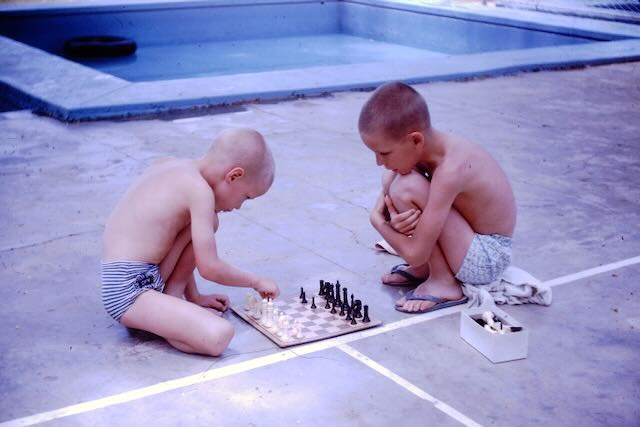
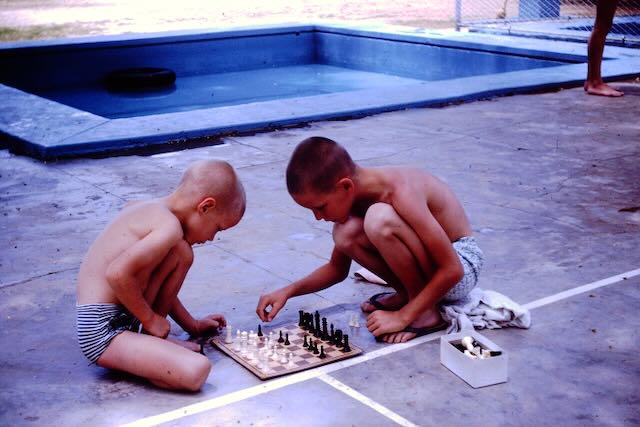
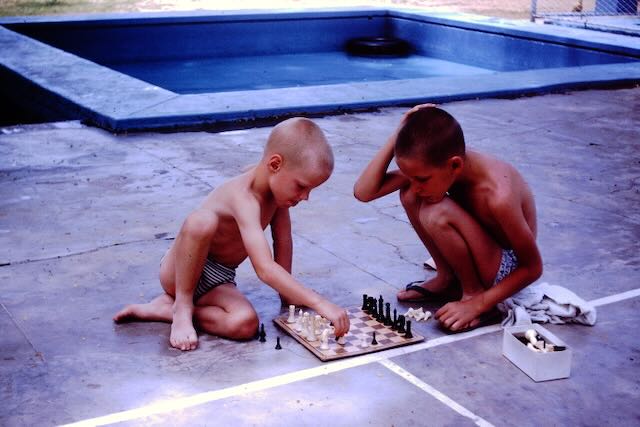
I immediately thought of this series of photos of my two older brothers. It’s from 1963 or 64, which would mean my brothers were probably 6 and 9.
Twice a week for the past few months I’ve been leading a walking workout up on the track at the facility where I work. The walking workout is for our seniors, and my goal is to get them to walk for 30 minutes. We do it on Mondays and Thursdays. I’ve got a small but dedicated group that attend.
Here’s how it works: I make a playlist and assign exercises to go with the different songs. We do grapevine, or side-steps, or bicep curls with weights while walking, etc. We even walk backwards, which is great for balance!
On Thursday of this week, I decided to look for love songs with an upbeat tempo for my playlist. The warm-up song was “Walking on Sunshine.” Afterwards, one of the ladies told me that was one of her favorites. “It’s the song I used to use as the first song when I would go running,” she said.
She doesn’t run anymore, but she be-bopped around the track and sang along as she did. It made me smile.
Now, as I explained, I have the walkers do different things while walking. I’ve tried having them do lunges (only four at a time!) which isn’t popular. I had them balance something on their head while walking. (I thought it might help with posture.) I thought about having them walk backwards and toss a football to a forward-walking walker who then would have to walk backwards — but it seemed complicated and I wasn’t sure if the idea was workable.
For the second song on Thursday, though, I tried out a new cock-a-mamie ideas.
The song was The Proclaimers’ song “I’m Gonna Be (500 Miles)” (see below). I wanted them to try walking at the same pace as someone else. I explained that when I was taking care of my father, one of the hardest things for me to do was to walk at his pace. I also explained that it was a drill I used to use occasionally when I coached swimming where I had the swimmers try to swim in synchrony with another swimmer. I’m not sure that it made them faster, but it did make them aware that they were not the only person in the world, which is a better life skill than being a fast swimmer.
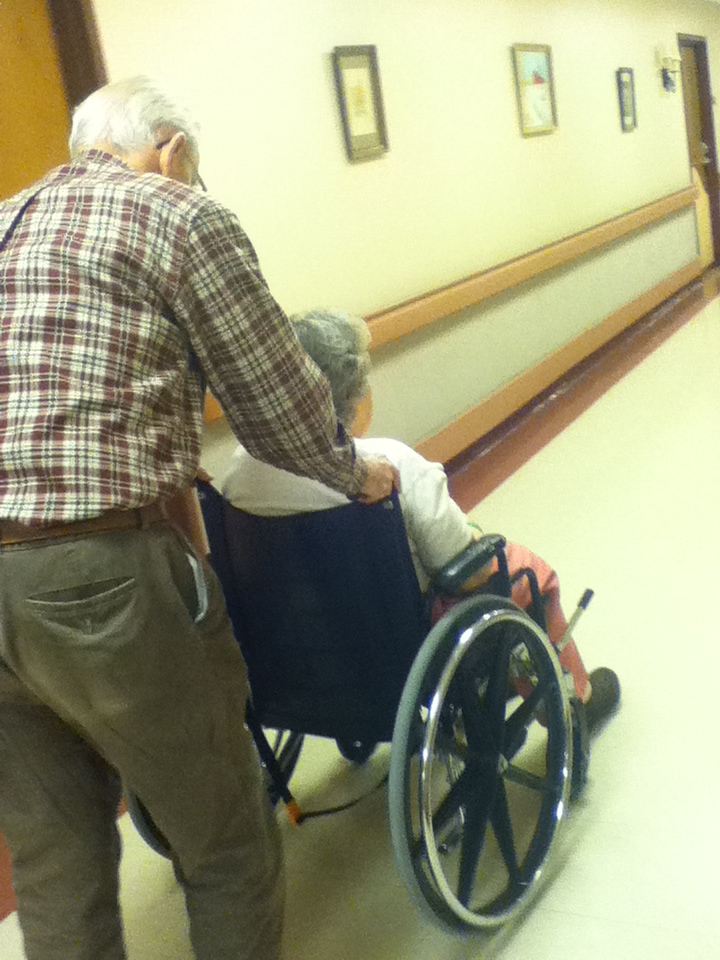
Anyway, I explained this to my walkers and then I watched them as they tried to walk in step with someone else. The more I watched, the more I thought about my father and how hard it was to walk with him through those last years but how he had set the example by walking with my mother through her last years.
Mom and Dad — 2015
I wouldn’t trade any of it for anything.
The next song that came up was Queen singing “Crazy Little Thing Called Love.” We did the grapevine to it.
In my head I was still back at how walking with another person at their pace is an act of love. I would walk 500 miles like that. Crazy little thing called love.
This is my response to Linda Hill’s Stream-of-Consciousness Saturday prompt: Love..
I start every day with reading. I’ve done that for most of my adult life, although what I read has changed over time.
These days I have four different books that I’m reading. It’s a weave, pulling threads from four different sources, and letting them intertwine. Sometimes it’s amazing how it works sometimes, the similarity between two disparate books.
This morning I was especially struck by that. I’ve been reading William Willimon’s book Aging: Growing Old in Church. I finally finished a very long chapter called “With God in the Last Quarter of Life” which was subdivided into topics like Grief, Church Participation, Being a Burden, Economics, etc. The last section was on Memory.
I cared for both of my parents as their memories shape-shifted and deteriorated. This section of the book hid hard and hit home as I remembered that period of time in MY life. Here are a few quotes:
One reason the aging remember is to preserve a now disintegrating sense of self. We remember selectively, even desperately, defiantly, having lost a job and some of our friends and family. Remembrance is an act of defiance against injustice, recalling the lives of past victims in order that their witness may not be lost. …
And yet some of our feverish attempts to hold on to our memories may be a sign that we fear we are being forgotten. We may have bought into the widespread American notion … seeing ourselves as the sum of our efforts rather than as a gift of God’s love and vocation. …
The elderly… can be living bodily reminders to us all that our lives are not the sum of our attainments, never our sole possessions, but rather, from birth to death, God’s gifts.
Compare/contrast/weave those words in with these words from Brian Doyle. I’m reading his collections of essays called Eight Whopping Lies and other stories of bruised grace. Today’s essay was “What Were Once Pebbles Are Now Cliffs” in which he remembers his sons when they were the size of pebbles; now they are cliffs.
Time stutters and reverses and it is always yesterday and today. Maybe the greatest miracle is memory. Think about that this morning, quietly, as you watch the world flitter and tremble and beam.
It’s good to be reminded that I am not the sum of my efforts, my attainments, my possessions. Every day is a gift. And memory is also a gift.
In order to do that, I had to stop cooking several years ago.
Life’s twists and turns had taken the desire to cook right out me. Occasionally, when I did cook something, digging out an old tried and true recipe, it didn’t necessarily turn out right.
I think it was around last Thanksgiving when one of my children mentioned cinnamon rolls. I used to make cinnamon rolls for almost every holiday. Sometimes for birthdays. Sometimes just because. But I had stopped making them.
So I pulled out the recipe and tried it again. The cinnamon rolls turned out meh. Just meh.
I made them again.
And again.
Something about kneading dough is therapeutic. I’d say that it scratches an itch — but that doesn’t really describe it. It’s the rhythm of push-pull-fold-turn. It’s the warmth of the dough and the way you can feel life starting to happen. It’s such a good feeling.
Then, when that lump of dough rises to double in size, it always feels like a miracle. Little things thrill me — and that’s one that does.
Rolling out the dough, spreading the cinnamon sugar filling, rolling it up again and cutting the neat rolls — well, that’s all fun too.
The dough rises again.
The rolls bake and smell amazing while doing so.
A little frosting goes on top when they come out of the oven, so the frosting melts a little right into the roll.
They are so good.
Last weekend, I made a batch of cinnamon rolls. The big snow was coming. While they were still warm, I brought some to the maintenance shed where I work, where the guys who plow the parking lots and driveways for the facility go inside to get warm.
My co-worker looked puzzled when he saw me at the door there. “I made cinnamon rolls,” I told him. “They’re still warm. I think it’s going to be a long couple of days for you guys.”
His face broke into a huge smile. “I just came inside to get warm,” he told me. “These will be great!”
I laughed and told him to be sure to save some for the other guys.
Then I took about a dozen cinnamon rolls to the county highway department. I told them the same thing I had told the guy at my workplace. They were so appreciative.
It’s a win-win for me. I love making them and I love sharing them.
I’m glad I started baking again.
This post is in response to the last two JusJoJan prompts. Yesterday’s was “cinnamon” and I ran out of time. Today’s Stream of Consciousness Saturday prompt was “scratch an itch” — and I thought I could make it work for what I had been thinking about for cinnamon.
I should have taken pictures of the cinnamon rolls last weekend. They turned out perfect!


 Hot Dogs and Marmalade