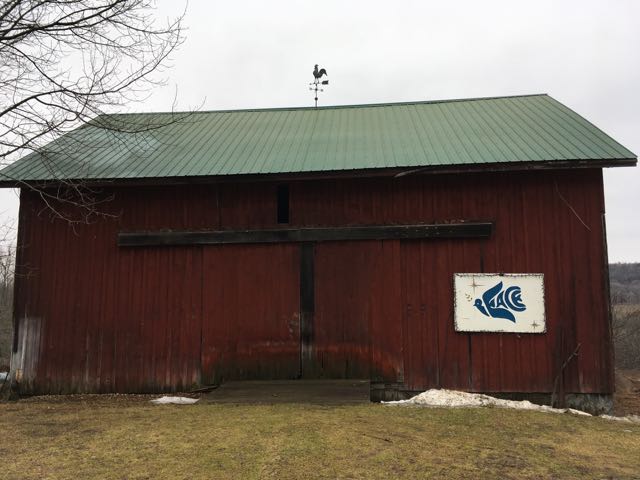
The side facing the road is red, the traditional color of many barns. My mother painted the Peace Dove around 40 years ago on a sheet of plywood. Bud found it in the barn this fall and decided to hang it for the holidays.
The northern side bears remnants of the red. Also a few broken windows.
And a tree with a cool twisty trunk.
The messy back side is a mish-mash of red, green (discolored plywood), and black, where the silo used to stand.
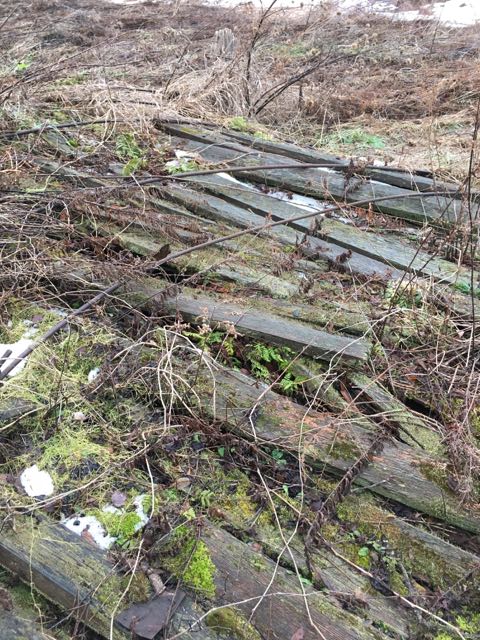
Here is what remains of the old silo — metal bands and wooden staves becoming one with the earth.
The southern side is all gray, discolored in the one corner where a truck cap leaned against it for years.
I think this side is the prettiest.
I took a picture of it during the summer just because I liked the way it looked.
It’s lovely, don’t you think?
Exposure to the elements and weather brings about changes — like the trials in our lives. We end up with some scars and a few broken parts.
But if we lean in, we might find some beauty there.
In the spirit of “Leaning In,” I offered to help my father write some letters.
During December I felt trapped, much the way a mother of a toddler feels. I remember being home with small children and wondering what it would be like to be able to do and go without worrying about other people. Now I sometimes feel that way again, but it’s not because of small children.
I had asked Laurel some of the same questions I asked Mary (see Explanation). Laurel knew how old I was. She also astutely answered the what’s-my-favorite-thing-to-do question. “You like alone-time,” she said — and I felt a little lump in my throat because she understood me so well.
Alone time. I crave it. Like chocolate. Or coffee.
When I was home with toddlers, I would retreat to the bathroom — and they would stand outside the door, talking to me, trying to get in, asking when I was coming out.
In December, my father would sometimes stand at the bottom of the stairs. “Sally? Sally? Are you going anywhere today? I’d like to go out,” he would say. And I would feel so selfish that I just wanted to go out alone. All. By. Myself.
With toddlers, sometimes they would follow me everywhere. “Fred” used to sit on my foot and hold onto my leg. I would hobble around, my steps uneven because I was dragging a little boy with me. He simply wanted to be with me. If I stopped to read with him or play with him, sometimes that would satisfy his Mom-time need, and, in turn, I would have a little alone time. In the kitchen. Woohoo.
Of course, I couldn’t find a picture of “Fred” hanging on my leg — they do exist! — but this is him, the youngest at the time, at about the right age.
So — leaning in. I decided in 2017 that I wouldn’t try to escape, but would rather lean in. Embrace.
Instead of escaping upstairs, I asked my father if I could help him write a letter. He had been saying that he wanted to write to a few people, but, beyond the struggle of gathering thoughts into words, he also struggles with the fine motor coordination of writing.
Yesterday, we sat to “write.”
It took him a long time to formulate his thoughts, but his words revealed how trapped he felt, too. He told his friend why he couldn’t travel to visit her —
… I feel like I should accept the wisdom of the rest of my family that I should not drive a car. I agreed to this reluctantly, but there’s no way out.
No way out. What a terrible feeling.
He got frustrated with the writing process and we put the letter aside.
So today, we’ll finish that letter and get it in the mail.
And I’ll take him out with me.
It’s a lot slower running errands with a person with a walker.
Yesterday was a rush-rush day. I had too many things to do in the available hours.
Around 4:30 PM, I made a quick run into the grocery store. The wind was gusty and frigid as I dashed for the door.
In between the open doors a woman stood calling back over her shoulder, “Come ON!” The exasperation was clear in her voice. She pulled her coat tight around her, flipping up the lapels to block the wind.
As I got closer I could see who she was talking to. A little girl, maybe 4 or 5 years old, was in the estuarial space of warm and cold, the space where shopping carts and bottle return machines exist, between the two sets of automatic doors. She had her back to her mother, her hands over her head, fingers extended and wiggling. She crouched and wiggled her bottom a little before jumping up with excited squeals.
She was watching herself on an overhead monitor that showed all the people entering and exiting the store.
“She thinks she’s on tv,” her mother said to me, and rolled her eyes.
I laughed — delighted by the child’s delight. The girl continued her dance, crouching then jumping, waving her hands and arms, giggling and squealing all the while.
Her mother smiled back at me.
For just a moment the two of us watched together.
Then I went in, grabbed the groceries I needed, and headed for the check-out.
I was still smiling when it was my turn to pay.
I was still smiling when I got home.
Two observations I’d like to make:
Delight is contagious. I’m glad the little girl shared hers with me.
Leaning in and slowing down can be as simple as a momentary pause at the grocery store.
Painting at the Fenimore Art Museum: Village Post Office, 1873. Thomas Waterman Wood
I stood in a very long line at the Post Office yesterday.
Post Office line definitions for a small town:
No line = go directly to the counter
Brief wait = someone already at the counter
Line = someone waiting, someone at the counter
Long line = 2 someones waiting, someone at the counter
Very long line = more than 2 people waiting in addition to the person at the counter.
Yesterday, when I first got there, a young couple was at the counter mailing several packages. They held whispered consultations with each other about every package. I think the cost was more than they expected. When the clerk announced, “That’ll be $79.50,” they looked at each other briefly before she swiped a card and they were done.
I still had two people ahead of me, but three or four people now stood behind me in this very, very long line.
The elderly woman at the front of the line approached the counter. She placed two packages on it.
“This one is FedEx,” the clerk said. “I can’t take it here, but you can mail this other one.”
“What?” the woman asked.
The clerk spoke slowly as she repeated in a louder voice, “This package goes to FEDEX. You have to take it down to THE COMMONS. But I can help you with THIS PACKAGE.”
I couldn’t hear what the elderly woman said, but I watched the postal clerk’s face soften.
“Let’s look at this one,” the clerk said, holding the FedEx mailer. “I don’t handle these but I think we can figure it out.”
She read aloud the instructions on the FedEx slip.
The man behind me groaned and left.
The woman ahead of me looked at me, shrugged, and followed him with her eyes out the door.
“You need to sign HERE,” the clerk was saying, “before you put it in the DROP BOX.”
The elderly woman said something.
“THE COMMONS,” said the clerk. “You know, THE SHOPPING CENTER SOUTH OF TOWN.”
The woman nodded and asked something.
“THERE’S A DROP BOX. YOU JUST HAVE TO PUT YOUR PACKAGE IN,” the clerk explained.
The door opened and closed several times over the course of this, each time bringing a wintry draft. I could feel the people behind me shuffling their feet and shifting packages between arms.
The clerk was remarkable — so pleasant, so patient, so unperturbed by the growing line. She took care of the package that was being mailed postal service and reminded the woman again where she needed to take her FedEx package, before turning her attention to the next person.
In this year of “Leaning In“, I knew that I needed to be more like the postal clerk. Too often I have been like the man who left, feeling the tick-tick-tick of time slipping away.
I don’t have time for this, I tell myself — but, really, what is so pressing?
Life is too short to rush through it.
Yesterday I learned something from an elderly woman who didn’t understand the difference between FedEx and USPS, and a postal clerk who took the time to help her.







 “You need to sign HERE,” the clerk was saying, “before you put it in the DROP BOX.”
 Hot Dogs and Marmalade