A to Z Blogging Challenge · About My Dad · family

T is for Turtle Eggs

When my father was a little boy, some bigger boys gave him a bag of turtle eggs. They looked remarkably like chestnuts that grew on some of the trees in their town.

“Take these home and keep them in a warm place. Turtles will hatch,” they told him, probably guffawing to themselves at the naiveté and gullibility of this little boy.

He brought them home and showed them to his father.

“You take good care of those,” his father said.

For days, he checked the bag. Nothing seemed to be happening.

Eventually, he forgot about them, caught up in other little boy activities, like baseball and playing with his dog, Mugsy.

A couple of weeks later, his father said, “Have you checked those turtle eggs lately? I thought I heard something in there.”

He ran to where he had stashed the brown paper bag holding the chestnuts. The bag was moving! Scratchy sounds were coming from it!

Cautiously, he opened the bag to see what was inside.

In the bag were some little turtles, their shells about the size of a silver dollar.

How did his father know they were in there?

A to Z Blogging Challenge · About My Dad · family

S is for Siblings (a pictorial essay)

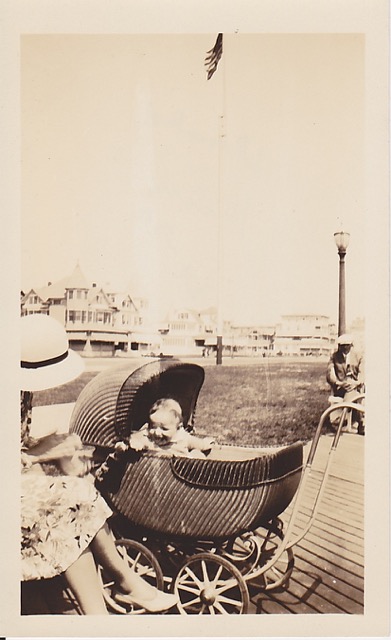
First there was my father —

Ocean Grove, 1930

Actually, before my father, there was Janice Aline, a daughter who lived only a day. Little over a year later, my father was born.

Then his brother, Stewart, came along.


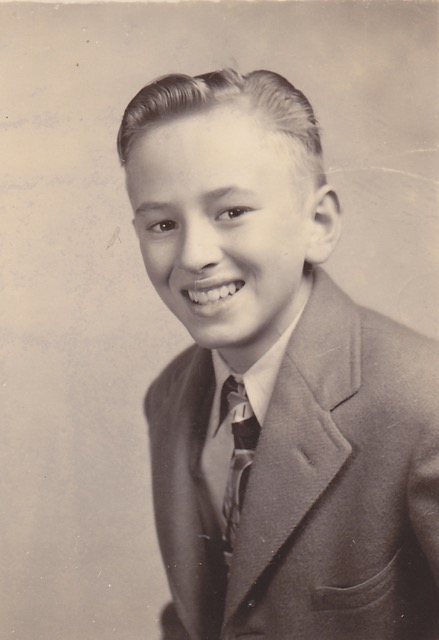
I showed my father the picture today and asked him to identify the person.

“That’s my brother, Stewart. He’s really smart!”

He went on to become a Supreme Court Justice in the state of New Jersey.

Next came Polly — except that wasn’t her name at first. Her given name was an old family name and she changed it to Polly.

Isn’t she cute?
I remember as a little girl thinking she was the most beautiful, most glamorous person in the whole world.

When I found out that she traveled to Yugoslavia in 1960 and worked on a road crew for the summer, she became even more legendary in my eyes.

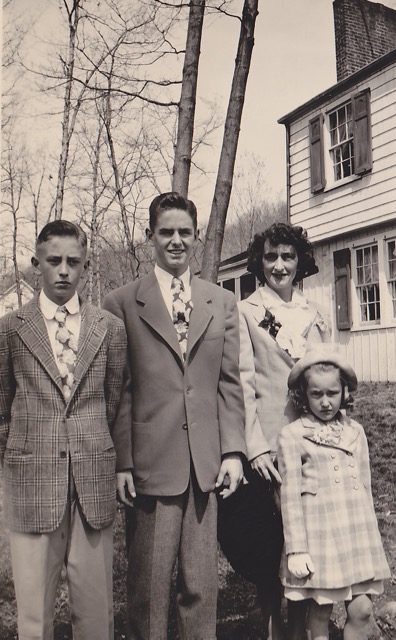
Stewart, my father, their mother, Polly


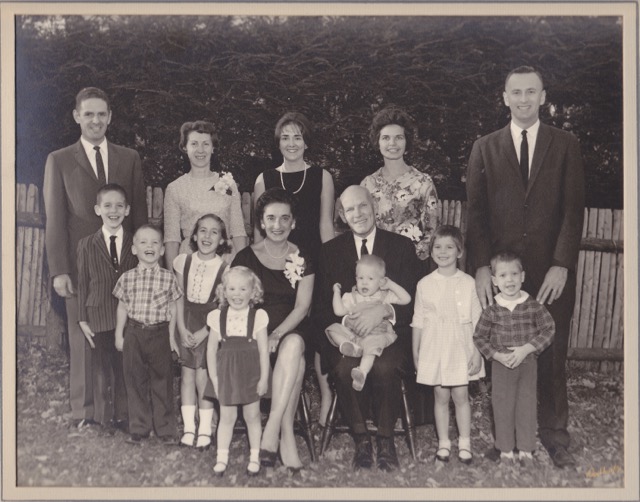
Family portrait
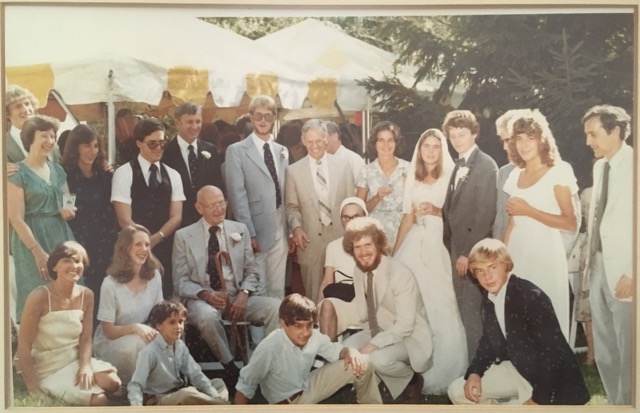
Back row: Stewart, Polly, my father
Middle row: Penny (Stewart’s wife), my grandmother, my grandfather, my mother
Front row (and laps): my cousin Wendy, my sister Donabeth, my brother Stewart, my brother Peter
Back row: My father, my mother, Polly, Penny, Stewart (my father’s brother)
Middle row: Stewart (my brother), Peter, Donabeth, my grandmother, my grandfather, Wendy, Stewart (my cousin)
Front row: Me and my cousin Jeff
Everyone… my grandparents; my father and mother, his siblings, and their spouses; all my siblings and all my cousins

Prolific

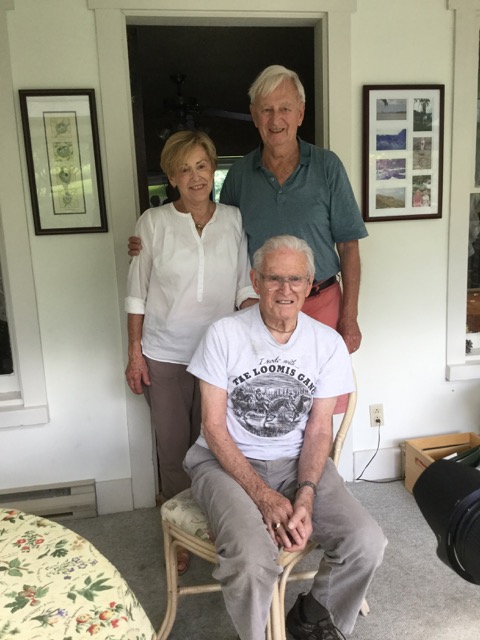
Siblings — summer of 2016

As Brad Paisley sang, “All because two people fell in love.”


A to Z Blogging Challenge · About My Dad · family

Q is for Questions

My father asks questions all the time.

“What does holy mackerel mean?” he frequently asks.

One of his friends explained the origin of the phrase — eating fish during Lent, etc, etc — but the next day he asked the same question. And the next.

“What are heebie-jeebies?” he asks, “and who ever thought of a word like that?”

“If something is ‘pretty good’, does that means it’s both pretty and good? And what about ‘pretty cute’?”

“What do dogs think about?”

To my children who go barefoot in the house — “Why don’t you wear shoes?” “Why don’t you wear socks?” “Aren’t your feet cold?”

To my tattooed son — “Why did you get those tattoos?” “Were you drunk when you got those?”

When we moved from Cheyenne, WY back to NY, our oldest son was just shy of 3. He asked questions ALL THE TIME. We planned to drive through the night to Kansas, and thought Philip would sleep the whole way. However, he talked for hours during that late night care ride.

I remember telling my sister about it when we got to Kansas because I was so tired.

“What did he talk about?” she asked.

“Mostly, he asked questions,” I said.

“Can I touch the moon?” “Can I hold it?” “Can I play with it?” “Where is that car going?” “What’s in that truck?” “Does the moon like me?” “What are you eating?” Where are we going?” “Why are you crying?”

The emotional and physical exhaustion of the preceding days had left me numb, and yet here was this little person I loved asking me questions.

Do you see the parallel?

It’s like deja vu all over again.

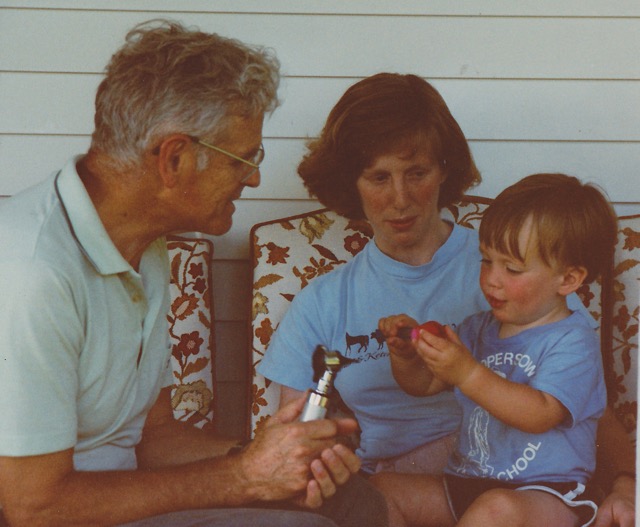
Undoubtedly, Philip is asking my father questions here.


A to Z Blogging Challenge · About My Dad · Faith · family

P is for Presbyterian

Cooperstown Presbyterian Church

Both my mother and father were deeply involved in the Cooperstown Presbyterian Church.

From my mother’s obituary:

Perhaps most central to Elinor’s life was her steadfast devotion to the First Presbyterian Church of Cooperstown, for it was there that she faithfully blended her love of family and God. A member since 1969, Elinor sang in the Chancel Choir, served in church leadership as a Deacon and an Elder, as Treasurer and Clerk of Session, volunteered as a Sunday School Teacher, was a member and/or chair of numerous committees over the years, and participated fully in the women’s association. A generation of young people will remember Elinor as the one who prepared the food for the weekly Thursday school gatherings at the Presbyterian Church.

I was going to say that my father did everything my mother did at the church and then some — except he didn’t sing in the choir, and I’m not sure he taught Sunday School, and he certainly didn’t participate in the women’s association. He didn’t prepare meals either.

But he WAS a  deacon and an elder and the Clerk of Session (I think). My sister, who is much more entrenched in the Presbyterian Church, could tell you what that all means.

I simply knew that he went to meetings there. A lot of them.

And he sold hot dogs at the annual Ice Cream Social.

From an old newspaper clipping on the refrigerator

The birthday cards from the church people often talked about his leadership, like this one:

My most powerful memories about you relate to the leadership you gave when several times over the years we found ourselves between pastors. You helped keep the ship floating and moving forward…

This was my favorite church story:

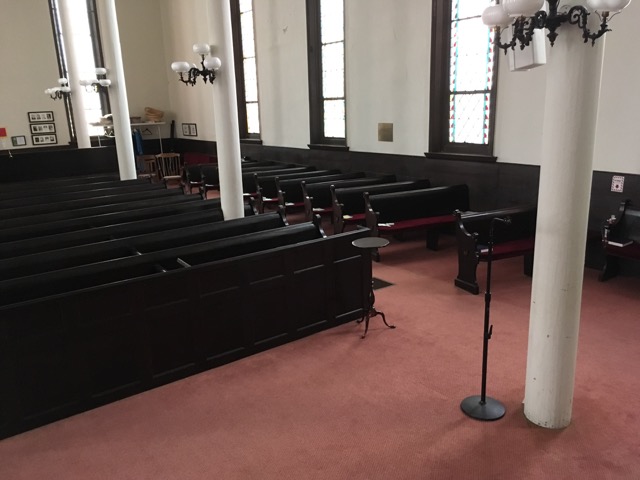
My most vivid memory … is of the congregational meeting relating to the arrangement of the pews in the sanctuary which were to be reinstalled after being removed for refurbishing. The temporary chairs used while the pews were worked on were arranged in a semicircle, and some church members wanted the pews to be arranged like that. Other members were determined that the pews should be placed in straight rows as they had been in the past. Supporters of both views expressed strong feelings, but you did a masterful job as moderator in keeping order, giving everyone opportunity to express their opinion, and guiding the factions to a compromise whereby the two center sections of pews were replaced in straight lines as before but the two side sections were angled to give an overall sense of a curve.

I can picture my father, patiently listening, patiently giving everyone a chance to speak, gently leading the way to compromise. Attentive listening is one of his super-powers.

Today, I stopped by the church to see the “curved” pew arrangement.

from the back
from the pulpit

The angling is so slight that it’s barely perceptible. If I felt strongly about the curve, I might have felt cheated.

Or not.

Sometimes it’s enough to be heard.

In any event, the church stayed afloat and moved forward, thanks, in part, to my father.

A to Z Blogging Challenge · About My Dad · family

N is for the Nurse Practitioners

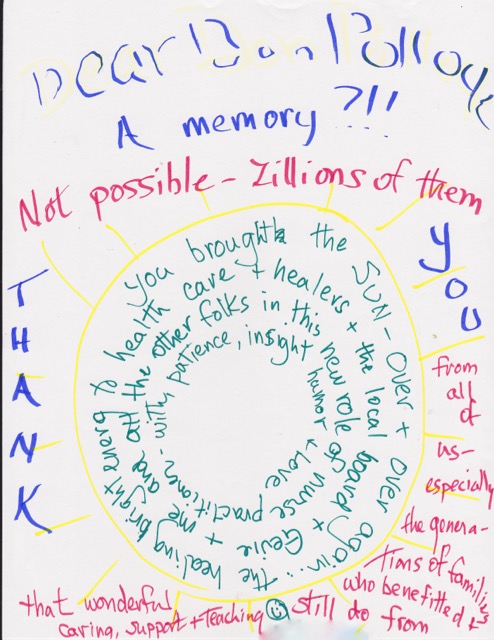
My father hired the first Physician’s Assistant and mentored the first independent Nurse practitioner in New York State.

I think he found the work with the nurse practitioners to be especially rewarding.  Gevie Kent, the first NP, worked in a rural clinic in Edmeston, NY. Others followed in other rural clinics, dotting the map around Cooperstown, bringing healthcare to the people of rural communities.

In 1991, Maureen Murray, a Bassett nurse, wrote a history of nursing at Bassett and included this, which, though it doesn’t mention my father by name, describes the role of the nurse practitioner:

In 1971, the Carnegie Commission studied the quality of rural medicine in the United States. The Commission recommended a nationwide system of regional health centers, including schools and hospitals, providing easy access to quality care for the nation’s people. In its report, entitled “Higher Education and the Nation’s Health: Policies for Medical and Dental Education,” Bassett Hospital is cited as the ideal prototype for the regional centers. As a result, Time Magazine carried an illustrated article based on the Carnegie Foundation’s report.

Nursing played a key role in 1972 when citizens from the nearby community of Edmeston approached the hospital for help in providing health care services as a replacement for a community physician who had retired. The issue was discussed with the hospital Joint Advisory Committee and resulted in the decision to select a Bassett staff nurse, send her for further education as a nurse practitioner, and establish a clinic with the nurse practitioner available to provide certain types of health care and follow-up visits for the Edmeston community. Consultative help and referrals would come from the hospital medical staff. Miss Genevieve Kent, RN, an Edmeston native was selected from the Pediatric staff to be the first nurse practitioner in the Bassett system. This was viewed as an experiment in the delivery of primary care and a possible solution to health care access in small rural communities…. Over the next 12 years, 12 more clinics, six of them staffed by nurse practitioners, would become part of a multi-site outreach network.

One NP told me, “I am so thankful for the time your father put into precepting me and the other nurse practitioners. The burnout rate today for NPs is so high because they don’t have people like your father to oversee and train them for as long as I had. He made sure we were competent and confident in our roles.”

Another wrote to him, “Thank you so much for your foresight and leadership. You have been a great mentor to Nurse Practitioners.”

Still another wrote, “Your mentorship meant a lot to me and your influence shaped so much of who I am now and my clinical practice…. I still remember how kind you were to me when I was new and how much I looked forward to meeting with you weekly.”

Another wrote this:

Dr. Pollock has been a sincere, caring teacher, believing in talking and listening to patients, showing us the small, redeeming acts of mercy. He reminded us to listen to our patients. He honored the shimmering mystery of what we are even when in pain, even as life leaks away. Remember the awe, the sense of being in the presence of something greater than oneself. Be a part of the healing.

And one gave us this that sums it all up.


A to Z Blogging Challenge · About My Dad · family

M is for Mentor

If I saw a theme in the birthday cards for my father sent or given to him by other doctors, it was the word “Mentor.”

Over and over his fellow physicians thanked him for being their mentor.

One doctor said that my father was first his “mentor, then a colleague, always a friend.”

Another said, “You have been a remarkable role model to countless young physicians — certainly including me.”

There are many more, but my favorite was this one:

…Happy birthday to my mentor, colleague and friend. I don’t know if I have ever told how I feel about the mentor part — if not, it’s about time!

When I think about what it means to be a good doctor, and a good teacher and leader of doctors, the things that stand out as most important in my mind are the qualities of humanism that you have demonstrated — have lived and breathed — every day of your life — compassion, humility, science, altruism, humor, integrity, and an unwavering moral compass, I can’t think of anyone I have known in my 39 years as a doctor who more completely fills that description. So, though you may or may not have been aware of it, I thank you for being a role model that I cherish — both then and now — as you have faced aging with dignity and grace.

You are loved…

A mentor to many, and very loved. Yes, that’s my father.


No picture today. I scrolled through so many photographs, but nothing stood out to me.

I need to crank out another A-to-Z post, too, to catch up. :-/

A to Z Blogging Challenge · About My Dad · family

I is for Internship

Starting at Bassett

When I went in the hospital to have baby #2 or #3, one of the obstetrics nurses at Bassett told that she still remembered my father’s first day.

“He carried that black bag,” she said, and then laughed to herself at the memory.

He still has the black bag.

She ended up in the same nursing home as my mother. She was non-verbal and non-communicative. More than once, I thought about sitting beside her, taking her hand and asking her if she remembered. But I never did. I need to be braver.

My father saved all the correspondence leading to his coming to Bassett as an intern.

Letter dated July 17, 1954, from James Bordley III, the Director of Bassett Hospital — “In reply to your letter of July 14 I am enclosing herewith descriptive sheet and application forms for internships at this hospital…”

The descriptive sheet gives details on a total of 9 appointments that were available. Then, this paragraph:

Salary and Maintenance: Salary $110 per month. Room and laundry are furnished but intern pays for meals. If all meals are eaten in hospital cafeteria the average cost is about $60.00 per month. During the second year of Rotating Internship the salary is $135 per month.

On the back of the sheet, my father had written a rough draft of a letter to Dr. Bordley.

Dear Dr. Bordley,

Mrs. Pollock and I would like to thank you and the members of the staff for an especially delightful visit at the hospital in August. We were extremely impressed by the cordiality of all those whom we met and were equally impressed by the excellent facilities offered at the hospital.

Before submitting my application I should like to ask you a few questions which occurred to me after our interview…

He went on to ask those questions, and Dr. Bordley answered them in a brief letter dated October 6, 1954.

Letter dated March 14, 1955 from James Bordley III —

Dear Mr. Pollock:

We were delighted to hear this morning that you had been matched for a one-year mixed internship at this hospital beginning July 1, 1955…

Letter dated April 2, 1955, from V. Earle Nicklas, Assistant Director —

In reviewing the housing requirements for incoming staff I have noted from your correspondence with Dr. Bordley that you are interested in obtaining an unfurnished apartment with 2 bedrooms.

He goes on to describe a building that had been divided into 4 or 5 apartments, and a 2 bedroom apartment that “overlooks both the golf course and Otsego Lake,” and that would rent for $60 a month. 

At the bottom of the page, in my mother’s neat handwriting, she had written: ? stove & refrigerator, ? heat

The final letter, dated April 16, 1955, from Earle Nicklas confirms their rental of that apartment:

The apartment at the hospital’s Lake Street building about which I wrote to you earlier is being reserved for you with occupancy to commence on June 1.

In answer to some of your other questions: the heat is included in the $60 a month rental. There are both stove and refrigerator included. These are part of a package unit which contains sink and cupboards as well. They are a fairly new installation having just been purchased and put in within the past year. This “kitchenette” has an accordion pleated door which separates it from the living room when not in use…

The accordion pleated door sounds awful.

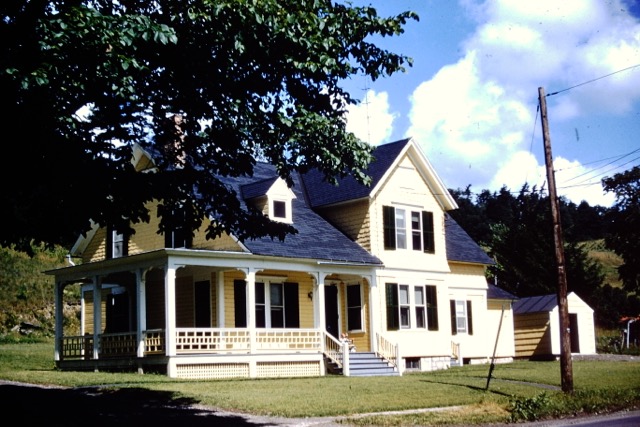
Although they stayed in Cooperstown longer than that one year, they didn’t stay in that house.

Of course it was all before I was born.

My father also saved the National Intern Matching Program form. It turns out Bassett wasn’t his first choice.

But it was most definitely the right choice.

A to Z Blogging Challenge · About My Dad · family

H is for Hamilton College

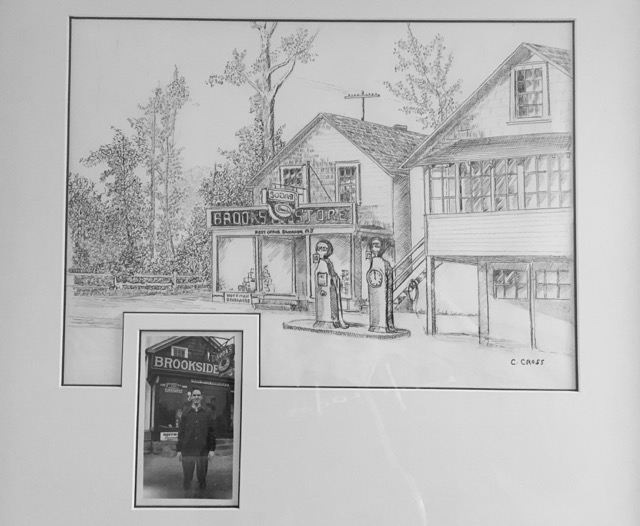
My father went to Hamilton College, a small liberal arts college in Clinton, New York.

Just to confuse people, not far away in Hamilton, NY, is Colgate University, another small liberal arts school.

But, no — my dad went to Hamilton. As did my uncle. As did my oldest brother.

Hamilton College was so formative for him. He has nothing but good words to say about the school. Let me share, though, words that others have written to him about his Hamilton College experience.

David Wippman, the current president of Hamilton College, wrote a nice birthday letter to Dad. Here’s a tiny excerpt:

As the first member of your family to attend college, you, followed by your brother, Stewart ’54, attained prominence in your chosen field and remain an inspiration to all, especially our “first-gen” students who comprise 15% of the student body.

Dad with Ben Madonia

Ben Madonia, Director of Planned Giving at Hamilton, came to visit my father last summer. Ben wrote a follow-up letter to my father, reminding him of the various Hamilton College-related stories they had shared. I thought it was a brilliant idea to recap the visit to help my father remember. Of course, I can’t find that letter to include an excerpt, but Ben also wrote one for my father’s birthday celebration.

… You and Elinor were among the first to greet and welcome us into the Hamilton alumni community at Achievement Day in August of 1980. We have been forever grateful to both of you for your kindnesses to us and for all that you have done for Hamilton.

In addition, you earned the admiration of your classmates, contemporaries, and alumni across the generations for your efforts and leadership…

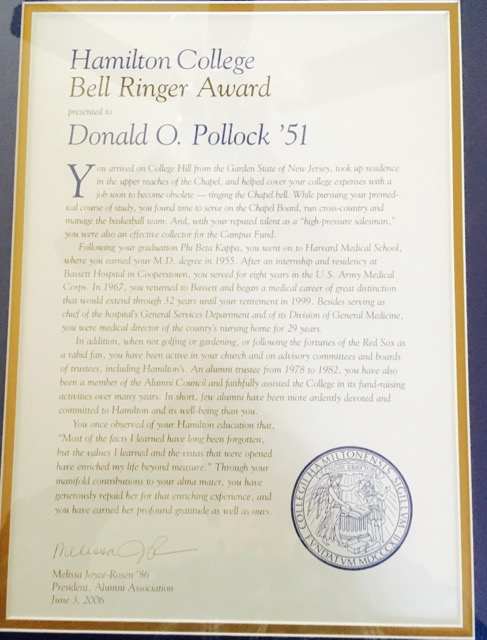
He went on the mention my father receiving the Bell Ringer Award, one of Hamilton’s highest honors. Dad has that award framed and hanging in the dining room.

Melissa Joyce-Rosen, the president of the Alumni Association, wrote this in 2006:

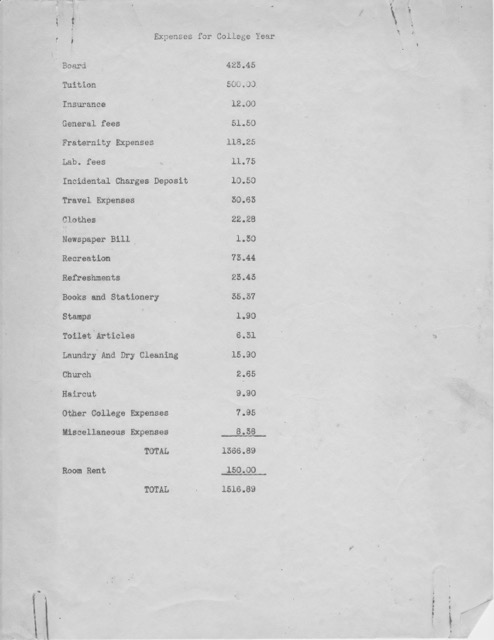
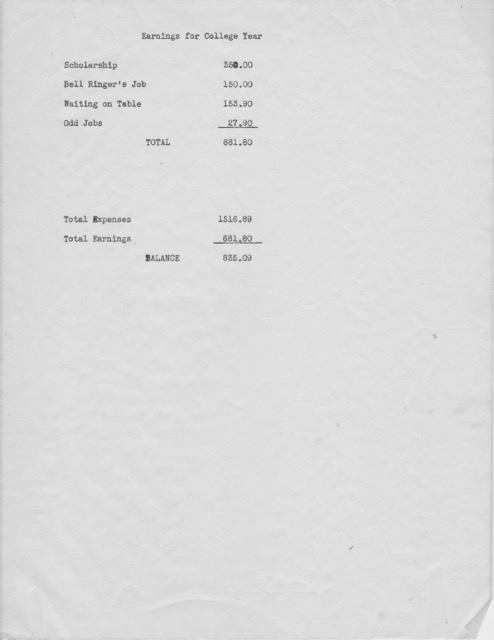
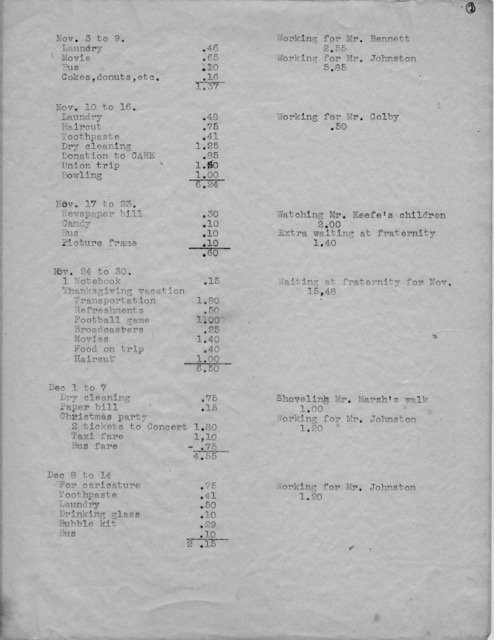
You arrived on College Hill from the Garden State of New Jersey, took up residence in the upper reaches of the Chapel, and helped covered your college expenses with a job soon to become obsolete — ringing the Chapel bell…

Last fall, one of my father’s friends drove him to Hamilton College and he climbed the stairs of the bell tower once more.

Melissa concluded her award letter with these words:

You once observed of your Hamilton education that, “Most of the facts I learned have long been forgotten, but the values I learned and the vistas that were opened have enriched my life beyond measure.”

On a different note, my father’s brother Stewart, who also went to Hamilton, wrote my father some letters in 1953 that have been saved these many years. In one, Stewart thanks my father for his help at Hamilton:

… Don, I really appreciate all the help and advice you have offered to me, and I am especially appreciative for your helping to start off on the right foot at Hamilton. I’m sure that if you hadn’t been here during my freshman year, the succeeding years would not have been as profitable for me.

As Dad may have told you, I burst forth from my cocoon of academic ignominy this past semester with 6 straight A’s…

In another letter, my uncle said, “…You will always remain somewhat of a god in my estimation…”

So, for Uncle Stewart, I include one last Hamilton College letter that my father has saved for 70 years. It was in the same folder as the Glen Cunningham letter, and was written by Winton Tolles, Dean.

I don’t know who wrote “Shame on you!” but I can almost bet they were laughing as they did.

I laugh too, because amid all the accolades, my father saved an academic warning letter. Maybe it’s the only one he ever received.

A to Z Blogging Challenge · About My Dad · family

G is for Generations

I’ve been away for a few days on a much-needed retreat with my husband (and, as a result, have fallen behind in my A to Z Challenge). We traveled to one of my favorite places — Laity Lodge, which is in the remote hill country of Texas.

Meanwhile, back at home, my father’s grandchildren took care of him.

My father has nine grandchildren — eight of them are mine.

Helen, my oldest daughter, is an RN. She took time off, so I could take some time off. I think that’s pretty wonderful.

Helen and my father 20-some years ago

Every time I go away, it seems, my father needs to go to the Emergency Room. Each time it turns out to be nothing. Still, it was awfully nice to have someone with medical experience there with him. Plus four other of the grandchildren helped Helen — it takes a family to care for the elderly.

I remember when my father first held his first grandson. Dad took Philip in his arms and Philip promptly spit up all over him. I’m sure it had nothing to do with my father. Philip and I had just spent the whole day traveling and we were exhausted. After the initial whoops and clean-up,  my father sat and held the sleeping baby for a long time.

Now I get great joy watching my father get down on the floor to play with his great-grandson.

When I think about my children taking care of my father, and about the special relationship especially the older kids have with him, it warms my heart.

Margaret Mead said, “Everyone needs to have access both to grandparents and grandchildren in order to be a full human being.”

I think she’s right.

A to Z Blogging Challenge · About My Dad · family

F is for Falls

“Tell me about the fall,” the Physician’s Assistant asked as he removed the stitches from my father’s forehead the other day,.

“It’s a long story,” my father deflected.

“I’d like to hear it,” the PA said.

My father launched into his very short story — “I was standing at the foot of my bed and I fell. I’m not sure how or why.”

“Have you had other falls that require stitches?” he asked.

“I’ve never had stitches before,” my father replied.

I don’t know if he’s never had stitches before, but he hasn’t required stitches in recent years.

His last serious fall was early October 2015. I was making my annual pilgrimage to Nashville, and my father could still be home alone at that point. He wears a Lifeline pendant which can detect falls, so when he fell that night, my brother next door was notified.

Peter came down to the house where he found that my father had fallen and hit his head on some bookshelves in his bedroom. My father was quite insistent that he was fine. The ambulance came, checked him out, and he refused to go to the hospital.

“I’m fine,” he said.

But he wasn’t fine.

A few days after I got home, he said, “That fall must have done something to me. Something’s not right.”

I took him to the hospital, and, sure enough, something wasn’t right. He had a subdural hemorrhage that had bled into the ventricles of his brain. Because he hadn’t gone to the hospital, no one had told him to stop taking his Warfarin, a blood thinner, and the bleeding had gone on for nearly a week.

This turned out to be a good-news/bad-news situation. The bad news was that his injury was pretty serious and would take some time to resolve. The good news was that the scans of his brain also revealed another condition called Normal Pressure Hydrocephalus (NPH). The NPH may have been present for some time, and had probably caused the instability that led to the fall.

The next summer a neurosurgeon put in a ventriculo-peritoneal shunt that relieved the pressure in his brain by draining fluid into his abdominal cavity. It greatly improved his motor stability.

post-surgical Dad at the butterfly conservatory

Of course, he doesn’t remember any of it now.

When we were in the ER for the latest fall, the nurse asked if he had ever fallen before.

“No,” was the immediate answer.

“Don’t you remember the fall when you hit your head on the bookshelves?” I asked him.

He looked at me blankly. “No, I don’t,” he replied.

It was a lifetime ago. In the intervening two years, my mother had died, he had had the surgery, gone to rehab, and started having a home health aide come to help care for him. He had lost his driving privileges. He couldn’t live alone.

When he fell most recently, I was downstairs to help him immediately. I could see the gash on his forehead.

“We need to take you to the hospital,” I told him.

“No, I’ll be fine,” he said.

Some things don’t change.

Or perhaps they do.

We overrode his wishes and took him to the ER.