The rock is around here somewhere, I just know it.
It was here last week. Bud picked it up and asked me about it.
“No,” I said, “I’m sure it has nothing to do with the Klan.”
Scratched on one side of the smooth rounded dark gray rock, the kind that’s flat enough to be perfect for skipping, were the letters “KKK.” On the other side “1945”.
KKK stood for Kamp Kill Kare, a boys camp in St. Albans, Vermont that operated from 1912 – 1960.
My father spent many summers working there as a counselor.
When he and my mother were dating, and the camp was in need of a nurse, he put her touch with the director and she was hired for the summer.
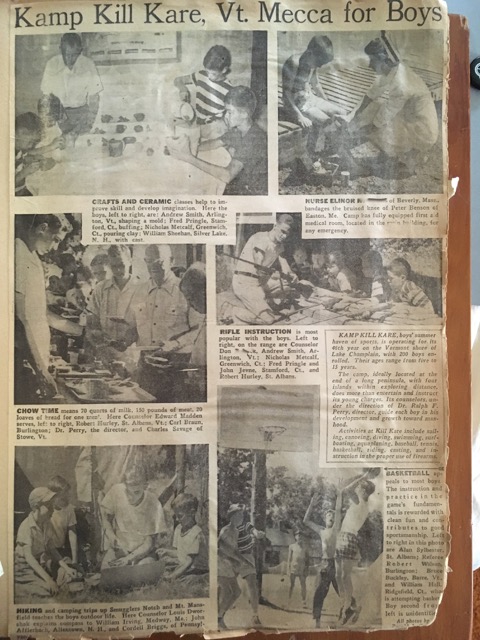
Here’s a newspaper page about Kamp Kill Kare that my father saved in his scrapbook.
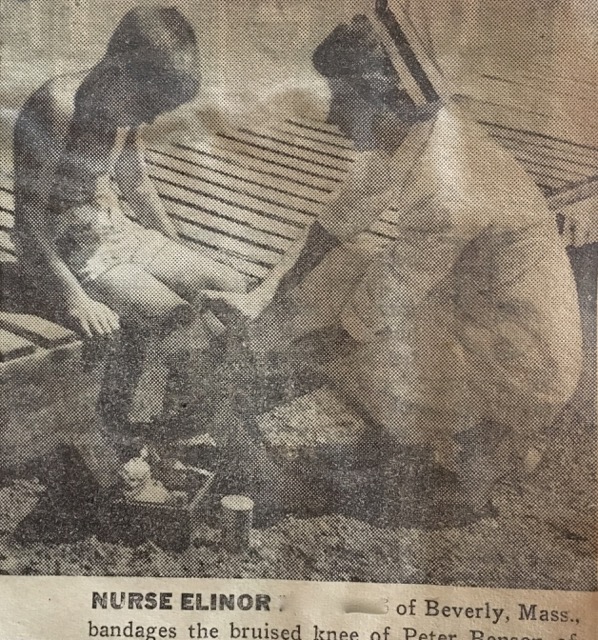
A close up of one picture shows the lovely nurse:
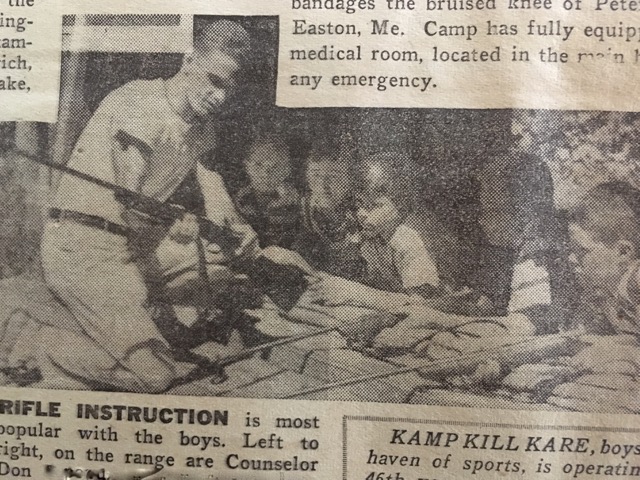
And a close-up of another shows the riflery instructor:
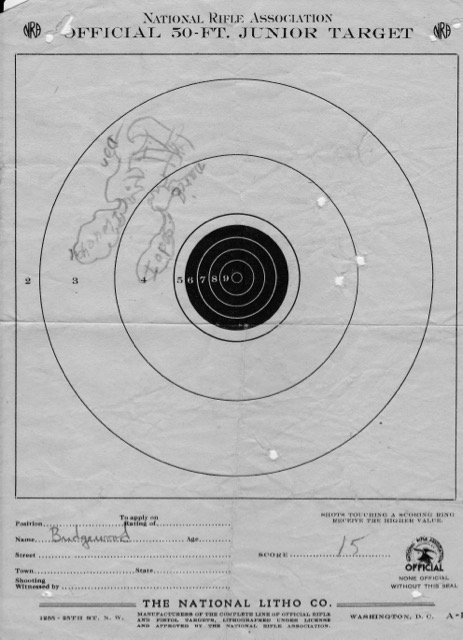
But some of my favorites pieces from the scrapbook are these. A scored rifle target —
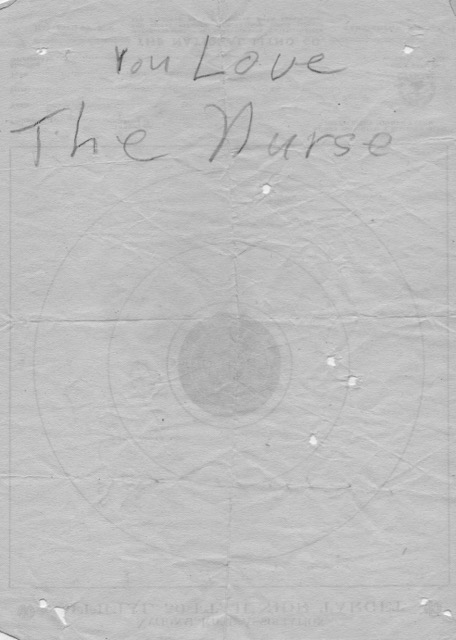
but the back of the target holds the real message.
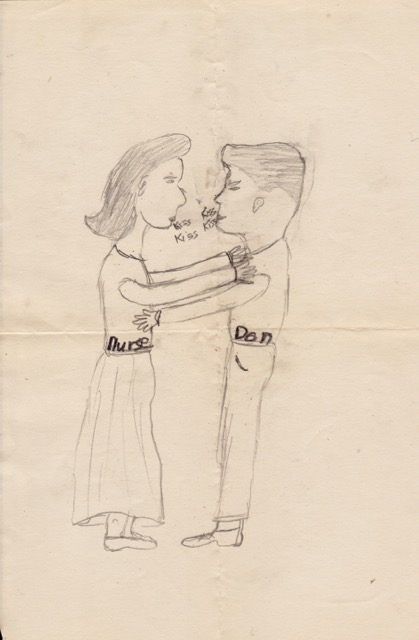
And then there was this drawing —
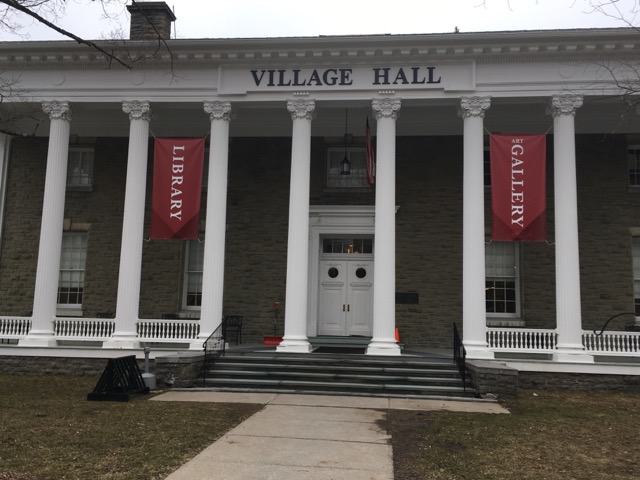
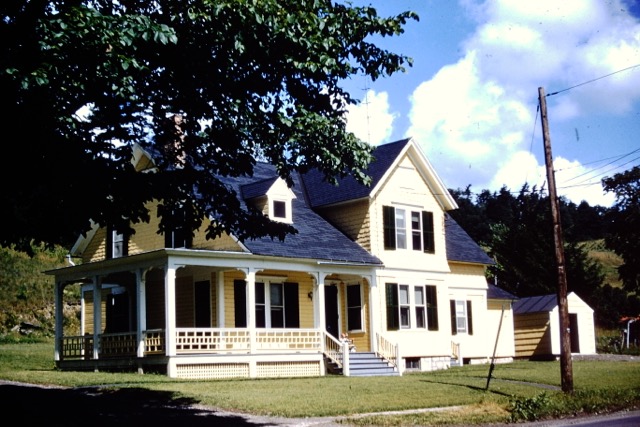
Kamp Kill Kare is now a Vermont State Park. The Main House, shown in the first picture, still stands, and has been renovated.
If it was just a little closer, it might make for a nice day trip in the summer to see what he still remembers.
But it probably isn’t the same without that nurse.
His ties were hung neatly on tie racks in his closet, his business affairs neatly filed in folders, his expenses written in neat columns in ledgers. His photographs are labeled, his stamp and coin collections catalogued.
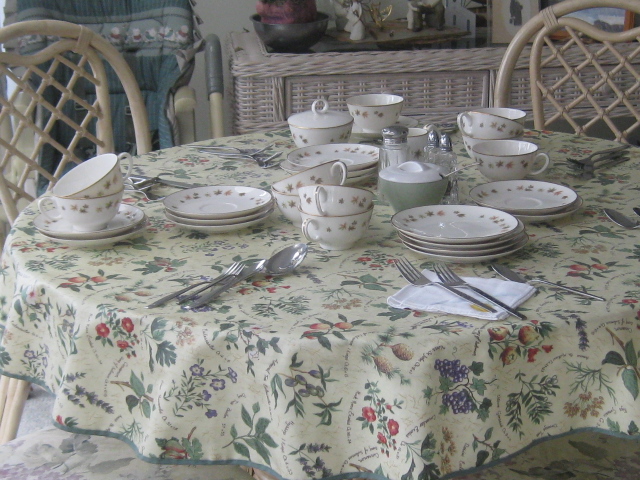
One of the evidences of my mother’s dementia was her setting the table for an army of guests. Non-existent guests. I would get frustrated with it because it meant that I had to put away all the china and silver that she had gotten out. Someone suggested to my sister that we could use the table setting as a bellwether for how she was doing mentally.
For a while, she set the table properly — fork on one side, knife and spoon on the other, dinner plate in the middle. Then one day, it was set like this —
It made no sense.
And I knew that my mother had lost a bit more of herself.
My father’s indicator has been the Daily Jumble.
For years he zipped through it within minutes of sitting down for breakfast. Then it started taking a little longer. Then one day, he wrote the word TOTATO in the answer space.
“Totato” would make perfect sense if he had been reading Andrew Peterson’s On the Edge of the Dark Sea of Darkness. But it’s not a real word, at least not for Daily Jumble purposes. (Correct answer: TATTOO)
My sister and I laughed about it because, truthfully, when we had solved the jumble, we had both seen TOTATO before we saw TATTOO.
Of late, though, my father usually only solves two or three of the words. Occasionally all four. Sometimes with spelling mistakes.
He wrote PICKEL the other day.
Sometimes he makes up words. Like LORAY. When I told him that wasn’t a word, he responded, “Well, it should be!” (Correct answer: ROYAL)
Sometimes he just gets things mixed up.
He sorts through loose change, putting the coins into neat piles, but five quarters in a pile, not four.
And he sorts through pictures, throwing away photographs of people he can’t remember.
His neat and tidy orderliness has become a sieve through which bits and pieces of his life slip every day.
When I went in the hospital to have baby #2 or #3, one of the obstetrics nurses at Bassett told that she still remembered my father’s first day.
“He carried that black bag,” she said, and then laughed to herself at the memory.
He still has the black bag.
She ended up in the same nursing home as my mother. She was non-verbal and non-communicative. More than once, I thought about sitting beside her, taking her hand and asking her if she remembered. But I never did. I need to be braver.
My father saved all the correspondence leading to his coming to Bassett as an intern.
Letter dated July 17, 1954, from James Bordley III, the Director of Bassett Hospital — “In reply to your letter of July 14 I am enclosing herewith descriptive sheet and application forms for internships at this hospital…”
The descriptive sheet gives details on a total of 9 appointments that were available. Then, this paragraph:
Salary and Maintenance: Salary $110 per month. Room and laundry are furnished but intern pays for meals. If all meals are eaten in hospital cafeteria the average cost is about $60.00 per month. During the second year of Rotating Internship the salary is $135 per month.
On the back of the sheet, my father had written a rough draft of a letter to Dr. Bordley.
Dear Dr. Bordley,
Mrs. Pollock and I would like to thank you and the members of the staff for an especially delightful visit at the hospital in August. We were extremely impressed by the cordiality of all those whom we met and were equally impressed by the excellent facilities offered at the hospital.
Before submitting my application I should like to ask you a few questions which occurred to me after our interview…
He went on to ask those questions, and Dr. Bordley answered them in a brief letter dated October 6, 1954.
Letter dated March 14, 1955 from James Bordley III —
Dear Mr. Pollock:
We were delighted to hear this morning that you had been matched for a one-year mixed internship at this hospital beginning July 1, 1955…
Letter dated April 2, 1955, from V. Earle Nicklas, Assistant Director —
In reviewing the housing requirements for incoming staff I have noted from your correspondence with Dr. Bordley that you are interested in obtaining an unfurnished apartment with 2 bedrooms.
He goes on to describe a building that had been divided into 4 or 5 apartments, and a 2 bedroom apartment that “overlooks both the golf course and Otsego Lake,” and that would rent for $60 a month.
At the bottom of the page, in my mother’s neat handwriting, she had written: ? stove & refrigerator, ? heat
The final letter, dated April 16, 1955, from Earle Nicklas confirms their rental of that apartment:
The apartment at the hospital’s Lake Street building about which I wrote to you earlier is being reserved for you with occupancy to commence on June 1.
In answer to some of your other questions: the heat is included in the $60 a month rental. There are both stove and refrigerator included. These are part of a package unit which contains sink and cupboards as well. They are a fairly new installation having just been purchased and put in within the past year. This “kitchenette” has an accordion pleated door which separates it from the living room when not in use…
The accordion pleated door sounds awful.
Although they stayed in Cooperstown longer than that one year, they didn’t stay in that house.
Of course it was all before I was born.
My father also saved the National Intern Matching Program form. It turns out Bassett wasn’t his first choice.
My father went to Hamilton College, a small liberal arts college in Clinton, New York.
Just to confuse people, not far away in Hamilton, NY, is Colgate University, another small liberal arts school.
But, no — my dad went to Hamilton. As did my uncle. As did my oldest brother.
Hamilton College was so formative for him. He has nothing but good words to say about the school. Let me share, though, words that others have written to him about his Hamilton College experience.
David Wippman, the current president of Hamilton College, wrote a nice birthday letter to Dad. Here’s a tiny excerpt:
As the first member of your family to attend college, you, followed by your brother, Stewart ’54, attained prominence in your chosen field and remain an inspiration to all, especially our “first-gen” students who comprise 15% of the student body.
Dad with Ben Madonia
Ben Madonia, Director of Planned Giving at Hamilton, came to visit my father last summer. Ben wrote a follow-up letter to my father, reminding him of the various Hamilton College-related stories they had shared. I thought it was a brilliant idea to recap the visit to help my father remember. Of course, I can’t find that letter to include an excerpt, but Ben also wrote one for my father’s birthday celebration.
… You and Elinor were among the first to greet and welcome us into the Hamilton alumni community at Achievement Day in August of 1980. We have been forever grateful to both of you for your kindnesses to us and for all that you have done for Hamilton.
In addition, you earned the admiration of your classmates, contemporaries, and alumni across the generations for your efforts and leadership…
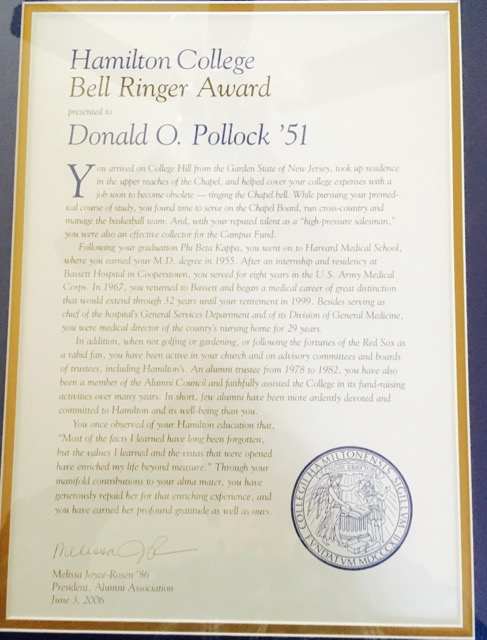
He went on the mention my father receiving the Bell Ringer Award, one of Hamilton’s highest honors. Dad has that award framed and hanging in the dining room.
Melissa Joyce-Rosen, the president of the Alumni Association, wrote this in 2006:
You arrived on College Hill from the Garden State of New Jersey, took up residence in the upper reaches of the Chapel, and helped covered your college expenses with a job soon to become obsolete — ringing the Chapel bell…
Last fall, one of my father’s friends drove him to Hamilton College and he climbed the stairs of the bell tower once more.
Melissa concluded her award letter with these words:
You once observed of your Hamilton education that, “Most of the facts I learned have long been forgotten, but the values I learned and the vistas that were opened have enriched my life beyond measure.”
On a different note, my father’s brother Stewart, who also went to Hamilton, wrote my father some letters in 1953 that have been saved these many years. In one, Stewart thanks my father for his help at Hamilton:
… Don, I really appreciate all the help and advice you have offered to me, and I am especially appreciative for your helping to start off on the right foot at Hamilton. I’m sure that if you hadn’t been here during my freshman year, the succeeding years would not have been as profitable for me.
As Dad may have told you, I burst forth from my cocoon of academic ignominy this past semester with 6 straight A’s…
In another letter, my uncle said, “…You will always remain somewhat of a god in my estimation…”
So, for Uncle Stewart, I include one last Hamilton College letter that my father has saved for 70 years. It was in the same folder as the Glen Cunningham letter, and was written by Winton Tolles, Dean.
I don’t know who wrote “Shame on you!” but I can almost bet they were laughing as they did.
I laugh too, because amid all the accolades, my father saved an academic warning letter. Maybe it’s the only one he ever received.
I’ve been away for a few days on a much-needed retreat with my husband (and, as a result, have fallen behind in my A to Z Challenge). We traveled to one of my favorite places — Laity Lodge, which is in the remote hill country of Texas.
Meanwhile, back at home, my father’s grandchildren took care of him.
My father has nine grandchildren — eight of them are mine.
Helen, my oldest daughter, is an RN. She took time off, so I could take some time off. I think that’s pretty wonderful.
Helen and my father 20-some years ago
Every time I go away, it seems, my father needs to go to the Emergency Room. Each time it turns out to be nothing. Still, it was awfully nice to have someone with medical experience there with him. Plus four other of the grandchildren helped Helen — it takes a family to care for the elderly.
I remember when my father first held his first grandson. Dad took Philip in his arms and Philip promptly spit up all over him. I’m sure it had nothing to do with my father. Philip and I had just spent the whole day traveling and we were exhausted. After the initial whoops and clean-up, my father sat and held the sleeping baby for a long time.
Now I get great joy watching my father get down on the floor to play with his great-grandson.
When I think about my children taking care of my father, and about the special relationship especially the older kids have with him, it warms my heart.
Margaret Mead said, “Everyone needs to have access both to grandparents and grandchildren in order to be a full human being.”
“Tell me about the fall,” the Physician’s Assistant asked as he removed the stitches from my father’s forehead the other day,.
“It’s a long story,” my father deflected.
“I’d like to hear it,” the PA said.
My father launched into his very short story — “I was standing at the foot of my bed and I fell. I’m not sure how or why.”
“Have you had other falls that require stitches?” he asked.
“I’ve never had stitches before,” my father replied.
I don’t know if he’s never had stitches before, but he hasn’t required stitches in recent years.
His last serious fall was early October 2015. I was making my annual pilgrimage to Nashville, and my father could still be home alone at that point. He wears a Lifeline pendant which can detect falls, so when he fell that night, my brother next door was notified.
Peter came down to the house where he found that my father had fallen and hit his head on some bookshelves in his bedroom. My father was quite insistent that he was fine. The ambulance came, checked him out, and he refused to go to the hospital.
“I’m fine,” he said.
But he wasn’t fine.
A few days after I got home, he said, “That fall must have done something to me. Something’s not right.”
I took him to the hospital, and, sure enough, something wasn’t right. He had a subdural hemorrhage that had bled into the ventricles of his brain. Because he hadn’t gone to the hospital, no one had told him to stop taking his Warfarin, a blood thinner, and the bleeding had gone on for nearly a week.
This turned out to be a good-news/bad-news situation. The bad news was that his injury was pretty serious and would take some time to resolve. The good news was that the scans of his brain also revealed another condition called Normal Pressure Hydrocephalus (NPH). The NPH may have been present for some time, and had probably caused the instability that led to the fall.
The next summer a neurosurgeon put in a ventriculo-peritoneal shunt that relieved the pressure in his brain by draining fluid into his abdominal cavity. It greatly improved his motor stability.
post-surgical Dad at the butterfly conservatory
Of course, he doesn’t remember any of it now.
When we were in the ER for the latest fall, the nurse asked if he had ever fallen before.
“No,” was the immediate answer.
“Don’t you remember the fall when you hit your head on the bookshelves?” I asked him.
He looked at me blankly. “No, I don’t,” he replied.
It was a lifetime ago. In the intervening two years, my mother had died, he had had the surgery, gone to rehab, and started having a home health aide come to help care for him. He had lost his driving privileges. He couldn’t live alone.
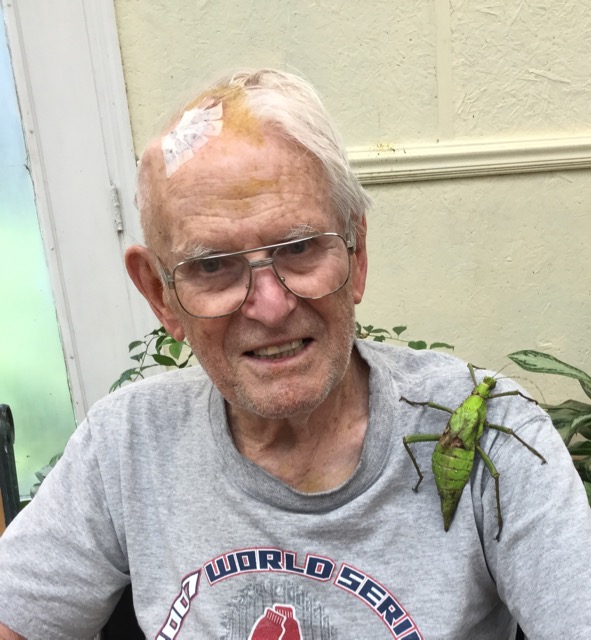
When he fell most recently, I was downstairs to help him immediately. I could see the gash on his forehead.
“We need to take you to the hospital,” I told him.
Every Sunday morning I fix two over-easy eggs and a piece of toast for my father. When I set the plate down in front of him, his eyes light up. “Oh! Eggs!” he exclaims, clearly delighted.
For the longest time, he had been eating his cereals on a rotation. I had to remember which he had eaten the day before and correctly serve something different. Frosted Mini Wheats. Honey Bunches of Oats. Real Medleys.
For a much longer time before that, my mother had prepared breakfasts based on a schedule. Eggs were served twice a week. Hot cereal once or twice a week. Waffles were Sunday fare. My sister knew the schedule. Honestly, I hadn’t recognized the consistency of it until she wrote it down.
But there it was — this routine that was all but carved in stone.
Until it wasn’t.
Because my mother was slipping.
It devolved into an orderly cereal rotation, something he could handle on his own.
When I introduced Sunday eggs as a way of making the Sabbath special, for him it became a weekly delight.
His delight is my delight.
Then there was the time when age-10-me called from 4-H camp to ask about bringing home some chickens. My father thought I said “a chicken” so he agreed.
I brought home nineteen cute little Polish chicks. Thirteen of them turned out to be roosters, most of which mysteriously disappeared one day when my parents sent me to the movies. We also has some delicious chicken soups after that.
That was the beginning of my father’s stint as a chicken farmer. He shopped Murray McMurray for unusual chickens, ordering more than once an assortment they called “the rarest of the rare.”
He really wanted some Araucanas – the chickens that lay green eggs. I think he eventually got some but they weren’t the greatest layers.
But to answer the age-old question — for my father, the egg clearly comes first.
The still-wet-behind-the-ears spring-chicken doctors who have never met my father before always ask it.
What they don’t understand is how much medicine has changed in the past fifty years.
Fifty years ago, when my father left the military and settled in Cooperstown with his family, his job title was Head of General Services. General Services included the emergency room, the ambulatory clinic, and medical clinic. Basically, it was everything except OB/GYN, pediatrics, surgery, and radiology.
Back in the 60s and 70s, many doctors didn’t specialize the way they do today. They practiced medicine. The vast majority were probably what we would consider primary care providers today. Doctors followed patients their whole adult lives — or maybe it was the other way around.
As a side note, in addition to General Services, as if that wasn’t enough, my father was the medical director at the county nursing home (then called the “county infirmary”) and also oversaw public health.
As the giant centrifuge of medicine spun and spun, doctors began to be sorted out based on specialized interests. Bassett Hospital fostered learning and encouraged doctors to pursue their interests. My father’s was dermatology.
“I dabbled in dermatology,” is often his answer to the what-kind-of-medicine question. Or he’ll say, “I practiced internal medicine and dabbled in dermatology.” He was Bassett’s first dermatologist although he was never “Board-certified.” When he retired, dermatology was the last practice he gave up.
The dermatology nurses were the first to arrive at his party last month. Obviously, they adored him.
One dermatologist sent us this note (with his regrets that he couldn’t attend):
Don was one of the major reasons I came to Bassett in 1995. We talked at length by phone on several occasions, and during my recruitment visits. Don embodied everything that was appealing and excellent about Mary Imogene Bassett Hospital. He always cared so much about his patients, and all of Bassett’s patients. He was curious about their problems and committed to practicing excellent medicine. He was kind, concerned, and practiced “patient-centered” care long before the term was coined… I was very fortunate to have been able to learn from Don, and work with him as a colleague for several years before his full retirement.
Another doctor — an internist — sat at one of the tables at the party writing, writing, writing. Finally, he looked up, saw me, and said, “I want you to know this story, but I don’t think I can do it justice writing here and now. Can I just tell it to you?”
Of course I wanted to hear it. I’ll retell it as best I can remember (the places may not be correct, but the gist is there).
Before we had a dermatology department, we sent all the derm patients to your dad. He was very good.
Once, I had a patient with a peculiar skin problem. He was one of the “uppity-ups”, you know, from the city. Anyway, this fellow asked if Bassett had a dermatologist, and I told him no, but we had someone on staff who was very good. That wasn’t good enough for this patient, so he went to see the head of dermatology at Columbia. Well, that guy couldn’t help him.
About six months later, I saw the patient again. He still had the problem and asked again if I could recommend someone. I suggested your father, but he went instead to see the chief of dermatology at the Mayo Clinic. This guy was world-renowned, you know, and he didn’t know what the problem was either.
The next time I saw the patient, he was getting ready to fly to Germany. The best dermatologist in the world was there and had agreed to see him. No luck again. The Grand Poobah of Dermatology did not know what it was.
Finally, the patient came to me one last time and asked about seeing your father, and, of course, your father correctly diagnosed him and treated him.
My father more than “dabbled” in dermatology. He was pretty darn good.
One of my father’s prize possessions is the following letter on University of Kansas letterhead stationery.
February 25, 1940
Dear Donald:
Your very good letter reached me several days ago and I was terribly sorry to hear of your accident. I hope that you are recovering satisfactorily without too much pain.
Those burns are painful and it sometimes takes a long time for them to heal. It took mine several months to even begin to get well. Just don’t let anything discourage you, fight your battle bravely and when you’re well you’ll be just that much better man for having had the experience. It sometimes takes things like these to make us fully appreciate good health and normal functioning of our entire bodies.
Take good care of yourself and do as your parents and you Doctor tell you to so you will get well without complications of any kind. It’s that dogged determination, the will to want to do a thing, that will make you successful in anything you want to do.
Best of luck and every good wish that you will be completely recovered very soon.
Your friend,
Glenn Cunningham
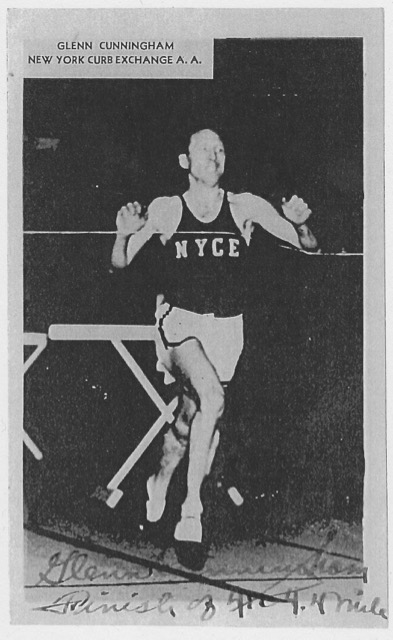
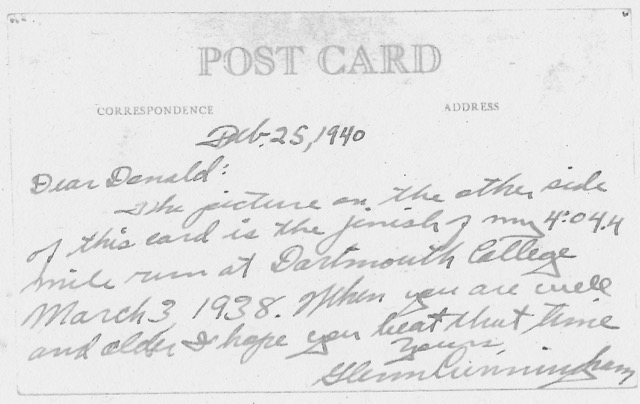
Glenn Cunningham had also included a picture with a note on the back:
Glenn Cunningham Finish of 4:04.4 mile“…When you are well and older I hope you beat that time.”
My father attended a 4-room school in Brookside, NJ through the 8th grade. The students had jobs to do at the school in addition to their studies. One day, when my father was 9 years old, he was doing his job of washing dishes and a shelf collapsed, spilling a large pot of boiling water on his legs.
I’m not sure who suggested it, but during his recuperation my father wrote a letter to Glenn Cunningham, a runner who had also suffered terrible burns to his legs as a boy. Glenn’s accident also took place at school when a stove exploded in the classroom. His brother Floyd died from the burns he suffered and doctors thought Glenn would never walk again.
When I read about Glenn Cunningham’s life, it reminds me of my father — a genuinely good man who used his life to help others. Glenn and his wife opened a ranch and helped raise over 10,000 foster children. My father had at least that many patients from walks of life and all socio-economic strata. Neither one prioritized monetary gain over service.
“It’s that dogged determination” and generosity of spirit that shaped both of their lives.
I have the feeling that my father was more the scrapbooker than my mother.
From his childhood, he had albums with photos mounted using photo corners onto black paper and funny captions written in white. My mother simply kept memorabilia stashed in a drawer or box — a mish-mash of notes, photos, and newspaper clippings. I follow my mother’s ways.
No matter who actually compiled it, we have a huge scrapbook that follows my mother and father’s relationship from first dates to wedding to first child to internship appointment in Cooperstown. My father pulls it out from time to time and leafs through it. The scrapbook has fallen apart and been put back together so many times, though, that it’s no longer in the right order.
“What was I thinking?!” my father said while looking through the scrapbook recently. “I took your mother to a boxing match!”
Sure enough, he took her to several boxing matches. I’ve never understood the sport of boxing. It’s so barbaric — putting two guys in a ring and having them punch each other until one is unconscious.
He also took her to the Ice Follies. I think he redeemed himself with that one.
A hockey game — the Bruins v. Red Wings. This was on his birthday, so maybe my mother got those tickets as a birthday present for him.
And a baseball game — the Red Sox v Tigers. 60c each for bleacher seats (he saved the stubs), and my father faithfully kept score in the program. Final score 8 – 5, Boston.
My father always loved folk music. He told me once that he used to treat himself occasionally on payday to the newest Burl Ives record, purchasing it at a little record store somewhere near the hospital. We still have a lot of those records.
So I was delightfully surprised when I was looking through the scrapbook and saw that he and my mother had gone to see Paint Your Wagon at the Shubert Theater in Boston — starring none other that Burl Ives. I’ll bet he sang “Wandering’ Star” a lot better than Lee Marvin.
I try to remember what Bud and I did for our first dates. We didn’t go to boxing matches or any other sporting events. We went for walks. We went to an auction. We went to church. We went to the movie “Coal Miner’s Daughter” and had to wait in line to get into the theater. We went to the drive-in and locked ourselves out of the car.
But we didn’t keep a scrapbook to tell the story for future generations.