A to Z Blogging Challenge · About My Dad · family

G is for Generations

I’ve been away for a few days on a much-needed retreat with my husband (and, as a result, have fallen behind in my A to Z Challenge). We traveled to one of my favorite places — Laity Lodge, which is in the remote hill country of Texas.

Meanwhile, back at home, my father’s grandchildren took care of him.

My father has nine grandchildren — eight of them are mine.

Helen, my oldest daughter, is an RN. She took time off, so I could take some time off. I think that’s pretty wonderful.

Helen and my father 20-some years ago

Every time I go away, it seems, my father needs to go to the Emergency Room. Each time it turns out to be nothing. Still, it was awfully nice to have someone with medical experience there with him. Plus four other of the grandchildren helped Helen — it takes a family to care for the elderly.

I remember when my father first held his first grandson. Dad took Philip in his arms and Philip promptly spit up all over him. I’m sure it had nothing to do with my father. Philip and I had just spent the whole day traveling and we were exhausted. After the initial whoops and clean-up,  my father sat and held the sleeping baby for a long time.

Now I get great joy watching my father get down on the floor to play with his great-grandson.

When I think about my children taking care of my father, and about the special relationship especially the older kids have with him, it warms my heart.

Margaret Mead said, “Everyone needs to have access both to grandparents and grandchildren in order to be a full human being.”

I think she’s right.
A to Z Blogging Challenge · About My Dad · family

F is for Falls

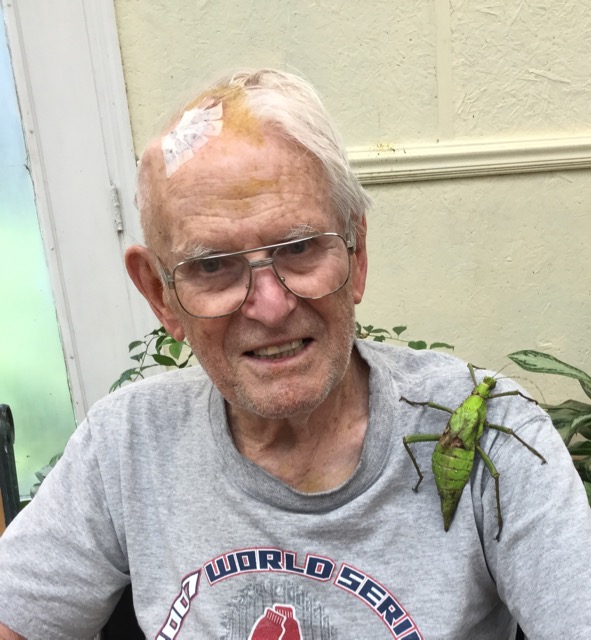
“Tell me about the fall,” the Physician’s Assistant asked as he removed the stitches from my father’s forehead the other day,.

“It’s a long story,” my father deflected.

“I’d like to hear it,” the PA said.

My father launched into his very short story — “I was standing at the foot of my bed and I fell. I’m not sure how or why.”

“Have you had other falls that require stitches?” he asked.

“I’ve never had stitches before,” my father replied.

I don’t know if he’s never had stitches before, but he hasn’t required stitches in recent years.

His last serious fall was early October 2015. I was making my annual pilgrimage to Nashville, and my father could still be home alone at that point. He wears a Lifeline pendant which can detect falls, so when he fell that night, my brother next door was notified.

Peter came down to the house where he found that my father had fallen and hit his head on some bookshelves in his bedroom. My father was quite insistent that he was fine. The ambulance came, checked him out, and he refused to go to the hospital.

“I’m fine,” he said.

But he wasn’t fine.

A few days after I got home, he said, “That fall must have done something to me. Something’s not right.”

I took him to the hospital, and, sure enough, something wasn’t right. He had a subdural hemorrhage that had bled into the ventricles of his brain. Because he hadn’t gone to the hospital, no one had told him to stop taking his Warfarin, a blood thinner, and the bleeding had gone on for nearly a week.

This turned out to be a good-news/bad-news situation. The bad news was that his injury was pretty serious and would take some time to resolve. The good news was that the scans of his brain also revealed another condition called Normal Pressure Hydrocephalus (NPH). The NPH may have been present for some time, and had probably caused the instability that led to the fall.

The next summer a neurosurgeon put in a ventriculo-peritoneal shunt that relieved the pressure in his brain by draining fluid into his abdominal cavity. It greatly improved his motor stability.

post-surgical Dad at the butterfly conservatory

Of course, he doesn’t remember any of it now.

When we were in the ER for the latest fall, the nurse asked if he had ever fallen before.

“No,” was the immediate answer.

“Don’t you remember the fall when you hit your head on the bookshelves?” I asked him.

He looked at me blankly. “No, I don’t,” he replied.

It was a lifetime ago. In the intervening two years, my mother had died, he had had the surgery, gone to rehab, and started having a home health aide come to help care for him. He had lost his driving privileges. He couldn’t live alone.

When he fell most recently, I was downstairs to help him immediately. I could see the gash on his forehead.

“We need to take you to the hospital,” I told him.

“No, I’ll be fine,” he said.

Some things don’t change.

Or perhaps they do.

We overrode his wishes and took him to the ER.


A to Z Blogging Challenge · About My Dad · family

E is for Eggs

Every Sunday morning I fix two over-easy eggs and a piece of toast for my father.  When I set the plate down in front of him, his eyes light up. “Oh! Eggs!” he exclaims, clearly delighted.

For the longest time, he had been eating his cereals on a rotation. I had to remember which he had eaten the day before and correctly serve something different. Frosted Mini Wheats. Honey Bunches of Oats. Real Medleys.

For a much longer time before that, my mother had prepared breakfasts based on a schedule. Eggs were served twice a week. Hot cereal once or twice a week. Waffles were Sunday fare. My sister knew the schedule. Honestly, I hadn’t recognized the consistency of it until she wrote it down.

But there it was — this routine that was all but carved in stone.

Until it wasn’t.

Because my mother was slipping.

It devolved into an orderly cereal rotation, something he could handle on his own.

When I introduced Sunday eggs as a way of making the Sabbath special, for him it became a weekly delight.

His delight is my delight.


Then there was the time when age-10-me called from 4-H camp to ask about bringing home some chickens. My father thought I said “a chicken” so he agreed.

I brought home nineteen cute little Polish chicks. Thirteen of them turned out to be roosters, most of which mysteriously disappeared one day when my parents sent me to the movies. We also has some delicious chicken soups after that.

That was the beginning of my father’s stint as a chicken farmer. He shopped Murray McMurray for unusual chickens, ordering more than once an assortment they called “the rarest of the rare.”

He really wanted some Araucanas – the chickens that lay green eggs. I think he eventually got some but they weren’t the greatest layers.


But to answer the age-old question — for my father, the egg clearly comes first.

A to Z Blogging Challenge · About My Dad · family

D is for Dermatology

“What kind of medicine did you practice?”

The still-wet-behind-the-ears spring-chicken doctors who have never met my father before always ask it.

What they don’t understand is how much medicine has changed in the past fifty years.

Fifty years ago, when my father left the military and settled in Cooperstown with his family, his job title was Head of General Services. General Services included the emergency room, the ambulatory clinic, and medical clinic. Basically, it was everything except OB/GYN, pediatrics, surgery, and radiology.


Back in the 60s and 70s, many doctors didn’t specialize the way they do today. They practiced medicine. The vast majority were probably what we would consider primary care providers today. Doctors followed patients their whole adult lives — or maybe it was the other way around.

As a side note, in addition to General Services, as if that wasn’t enough, my father was the medical director at the county nursing home (then called the “county infirmary”) and also oversaw public health.

As the giant centrifuge of medicine spun and spun, doctors began to be sorted out based on specialized interests. Bassett Hospital fostered learning and encouraged doctors to pursue their interests. My father’s was dermatology.

“I dabbled in dermatology,” is often his answer to the what-kind-of-medicine question. Or he’ll say, “I practiced internal medicine and dabbled in dermatology.” He was Bassett’s first dermatologist although he was never “Board-certified.” When he retired, dermatology was the last practice he gave up.

The dermatology nurses were the first to arrive at his party last month. Obviously, they adored him.

One dermatologist sent us this note (with his regrets that he couldn’t attend):

Don was one of the major reasons I came to Bassett in 1995. We talked at length by phone on several occasions, and during my recruitment visits. Don embodied everything that was appealing and excellent about Mary Imogene Bassett Hospital. He always cared so much about his patients, and all of Bassett’s patients. He was curious about their problems and committed to practicing excellent medicine. He was kind, concerned, and practiced “patient-centered” care long before the term was coined… I was very fortunate to have been able to learn from Don, and work with him as a colleague for several years before his full retirement.

Another doctor — an internist — sat at one of the tables at the party writing, writing, writing. Finally, he looked up, saw me, and said, “I want you to know this story, but I don’t think I can do it justice writing here and now. Can I just tell it to you?”

Of course I wanted to hear it. I’ll retell it as best I can remember (the places may not be correct, but the gist is there).

Before we had a dermatology department, we sent all the derm patients to your dad. He was very good.

Once, I had a patient with a peculiar skin problem. He was one of the “uppity-ups”, you know, from the city. Anyway, this fellow asked if Bassett had a dermatologist, and I told him no, but we had someone on staff who was very good. That wasn’t good enough for this patient, so he went to see the head of dermatology at Columbia. Well, that guy couldn’t help him.

About six months later, I saw the patient again. He still had the problem and asked again if I could recommend someone. I suggested your father, but he went instead to see the chief of dermatology at the Mayo Clinic. This guy was world-renowned, you know, and he didn’t know what the problem was either.

The next time I saw the patient, he was getting ready to fly to Germany. The best dermatologist in the world was there and had agreed to see him. No luck again. The Grand Poobah of Dermatology did not know what it was.

Finally, the patient came to me one last time and asked about seeing your father, and, of course, your father correctly diagnosed him and treated him.

My father more than “dabbled” in dermatology. He was pretty darn good.

Humility keeps him from saying that — so I will.

A to Z Blogging Challenge · About My Dad · family

C is for Cunningham

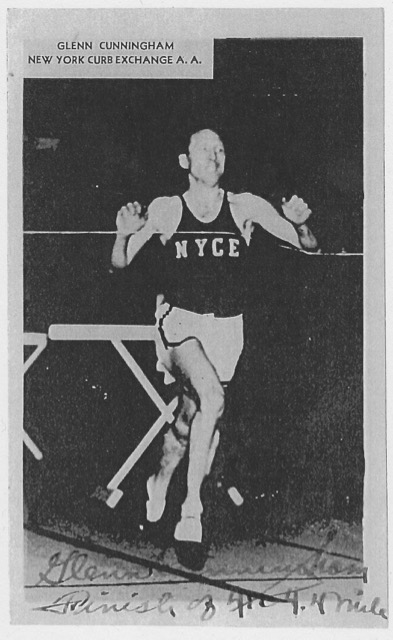
C is for Cunningham. Glenn Cunningham, to be precise.

One of my father’s prize possessions is the following letter on University of Kansas letterhead stationery.

February 25, 1940

Dear Donald:

Your very good letter reached me several days ago and I was terribly sorry to hear of your accident. I hope that you are recovering satisfactorily without too much pain.

Those burns are painful and it sometimes takes a long time for them to heal. It took mine several months to even begin to get well. Just don’t let anything discourage you, fight your battle bravely and when you’re well you’ll be just that much better man for having had the experience. It sometimes takes things like these to make us fully appreciate good health and normal functioning of our entire bodies.

Take good care of yourself and do as your parents and you Doctor tell you to so you will get well without complications of any kind. It’s that dogged determination, the will to want to do a thing, that will make you successful in anything you want to do.

Best of luck and every good wish that you will be completely recovered very soon.

Your friend,
Glenn Cunningham

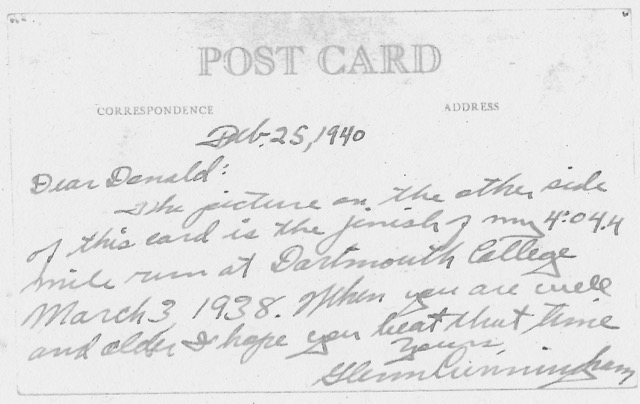
Glenn Cunningham had also included a picture with a note on the back:

Glenn Cunningham
Finish of 4:04.4 mile
“…When you are well and older I hope you beat that time.”

My father attended a 4-room school in Brookside, NJ through the 8th grade. The students had jobs to do at the school in addition to their studies. One day, when my father was 9 years old, he was doing his job of washing dishes and a shelf collapsed, spilling a large pot of boiling water on his legs.

I’m not sure who suggested it, but during his recuperation my father wrote a letter to Glenn Cunningham, a runner who had also suffered terrible burns to his legs as a boy. Glenn’s accident also took place at school when a stove exploded in the classroom. His brother Floyd died from the burns he suffered and doctors thought Glenn would never walk again.

When I read about Glenn Cunningham’s life, it reminds me of my father — a genuinely good man who used his life to help others. Glenn and his wife opened a ranch and helped raise over 10,000 foster children. My father had at least that many patients from walks of life and all socio-economic strata. Neither one prioritized monetary gain over service.

“It’s that dogged determination” and generosity of spirit that shaped both of their lives.

A to Z Blogging Challenge · About My Dad

B is for Boxing, Baseball, and Burl Ives

I have the feeling that my father was more the scrapbooker than my mother.

From his childhood, he had albums with photos mounted using photo corners onto black paper and funny captions written in white. My mother simply kept memorabilia stashed in a drawer or box — a mish-mash of notes, photos, and newspaper clippings. I follow my mother’s ways.

No matter who actually compiled it, we have a huge scrapbook that follows my mother and father’s relationship from first dates to wedding to first child to internship appointment in Cooperstown. My father pulls it out from time to time and leafs through it. The scrapbook has fallen apart and been put back together so many times, though, that it’s no longer in the right order.

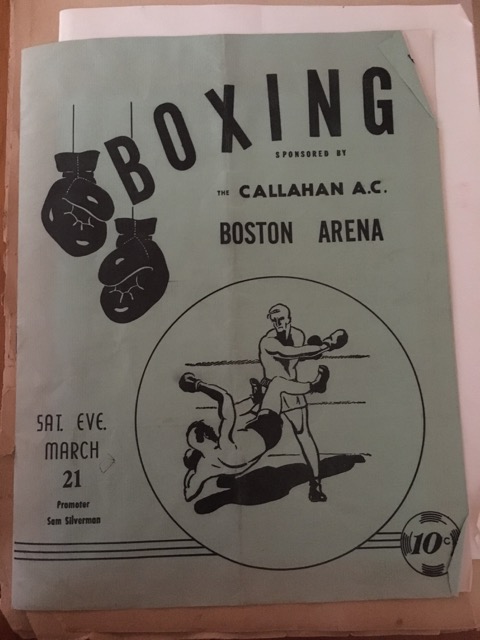
“What was I thinking?!” my father said while looking through the scrapbook recently. “I took your mother to a boxing match!”

Sure enough, he took her to several boxing matches. I’ve never understood the sport of boxing. It’s so barbaric — putting two guys in a ring and having them punch each other until one is unconscious.

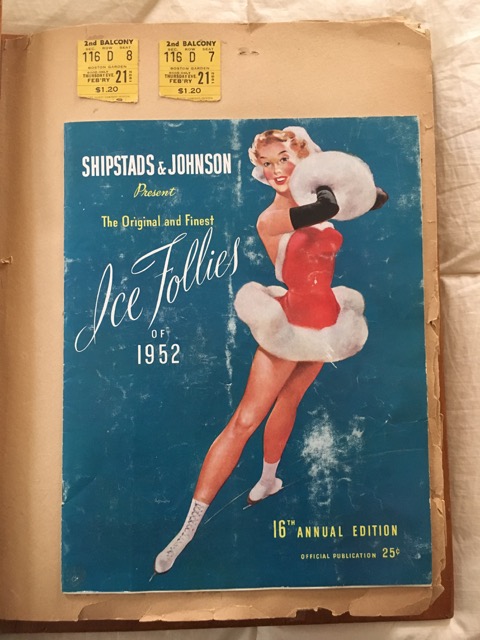
He also took her to the Ice Follies. I think he redeemed himself with that one.

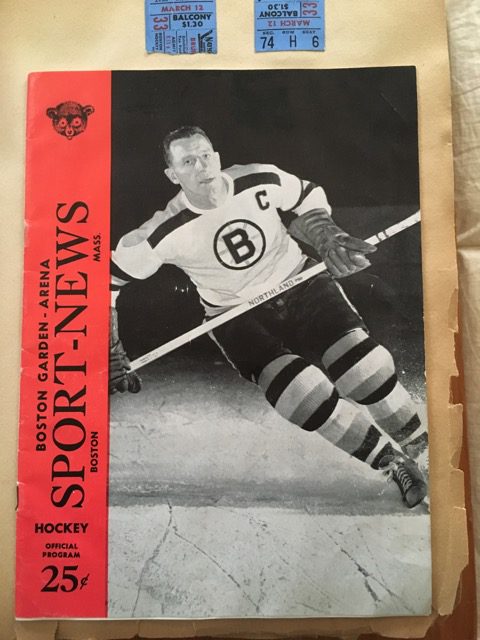
A hockey game — the Bruins v. Red Wings. This was on his birthday, so maybe my mother got those tickets as a birthday present for him.

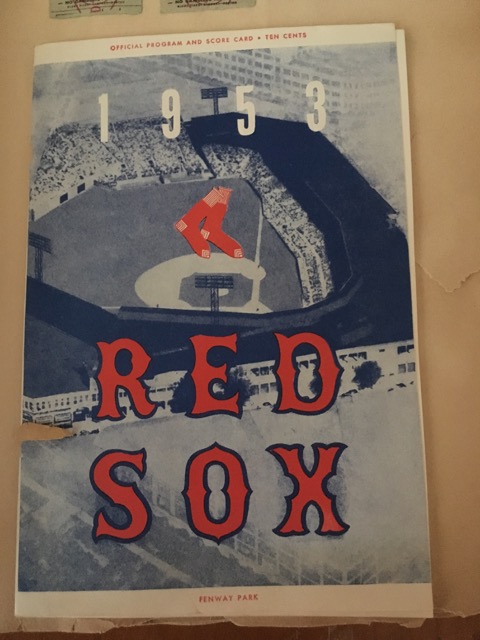
And a baseball game — the Red Sox v Tigers. 60c each for bleacher seats (he saved the stubs), and my father faithfully kept score in the program. Final score 8 – 5, Boston.

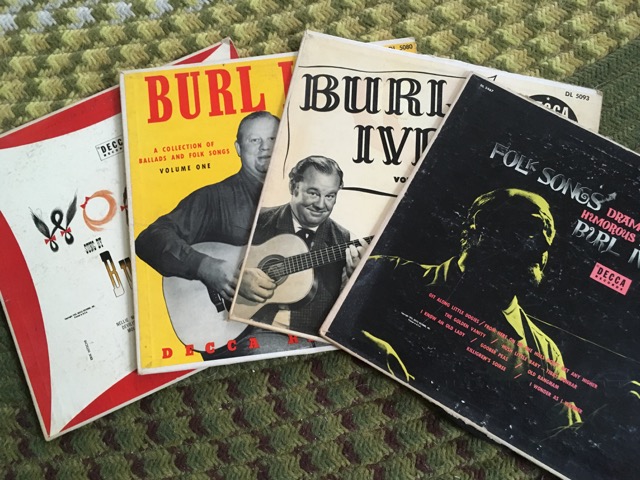
My father always loved folk music. He told me once that he used to treat himself occasionally on payday to the newest Burl Ives record, purchasing it at a little record store somewhere near the hospital. We still have a lot of those records.

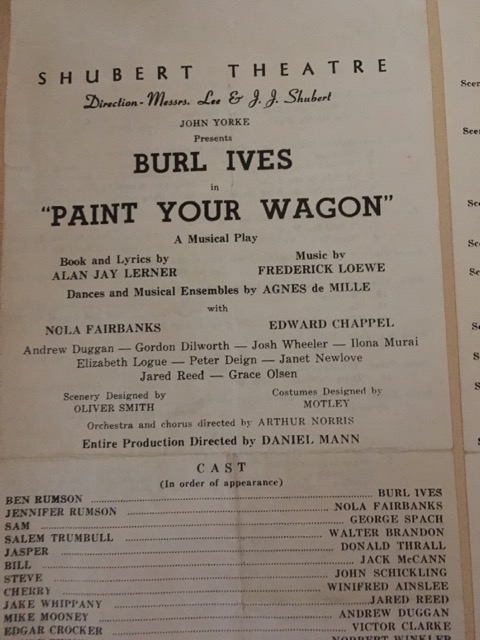
So I was delightfully surprised when I was looking through the scrapbook and saw that he and my mother had gone to see Paint Your Wagon at the Shubert Theater in Boston — starring none other that Burl Ives. I’ll bet he sang “Wandering’ Star” a lot better than Lee Marvin.

I try to remember what Bud and I did for our first dates. We didn’t go to boxing matches or any other sporting events. We went for walks. We went to an auction. We went to church. We went to the movie “Coal Miner’s Daughter” and had to wait in line to get into the theater. We went to the drive-in and locked ourselves out of the car.

But we didn’t keep a scrapbook to tell the story for future generations.

I’m thankful my parents did.

A to Z Blogging Challenge · About My Dad · family

A is for Army

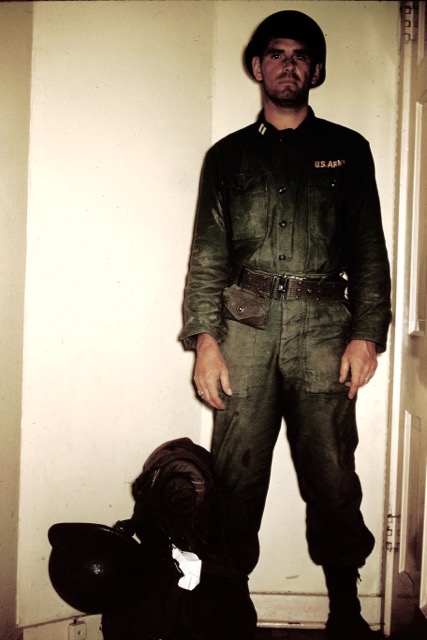
My father served in the United States Army.

I don’t think he would ever begin the story of his life at this point, but this is an alphabetical telling, not chronological. Plus, I was born during the Army years, so I suppose it’s a good place for me to start.

The Army helped pay for his medical school. In return, he gave them 6 years active duty.

One posting was in Eritrea, which at the time, was part of Ethiopia. My earliest memories are from Kagnew Station, the army base there. Those little fragments of memories hardly seem real. I rode camels. I sifted sugar to help in the kitchen. We had chameleons.

My early memories rarely include my father though. I imagine he was kept quite busy with his work.

He moved his way up through the ranks. This is one of my favorite pictures of my mom and dad from one of his promotion ceremonies.

When he left active duty, he didn’t fully leave the Army. For many years he belonged to an army reserve unit — the 414th Civil Affairs Battalion out of Utica. While in the reserves, he continued to study and move up in ranks, eventually becoming a Colonel. He called it a “full bird Colonel.”

“What comes after that?” younger me asked him.

“General,” he said, and I was duly impressed.

When he had put in whatever time he needed for a full retirement, he did just that.

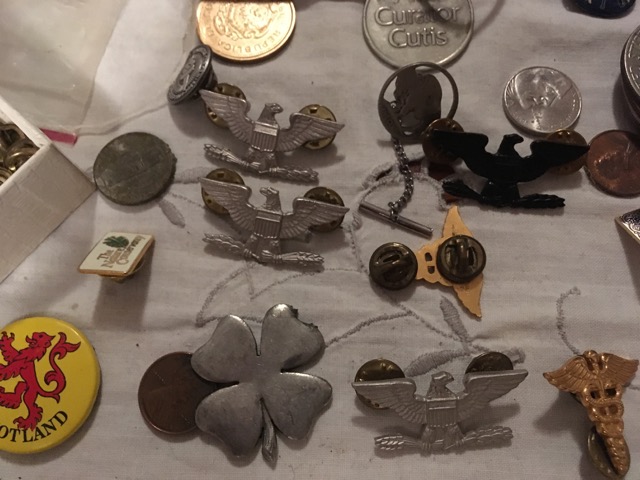
These days he likes sorting things — emptying banks and sorting the coins, sorting through papers and photos, sorting pins of various shapes and sizes that he has acquired over the years.

At dinner the other night, he said to Karl, “I have a lot of insignia pins. I found a dish that had a whole bunch of them. Maybe you’ll have some use for them.”

I looked at the assortment he had spread over his dresser. Sure enough, those full-bird eagles were thrown in some pennies and nickels, a lucky 4-leaf clover, and a few caduceus.

He had forgotten the hard work that went into earning them. I’m not even sure he knew their significance. He was ready to give them away to anyone who seemed interested.

My dad was in the army, but I think he has forgotten it.

I remember, though.

I remember him shining his army boots on the night before reserve duty, and the smell of the boot black.

I remember how different he looked in his fatigues.

Mostly I remember feeling kind of proud that my father served in the army.


A to Z Blogging Challenge · dreams · family

2018 Blogging from A to Z: About My Dad

Tomorrow the A to Z Blogging Challenge starts. I missed the deadline for the Theme Reveal and I’m pretty sure I signed up twice. It makes me wonder how this year’s challenge will go.

Writing has been such a struggle lately. I can’t seem to find a chunk of time to write. Writing, or, for that matter, doing anything “in dribs and drabs,” as my mother used to say, is a challenge. It takes time to get into the right mindset and find the right words. For me, an interruption comes and I’ve been sent back to Monopoly/Writing Jail without collecting $200 or 200 words or anything.

Recently I had this horrible dream:

I was walking in a field with my family — my husband, my children, my siblings, and my father. The field grew swampy, and we were talking about how it hadn’t always been that way and how we planted corn on it in the past. The path was narrow and my father stepped too close to the swamp. As he fell in, the swamp became a deep hole full of water and I jumped in to save him. He was sinking so I swam beneath him to get his head to the surface so he could breathe. As I pushed him up to the surface, I felt myself running out of air. While underwater, I could see some family members sitting to rest, but they hadn’t noticed him falling in. No one was coming to rescue us. I couldn’t call for help because I was underwater. My father couldn’t call for help because he can’t think clearly. I realized that I needed air and I needed to get help, but to do that, I would have to let go of my father. I used all my strength to heave him up and then pushed myself toward the surface for a breath. He slid past me, like dead weight, and I grabbed his hands. Instead of reaching the surface, I went down, down, down into darkness.

Then I woke up. It was an awful dream. I don’t need a Joseph to interpret it, but it served as a warning.

To misquote an African proverb: It takes a family to care for the elderly.

I’m so thankful that I DO have a strong and supportive family. My brothers, my sister, my children, my husband all pitch in.

The other night, when my father fell around midnight, Karl was right there ready to help. He drove us to the hospital and then stayed with my father so I could go home and get a little sleep before I went to work at 5 AM. (My father ended up with stitches in his forehead and staples in his scalp. Everything else seems to be okay.) I know Karl wouldn’t let me drown.

Helen is taking days off from work to stay with my father so Bud and I can get away for a mini-vacation. She did the same thing back in January. She’s not going to let us drown.

And I need to make sure I ask for help BEFORE I’m underwater. (Lifesaving 101)

But back to the A to Z Challenge. I decided to adopt this theme: About My Dad.

Writing about who he was will help me with who he is.

Plus, he’s one of my favorite people in the whole world. I think you’ll like him, too.

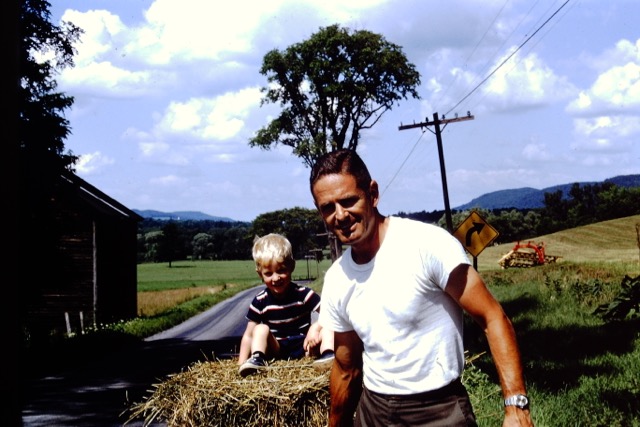
Dad and Jim, summer 1968

I just have to make sure I carve out those chunks of time for writing.

Faith · photography · Uncategorized

A Little Bit of Narnia

March 28, 2018

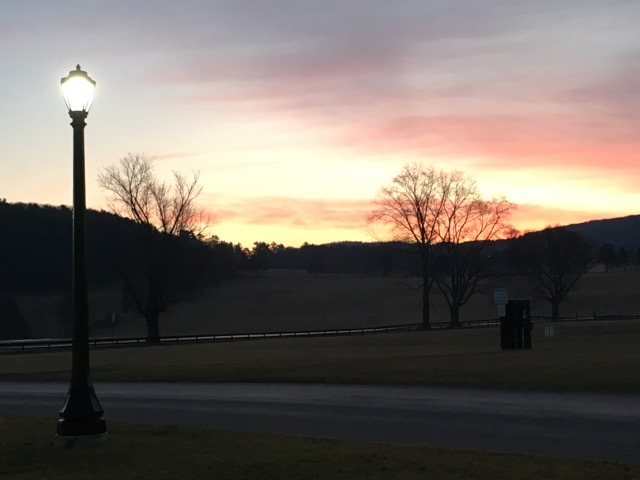
Yesterday’s sunrise was pink and blue.

March 27, 2018

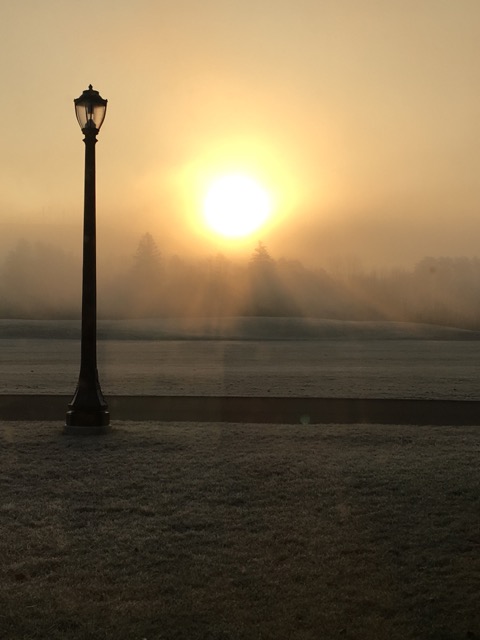
The day before it was orange and yellow.

March 1, 2018

I take so many pictures of the sunrise. I’ll be at the pool and one the ladies swimming will say, “Ooh! Sally! Get your camera!” I’ll grab my phone and step out the door into the cold for yet another sunrise photo.

February 23, 2018

It never grows old.

February 19, 2018

Here’s one of my favorites, looking in a slightly different direction:

December 4, 2017

I’m reading excerpts of Lamentations for Holy Week. Feeling the sadness of the Jewish people as they lament the destruction of Jerusalem sets the tone for the sadness Christians should feel as we approach Good Friday. I love the way C. S. Lewis,  in The Lion, the Witch and the Wardrobe, described Aslan walking to the Stone Table

…one of the girls walked on each side of the Lion. But how slowly he walked! And his great, royal head drooped so that his nose nearly touched the grass. Presently he stumbled and gave a low moan.

“Aslan! Dear Aslan!” said Lucy, “what is wrong? Can’t you tell us?”

“Are you ill, dear Aslan?” asked Susan.

“No,” said Aslan. “I am sad and lonely. Lay your hands on my mane so that I can feel you are there and let us walk like that.”

And the girls did what they would never have dared to do without his permission but what they had longed to do ever since they first saw him — buried their cold hands in the beautiful sea of fur, and stroked it and, so doing, walked with him.

That part of the story is almost unbearable to me. Because even if I picture burying my cold hands in his mane, I know that soon the lion will be gone and my hands will be colder than before. It’s an awful feeling.

But Lamentations 3 holds one of my favorite passages — and arriving at it is like arriving at Easter morning.

21 But this I call to mind,
    and therefore I have hope:
22 The steadfast love of the Lord never ceases;
    his mercies never come to an end;
23 they are new every morning;
    great is your faithfulness.

Every sunrise holds that promise for me. His mercies are new every morning. In Narnia —

There, shining in the sunrise, larger than they had seen him before, shaking his mane… stood Aslan himself.

The Narnian lampposts that line the driveways and parking lots at the pool extinguish themselves one by one every morning and I am left with a glorious sun. Even on the grayest days, I know it’s there — and it brings me hope.


Book Review

The Hate U Give

The paper fluttered out of my Bible one morning.

I had written the following quote on it:

You may choose to look the other way, but you can never say again that you did not know.

William Wilberforce

William Wilberforce spoke those words to Parliament in 1789 as he told of the horrors of the slave trade.

The quote fit perfectly with the book I was reading, The Hate U Give by Angie Thomas. My friend Shannon had recommended it, and midway through she asked what I thought of it.

“It’s a brutal view into a world that I don’t know,” I told her.

And it is.

I grew up in a white town, attended a white school, had white friends. There’s nothing intentionally racist about that; it’s just a fact. Small upstate New York towns were predominantly white in the 60s and 70s.

At my father’s birthday party, a woman, while looking at one of his old yearbooks, said to me, “This is fascinating.”

“What?” I asked.

“His high school had two choirs — one white, one black,” she said.

I looked at the yearbook — the 1947 Cobbonian from Morristown High School. One page did feature two choirs: the Spiritual Choir and the Madrigal Choir.

The reverse side of the page featured the A Cappella Choir and the Training Choir, both of which were integrated — just barely — with less than a handful of people of color participating in either one.

“We’ve come a long way, haven’t we,” I said to the woman looking at the yearbook. She smiled and nodded.

But we still have a long way to go.

For the breadth of Angie Thomas’s book, I was allowed to stand in the shoes of a 16 year-old African-American girl, who grew up in the projects, who saw two friends gunned down, and who ultimately learned that her voice is her most powerful weapon.

I thought about the book this weekend when I saw the news coverage of students across the country participating in March for Our Lives Rallies against gun violence. They used words — and silence (after reading the names of the 17 students who died at Marjory Stoneman Douglas High, student Emma Gonzalez stood in silence on the stage for 6 minutes and 20 seconds, the amount of time it took the gunman to kill them).

I’ve read solutions to the gun problem that range from arming teachers, to supplying buckets of rocks in classrooms, to having therapy dogs in schools. Some sound disastrous; others seems inefficient and ridiculous; still others might work. I don’t know what the answer is —

But I do know it begins with talking and listening.

It begins with standing in the other person’s shoes, no matter what the issue is, if only for a moment.

After that, I can choose to look the other way.

But I can’t say I didn’t know.

I’m glad I read The Hate U Give.