Why do you unsettle me? Why can’t I look into your eyes, your face, without feeling pain? Is it the burden on your shoulders? Is it that I will never fathom your life, so different from mine?
This is in response to Sadje’s What Do You See? prompt — the photograph above.
The other day a conversation I was in touched on the phrase “Choose Joy.”
“It’s all in how it’s said,” the other person was saying, and it hit me how very correct he was.
Say it with heartfelt sincerity and it sounds like what it’s intended to be — an encouraging sentiment. Say it sarcastically, sardonically, with a touch of a sneer and it is exactly the opposite. However a person has heard in the past probably impacts how they hear it today, right?
Every trite little slogan has that potential.
When life is an utter sh-thole, the last thing someone needs to hear is “Choose Joy” — as if they had chosen the fecal matter surrounding them. Sometimes, our choices do lead us to the latrine — but sometimes a thousand things outside our control take us there.
Timing is everything.
When I wake up in the morning, I can tell myself to choose joy today. When I drop a cinderblock on my foot, I may not choose joy in that moment.
But, then, I do have a sign boldly proclaiming “HOPE” on the side of our barn. Does”HOPE” also fall somewhere on the sarcasm/sincerity continuum? Can it be said both ways? I sure hope so? not?
Hope somehow feels different to me.
Yesterday, I lifeguarded at a local park. All the young lifeguards are back to school or at soccer practice or some such. I’m glad I can help.
An old woman came down to the beach. I would guess that she was in her late 70s, maybe early 80s. She was unsteady entering the water from the beach. I watched her pick her way along, hoping she had water shoes on because the zebra mussels can hurt terribly when stepped on.
She lifted the rope separating the shallow end from the deep end over her head and started swimming. Maybe she was a strong swimmer at some point in her life, but she wasn’t yesterday. She made me nervous, especially when she had to stop and “rest” holding onto the rope delineating the further boundaries of the deep end.
“Are you okay?” I asked.
“I’m fine,” she said, and sounded annoyed at the question.
When she went back to shore, she lost her footing in thigh deep water. I jumped up, quite sure I would need to go in to assist her, but she finally stood again on her own and walked the rest of the way. Back on the beach, she sat, exhausted, in an Adirondack chair for the next hour.
Why she came to mind as I pondered Joy and Hope stream-of-consciously is a bit of a mystery to me. I wish I understood how my mind works. Here’s my guess though:
I think she chose Joy when she chose to go swimming that day. She drove by herself — a questionable choice because she hit a bench when attempted to park. She descended steep uneven stairs to get to our narrow beach. Then she swam — even though it exhausted her and she had lost her footing in the water. She chose to do all that even though the rest of us questioned her choices.
Maybe that’s choosing Joy — choosing something for ourselves, even when it doesn’t make sense.
That line that she clung to? That was Hope. It’s not so much a choice as it is something we just hold onto when we need it.
When Lilly saw Gemma in the grocery store, she knew this would not be the quick trip that Mom promised.
“Ella!” she exclaimed, rushing over to them. “Have I got a story for you!”
Mom glanced down at Lilly and said, “Why don’t you go get some cherries while Gemma and I talk?”
Lilly did not need to be asked twice. She loved cherries.
Still within sight of her mom, she went to the large display in the produce section. She grabbed a bag and started filling it with fruit. Then she spied something in the cherry bin.
She went back to her mom and tugged on her sleeve.
“And then I saw them –,” Gemma was saying, but Ella put up her hand to pause the story.
“What do you need, honey?” she asked Lilly.
“What if there’s something besides cherries in the cherry bin?” Lilly asked.
“That happens sometimes,” Mom said. “The fruit gets mixed up. Just put cherries in the bag.”
“But what if I want to get something besides cherries?” she asked.
“Put each different thing in its own bag,” her mother replied.
Lilly nodded and headed back.
She heard Gemma continuing, “The two of them were…”
Lilly finished filling the cherry bag and then put her other item in a different bag. She shrugged as she did it, but Mom had said.
“Ready?” Mom asked, coming alongside Lilly. She nodded her approval at the cherries, then screamed — when she saw the large snail in a bag.
Star Faintly Twinkling In the dusky Sky — You’re there even When I can’t see your light Like in the daytime, or night When clouds obscure most ev’rything I know comrade stars form animals And warriors and women above me Unseen Orion still wields his club aloft While vain Cassiopeia admires herself I can’t see them but that doesn’t mean they don’t exist One little star First star I see Reminds me of What is unseen And beautiful And just as real
I know that this poem isn’t about changes, impermanence and strength. I had an idea of what I wanted to write, but all of the sudden I had veered off in a different direction. Sorry. Not really sorry.
Actually, pretty sure this is the moon, but it will have to do.
A year ago I didn’t know either of those words. Here are the definitions
Ekphrastic — a written response to a visual work of art
Etheree — syllabic poetry that has 10 lines, with the syllable count 1-2-3-4-5-6-7-8-9-10 –Mine is a Reverse Etheree because the syllable count goes 10-9-8-7-6-5-4-3-2-1
The world is a parade past my window Strolling, walking, marching, riding past Some in groups, trios, pairs, alone Chatting, whistling, silent An unsteady nonrush I watch quietly Inside my home Unobserved And sip Tea
Duncan opened his eyes and looked around the room.
He couldn’t believe his luck! Everyone was sleeping.
The huge family dinner had been amazing and delicious. Now the family was sprawled in chairs, sofas, even on the floor. Duncan pushed himself up out of his chair and carefully stepped over the sleeping boy with the open book on his chest. Someone stirred on the couch, but Duncan tiptoed out through the back kitchen door.
As the door clicked shut behind him, he breathed in the fresh afternoon air. Now, where was his bike?
Behind the garage, he found the blue BMX. He climbed on, but it was strange; suddenly it felt too small for him. No matter — he was just taking a wee spin around the park.
He headed down the bike path and began pedaling. He hoped he would see some of his buddies kicking the ball on the field, but he didn’t recognize any of the kids playing.
He kept riding.
The playground looked unfamiliar. The slide was bright blue, the swings were a rainbow of colors. When did they put that there? he wondered.
As he looped back toward the house, he wondered at the people staring at him.
The seat is too low, he thought. It does feel awkward. I need to raise it.
When home was in sight, he saw a woman running toward him.
“Dad!” she cried. “Dad, don’t scare us like that by taking off on Johnny’s bike!”
I think you need to read yesterday’s Blather to understand what’s going on here. In short, this strange, strangely-formatted poem, is because I could hear it, almost like a song with three distinct voices. This is in response to the W3 prompt which called for using a line or two from Leonard Cohen’s Anthem.
Gosh, I apologize. If you were to meet me in person, you might think I’m normal. However, after reading this, you won’t think that at all.
Okie-dokie — Here goes:
Must be a hell of a scary crack
That’s how the light gets in That’s how the light gets in
A hell of a scary crack
That’s how the light gets in That’s how the light gets in
I was sittin’ with my coffee In the hotel breakfast room When a homeless guy walked past me He was headin’ for the food, for the food
Must be a hell of a scary crack
That’s how the light gets in That’s how the light gets in
Mmm… it smelled so delicious He closed his eyes just to drink the smell in But his hands were a’trembling greatly Like a leaf at the end of a willowy limb
Must be a hell of a scary crack
That’s how the light gets in That’s how the light gets in
Hunger moves a man to do a scary thing He’d been thrown out before, thrown out before Still he braved it all again When he saw that crack in the door, crack in the door
Must be a hell of a scary crack
That’s how the light gets in That’s how the light gets in
Lights and smells both beckon But not to those who have everything If we aren’t hungry, we miss them We miss it all, yes, we miss it all.
Must be a hell of a scary crack
That’s how the light gets in That’s how the light gets in
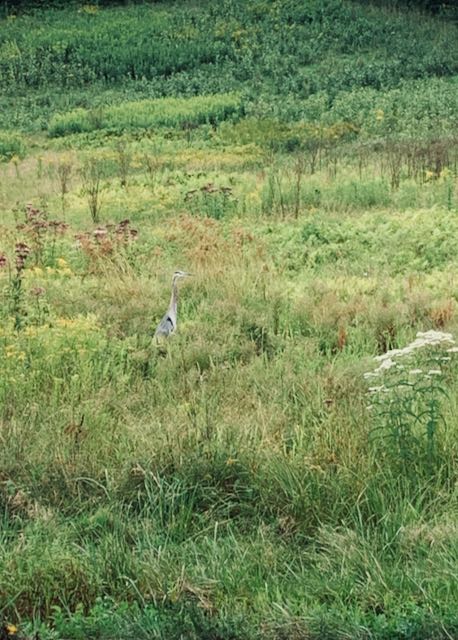
You blend in so well that I Almost passed by, but my soul Leapt as your head turned, follow- ing me, swallowing a vole,
Or who knows why? I caught my Breath. ’twas a sigh in reverse – A moment of surprised awe Then crows cawed and you dispersed.
Maybe I just blame the crows – Maybe you arose in broad- Winged flight because some other Thing broke cover at your nod
Tanka Tuesday Prompt: This week, choose a kigo (season word or seasonal phrase) and write your syllabic poetry using the word or seasonal phrase. My word was heron.
I’m not sure I understand the whole kigo thing. I’m dense maybe. Or my head is too full of trying to learn Gaelic. And French.
However, I chose a Welsh form that I’ve used before: Awdl Gywydd. It calls for internal rhymes and end rhymes.
I drove to Roanoke and back, stopping overnight in DC where we visited an amazing new museum called Planet Word. I delivered my middle daughter to school and drove home yesterday.
In the meantime, I fell behind in the minimal writing I’ve been doing. Tanka Tuesday and W3 — you’re on my list for today. Readers, stay tuned.
For this post, though, my Stream of Consciousness writing exercise, I want to try to unravel the writing process a little more. I’ve been wrestling with the W3 prompt for this week which is to use line or lines from Leonard Cohen’s song “Anthem” as part of a new poem.
I had Anthem on repeat for a good year at one point not so long ago. It’s a great song.
There is a crack, a crack in everything. That’s how the light gets in
Leonard Cohen, Anthem
So… process… I reread the words to the song, and immediately, the whole thing was playing in my head.
How can I take something so epic, so classic, and craft it into something new?
Enter Doctor Who. Remember the episode when the Doctor meets young Amy. For the record, it’s called “The Eleventh Hour,” S31 E1. My favorite line: “Must be a hell of a scary crack in your wall.”
Process — continued — Suddenly I have two sets of background singers in my head. One is singing, “Must be a hell of a scary crack,” and the other responds, “That’s how the light gets in, that’s how the light gets in.”
Seriously, I even hear a tune to their words. I can hear them going back and forth. And it’s like I’m just waiting for that lead singer to step up to the main mic and start singing the verses.
That’s what I have to write. The verses that go with the background vocals.
In the meantime, all I can think about is this homeless man that came in to eat the hotel breakfast at 6 AM of my day in DC.
I was drinking my coffee and doing my morning reading down in the breakfast area while my daughter was still sleeping in our room. He walked past me, and the first thing I noticed was the worn grocery store bag he was carrying filled with recyclables — bottles, mostly.
He wore a dirty army green jacket — and that was noteworthy to me because it was hot out, even at 6 AM. His hair was unkempt. He was unshaven. All this was one quick impression as he passed me.
I had my back to the food, so I didn’t see what was happening. I was reading, so I didn’t even really pay attention to it at all. There were a few other patrons there plus the woman who was keeping the food stocked and the area clean.
Suddenly, four men went past me in a hurry. They were big and wore vests with the word “SECURITY” emblazoned on them.
I heard the scuffle behind me, but didn’t turn to look.
They literally dragged the homeless man out. He cried, “Where is the humanity?! Where is the humanity?!” all the way out the door.
Then silence.
I sipped my coffee and pondered his question.
The woman who worked the breakfast came over to me. “I’m so sorry,” she said. “He can’t just come in here like that.”
“I understand,” I replied. “It’s sad, though, isn’t it?”
“If he came back at 10, I would give him the leftover food,” she said. “I have to throw it away. I’d rather it be eaten.”
We co-existed in silence for a bit, each lost in our own thoughts.
“Thank you,” I finally said. “You do a lovely job here.”
But that story, I knew later, was the fodder for the verses to go with my insistent background vocals.
Because, really, where is the humanity? It’s masked by a scary crack. And that’s where the light gets in.




 Hot Dogs and Marmalade