elderly · family

House Beautiful

Whenever I drive my father anywhere, he comments on the houses we pass.

“Those are some well-kept houses,” he says, especially in the summer when the yards are groomed and flowers are blooming.

Somewhere along the line maintaining his house became too much.

My mother kept beautiful gardens. She was outside nearly every day in the spring and summer planting, weeding, and pruning so that passers-by were treated to some beauty.

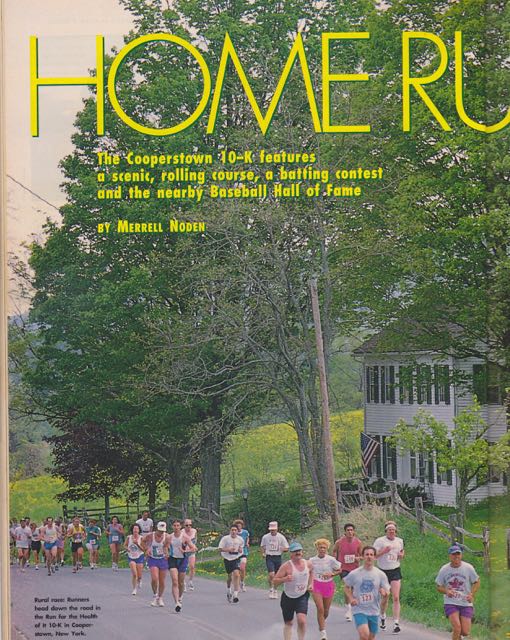
In May 1994 the house was featured in a 2-page spread of Runner’s World magazine. A 10K race was routed right past the house.
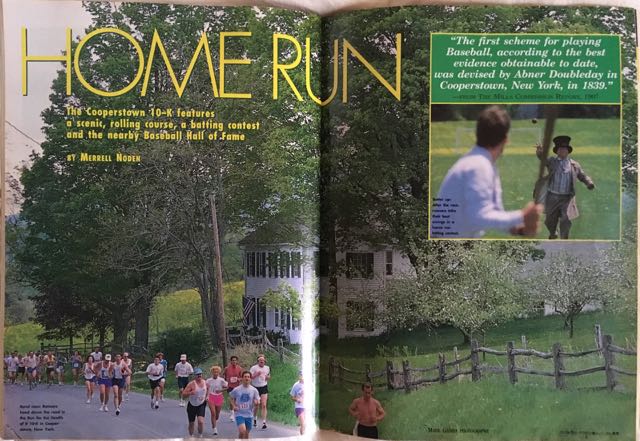
the 2-page spread
the 2-page spread
a better picture
a better picture

As dementia crept in, we discouraged her from being out near the road. I was worried about her safety.

Plus she would shake her fist at cars that drove past too fast.

I was worried she would get a reputation for being a crazy old lady.

As the gardens were overtaken by weeds, the fence rotted.  The split rail fence needed a number of rails replaced but when my father purchased new rails a few years ago and brought them home, he discovered they were too short.

“That’s okay,” he said to me. “I’ll just dig up the posts and move them closer.”

My eighty-something father, who was struggling was balance issues and growing frailer by the minute, honestly thought he could do that.

With aging parents — as with children — figuring out how to address challenges without totally discouraging them with you-can’ts is tricky.

“How about if we get someone to help you with it?” I suggested.

“I can do it,” he insisted.

But he didn’t.

And now the rails are rotting in a pile.

Bud has been working hard to reclaim the gardens. Last summer, he weeded and weeded and weeded. He cleared brush. He mowed. He pruned. He’s one of the hardest working people I know and I wondered if my father even noticed.

We were driving to get his haircut last week, and he commented on how well-kept the houses were on the way.

“It takes a lot of work to keep a house looking nice,” I said.

My father was quiet for a few minutes staring out the window. “When is Bud coming again?” he finally asked.

“Friday,” I told him, “when he gets done with work.”

I was relieved because that told me two things:

  1. He made the connection between the work required to keep the house looking nice and Bud.
  2. He recognized that Bud and I don’t get to see each other every day.

We’re doing it for him.

It isn’t easy, but it’s important.

And I’m grateful that we can be there — and get that house looking nice again.

Faith · prayer

Prayer of Confession

In the Book of Common Prayer, the morning prayer of confession begins,

ALMIGHTY and most merciful Father; We have erred, and strayed from thy ways like lost sheep…

I was interested to read Lancelot Andrewes note on this prayer —

We have wittingly and willingly run from Your ways like an untamed heifer

img_0672Last summer, on my walks, I often saw the cattle in a neighboring field.  Sometimes they would run up to the fence as I walked past. One liked to lower his head and shake his horns at me threateningly.img_9663 I tried to reassure him that I meant no harm. I was simply out for a walk.img_0675

My bovine friends — or not-friends — became a fixture on these walks. I would scan the field to see where they were grazing. When one escaped, I tried to encourage him to go back with his compadres, but it’s hard to encourage an 1800 pound animal and keep a safe distance. img_0504

One fall day, Bud was working in the barn across the street when he heard the screech of tires. He ran out to see a woman, wide-eyed, sitting in her stopped car in the middle of road, staring a herd of cattle thundering toward her up the road. They ran past the house, tipping the mailbox as they went and disappearing over the crest of the hill followed by men in pick-up trucks.

“I had seen them trying to load them into a trailer earlier,” Bud told me. “Must be they decided to get them to the other farm the old-fashioned cattle drive way.”

That evening, when we went for a walk, we saw the guys in the pick-ups sitting outside the pasture that had once held their steer.

“That was something else,” Bud said to them, “watching them run up the road.”

“They didn’t want to get on the trailer,” one guy said, “and broke the fence. If you see ’em, let us know.”

“You weren’t herding them?” we both asked.

“Hell, no,” the man replied.

About a dozen steer were now on the wild in Otsego County, including the one who occasionally menaced.

As best I know, they were never found — although I did hear of occasional steer-sightings.

I pictured them when I read Lancelot Andrewes words.

Breaking through the fence — wittingly and willingly.

Running from the livestock trailer — running from Your ways

Like wild cattle — like an untamed heifer

It’s quite an image.

Almost exquisite — if one can use that word for cattle.

elderly · Faith · family

Incapable

Below is a(nother) dusted-off post from 2011. In 2011 my mother was still alive and living at home. She clearly had dementia and her body was slowly failing on her.  My father was her main care-provider, but that summer was hard on him, too. With all that was going on, I helped out as best I could.

Mom and Dad -- summer of 2011
Mom and Dad — summer of 2011

Last Thursday we went for the follow-up visit for my mother’s bladder biopsy.

The baby-faced doctor handed my father the pathology report.  “It’s bladder cancer, just as I suspected,” he said.

He continued speaking, “It’s high-grade papillary urothelial carcinoma.”  I could see the words on the path report in my father’s hands. “The cancer hasn’t spread past the lining of the bladder.  There is no invasion into the muscle or the subepithelial tissue.”

When he began discussing the treatment options, it was truly a discussion.  He listened to our concerns, answered questions, explained, and listened some more.

We finally reached the point in the process that I was anticipating (and dreading).

My mother is now incapable of making decisions, especially decisions like this.  She can decide what she wants for lunch — usually something involving marmalade.  She can decide what she wants to wear — usually the same thing she has been wearing for the past three days.  She can decide when she wants to take a nap — often.  She cannot make an informed decision about her health care.

My father has always shown the utmost respect for people and guarded their dignity.  I knew my father would want to include my mother in the decision-making process. When the moment came, my father turned to my mother and said, “I suppose we need to ask the patient what she would like to do.”

I started to pipe up, “Dad, I think we’re at the point when you need to make these decisions for Mom,” but my mother interrupted.

My mother, with the utmost clarity, said, “I don’t think I understand what’s going on.  I trust whatever you decide.”

Hallelujah!  If the angels weren’t singing in heaven, they were singing in my heart!

I hadn’t known to pray for this, but this was an answer to prayer.

The rest of the visit was a piece of cake.  We made the decision to simply wait.  At 83, any treatment may have been worse than the disease itself….

I had forgotten so much about that time period. The bladder cancer turned out to be a red herring. So many other things made that season hard. Had I know what lay ahead, I would have said that I was not capable of any of it.

But I was.

God makes our path a little windy so we can’t see what’s around the next bend. Perhaps if we knew, we wouldn’t want to go on.

Today, January 13, 2017, I can look back and say, Thank you, God, for getting me through those years. It makes it easier to trust You on the road I’m traveling now.

Alzheimer's · Faith · family · poetry

The Weight of Struggles

In 2011, my mind was spinning with all the information being thrown at me.  Bladder cancer.  Catheter care.  Chemotherapy.

That summer, my mother had been diagnosed with bladder cancer.

As if Alzheimer’s wasn’t enough.  As if a second bout with breast cancer wasn’t enough.  As if my father needing a pacemaker wasn’t enough.

In the midst of all this, I wrote a poem based on Milo of Croton, the legendary Greek wrestler who began each day lifting a calf.

Okay -- not lifting a calf here.
Okay — not lifting a calf here.

The legend goes that by lifting the same calf every morning, Milo could eventually lift a full-grown cow or bull. I didn’t need to lift a physical cow, rather a heavy load of struggles, one that was increasing in size.

If I lift the same calf every day
Could I someday lift a cow?
It seems logical and sensible
But impossible somehow.

Somehow I become broken
And it’s more than I can take.
Will I see failure coming?
Or do I need to break?

Or do I need a break
From lifting up the cow?
Am I stronger then, or weaker,
When I start to bow?

To bow under the pressure that’s
So heavy on my soul
That the spirit and mind and body
All begin to show the toll;

When can I say “Uncle”
And deal with this no more?
I strain under the calf-turned-cow
My cheek pressed to the floor,

Trying to lift up the cow,
But the Lifter of my head
Says, “Let Me help. Stop a while.
I’ll put others in your stead.

“Let friends come beside you.
You can take a rest.
Trust Me; it will be okay.
I really know what’s best.”

But the habit formed of lifting,
Lifting, lifting every day
Is scary to give up.
Lord, show me the way.

During that time I felt God answering every prayer I ever prayed about knowing Him more, trusting Him more, and resting in Him more completely.

The funny thing about challenges is that the harder they are, the deeper we grow.

I couldn’t meet the challenges.

At least not alone.

I found myself clinging to my faith during that challenging time.

Faith is not a crutch as some might say.  It is a Strength.

It’s also faithful friends — that hands and feet of Christ.

I wrote Milo of Croton 5 years ago — and I think I still haven’t learned to yield.

But I’m certainly stronger.

Thanks be to God.

family

Explanation

“What’s something I say a lot?” I asked Mary.

I was reading another person’s post on Facebook that contained a list of questions parents can ask their children to get funny answers.

I knew I was in trouble when Mary answered, “I’ve suddenly forgotten everything you’ve ever said.”

“Really?” I asked.

“My mind just goes blank sometimes,” she said. “Once in geometry class, the teacher asked me a question and I told that I had just forgotten everything I ever knew about angles. She thought that was pretty funny.”

Mary’s answers revealed that she recognized my penchant for coffee.

      Q: What makes me happy?
      A: Coffee.
      Q: What makes me unhappy?
      A: Lack of coffee.
      Q: What’s my favorite food?
      A: Is coffee considered a food?

And that she understood how important home is to me

      Q: If I could go anywhere in the world, where would it be?
      A: Home

But one answer definitely needed more explanation.

      Q: What’s my favorite thing to do?
      A: Cut pictures out of children’s books

Yes, this is true. But it may not be exactly as it sounds.

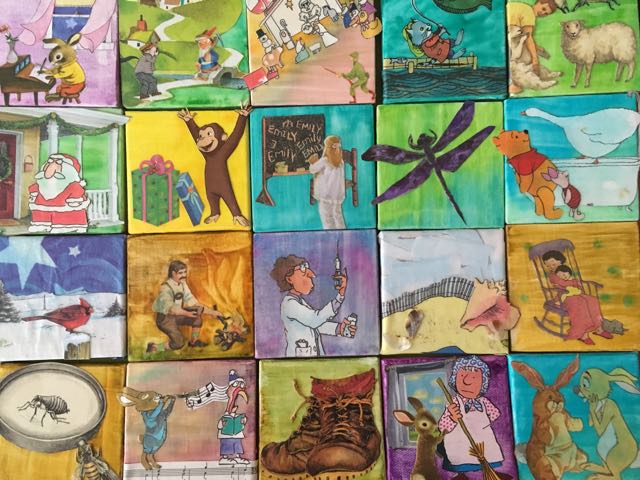
I’ve been playing with collage, and using old picture books — the ones with pages falling out, or colored on, or ripped — and cutting out the pictures to use in my collages.

For Christmas, our place holders didn’t have names on them, just pictures that made me think of that person. img_0899To make 20 place-cards required a lot of pictures. Mary watched me spend a lot of time snipping. And she saw me get excited whenever I found a beat-up copy of a favorite book.
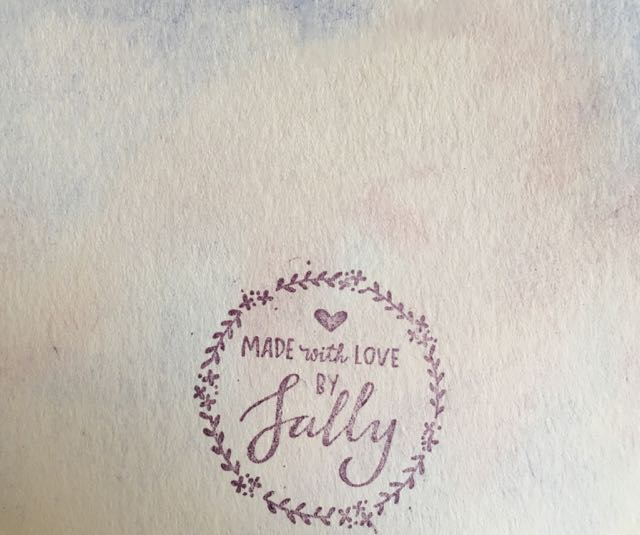
Some of my cut-out pictures have made their way onto cards. Quirky cards, at best. The possibilities are infinite when combining children’s books.

A dear friend (and recipient of one of these strange cards) sent me a stamp so I can add my name to the back of the cards and make them official.img_1033

They are made with love.

And often while sipping a cup of coffee.

Mary can attest to that.

family

Pursuing Dreams

I remember when Sam learned that he had arthritis.

He had been struggling with shoulder pain and gone for treatment for tendonitis, a common problem for swimmers. He couldn’t lift his arms over his head and the physical therapist commented that he was like an old man.

Fortunately, someone recognized that Sam had a bigger issue than tendonitis — a “more global problem” is how they put it.

After running a bunch of tests, they gave him the life sentence — psoriatic arthritis.

“What am I going to do?” he asked. “I won’t be able to do the things I love.”

By that he meant climbing, paddling, skiing and all sorts of other outdoor activities. Sam was tempted to throw in the towel.

His rheumatologist looked him in the eye and said, “It doesn’t mean that at all.” He encouraged Sam to pursue his dreams.

And Sam did.

That was ten years ago.

The first time we went to British Columbia, I knew Sam would thrive there.self-in-bc

img_0553Honestly, I wasn’t surprised when he wanted to make it his home.

And found a lovely Canadian woman to marry.

When Sam was home at Christmas, he mentioned going to “physio” — that’s Canadian for physical therapy. He works at a canoe and kayak store, and has recently been having trouble lifting boats over his head.

Instead of giving up, he’s working (again) at strengthening those shoulders.

Professional golfer Phil Mickelson is the poster boy for psoriatic arthritis.

I think Sam should be — his story is more inspiring.

To me, anyway.

But I may be biased.


Alzheimer's · Book Review · family

The Benefits of Rust

Remember when I said I would be rusty trying to write again? I was feeling that rust this morning as it seized up my writing gears.

Today I wrote a whole post, deleted half of it, wrote a little more, made a meme, considered dropping the whole thing in the trash, and then decided to just stick it in a draft folder. Here’s the meme, though —predictable

Then I looked back to see what else I had written on this day in history.

Five years ago, I had written a book-review-ish post for a fellow blogger, Christine Grote. We had started blogging about the same time and visited each other’s blogs fairly often. Each of us was dealing with Alzheimer’s — me with my mother and her with her father.

We cross paths with so many people, especially in the blogging world. When I visited her blog today, I felt like I was visiting a long-lost friend.

Here’s part of what I published 5 years ago —

Dancing in Heaven — a sister’s memoir is a tender story of growing up with a severely handicapped family member.  Christine’s sister, Annie, was so developmentally handicapped that doctors predicted she wouldn’t live past the age of eight.  Through the love, devotion and tireless care from the whole family, Annie lived to be 51.

Christine weaves into the story the onset of her father’s Alzheimer’s.  That’s what I had been following on her blog.  Before Alzheimer’s, however, she had interviewed her parents about life with Annie.  When she asked her father if he had any regrets, he said,

“The biggest regret I’ve got of the whole thing is that she cannot speak.  Everything else I can deal with pretty much as it comes along.”

As I read that part, I felt a catch in my throat.  His Alzheimer’s has taken away his ability to speak.

Alzheimer’s seems to affect people in very different ways.  Some symptoms are universal — the loss of memory, for example.  But my mother has not lost her ability to verbally communicate.  She can be sharp-tongued and nasty.  She can definitely communicate.

2017 note: My mother did eventually lose the ability to communicate. She rarely spoke near the end, and when she did, it made little sense.

Christine’s father has fallen into a silent world.  He doesn’t speak often.  As I read his quote about regrets in Dancing in Heaven, I remembered one of Christine’s posts about a communication break-through they had experienced using a whiteboard, Resolving a Quandary.  How much more meaningful that post became knowing how precious that ability to communicate was to him!

Thank you, Christine, for your beautiful memoir.  It is sweet, gentle, and encouraging.

In the intervening five years, Christine’s father passed away as has my mother. Today, when I visited her site, I saw that she had completed her book about her father, Where Memories Meet.

I guess rust can sometimes be a good part of the adventure. It made me slow down and help me reconnect.

I can’t wait to read her book.

Faith · family · flowers

Christmas Flowers

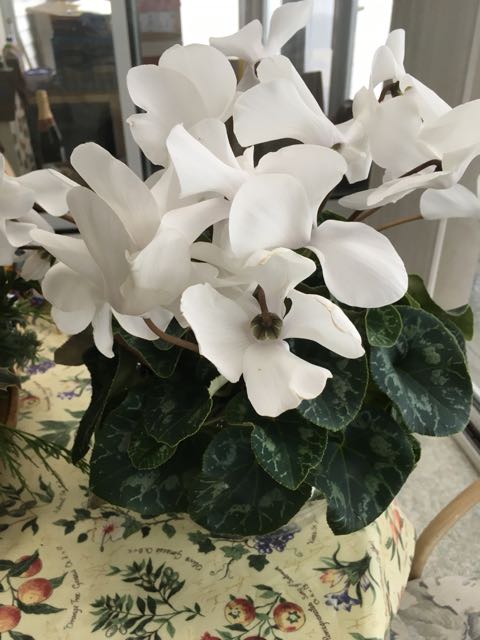
img_1016On Sunday the pastor announced that anyone who wanted Poinsettia or cyclamen was welcome to take plants home. The front altar had been filled with plants for the holiday season — so, so lovely.

The cyclamen on the piano had caught my eye. It was looking droopy and sad, kind of worn out. I understood how it felt.

We are invariably among the last to leave. Bud loves to visit with people and I try to wait patiently (albeit awkwardly). I watched plants leave the sanctuary, one by one, but so many still waited to be adopted. The cyclamen on the piano drooped even more. I  grabbed it and a poinsettia to take home before we left.

For my mother — you know? She loved plants. When she was alive, she always had Poinsettia at Christmas. Her Christmas cactus burst into bloom on cue with the season, as did her Crown of Thorns at Easter. It was magical.

Here is part of  a post I wrote nearly 5 years ago:

At the tower of Babel, God scattered the languages of the world, “so that they may not understand one another’s speech.” (Genesis 11:7)  But He left us some universal languages.

Music crosses cultures and generations.

Art speaks and moves me, though I may know not a word in the native tongue of the painter.

And flowers — God Himself uses this language to speak to us through their beauty.

Flowers may have been the language my mother understood best.  She worked tirelessly in her garden, weeding, tending, making it beautiful for all to enjoy.  Inside the house there was always something blooming — Poinsettia, Christmas cactus, Amaryllis, the crown of thorns, Easter lilies, mums.  She understood the language of the flowers and plants, and they understood her and responded.

As my mother descended into dementia, the plants in the house looked more and more sickly. Nearly all the plants eventually died. Her huge Christmas cactus and Crown of Thorns are gone.

As I left the sanctuary on Sunday holding my sad cyclamen, Bud noticed a healthy one in the vestibule. “Do you want this plant instead?” he asked.

“No,” I told him. “I want to try to revive this one.”

It’s amazing what a little water and sunshine will do.

img_1030

I used to tell myself that I had a black thumb and that I could never grow plants the way my mother did, but I understand better now. It’s not the color of my thumb, it’s the care and attention.

It holds true with plants.

It holds true with people.

Faith · family · Writing

Leaning In

“What’s your theme for 2017 going to be?” my friend asked.

I could barely remember what my theme for 2016 was. If 2015 was hard with the death my mother, 2016 was … um… I don’t even know. Rich? Full? Exhausting?

And where did 2016 even go? A snap of the fingers, and — poof! Good thing this isn’t a 2016 recap because I can’t remember.

My life is rich and full, mostly because of these people —

img_0990-2
Christmas 2016
Starting on the top step — Amanda and Philip
Owen and Emily
Sam and Donna
Me and Bud
Jacob, Helen, and Laurel
Karl, Henry, and Mary

But my 2017 theme is coming from the exhausting part of my life.

My theme is “Leaning In” — the idea of embracing my challenges.

On Christmas Day,  I was standing in the laundry room, seeking solitude and a brief escape from an irritating situation, Helen asked if she could help.

“What can I do about this?” I asked her and told her what was bothering me.

Among her suggestions — write it out.

Write it out.

That’s why I had started this blog in the first place — to make sense of the difficult, to find good in the bad, to untangle the knot — all by writing it out.

So — leaning in. In 2017 I am going to lean in — and part of my embrace will be to write again here.

I thought of three general concepts that relate to leaning in —

  1. Leaning in, as a horse leans into a harness to pull a heavy load. Head down, not high and haughty. Muscles straining– it is hard work. Moving forward, little by little, not giving ground, but gaining and pressing on.
  2. Leaning in, as in a team huddle. Sharing strategies. And concerns. Supporting others — and they supporting me. I can’t do it alone.
  3. Leaning in, as one paying attention to detail. I can’t gloss over things, nor do I want to. Little things are sometimes so much more important than big — and I need to remember that.

Specific goals for 2017 —

  1. Postaday — I’ll write again (or try to), but I may also dust off old posts that I have taken down. My daily posts will be a mix of old and new.
  2. People — I need to cultivate relationships with people who can be part of my team huddle. Again, I see this as a mix of old and new. Friendships needs attention and time. I need to reach out to others on a regular basis — get together with other people, share joys and sorrows, pray, laugh, eat, walk, send cards, write letters, talk on the phone.
  3. Pursue beauty — I toured the Lackawanna Coal Mine once. It was dark and scary, but men found something of value there. Same with my life. I need to look for those places of beauty and goodness. They’re there. I know they are.

So forgive me if my writing muscles are a little rusty. It may take me some time to get my groove back —

But 2017 — here I come.