In 1943, Antoine de Saint-Exupery traveled with an American convoy to North Africa.
He later wrote this “Letter to an American” which is fitting for Memorial Day.
at the Musée du débarquement Utah Beach
… If your soldiers had gone to war only for the defense of American interests, the propaganda would have emphasized your oil fields, your plantations, and your threatened commercial markets. Instead, it scarcely touched on such subjects. If other things were being spoken of, it is because your boys wanted to hear something different.
And what were they told that could motivate them to sacrifice their lives? They were told of hostages hanged in Poland. They were told of prisoners shot in France. They were told that a new form of slavery threatened to extinguish a part of Humanity. They were told not about themselves, but of others. That gave them a sense of solidarity with all mankind.
The fifty thousand soldiers in my convoy went to war not to save American citizens, but rather for Man himself, respect for Mankind, liberty for all men, the greatness of Man…
Traveling with a mobility-challenged person limited our choice in accommodations. We knew we needed a hotel with a “lift” (an elevator).
(Side-note: Sometimes having a lift doesn’t mean it can accommodate a wheelchair, as we learned at our hotel in Paris. The elevator was so tiny that my father had to leave his wheelchair in the lobby and use his walker to get to the elevator and then to his room.)
Through a series of missteps and sheer luck, we ended up at the Villa Lara. I cannot imagine a better place to stay.
(Second side-note: I initially booked at a place just outside Bayeux that looked lovely. I emailed them to ask if they had a lift or rooms on the first floor. “All our rooms are on the first floor,” they replied. Then our guide told us that the first floor in France is what we consider the second floor in the US. I cancelled our rooms at the lift-less, second-floor room place, and, thankfully, the Villa Lara still had three rooms available.)
When we first arrived, and our driver pulled up right in front, Louis greeted us before we were even out of the car. I hesitate to call Louis a bellhop because he was so much more. He was the first ambassador for a pleasant stay, doing everything in his power to make us feel welcome and comfortable.
My brother and sister planning their geocaching for the day — Louis is in the background
I don’t remember who was at the front desk to check us in that day. The weariness of travel blurred my memory.
But I do know that every single person that sat behind that desk was cheerful and helpful. They made reservations for us for dinner every night, taking into account that we needed a place that was wheelchair friendly. They helped us with our French. They got us the all-important coffee tray in the morning.
Laura was my favorite. She was from a small nearby town and obviously loved where she lived. I know that feeling. It’s infectious.
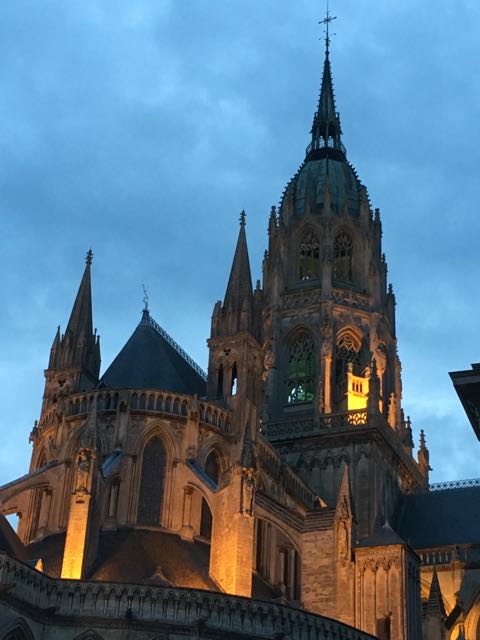
The rooms at the Villa Lara were spacious and comfortable. My sister and her husband had a room with a sitting area off the bedroom. It had gorgeous views of the cathedral.
The evening view of the cathedral
While we didn’t eat our breakfasts at the hotel — we’re a coffee and a pastry kind of family — we did visit the hotel bar one evening for Calvados, the local apple brandy. My sister, her husband, Bud, and I sat in the lounge sipping our brandy — a first for me — and relishing the experience.
New York Times always available so we could keep up with the news from home — the hotel bar is in the background
If I’m gushing about the Villa Lara, it’s because that’s exactly how I feel. It’s a place infused with hospitality. If I ever have the opportunity to visit Normandy again, I would plan my trip around their availability because for me, now, there is nowhere I would rather stay.
Traveling is a weary business. Especially when traipsing across time zones.
When you start in a rural area and end in a rural area, travel time is extended by the road time at either end.
We left Cooperstown around 12:30 PM and arrived in Bayeux around 1 PM the following day — which would have been 7 AM New York time.
A little walk, a little food, a little wine — and I was refreshed. When it got to be dinner time, my father didn’t join us because he wasn’t hungry. My sister stayed with him while the rest of us got some crepes.
The next day was to be our first day touring the Normandy beaches. I had gotten up early and been served a lovely tray of coffee in the lounge area downstairs. My sister joined me and we walked to a patisserie to buy some pastries. So far, everything was absolutely wonderful.
But…
an hour or two later…
I was in our room when my brother pounded on the door.
“I need you,” he said, and we hastily followed him back to the room he shared with my father.
My father was laying on the bathroom floor, his face roughly the same color as his t-shirt — white — and damp.
“I saw him hanging onto the counter,” Peter said, “like he was going to pass out, so I helped him lie down and got you.”
Bud quickly sat on the only available seat — the stool — and elevated my father’s legs.
We got a pillow for under his head.
And we discussed what to do.
Last year, right about this time, my sister stayed with my father, heard a crash, and found him on the bathroom floor.
My brother had gotten more than one call from Lifeline after my father had fallen.
I had seen him near-collapse and called the nursing service we use for home care.
Each of us had seen our father like this before —
And therein lies the blessing.
While it was scary, it was not unfamiliar.
“I think it’s a syncopal episode,” one of us said.
I remembered the nurse telling me that one of the causes can be dehydration. Had he drank enough while we traveled? Probably not.
I ran downstairs and got a glass of orange juice. By the time I got back upstairs, his color was much improved. My father felt like he could sit up, so my husband and brother lifted him to a chair.
Orange juice and pain au chocolat work magic
The episode passed. We had a reprieve. The rest of the trip went without incident.
He had a cardiology appointment when we got home. They interrogated his pacemaker and could tell that it hadn’t been a cardiac event. We had been correct in our assessment.
For one moment, I had visions of getting to know the French health care system — but because of my brother’s quick thinking to prevent a fall and our collective experiences with his syncopal episodes, we weathered that storm.
Sometimes, in the midst of a terrible situation, it’s hard to see the good.
And maybe the good is never really good, but becomes a relative goodness — one where you’re able to say a little thank you for a terrible thing that previously happened.
The man seated ahead of us on our Newark to Paris flight was large and loud.
I missed the beginning of the “discussion” because we were getting situated in our seats, stowing my pack in the overhead compartment, turning my phone to airplane mode, finding both ends of the seatbelt.
My ears tuned in at — “NO! You listen to me!”
His angry voice rose above the murmur of the other passengers who were doing the same things I had been doing.
The flight attendant, a neatly-groomed small-framed man who spoke excellent English with only a trace of a French accent, remained calm. “Sir,” he said, “I’m trying to explain.”
The passenger interrupted. “I’m paying your salary,” he bellowed. “You need to do what I say.”
“Please listen to me,” the flight attendant said. I was amazed at how unrattled he was by the confrontation. “I cannot give you two pillows right now –”
“I need to be comfortable on this flight!” the man interrupted with another bellow.
“Sir,” the flight attendant began again, “if you will listen, I will explain.”
I looked out the window at the raining pouring down outside, wishing I could be almost anywhere but there, where the groundwork was being laid for the next ugly airline confrontation. Getting my phone out to record it didn’t cross my mind.
“As long as your explanation includes a second pillow — ” the man said, interrupting again.
“Yes, sir, I have to wait until everyone is seated. We have only enough pillowcases for the passengers on board,” the flight attendant said.
“Well, what’re THOSE?!” the man asked, pointing to a small pile of pillows in an overhead compartment across the aisle.
“Those are pillows without pillowcases,” the attendant said.
“Gimme one of ’em,” grumpy man demanded.
The flight attendant complied, repeating the fact that it did not have a pillowcase on it.
“See?” the man said snidely. “We found a peaceful solution.” His sarcasm cut rudely through his words.
As he plumped his pillows and settled into his seat, the flight attendant moved down the aisle to assist other passengers.
I sighed. It’s no wonder Americans have a bad name.
The plane was quickly prepared for take-off and didn’t linger long on the runway.
Once in the air, the man ahead of me signaled the flight attendant as he walked past. He beckoned him to lean close, so he wouldn’t have to yell, but I could still hear.
“I’m sorry for the way I treated you,” he said. “I was out of line.”
“No problem, sir,” said the flight attendant.
Above the clouds, the rain was gone. The sun truly looked like a silver lining.
And the angry words were washed away in one man’s humility.
I more than survived the experience. In an unexpected twist, I was blessed by it.
I confess — I had to look up the meaning of evanescent, this week’s photography challenge. It means “soon passing out of sight, memory, or existence; quickly fading or disappearing.”
That’s describes my trip to France, I thought.
Life is already crowding out the moments I thought I would savor for a long time.
To hold onto the memories a little longer, I put together a two picture per day summary.
May 13 — Travel day
British Airways took very good care of us. At the urging of a friend, I upgraded both my father and my brother to each have a “Biz Bed”. Because we were traveling with someone who needed assistance (my father was in a wheelchair), we also got special treatment. I’m not exactly sure what all the little dots meant, but they were good. My brother and father got to eat in the British Airways lounge before the flight, while Bud and I had a quiet dinner in a little airport restaurant.
It was pouring when we left Newark. This was my view out the window.
May 14 Arrive in France, make our way to Normandy
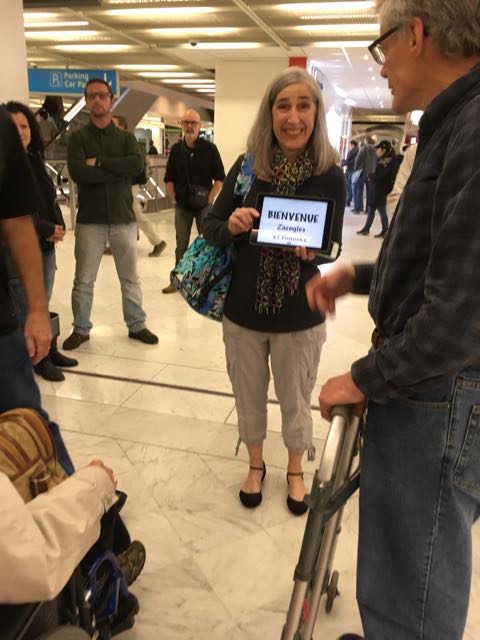
My sister and her husband met us at the airport.
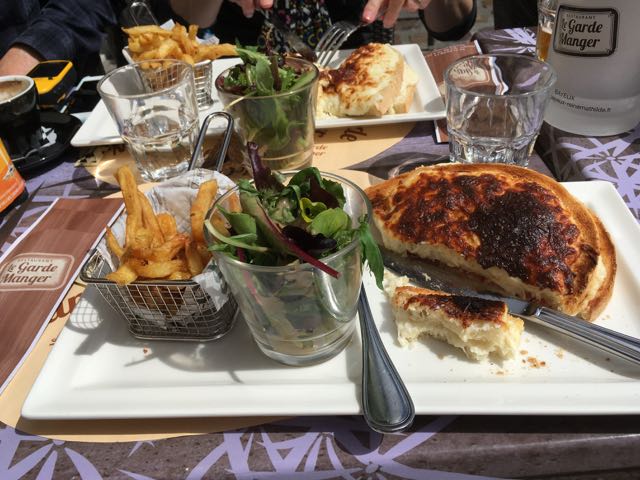
When we finally arrived at Bayeux, we were tired and hungry. I had Croque Monsieur for the first time in my life at a little cafe a stone’s throw from our hotel.
May 15 Normandy
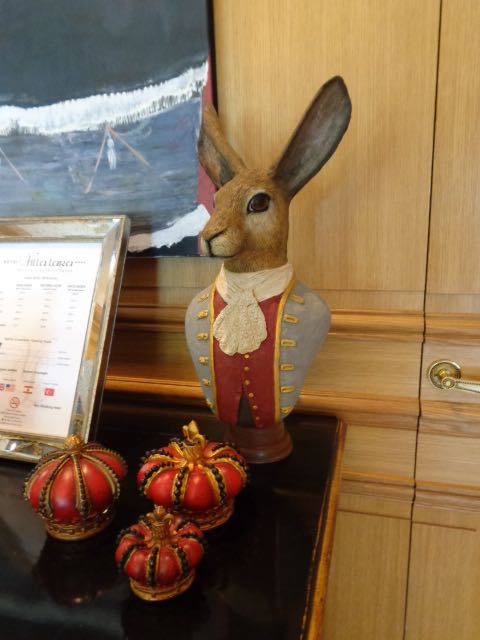
We loved everything about our hotel in Bayeux, the Villa Lara. This rabbit guarded the stairway door.
For our first day with our guide, he brought us to the Pegasus Bridge and the Canadian cemetery. Colin had so many stories to tell, but I think my favorite of all of them was here, of the bagpiper who played for the British troops.
May 16 Normandy
We had coffee every morning in a little sitting area off my sister’s room. I loved seeing the cathedral.
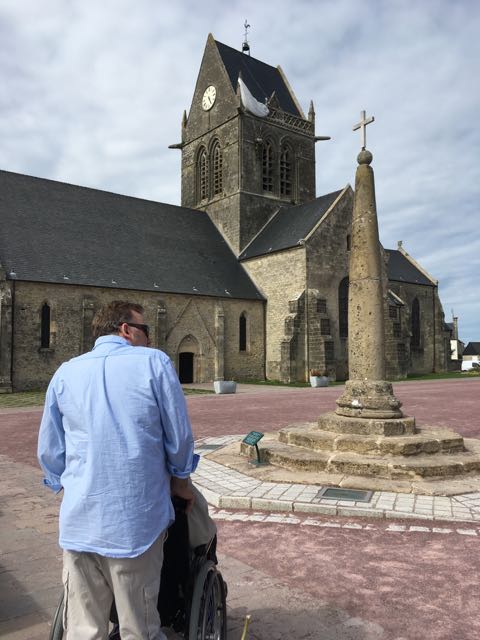
Among the places we visited this day was Sainte-Mère-Église where a paratrooper had gotten caught on the church steeple.
May 17 Normandy — then travel to Paris
The craters from the shelling at Omaha Beach were very impressive.
The view from a German bunker at Omaha Beach.
Then we drove to Paris.
May 18 Paris
We walked around Paris. Old and new stand side by side.
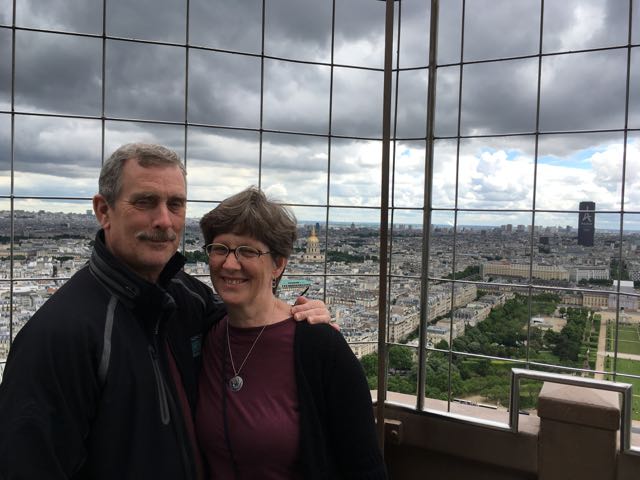
Dinner cruise on the Seine. The Eiffel Tower is pretty spectacular.
May 19 Paris
LaDuree — the macaroons are amazing.
Impressive art at the Petit Palais.
May 20 Travel day
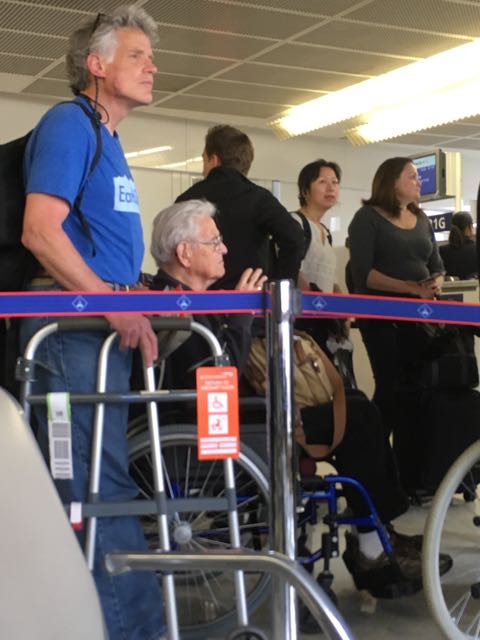
The return trip. Waiting at the airport.
I’m easily amused. I thought “Salad Sauce” was funny. The flight home felt a thousand times longer — I looked for entertainment where I could find it.
My sister asked at the beginning of the trip if there was anything special we wanted to do, I said, “Bud and I would like a dinner together, just the two of us.”
It happens so rarely. Still.
On our last night in Paris, we had that just-the-two-of-us time. We talked about asking the concierge to recommend a nice restaurant. We talked about riding on the top of a double-decker bus and touring Paris. In the end, however, we went for a walk.
If I had to pick a metaphor for my life, it would be a walk. One foot in front of the other, over and over and over — sometimes stopping to savor a moment, sometimes ducking and running as a storm blows through, but mostly just walking.
I’m so glad I have a companion for the walk.
If I had to choose a metaphor for Bud’s life, it would be a car. On one of our first dates, we went to see “Coal Miner’s Daughter.” The line was long to get in, and wound out along the sidewalk. As we stood outside trying to make get-to-know-you small talk, Bud started talking about a car. I can still hear him — “It wasn’t really a car — it was a work of art.” He described its leather seats and fancy wheels, and I had barely any idea what he was talking about.
For Bud, automobiles are a combination of utility and beauty. Bud embodies that combination — he is the hardest working person I know but he also pauses to appreciate beauty.
That night in Paris, Bud and I walked down the Champs-Elysées. We stopped at the Peugeot store — yes, there were car storefronts — and while I admired the beautiful ocean-y color of the car, he looked at the specs.
Then we continued walking down. Down, down, down — past the Grand Palais and the Petit Palais.
Earlier in the day we had walked there with my family and toured the fine arts museum in the Petit Palais. The Louvre seemed overwhelming to get to and tour with my father, but this museum was perfect for us.
As Bud and I continued our walk, we found a large event occupying the space between us and Les Invalides. They were preparing for the Paris ePrix, a Formula-1 type race using electric cars.
We walked down pit road. Clusters of people spoke with drivers and I wondered which of these was the Dale Earnhart Jr of eFormula. Bud studied the cars.
Years ago, as our metaphors clashed and life’s bumpy road put stresses on us, we went to see a counselor.
“You two approach life very differently,” she observed, “but you make it work.”
And we do. Both. Approach life differently AND make it work.
Because marriage IS a lot of work.
But walking or driving — it’s worth it.
35 years ago I could not have imagined being in Paris with Bud, but this walk through Paris, admiring the beauty of cars, was the perfect way for us was to celebrate our anniversary.
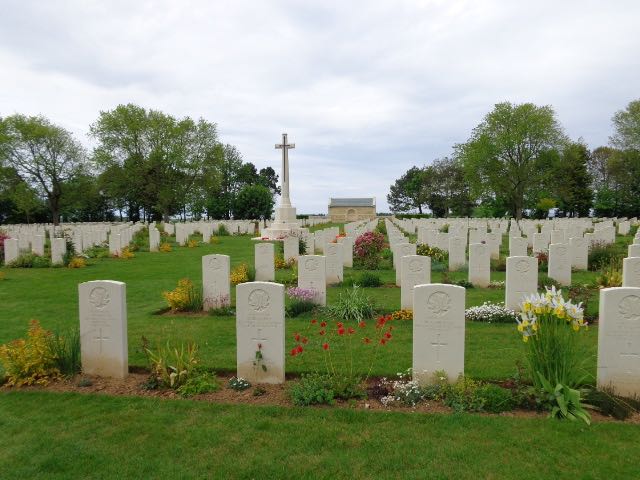
On our first day of touring Normandy, our guide ended the day at the Canadian cemetery.
I can’t tell you how many times over the course of the day, as Colin told us stories of the D-Day invasion, focusing that first day on what the British and the Canadians were doing, I said, “Really?! I had no idea that the Canadians were here!”
I confess, I did NOT do my prep for this trip. I was so focused on getting my father there and thinking about the details of that, that I didn’t finish any reading on it. In all truth, I barely began the reading.
“Did you watch ‘Band of Brothers’?” Colin asked more than once.
Nope.
“Have you seen ‘The Longest Day’?” he asked.
Nope.
I probably made a pretty tough audience.
“Just focus on him,” I told Colin, indicating my father. The rest of us — we were just filler.
Colin, my father, Bud
But yes, our lovable neighbor to the north — the most kind, friendly, big-brotherly people — the ones who, in the course of our vitriolic election, let us know that they think we’re great — those guys fought in World War II for the Allies. They took Juno Beach on D Day.
While I was still trying to wrap my mind around that, Colin brought us to the Canadian cemetery.
Military cemeteries are sobering places. France donated the land to all the countries for their cemeteries, even the Germans.
I heard a couple discussing that fact — and the husband said, “The French don’t hold grudges.”
But Canada’s was the first we visited — and I watched my sister wipe tears from her eyes. I watched through the fogginess of my own.
The Canadian cemetery
Rows of stones with names and ranks and divisions and dates of death etched below the maple leaf that decorated each one. Some families had other words, often about self-sacrifice, engraved as well. The Canadian government made the provision for families to do that.
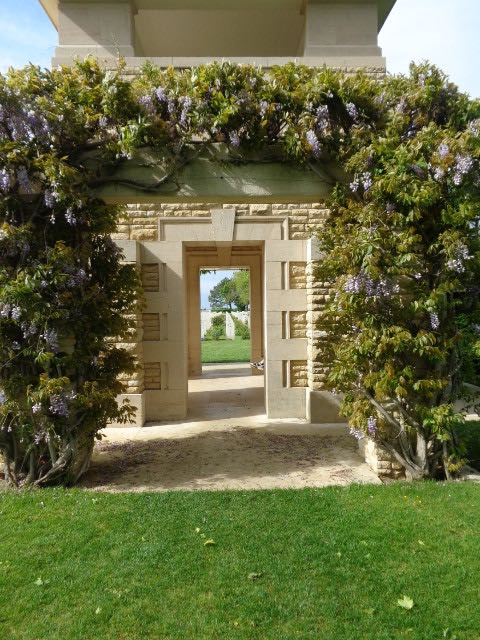
The grounds were so beautifully tended. Wisteria climbed the arches near the entrance. A variety of flowers bloomed between the stones.
Wisteria
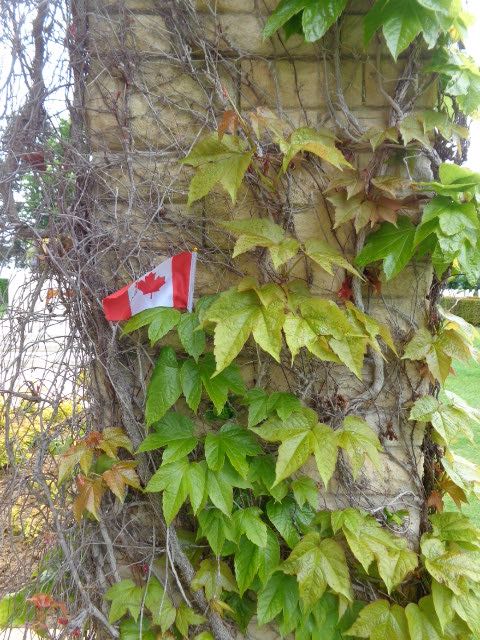
Visitors left small tokens. Pebbles on the tops of Jewish soldiers graves – to signify the permanence of their memories. Loonies and other coins on the tops of others. Paper poppies and wreaths at the center cross.
Someone’s small remembrance
Our heritage, our freedom, rested on the backs of these brave young men.
Three years ago today, as we waited word on the arrival of our first grandson, we also watched Karl and his partner, Michael, play tennis for high school sectionals.
In no particular order, here are a few things about my mother.
My mother was the youngest of four. She had an older sister and two older brothers. She was the one who took care of her own mother in her last decades.
My mother and her mother
My mother lived to the age of 87, although Alzheimer’s took her “in dribs and drabs” for years before that.
My mother loved gardening. Her father brought her some pansies when she was a girl and that started her love affair with flowers.
When my mother was weeding the gardens between the fence and the road, she would shake her fist at cars that drove by too fast.
On summer evenings, my mother always had a bowl and/or a bag and/or a cutting board so she could work on shelling peas or cutting up green beans from the garden. She would then freeze them in neatly labeled containers and we would enjoy them all winter.
My mother made the best soups in the world. Leftovers never went to waste. They would appear in soups and somehow tasted delicious. The turkey carcass at Thanksgiving turned into the best of the best soups. It would simmer on the wood stove for days.
My mother often put on her lipstick using the rearview mirror in the car, but she really didn’t wear much make-up besides that.
My mother struggled to tame her hair just like I do. Sometimes she would wet it down, curl it the right way, and put a little hair clip in to hold it while it dried. Then she would pull the clip out before she left the house (or sometimes the car) and quickly brush through her hair, hoping for the best.
My mother clipped coupons. Loads of them. And kept them in her purse in an overstuffed coupon wallet.
My mother lapsed into Boston occasionally when she spoke. “Pahk the cah on Pione-eh Street.” Most of the time she spoke the right way though.
When my mother would ask me to set the table for dinner, and I told her I was right in the middle of “The Brady Bunch” or “Gilligan’s Island,” she would let me wait until the show was over to do the job.
My mother gave me a negligee the night before my wedding. It was long and lacy and had a matching robe. She didn’t say much when she gave it to me, just “I thought you might like this.”
My mother flew to Wyoming to meet her oldest grandchild. I remember the way she carefully cradled his head because of an infant’s weak neck muscles, just the way she had taught me so many years ago in 4-H.
When my mother needed to hem a dress for me, she would have me stand on the dining room table and slowly turn while she used a yardstick and pins to mark the right length.
When my mother answered the phone, she didn’t say “Hello,” she said, “This is Mrs. P–” She taught me to answer the phone, “Dr. P–‘s resident, Sally speaking.”
When my mother drank wine, her cheeks got red.
My mother was registered nurse. When my youngest brother was in 7th grade, she went to work for the Red Cross, drawing blood at bloodmobiles. She was very proud of the fact that sometimes people would wait for her to be available to do the poke because she rarely missed.
My mother knew how to pick up snakes, using thumb and forefinger right behind the head. Her brother taught her, and she, in turn, taught me.
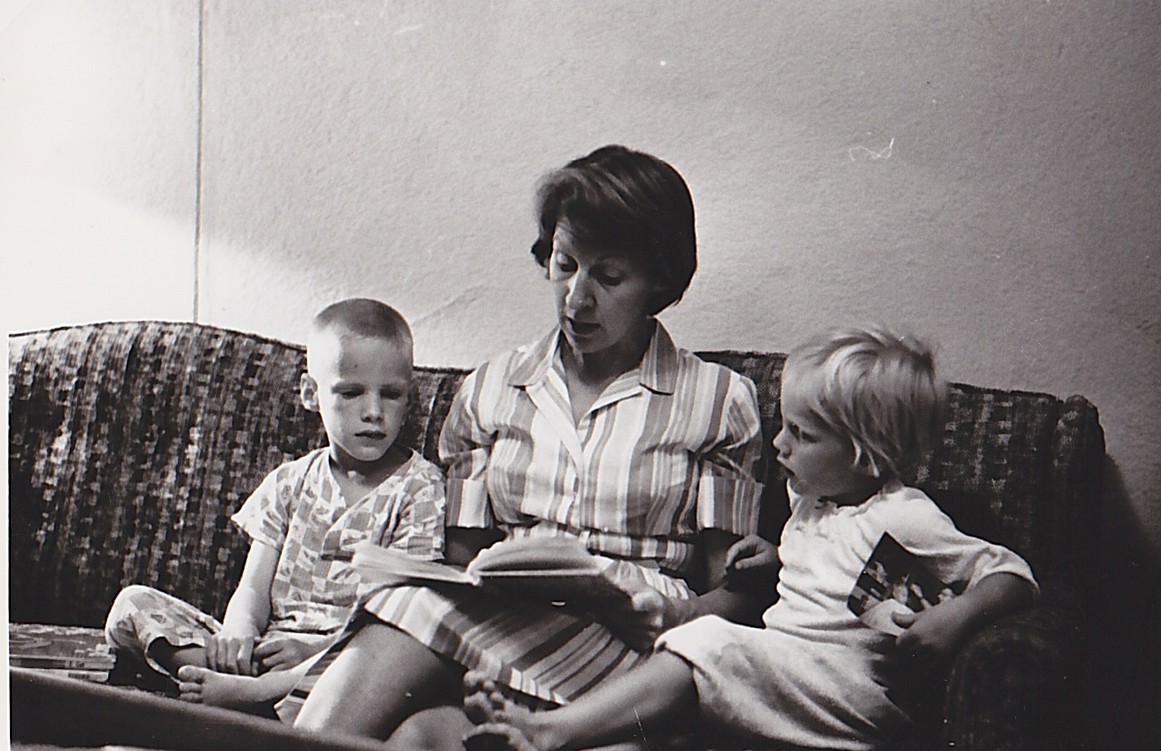
My mother read to me, sitting on the grey couch that we still have. My favorite books were “One Fish, Two Fish” and “The Poky Little Puppy.” I never heard her complain about reading them over and over and over and over.
My mother taught me to read.
I never heard my mother swear, except for “damn” and that was when she really mad or frustrated, and I’m not sure that even counts as a swear word.
My mother knew six ways to anywhere. She liked to drive ways with the least number of left hand turns, and sometimes she would take a longer route in order to avoid left hand turns.
My mother would drive a few extra miles to save a penny per gallon on gas.
My mother knew all the rest areas between Cooperstown and Myrtle Beach, and had mentally ranked them. She knew which ones were “good” — that meant they were generally clean — and which ones were not.
My mother always made us use the bathroom before we went on a car trip. If we told her that we didn’t have to, she would tell us to “go try.” We usually produced.
Once, when we were coming home from Christmas shopping in Albany, our car ran out of gas. My father hitchhiked to get some gas for us. I was convinced that I was going to freeze to death right there in the car, and my mother calmly had me lie down in the Vista Cruiser station wagon while she unfolded a newspaper. She placed the large newspaper sheets over me as a blanket. I’m pretty sure she saved my life, although nobody else seemed to be freezing the way I was.
My mother let me have her wedding dress, although I was nowhere near as tiny-waisted as she had been. The seamstress who made my dress used lace from my mother’s to make the yoke on my bodice and the cap for my veil.
MomDad, me, Mom
My mother wrote notes to herself and made lists, both of them to help her remember. I still find them occasionally. One will flutter out of a book, or be mixed with a pile of papers. I’ll recognize her neat handwriting and the way she underlined words that she wanted to emphasize.
My mother, in the summer, hung our sheets to dry on the clothesline by the chicken coop. When she made the bed with clean sheets, she tucked the corners in so tightly that my feet were squished when I first got into bed. The sheets smelled like green grass and fresh air, a scent no dryer sheet will ever reproduce.
My mother loved to sing. She sang in the church choir for as long as I can remember. When she was dieing, members of the choir came to her hospital room and sang hymns to her. It was some of the most beautiful singing I have ever heard.
This is my second Mother’s Day without a mother. It’s good to remember her.




 British Airways took very good care of us. At the urging of a friend, I upgraded both my father and my brother to each have a “Biz Bed”. Because we were traveling with someone who needed assistance (my father was in a wheelchair), we also got special treatment. I’m not exactly sure what all the little dots meant, but they were good. My brother and father got to eat in the British Airways lounge before the flight, while Bud and I had a quiet dinner in a little airport restaurant.











 Hot Dogs and Marmalade