fiction

Riding the Bus

I climbed onto the bus and smiled. We don’t have buses like this where I come from. As a newby traveller, I was determined to make my way places using public transport.

I only spoke English. “Should I learn their language?” I asked my friends from home.

“Nah, everyone speaks English,” more than one person had said.

It turns out that not everyone speaks English, especially in the smaller, more isolated cities.

The bus was mostly empty. I rested my head against the window and closed my eyes listening to the rumble-hum of the bus, the psssssshh of the airbrakes at each stop, and the murmur of words I couldn’t understand.

Suddenly I recognized words whispered in English.

“Your job is to grab the old lady and tie her up,” said a male voice in a gravelly whisper.

“Hush,” replied another male whisperer.

“She’s the only one in earshot,” said the first voice, “and I doubt she speaks English. Besides she’s sleeping.”

As they reviewed their plans to rob a rich woman in her home, I listened in horror.

Quickly I came up with my own plan.

The bus stopped in a crowded market area. The men behind me got off. I followed.

“Excuse me,” I called. They turned, and I snapped a photo of them on my phone.

“I’m scheduling a ‘send’ of this photo to the police. Meet me here tomorrow at this time with my cut and I will cancel the send,” I said, and slipped away.


This is my contribution to the Unicorn Challenge. The rules are easy: 1. Use the photo for inspiration, and 2. No more than 250 words.

Sometimes Most of the time my ideas are bigger than 250 words. That’s the hardest thing. I don’t think I did this idea justice, but I did bring it in at 250 words!

fiction · Writing

Skeecher

“Mom! I can’t find Skeecher!” Jeremy yelled.

Mom turned from the sink. This was the third time this week that Skeecher, a strange statue that Jeremy had unearthed in the garden, had gone missing.

Last week when she had sent Jeremy out to pick rocks from the newly-tilled soil of the garden, he moaned about the work like any normal 10-year-old. But when he came running in holding this dirt-covered statue of pot-bellied humanoid, he was anything but annoyed. He was delighted. Why Jeremy named it Skeecher was as much a mystery as the thing’s origins.

“Did you look on your dresser?” It sounded like an obvious place, but that’s where Skeecher was yesterday when they went to look.

“No! I looked there. AND the window sill. AND the closet,” Jeremy said, listing off Skeeter’s previous hiding places.

“I’ll help you find him” she said, drying her hands and heading down the hall. She opened the door to Jeremy’s room, and there was Skeecher standing in the middle of the floor.

“Is this a joke?” she asked.

Jeremy didn’t say anthing. He just scooped up the figure and hugged it.

The next day, while Jeremy was at his friend’s house, Mom heard noises in Jeremy’s room as she passed. She opened the door to see 6-foot tall Skeecher leap onto the desk and shrink to his normal size.

She ran in and grabbed the statue. His body still felt supple. His eyes blinked open and met hers.


This is my contribution to the Unicorn Challenge. It’s a challenge with only two rules: 1) no more than 250 words, and 2) inspired by the photo.

I know, I know — I’ve been MIA, but the creative tank has been low. Life.

And I realize this is an incomplete story. Again – life.

Don’t you think life is just one big incomplete story?

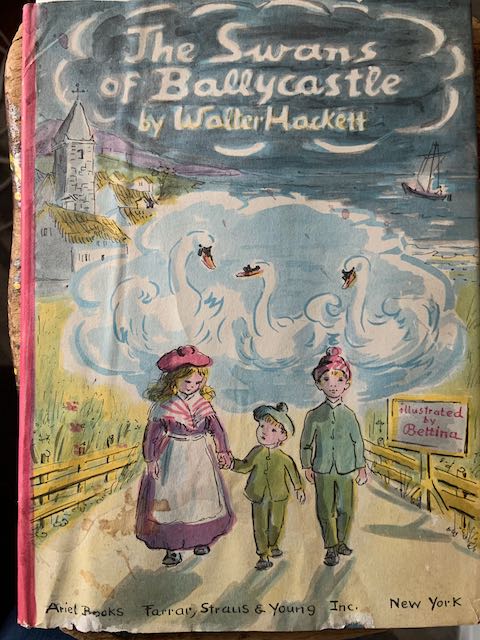
fiction · The Swans of Ballycastle · Writing

The New Swans of Ballycastle

In the Irish seaside town of Ballycastle, the people still tell the story of the three wandering swans…

Thus begins the original Swans of Ballycastle, and thus begins my tale.

The children and a single father are introduced: “Deirdre, the oldest was ten, Kevin was eight, and Michael was only five. Their father’s name was Brian and he kept a small shop in the center of Ballycastle. The three children and their father lived on the second floor over the shop. Their mother had died when Michael was very young. Brian, the father, raised the children as best he could.

The children were incredibly happy. They played make-believe games in the shop or wandered to the beach and built sandcastles. They were happy. They were content. Life was good.

One day, their father journeyed to Belfast to buy goods for the store. “In his absence, Widow MacConnell ran the shop and looked after the children. Not that she had much to do on that score, for Deirdre, as usual, took care of her younger brothers. She cooked, served the meals, swept and dusted and saw that her brothers went to bed on time.

Brian was gone a long time.

One morning the children rose and went downstairs. In the kitchen they found their father. With him was a strange woman.

[Here the Sally-version takes over]

She was short and round. Her hair was white and curly, like the caps on the waves. She wasn’t old, but she wasn’t exactly young either. Her dress was ocean blue, billowy and soft. Her smile, when she saw the children, grew and grew. It was warm and welcoming.

Deirdre wanted to run to her immediately for a hug, but something stopped her. She didn’t know this woman and she was her brothers’ protector. Instead she looked to her father.

He took another sip of his coffee, stood, and said, “Deirdre, Kevin, Michael — This is your new mother.”

He opened wide his arms and the children ran to him. While they were gathered in their family hug, he reached his arm out to the new woman and pulled her into the embrace. Deirdre thought she smelled like the sea breeze and welcomed her closeness.

Her name was Cordelia, but she insisted that the children call her Corrie. “I would never dare to presume that I could replace your mother,” she said, “but I promise to love you as best I can.”

Corrie’s favorite thing to do was walk on the beach. Every morning, she led the little entourage to sandy shore. Michael held her hand now, instead of Deirdre’s when they walked.

Kevin and Deirdre found that Corrie had a wealth of wisdom about the sea and the shells and the birds and the fish. They would run ahead when the beach was in view and begin their hunts.

“What’s this?” they would ask, bringing her a shell. She always knew the name and a story about the creature that lived inside.

One day Deirdre found a golden coin stamped with the picture of a swan. “Look, Corrie,” she said, extending her open hand to her with the coin on it.

A shadow crossed Corrie’s face. “Throw that away,” she said sharply, “as far as you can into the sea.”

Deirdre pretended to throw it, but she folded her thumb over the coin while she made the throwing motion, then stealthily slipped it into her pocket.


Okay — this new story is going to take more than one day’s work. Tune in next Tuesday, for part Two.

fiction

Quarry Road

“Come see me,” he said. “It’ll be easy,” he said. “Throw a pebble at the window,” he said.

Those words irked me. He thought it was easy, but it wasn’t.

“It’s the big stone building on Quarry Road,” he said.

Quarry Road, sheesh. That should have been my first clue that every building on that road was built from stone.

I ruled out the cottage right away, then the houses, even though some were pretty big.

The stone barn was impressive, stone silos and everything, but he would have called it a barn.

But after the barn, there were fields. And cows.

Off in the distance I saw the big stone building, sitting on top of the hill at the end of the road. Why didn’t he say, “It’s the last building,” or, “Go past the farm,” or “Top of the hill.” Sheesh.

Found it. Went around to the back. Yep, windows.

“Throw a pebble at my window,” he had said. “It’ll be the only one with the shade pulled all the way down.”

Right.

Actually, wrong.

There were two with the shade pulled: one on the third floor and one on the first.

I kept thinking, This. Makes. No. Sense.

If I throw at the 3rd floor, I’ll miss. My throwing is imprecise at best. The first floor window? I could just go tap on that one!

“Whatever you do,” he had said, “don’t hit the wrong window. Something terrible will happen.”

He didn’t tell me what.

Finally, I —


hit my 250 word limit! So sorry!

The Unicorn Challenge is very strict about their 250 word limit.

And we’ll probably never know what happened, unless, of course, YOU know —

family · Life · Writing

Success

The other day a friend posted on Facebook a rejection she had received for poetry submitted for publication.

She is a wonderful poet and writer, and I ached because a rejection feels like, well, a rejection — a failure — and she is not a failure.

How do we measure success? I asked myself — and, in a flash, I saw the scene that I wrote out below. It’s a totally made up story, kind of like a nightmare — but here it is for what it’s worth.

“Thank you for filling out the questionnaire,” the doctor said, studying the paper in front of him. He was checking off my answers with a pencil. I felt like it was more a quiz, than a get-to-know-you form for the first visit.

“You prefer to be called Sally?” he asked, looking up at me.

“Yes, I do,” I replied. I smiled at him, but he was already looking back down at the paper.

“Height, okay… Weight,” he looked up at me again. “You might want to lose a few pounds.”

“I know,” I said, “but things have been stressful lately, and I stress-eat…” My voice trailed off. I was hoping for a bye, but he just kept going down the list.

“You noted that you’re a writer,” he said, looking up again.

“I did?!” I said, questioningly because I didn’t remember putting that down.

He picked the paper up and turned it toward me, his finger pointing at a fill-in-the-blank mid-page. In my handwriting, next to the word “employment,” was the word “writer.”

“Oh,” I stammered, “I’m not really a writer. I don’t know why I wrote that.”

“Do you write?” he asked.

“I guess,” I said.

“Have you submitted pieces for publication?” he asked.

“A few, I guess, a long time ago.”

“How many times have you been rejected?” he asked. It was more of a demand.

I squirmed uncomfortably. What was this all about? I wondered.

“I don’t know,” I said. “I don’t understand. Why do you need to know this?”

He glared at me.

“Can I change my answer?” I asked.

“Real writers have a pile of rejections,” he said. “I think changing your answer would be wise.”

He picked up a pen and neatly crossed out my response, then sat with pen poised waiting for my new answer. “Employment?” he asked.

“Umm.. I’m mostly a mom,” I said.

“How many children do you have?” he asked.

“Eight,” I told him.  I found myself sitting a little straighter in the chair now. Surely this would impress the man.

“How many times have they broken your heart?” he asked.

“What?!” I asked.

“You know, how many times have they fallen, made bad choices, or failed?” he said.

“I thought you would want to hear about their successes. They’re doing pretty well,” I said.

“Real mothers have their hearts broken on a regular basis. They start off putting bandaids on skinned knees and move on to bruised egos and hurt feelings. They ache with their children. I’m trying to determine if you are a real mother,” he said, and then he repeated his question. “How many times have they broken your heart?”

I thought of the many emergency room visits, the hospitalizations, the times I stood outside a bedroom door and prayed for the child inside. I thought the listening and the insufficient advice I tried to give. I thought of skinned knees, skinned hands, stitches in the head, broken bones, tears, tears, tears, and more tears. I thought of driving when called for help and crying all the way, dropping kids off for college and crying all the way home, and watching them get married and crying for joy.

“How many times have they broken your heart?” he asked for the third time.

“None,” I said.