family · Life

Primary Experiences of Life and Death

Many persons live their entire lives without ever seeing a human being die.

Howard Thurman, “Life Must Be Experienced” in The Inward Journey
My father caring for my mother in her last days

At the time, I didn’t realize what a privilege it was to sit with my mother and then my father as they passed from one life into the next.

In some ways, it felt like an awfulness. Especially with my mother, with that gurgle of excess fluid that the nurse would suction out to make her more comfortable. It’s a sound I won’t forget.

And I prayed in my mother’s last few days conflicting prayers of “Please, Lord, let her live until my sister gets here” and “Please, Lord, relieve this terrible suffering.”

She lived until my sister arrived. We were all gathered around my mother’s bed in the hospital — her living children and my father — as she died.

My father went more quickly. One day he was up, dressing himself, coming out breakfast. Before the end of the day, my children had to help him back to bed. The next day he didn’t get out of it and he died that evening.

My brothers were there. One sister-in-law. One nephew. Most of my children. His home health aide. My sister had not yet arrived. My brother played a song on a CD for him as he passed.

My sister got there in the wee hours of the morning and went to see him as he was laid out in his bed. The hospice nurse who had prepared the body had clasped my father’s hands across his abdomen and it looked so unnatural. He looked so dead, and I wished with all my heart that my sister could have seen him alive one last time. We had Face-timed with her in the afternoon, but it’s not the same.

These days, the stories that come out of the hospitals impacted with COVID are awful — the shortages of rooms, equipment, and personnel. The makeshift morgues. The isolation.

I wept one day in the car listening on the radio to a nurse describe staying over and over after her shift had ended to sit with a dying patient because she didn’t want anyone to die alone. How many patients had she done that with? I don’t remember — but it was many.

And I realized the great privilege I had — to sit with my parents in a non-COVID world and tell them I loved them one last time.


A to Z Blogging Challenge · Grief

Blessed is Resurrection

When my father passed away at home, I didn’t know what would happen next — so I went for a walk.

That Sunday spent watching him decline, decline, decline — sitting by his bed — pacing — calling hospice and family and hospice again — trying to make the best decisions based on what he had said he wanted — it all made for an incredibly long day.

Yet, at the same time, the day was too short.

Suddenly he was gone.

I cut across the yard when I left the house, walking past the red maples he had planted 40 years before. Their burgundy leaves were half on, half off —  trees caught mid-way through their fall undressing.

The oak tree I passed was barer. Its brown leaves and acorns littered the ground. Many of the acorns were cracked and broken. I wondered if the damage had been done by squirrels or the fat woodchuck I often saw in that corner of the yard or the heavy equipment that had driven through there earlier in the week to replace our septic system.

The acorns held no promise of a mighty oaks, just broken pieces with jagged edges.

The walk refreshed me, but, back at the house, we moved in a thick fog.

While I had been walking others had left, or come and gone, or stayed, waiting to say good-bye to me.

My two grandsons had been in the house when my father passed. When I heard them playing in the other room, I thought about an article I once read about Irish wakes and how healthy they are for children — to be around death and see that it is a part of life.

In the midst of life we are in death.

Book of Common Prayer

I said good-bye to the grandsons and to my oldest son who looked so weary and so grown-up. I wished he was the size of his boys and this hurt was a boo-boo a bandaid could cover.

A knock on the door surprised me. The man identified himself as a hospice nurse. “I’m here to clean the body,” he said.

I showed him to the room where my father lay. My father’s face looked ashen and waxy.

“Do you have some clothes I could dress him in?” the nurse asked.

My father was still wearing his old red Fenway shirt. He liked to wear Red Sox apparel when he watched their games, and the last game of the season had been on when he passed away.

I chose a favorite flannel shirt and a pair of corduroy pants that went with it.

Leaving the room, I re-entered the family fog. Pea-soup fog, my mother would have called it, so thick you can’t see your hand in front of your face. People may, or may not, have talked with me. I may, or may not, have responded.

The nurse finished. He ushered us back in the room with my father.

My father’s hands were folded on his abdomen. It was a pose I had never seen him in before. He looked so dead.

I look for the resurrection of the dead and the life of the world to come.

Nicene Creed

*****

It has now been 3 1/2 weeks since my father passed. When I close my eyes, I see that dead body. I see my sister coming out of his room, closing the door behind her, at 2 AM. She had just arrived and wanted to see him. I see the funeral director arriving at 8 AM and using the front door to remove the body.

I close my eyes and see death.

Ah, but the Nicene Creed. “I look for the resurrection…”

When I look for resurrection and life, it’s there.

The new grass pushing through the straw where the lawn was dug up for the septic. The two stubborn Shasta daisies that refuse to give way to fall. The geese flying south, calling my attention to them with their noisy honking.

It’s a beautiful sound.

At the memorial service, my son Owen read Wendell Berry’s poem, Wild Geese.

… Geese appear high over us,
pass, and the sky closes. Abandon,
as in love or sleep, holds
them to their way, clear
in the ancient faith: what we need
is here. …

I am surrounded by life in all its beautiful and terrible stages.

Many trees in the yard are already bare, but I’ve lived long enough to know that, in the spring, new leaves will appear.

I know the geese will return, too.

On my walks I see woolly bears hurrying across the road. Sometimes I help them along — picking them up and watching them curl into a ball in my palm, then gently placing them on the other side of the road. I figure it’s one less death for the day.

And I sort through a few of my father’s things.

Life goes on.


A to Z Blogging Challenge · Grief

Blessed is the Quiet

I turned the monitor off Sunday morning not knowing it would be the last time.

For three and a half years I have slept with one ear open, listening to the monitor, learning the sounds of the different creaks of the hospital bed in the room below me.

One creak meant he was getting up. It was followed by the shuffle-thud of him walking with his walker into the bathrooom.

A different creak meant he was getting back into bed. I could hear the soft rustle of the bedding as he rolled onto his side and pulled the blankets up above his shoulders.

If I didn’t hear the back-to-bed creaks but heard the click of the light switch, I knew I needed to go down and redirect. He would be heading to his closet to choose clothes for church — no matter what day of the week it was. Sometimes that happened at 11:30 PM and sometimes in the wee hours of the morning. Sometimes it was every hour throughout night.

The monitor sat on my bedside table where its yellow light showed me it was on and its faint buzz served as a secondary reminder.

Now I hear the deep breathing of my husband sleeping beside me.

Just the other day I had been telling someone that I hadn’t heard the coyotes all summer. With the monitor off and the insomnia on, I could hear them, their long lonesome howls coming from somewhere farther away than previous years, but still there.

I hear a bird I can’t identify.

I hear gentle rain hitting the wide leaves of the hydrangea.

I hear the obnoxious sounds of vehicles driving on wet road. I can identify the milk truck, the speeding pick-ups, the cars. I can tell it’s foggy because everyone drives so much slower.

It’s so quiet, though, without the monitor.

Too quiet.

I want to hear the bed creak and the shuffle-thud.

My father passed away Sunday night.

He had dressed himself Saturday morning and eaten a bowl of cereal. Mid-afternoon he vomited brown-black — a sign of a GI bleed. He went to bed before dinner, and never got out of it again. The next day he was gone.

Thomas Merton said, “Prayer and Love are learned in the hour when prayer has become impossible and your heart has turned to stone.” (Seeds of Contemplation)

Prayer and love are learned in the quiet of a monitor that been turned off.

Merton also said, “The monk faces the worst, and discovers in it the hope of the best.” (Contemplative Prayer)

I’m facing the quiet.

I’m looking for the blessing.

Grief · Life

The Brindle Boxer

When I pulled in to the veterinarian’s office, the red-bearded man with the brindle boxer was standing out front.

Maggie was fluctuating between ecstasy and fear. She had been delighted when she got to go for a ride in the car, but she recognized the building when we pulled in. The dog out front delighted her — Maggie is very social — but the door just beyond terrified.

She jumped willingly out of the car. The boxer squared off in the middle of the sidewalk.

It was a big dog, solidly built. She laid claim to the sidewalk, blocking our way to the entrance. The man made no move to move her. I nudged Maggie to my right side so I would be between her and the boxer. I knew Maggie would want to give an exuberant hello and I wasn’t the boxer shared the sentiment.

The man watched me shift Maggie.

“Don’t worry,” he said, “she can’t see nothing.”

I had already launched into my usual Maggie’s-biggest-problem-is-she’s-overly-friendly line when I heard him add as we passed, “She’s dying anyway.”

His words seeped in as I took Maggie through the door.

I should go out and say something, I thought, as I sat on the bench in the waiting room, but Maggie had already started her shiver-and-shed routine. She really doesn’t like visiting the vet.

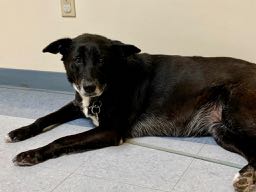
Maggie at the vet

While calming Maggie, I made small talk with a woman who had worked with my father. Her cat waited quietly in a red backpack cat carrier on the bench next to her. We waited and chatted while people dropped off and picked up their cats, mostly. Through a window, I could see the man with the brindle boxer standing outside, still owning the sidewalk, although it looked a lot less like ownership now.

A technician came out and called a name. Three people, a woman roughly my age and two young adult children, stood. The girl went outside and came back in with the man and the boxer.

“We have a private room here,” said the technician as she opened a door behind her.

I couldn’t see the other faces, but I could see the man, pressing his lips together, the corners of his mouth turned down, as he slowly led the boxer in. A few minutes later, the girl came out again, her eyes red and puffy. She went outside and came back with an older man, who walked very slowly.

The door to the room opened.

“Pop, we’re in here,” said the red-bearded man. His voice broke.

The girl followed her grandfather. She was openly weeping now. With her back to me, I saw the large sparkly letters on her gray hoodie — “LOVE LOVE PINK.”

I wished I could magically change it to read “LOVE LOVE BRINDLE” because I knew that’s what she was feeling.

The small talk ended. My father’s friend and I both watched the drama with heavy laden eyes as the family closed the door to their private room at the vet.

“So hard,” she whispered to me.

Yet, we were witness to a well-loved dog surrounded at the end by three generations.

Sometimes the most terrible things are also the most beautiful.

family

My Mother’s Closet

My mother’s  closet has only been hers.

When my parents bought this old farmhouse 50 years ago, it had one closet — a tiny one, at that.

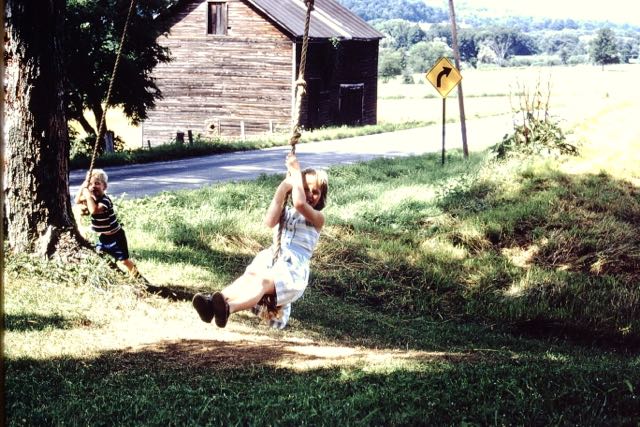
While we kids put up a rope swing, my father put in closets.

Putting up the rope swing

Swinging

putting in closets

Bi-fold doors must have been in then, because that’s what he installed — in his closet, my mother’s closet, my sister’s closet, and my oldest brother’s closet. The rest of us didn’t get closets; we had cardboard wardrobes.

I stood outside my mother’s closet the other day, hesitating to open the door. It has to be done — the cleaning of it, I mean. She’s been gone over a year and a half. My son is staying in that room. And he sure could use a closet.

But I stood there, not wanting to look again at what’s inside.

The brown wool plaid skirt. The green skirt with Greek meander border. The dress she wore at my wedding.

The ruffled blouses that she wore to dress up.

The sweaters.

The housecoats, even.

They’re housecoats, for crying out loud.

But I can picture her standing in the kitchen wearing them, making our lunches for school.

A woman I know lost her house in a fire recently.

Is that how you want to deal with your mother’s things? a voice whispered in my heart. I knew it wasn’t God, because He didn’t burn my friend’s house down. He doesn’t threaten to burn houses down. I saw, however, in my mind’s eye, my fingers being forcibly pried off the things I’m holding onto.

Is that how I want to deal with my mother’s things? No. Absolutely not.

But they must be dealt with.

Garbage? No. That’s wasteful. My mother was never wasteful.

A yard sale? No — I don’t think I could bear watching people paw through her things.

Donate to the church’s rummage sale? No — same reason.

I think I need to box it all up and take it to a donation point in another city. She would want some good to come of it all.

Then, I’ll have to look at an empty closet.

And mourn a little, allowing the closet’s history to move just a wee bit distant into the past.

Before my son moves his stuff in and the closet has its second occupant.


A to Z Blogging Challenge

November

“Did I do anything for your last birthday?” I asked Laurel this morning.

I honestly couldn’t remember. Laurel’s birthday and my mother’s deathday were too close together.

“Uh-huh,” she answered. “You made rice.”

Not really sure that will win me any parenting awards. Rice. In the microwave.

But it is one of her favorites.

November was a blur.

“Did I buy you any presents?” I asked her.

“Yes,” she answered. “Pajamas.”

At least it wasn’t socks and underwear.

Wait — maybe I got her those, too, and she was too polite to tell me.

I remember so little of that month.

Did we celebrate Thanksgiving? Did I make the turkey?

What did I do for the 30 days that November hath?

I looked through the pictures on my computer for clues.

Here is the story they told:

On the day my mother died, I noticed the sunset. IMG_7769 (1)

My sister and I helped my father.

Donabeth, Dad, and me

On Laurel’s birthday, I went for a walk.

The stone bridge

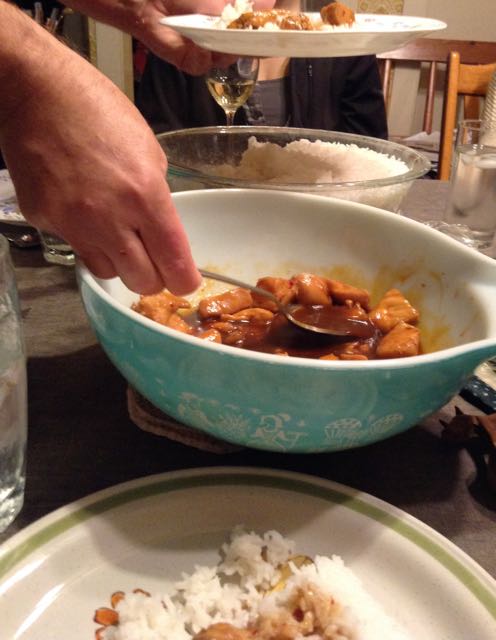
I made the previously mentioned rice — and some chicken to go with it. Broccoli, too, but it didn’t make the photo.

Birthday dinner

The kids played cards (probably while I was making rice).IMG_0340

And all through November, life continued.

Family gathered.

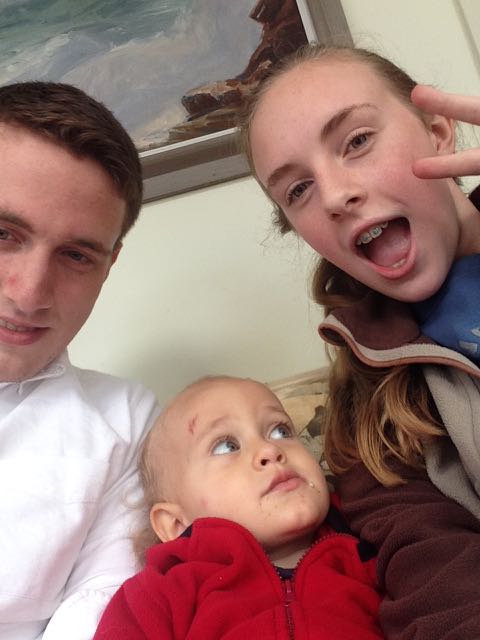
Jacob, Henry, Laurel

We played games.

Family games

I sat at the Columbarium.

The Columbarium

Laurel swam.

Swimming

I noticed a sunrise.

Sunrise

And I’m pretty sure we had Thanksgiving.IMG_7874


A to Z Blogging Challenge · family

Long in the Tooth

I’ve occasionally wondered what was in the guy’s trailer by the time he got home.

He started off with an empty trailer and some debts he needed to collect.

At the first stop, he got a dirt bike because the guy didn’t have any money to pay him.

At the next, he traded the dirt bike for a horse.

When he arrived at our house, it wasn’t to collect a debt, it was to look at a pregnant heifer that my dad had advertised in the Pennysaver (<— Craig’s List of 1970). To make the story of the pregnant cow short and tasteful, my brother had been given a Holstein calf which we named Sock-It-To-Me Sunshine.

Peter and the calf, named Sock-It-To-Me Sunshine, with Shetland pony, Rosie, in the background
Peter and Sock-It-To-Me Sunshine, with Shetland pony, Rosie, in the background

It grew up.

Clearly we were not sure what to do with a calf.

The dairy farm next door had a bull instead of an artificial inseminator. The bull and the heifer had a surreptitious rendezvous, and voila.

So the guy showed up with a horse in his trailer. He left with Sock-It-To-Me Sunshine (in the family way) in it instead.

Goldie
Goldie

Peter got the short end of that trade. He lost his cow and I got a horse, a large Palomino named Goldie. (I think, at the time, we also had a cat named Gray Kitty and another named Black Kitty. I would say that we weren’t skilled in naming animals, but I’m not sure if a cow named Sock-It-To-Me Sunshine makes my point or disproves it.)

Goldie was large and docile. I usually rode her bareback because getting a saddle on her and then getting the girth tight enough so that it didn’t slip was beyond my strength. Sometimes I didn’t even put the bridle on but just looped a rope around her halter. She was so patient with me.

I never knew how old she was. I asked my father, but he didn’t know. He also told me, “Don’t look a gift horse in the mouth,” and I had to look up the meaning of that saying. It turns out that a horse’s age can be determined by their teeth.

I also learned the saying, “Long in the tooth,” because a horse’s gums recede as they get older so their teeth appear longer.

Goldie was not long in the tooth when we got her. She was young and healthy and brought me great joy. When I grew too busy with school activities, she went on to bring another family great joy.

My mother was long-in-the-tooth by the time she died. Not literally.

But she was 87.

I’ll never forget the young doctor meeting with us and beginning with the words, “Mom is very sick.”

Here she paused and looked slowly around the room at the gathered family members. She wanted her words to sink in.

“And she has been sick for quite a while,” she continued.

She boldly laid all the cards on the table, face up, so we could all see the hand that had been dealt.

Long in the tooth, when it comes to elderly dementia, means a deteriorating brain.

She wasn’t just losing memory. She was losing the capacity to live.

Hours. We spent hours talking about my mother’s condition. I grew longer in the tooth in those few hours than I had in my whole life.

Weight piled upon weight piled upon weight.

I felt that I would never be able to stand under all of it.

When the meeting was over, we had acknowledged a trade.

Not a horse for a cow, but a new existence by letting go of this old one.

When we got home, my sister found the health directive my mother had written years before. We had followed my mother’s wishes, and that brought peace.

In trading, sometimes you win, sometimes you lose. I think both happened that day.

family

Ashokan Farewell

It felt like such a private moment. The delicate strains of the violin playing Ashokan Farewell swirled around us in the great sanctuary.

I watched her play, and then I had to look away.

It was Bob Herst’s memorial service. I knew that I needed to be there.  Our families’ lives have long been intertwined. Both families, ours and the Hersts, arrived in Cooperstown in 1967. They had four children, we had five — my youngest brother the only one without a corresponding Herst.

In those early years, I sat in the front row and played tic-tac-toe with Calvin on the nap of the velvet pew cushions of the Presbyterian Church while his father stood at the lectern and preached. Calvin knew the Lord’s Prayer and all the words to the Nicene Creed; at the age of 8, I was duly impressed.

We vacationed with them in Myrtle Beach. One time, at a crowded restaurant, in order for our large party to be seated, we had split up — adults at one table, children at another. Ricky harassed our waitress by flipping up his eyelids and batting them at her while he ordered.

Oh, the memories.

When someone at the memorial service talked about the Herst’s hospitality, I remembered sitting in their kitchen while Ricky prepared blue mashed potatoes. I mentioned it to him yesterday.

“You were ahead of your time,” I told him. “I thought of you when they started coming out with blue foods.”

I thought of me when they started making blue foods,” he laughed.

But their house was always open. I never felt unwelcome there.

And it seems like there was always music there. Sweet music. Rich music. Cello. Violin. Piano. Trumpet. French horn.

Calvin played the organ at my wedding. He has made a living of music.

Jean Herst -- waiting to play
Jean Herst — waiting to play

He accompanied his mother at the memorial service.

Ashokan Farewell — gentle and sorrowful.

She began playing solo and then Calvin joined in.

Although, she had a music stand in front of her, I don’t think she looked at it. Her eyes were closed and the music rose as the bow passed over the strings.

Heartache was etched in the lines on her face, but love poured from the violin. I watched until I couldn’t bear it.

She held the last note and left it lingering over us.

When she stopped, silence fell on the seated congregation.

How can anyone speak after that?

playing Ashokan Farewell

Later I hugged her.

“You were so brave,” I told her. “You played beautifully.”

“It was his request,” she said.

Nearly 66 years together. She honored him well.

Stewart

Pieces of Stewart

IMG_3634[1]The following is the text of what I said at my brother’s memorial service.

My siblings and I carry little pieces of Stewart in our hearts and in the way we live our lives. Each of us reflects Stewart in little ways. Today I want to mention some of the ways I see Stewart in my brothers and sister.

First, I want to say something to my mother and father. Dad, Mom, as I went through the papers from Stewart’s apartment, I saw something about you that I didn’t want to go unnoticed or unmentioned. Mixed in with all the other papers were notes from you – words of encouragement, spanning years and years of his life. Every step of the way, you were there for Stewart. In his times of accomplishment – when he graduated from Hamilton, Yale, and Syracuse – and Dad, I know you were especially proud that he passed the New York State bar on the first attempt – and when Stewart encountered difficulties, both of you were faithful and supportive. I don’t say it often enough, but thank you for all you have done and still do.

Donabeth – you and Stewart shared the secret language of Presbyterians. And it is a secret language. You Presbyterians say the word “Session” with a capital “S”. I can hear it when you say it. You and Stewart used words like synod and polity and stated clerk, and you knew what they all meant. The Book of Order, a Presbyterian thing for sure – you know, Stewart had at least 20 of them. And all that General Assembly stuff, you knew about it. I was clueless. Donabeth, the other thing you share with Stewart are the most memories. Being the two oldest, you had the most time together. Things like Stewart doing that dance before he pulled up the stump are memories I have only because of the movie Dad took – you probably remember that moment. Lucky you.

Peter – When Stewart passed away, the mantle of the oldest son passed to you, and you took it on admirably. You handled the phone calls and the arrangements and speaking at the Memorial Service in Pittsburgh so well. Thank you. When I think of the similarities between you and Stewart, I think of his sense of humor. It’s a sharp wit, an educated wit, that makes mathematical jokes or periodic table jokes. I also think of the way your minds both can see numbers as playthings. The tessellation art that you gave each of us for Christmas one year reminds me of that fractal thing Stewart had running on his computer in Jamesville. That was back in the days before everyone had computers. Stewart had a home computer and wrote computer code things back in the ’80s. Stewart also could take the complex and make it seem simple – something a teacher does, something you do, Peter, as you teach and tutor. It’s a gift – and a similarity to Stewart.

Jim – You and Stewart are the bookends. I have always appreciated the symmetry of our family – boy-girl-boy-girl-boy. Stewart was the oldest, and you were the youngest. When we were cleaning out Stewart’s apartment, I found a pile of neatly cut wood blocks in the closet, and they made me think of you. You’ve made some beautiful things out wood: shelves, frames, planters. Stewart was obviously planning his own wood project. It’s that ability to create something tangible, something beautiful, the ability to craft something – you shared that with Stewart. I’m only sorry that the wooden walking stick that Stewart made didn’t make its way back here to you, but all things are transient. We have to hold everything with open hands, even the memories, as Mom reminds us. But we can tell the stories and relive our times with Stewart. You’ve mentioned to me several times about your time spent with Stewart when he moved to Tarentum. What a gift for you to have had that one-on-one time with him! Precious memories of two bookends together.

Me? – Stewart and I shared a love of books. Mary has been going through the boxes of books at our house. “I just love the smell of books,” she said to me one day, because there is something special about that dry papery smell and the feel of old hard-bound books; a Kindle can’t replicate that. Stewart and I also shared a love of new notebooks. When I was a kid, one of my favorite places in all Cooperstown was the back room of Augur’s Bookstore, where the office supplies were hidden away. I loved to go look at the brand new notebooks, clean and unspoiled. There’s something about a new notebook that holds so much promise. As we cleaned out Stewart’s apartment after his death, we found, I daresay, over a hundred legal pads, composition books, steno pads and other notebooks, nearly all with only the first few pages written on. He was always looking for that fresh start – and I can relate to that.

In closing, I found Stewart’s little black notebook that he used for funerals. On one page was written the poem “Do Not Stand At My Grave and Weep” by Mary Elizabeth Frye. I rewrote it for Stewart.

Do not stand at my grave and weep.
I am not there. I do not sleep.
I’m a ride to the doctor, a helping hand.
I’m the good listener. I understand.

I’m the synod, the session, the stated clerk.
I’m the thing that is funny, the little quirk.
I am wit and pun, fractal, tessellation.
I am homemade chili on family vacation.

When you see and feel the beauty of wood,
Think of me then, and do something good.
I’m a partly used notebook, the words of a hymn.
I’m in Donabeth, Peter, Sally, and Jim.

So do not mourn that I’ve gone afar.
Once again I have passed the bar.

Stewart

Vultures (and a boxful of Buechner)

I’ll admit that I felt a little vulture-ish, looking through my brother’s belongings, and, in the course of deciding where things should go, choosing a few things to keep for myself.

The good thing is that my family is really not about material possessions.

Q: What did one vulture say to the other vulture?

A: I’ve got a bone to pick with you.

That (^) never happened, not even once.

We sorted through piles and piles and piles of papers. We sorted through boxes and boxes of stuff. I know stuff is a terribly nondescript word, but it is so apropos that I feel okay about using it.

Stuff includes notepads (see previous post) and office supplies, playing cards, games, craft supplies, photographs, and books.

One collection of odds-and-ends I put together was party supplies: crepe paper, balloons, plastic eggs, strings of styrofoam skulls, strings of ceramic chili peppers, a giant plastic sombrero serving dish, and smaller Cinco de Mayo serving accessories.

Two vultures were eating a dead clown. One asked the other, “Does this taste funny to you?”

I found a tin full of little plastic doo-dads.  I showed them to one of his friends, and she laughed. “I’d like to keep that if I could,” she said. “Those were all cupcake toppers from celebrations.”

Stuff also included artwork, mugs, dishes, canned foods, toiletries, and books.

A vulture tried to board an airplane lugging two dead raccoons but was stopped by the stewardess. “I’m sorry,” she said, “but airline regulations only allow one carrion per passenger.”

My sister found two framed pieces of art that she really liked and was able to pack them in her suitcase.  She called me later to tell me that she just realized that she had probably given Stewart those pictures years ago. “No wonder I liked them so much,” she said, laughing.

Other stuff included old computers, monitors that no longer worked, flash drives, cameras, CDs, DVDs, VHS tapes, a Kindle, and books.

Did I mention that Stewart had books?

Q: What’s the difference between a lawyer and a vulture?

A: A vulture has wings.

Quite honestly, Stewart was the antithesis of a vulture and a lawyer.  He did, however, have boxes and boxes of books. Several of them contained all his law books from when he was in law school. Is there a market for twenty year old law textbooks? I rather doubt it.

DSC00719It was in these boxes of books that I found my treasure, my keepsake from Stewart. I found a box full of Buechner. In fact, it held 15 books by Frederick Buechner, 6 books by Robert Farrar Capon, a Henri Nouwen book I didn’t own, and a book by Elie Wiesel. Jackpot.

Frederick Buechner is one of my new favorite authors. His thoughts are profound and full of grace. In fact, this quote of his, not about vultures, captures some of the most comforting words I have read since Stewart’s death.

“When you remember me, it means you have carried something of who I am with you, that I have left some mark of who I am on who you are. It means that you can summon me back to your mind even though countless years and miles may stand between us. It means that if we meet again, you will know me. It means that even after I die, you can still see my face and hear my voice and speak to me in your heart.”

When I look at this collection of Buechner on my bookshelf, I will remember my brother.

And I won’t feel like a vulture.