Book Review

The Hate U Give

The paper fluttered out of my Bible one morning.

I had written the following quote on it:

You may choose to look the other way, but you can never say again that you did not know.

William Wilberforce

William Wilberforce spoke those words to Parliament in 1789 as he told of the horrors of the slave trade.

The quote fit perfectly with the book I was reading, The Hate U Give by Angie Thomas. My friend Shannon had recommended it, and midway through she asked what I thought of it.

“It’s a brutal view into a world that I don’t know,” I told her.

And it is.

I grew up in a white town, attended a white school, had white friends. There’s nothing intentionally racist about that; it’s just a fact. Small upstate New York towns were predominantly white in the 60s and 70s.

At my father’s birthday party, a woman, while looking at one of his old yearbooks, said to me, “This is fascinating.”

“What?” I asked.

“His high school had two choirs — one white, one black,” she said.

I looked at the yearbook — the 1947 Cobbonian from Morristown High School. One page did feature two choirs: the Spiritual Choir and the Madrigal Choir.

The reverse side of the page featured the A Cappella Choir and the Training Choir, both of which were integrated — just barely — with less than a handful of people of color participating in either one.

“We’ve come a long way, haven’t we,” I said to the woman looking at the yearbook. She smiled and nodded.

But we still have a long way to go.

For the breadth of Angie Thomas’s book, I was allowed to stand in the shoes of a 16 year-old African-American girl, who grew up in the projects, who saw two friends gunned down, and who ultimately learned that her voice is her most powerful weapon.

I thought about the book this weekend when I saw the news coverage of students across the country participating in March for Our Lives Rallies against gun violence. They used words — and silence (after reading the names of the 17 students who died at Marjory Stoneman Douglas High, student Emma Gonzalez stood in silence on the stage for 6 minutes and 20 seconds, the amount of time it took the gunman to kill them).

I’ve read solutions to the gun problem that range from arming teachers, to supplying buckets of rocks in classrooms, to having therapy dogs in schools. Some sound disastrous; others seems inefficient and ridiculous; still others might work. I don’t know what the answer is —

But I do know it begins with talking and listening.

It begins with standing in the other person’s shoes, no matter what the issue is, if only for a moment.

After that, I can choose to look the other way.

But I can’t say I didn’t know.

I’m glad I read The Hate U Give.

family

Celebrate 88

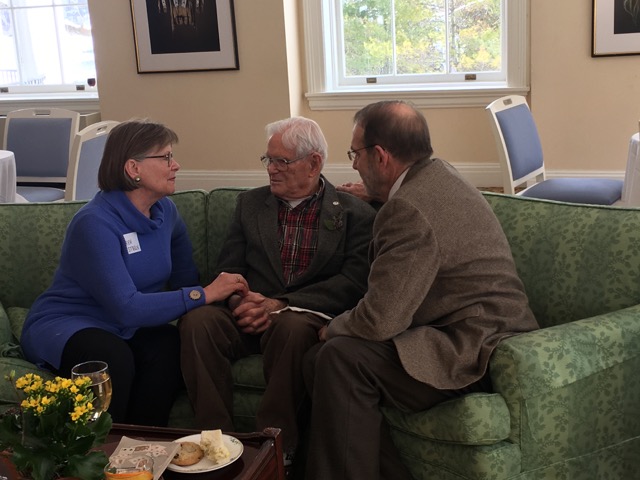
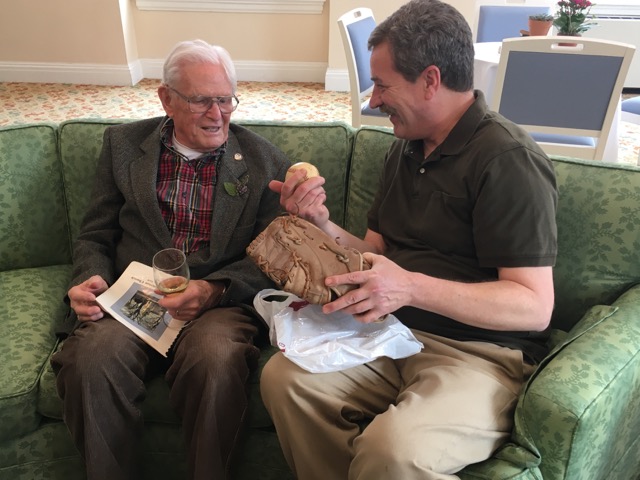
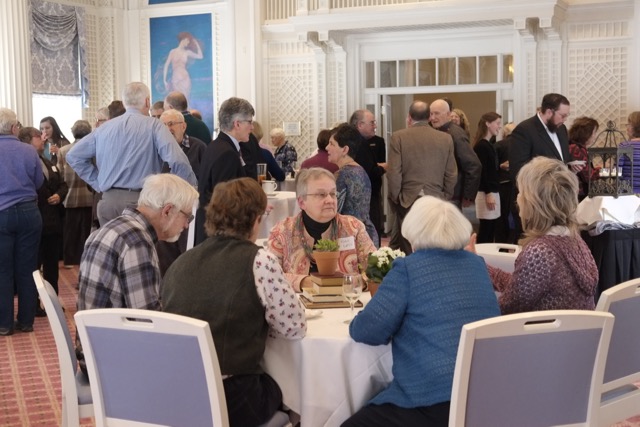
“This is such a great idea,” any number of people said the other day when we hosted a birthday party for my father at the Otesaga.

Not to be morbid, but the idea came from receiving lines at funerals. When my oldest brother died four years ago, I stood in a funeral receiving line for the first time. It felt like everyone had a story to tell about Stewart. I wished he could have heard them. He would have felt so loved.

When my mother died, the same thing happened. Person after person held my hand and told me a story about my mother and how much she meant to them. It gave me comfort to hear, but I wished my mother could have heard the stories too.

When Mr. Hanson, my 7th grade math teacher, died, his funeral was packed. The receiving line stretched out the door of the Vet’s Club and down the street. I wished I could have grasped his hand one last time, looked him in the face, and told him how much I appreciated him.

That’s why I started thinking about a party for my father.

I bounced the idea off my siblings. Before long, I was on the phone with the Otesaga. It had to be a strange call for their event planner.

Me: I’d like to have a birthday party for my father.

Planner: How many people do you expect?

Me: I have no idea.

Planner: I really need a number.

Me: I have no idea.

She worked with me.

I am so thankful for Brooke. She listened and guided and suggested.

For instance, she suggested that we use several adjoining rooms so it never felt crowded. She suggested we set up one room with comfortable seating, so my father could sit on a couch instead of a dining chair. She and her staff put out the decorations we had brought — books and photographs. She was wonderful.

The real quandary was how to get the word out. Friends of Bassett helped SO much. They blasted the invitation to retired physicians, current physicians, administration, and I forget who else. The local churches also helped to spread the word. As I ran into people at the grocery store or the gym or the post office, I invited them. It’s hard to corral a lifetime of people.

Among the first to arrive were two nurses from Dermatology, his last hold-out in his long and varied medical practice. He was delighted when he saw them.

Dermatology represents

From the home health aide who takes care of him,

Doreen and family

To a former CEO of the hospital,

Dr. and Mrs. Streck

To one of his secretaries,


To a little leaguer he had coached,
To family,

Family

More family,

His sister surprised him

And a slew of friends and colleagues, his life was well-represented.

The next day, as he started working his way through all the cards, he asked, “How did all those people know it was my birthday?”

I just smiled.


dementia · family

God Bless the Moon

Every morning I go downstairs and sigh when I see the tray table beside my father’s chair. It’s a mess.

I tidy it — but I know my organization will erode to disorder by evening.

The problem these days is that he has taken to playing the boombox my brother got him last year. My father doesn’t understand the difference between a DVD and a CD, or, for that matter, between the radio setting on the boombox and the CD setting. He needs help, but often won’t ask for it. The CDs and their empty cases cover his tray table.

Whenever he puts a CD called “Scottish Tranquility” in, we have this conversation.

Dad: This music is so mournful.

Me: It’s supposed to be peaceful.

Dad: There are no words!

Me: It’s instrumental.

Dad: I understand that, but where are the words?

Me: Instrumental means it’s just the instruments.

Dad (pointing to the CD case): But it lists the names of the songs.

Me: Yes, the songs still have names.

Dad:  This music could put you to sleep.

Me: That’s why it’s called Scottish Tranquility.

Dad: Can you put something else on? This is terrible.

It really isn’t terrible. It’s soothing and quiet, just what my soul needs.

This morning, at 4:30 AM when I got up for work, I looked at the mess on his table. Open books, half-done crossword puzzles, CDs, and empty cases.

“Why is everything always out of place?” I said out loud, frustrated, longing for that Scottish Tranquility.

Half an hour later, when I walked outside, I was pleased to see the moon in its proper place. It silhouetted the barn and reflected off the road. A restart to a messy day.

Something about that sight gave me peace.

The moon is always right where it should be.

The other night it was peeping through the trees.

Sometimes it’s out in the daytime.

I’ve seen it from an airplane.

And it was gorgeous in Bosnia.

photo by Nicole Flohr

I can’t count on the moon to be in the same place every night.

But it will never be misplaced.

It may not be as reliable as the sun — rising in the east, setting in the west — but it’s there.

All I have to do is look.

Ah, the Sea of Tranquility.

Faith · family

Lent 2018

My sister messaged me yesterday, “…about Tuga… has he returned to your pocket, or was he so last year?”

Tuga, the little brown bunny who stayed in my pocket for Lent 2017 as a reminder of the sorrow in the world, is not so last year. He’s so in Bosnia.

I have other Tugas. Three sets, as a matter of fact, of Tuga and Aleluja, sitting on my shelf. One set is promised to someone. The other two are at-the-ready, for when I meet someone who needs a mindfulness token of sorrow and joy.

Ash Wednesday, the first day of Lent, has had new meaning for me since 2014. That year, early in the morning of Ash Wednesday, my sister called with the news that my oldest brother had unexpectedly passed away after a heart attack.

Yesterday I read through some of the posts I had written in the subsequent days. Most are private now — as in, you can’t read them; I took them down because they were too personal — but the Ash Wednesday one is public.

When I’m telling someone about Stewart, I almost always refer to him as brilliant. Hamilton College undergrad — their first Russian Studies major. Yale Divinity School for his M. Div. and then Syracuse Law for his J.D. He had a home computer before that was a thing — like in 1983. He had set it up to run tessellations — which, of course, has nothing to do with Russian or Divinity or Law.

In the last few years of Stewart’s life I had been frustrated with him.  He had been nearly job-less, doing pulpit supply and seemingly little else. Every month my father sent him money to pay his rent.

In the meantime, I was running myself ragged, driving back and forth between Greene and Cooperstown, trying to help my father take care of my mother.

“Why can’t Stewart move in with Mom and Dad?” I griped to my sister. “He could be of real help to them and Dad wouldn’t have to keep sending him money.”

It irked me.

It seemed unfair.

But when Stewart died, and I met the many people whose lives had been touched by Stewart’s, I realized that I only knew part of the story. Stewart lived in a low-income area. He drove neighbors to doctor’s appointments and listened to their lives. His congregation gathered every evening in the apartment complex’s gazebo.

“That’s where Stewart sat,” one lady told us, pointing to a bench at one of the picnic tables. “He was always here for us.”

He had a church, unrecognized by anyone, because it was so informal, yet so personal. It didn’t pay the bills. It paid in intangibles.

I couldn’t see it — I don’t think anyone could — until he was gone, and we slowly unknotted the knot that was his life.

In his book, Great Lent, my Lenten reading for this year, Alexander Schmemann said,

If God loves every man it is because He alone knows the priceless and absolutely unique treasure, the “soul” or “person” He gave every man. There is no “impersonal” love because love is the wonderful discovery of the “person” in “man,” of the personal and unique in the common and general. It is the discovery of the unique in each man of that which is “lovable” in him, of that which is from God.

I looked around my room this morning for something to carry in my pocket for Lent. Tuga had been a good companion last year, but I wanted something to remind me of the hidden person, the God in each person I meet.

I settled on a Monkey’s Fist that had been sitting on my dresser. It probably belongs to one of my children — but it’s mine for this season. A knot, the heart of which is hidden from me.

Wikipedia says, “Monkey’s fists are commonly used as a convenient and unobtrusive method of storing and transporting precious gemstones.” What can be more precious than God?

God wears a costume of human flesh. He’s in the guy at the gas station, and the friend that encourages me.

But He’s also hiding somewhere in the woman who irritates me, and the man sitting on the couch in the other room, rifling through papers again and again.

I’m going to be on the lookout for Him.

dementia · family

Old Photographs

One of my kids told me, “I pulled some pictures out of the garbage by Grampa’s chair yesterday.”

“What?!” I said.

I knew my father had been going through old photographs. It’s something he enjoys. He’ll sit there for hours sifting through and resifting.

“Hey! Have I ever shown you this one?” he’ll ask as I walk past.

I’ll pause and squint to see the glossy black-and-white snapshot in his hand. “This is the house I used to live in,” he’ll explain, and sometimes launch into a story of how his cousin lived right next door and that there was a path worn through the trees, or how he and his father hid time capsules under the floorboards or in the walls.

“This is my father,” he’ll say. “He was a pretty handsome fellow, don’t you think?”

“Here’s one of my old girlfriends,” he’ll say, and my stomach gets a little squeezy because I don’t want him thinking about old girlfriends even though I know that’s silly.

As my son was telling me about the photographs that had been in wastebasket, he looked in. “Here they are again,” he said, and he pulled several out.

I was upset and a little bewildered. Why was my father discarding these old photographs?

“I think it was just an accident,” my son said, reading the unhappy look on my face.

No, the first time could have been an accident, but twice in two days seems pretty intentional.

I’ve heard my father say, in very general terms, “I don’t know who’s going to want all this stuff.”

“What are you wondering about?” I’ll ask.

“That Johnny Damon statue,” is a common reply. He went through a period convinced that we needed to take Johnny Damon to the Baseball Hall of Fame. Surely they would want it. 

I’m not so sure.

Maybe he was thinking that no one would want these old photographs.

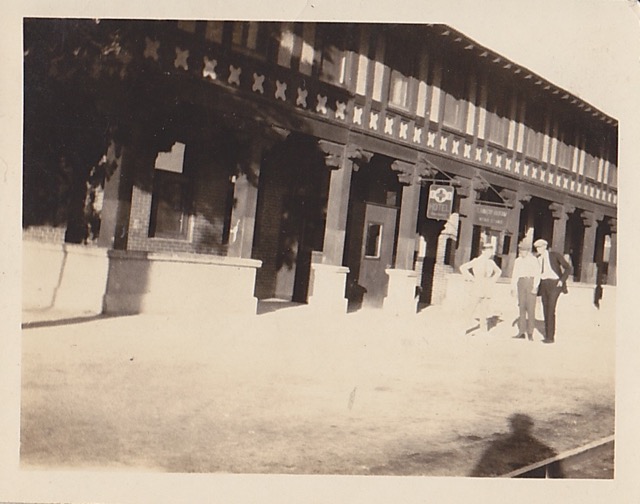
I looked at the most recent batch pulled from the garbage. They were all taken in Seligman, Arizona, in 1924.

The story goes that my grandfather and some friends had driven a car across the country in 1924, stopping in towns along the way to sell advertising on the side of the car and work for a short stint to earn money for the next leg of the journey.

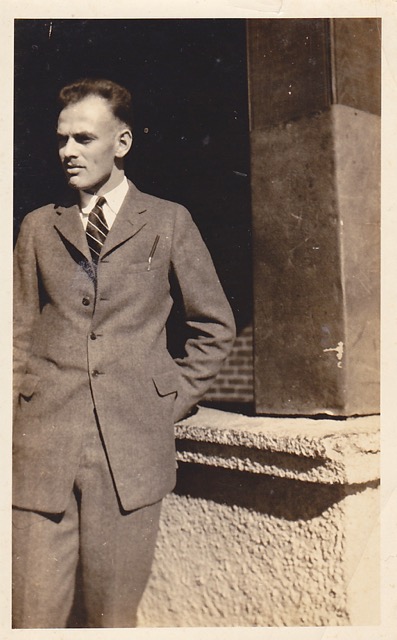
Here’s my grandfather.  He is a handsome fellow.

This is the Harvey House where I think they stayed. I know that because my grandfather was very good about writing words on the backs of photographs to identify the picture.
Except he didn’t identify this one but I think it’s him and his friend and the car and a roadside picnic.

I’ll have to ask my uncle or my aunt.

My father’s memory is dwindling.

And his thinking is muddy.

Otherwise, I doubt he would have thrown out the pictures.

In any event, they’re safe now.

Life

Amen

Yesterday we had a guest preacher, a woman from a nearby city. When she called the children forward for the children’s sermon, two school-age boys and one toddler girl came forward.

The little girl was delightfully in her own world, jabbering and clapping her hands. At first the pastor tried to quiet her and distract her, but her efforts were fruitless.  The girl had obviously just figured out that she could string words together and adults would stop to listen.

The pastor moved on. With a steady little drone of chattering in the background, much like a cheerfully babbling brook, she launched into her mini-sermon on gratitude.

Then she made the mistake of asking the boys about the best Christmas present they got this year. I knew the answer before they said anything.

Lego.

Both boys are Lego maniacs and love to talk about it. They began describing the giant Lego sets that they had received.

“I think mine had ten bags of pieces in the box,” one boy said.

“No,” said the other, his brother, “it had twelve!”

They debated the full number of pieces and how long it took to assemble. Meanwhile, the little girl kept up her jabbering. I didn’t think the pastor was going to be able to reel in her children’s sermon, but she did.

“Let’s finish by saying thank-you to God,” the pastor said.

One boy threw his hands in the air and yelled, “Thank you!”

But the pastor said, “No, let’s bow our heads and close our eyes to talk to God.”

The boys complied. The girl twirled around.

“Thank you, God, for all the good things You give us,” preacher prayed. “Amen,” she concluded, emphasizing the “A”.

One boy’s head shot up, then his hand followed. “I have a question,” he said.

I’m sure she was anticipating more Lego talk. I was surprised she didn’t look exasperated.

“Yes?” she asked.

“Why can’t we say ‘A-women’?” he asked. “It doesn’t seem fair.”

I had to stifle my laughter.

Kids.

You never know.


Coaching swimming · Life · swimming · Uncategorized

Change

Some of my swimmers dabbing at practice. I love these kids.

When I walked into the pool area yesterday, one of my swimmers was waiting for me. She looked up at me with doleful eyes. The corners of her mouth were turned down. Way down.

“What’s wrong?” I asked, crouching down to talk with her.

She pressed her lips together and I could see her lower lip quivering.

“Is this because you moved up?” I asked. Technically, she wasn’t my swimmer anymore. She had moved up to the next group.

Almost imperceptibly, she nodded yes.

“Aw, Genna*,” I said, “we talked about this the other day. You are so ready to be part of the Orange group. Plus Coach Katy is super-fun, so much more fun than I am.”

She looked up at me doubtfully.

“Don’t worry about the warm-up. Coach Katy will tell you what to do,” I told Genna. “It’s different from ours, but you can do it.”

I was running out of encouraging/reassuring things to say to this sad little girl who obviously didn’t like change.

“Coach Sally,” she finally said in a tiny voice. I leaned in to hear what she had to say. “Coach Katy doesn’t have lollipops like you do.”

I laughed. At the beginning of the season, Genna had hung back, hesitant to try anything.

“What can I do to motivate her?” I asked her sister one day.

“Candy,” she replied.

I bought a bag of dum-dums. They were magical.

Yesterday I whispered to Genna, “I’ll give some lollipops to Coach Katy. Would that be good?”

Immediately her face brightened and off she went with her new coach. I sighed and headed to my lanes where my swimmers were already warming-up.

I studied the swimmers who were in the water. “Where’s Bern*?” I asked.

Bern had just moved into my group. Katy spotted him and brought him over to me. He stood shivering beside me, chewing on his goggle strap.

“They’re finishing their warm-up,” I told him. “You can get in and do 100 freestyle. We’ll be moving on to something else soon.”

He didn’t respond. His expression was inscrutable as he stared at the water and chewed his goggles.

“Do you know any of the other kids in this group?” I asked.

He took his goggle strap out of his mouth. “I don’t want to warm up,” he said.

“Warm-ups are important,” I said, and was about to launch into a mini-treatise on warming up when his mother came into the pool area and called him over.

Bern went over, stood in front of her, and immediately burst into tears.

I backed away. I had a dozen or so kids in the water who needed attention. Mom could talk to Bern.

I handed out kickboards and explained what we would be doing.  The kids started their kick set. Every so often I looked back at Bern. He and his mother were having quite a têteà-tête. Finally I saw Bern drying his tears.

Soon his newly-dried face wouldn’t matter because he jumped in the water and started swimming. He did fine.

At the end of practice his mother told me, “Bern doesn’t like change.”

“Neither do I,” I told her.

She said, “He told me, ‘I don’t care about swimming fast. I just want to swim with my brothers.'” His two younger brothers were still in the group he had graduated from.

With that, I appreciated Bern so much more.

We all hold onto things that are sweet and dear.

For Genna, it’s candy.

For Bern, it’s his brothers.

For me, it’s a thousand little things I want to freeze in time instead of watching my father age.

But time marches on, and change comes with it.

It will be okay.


*not their real name


Faith · Life

Pearls

Let me be candid. I was shouting in the officials’ room at the swim meet on Saturday.

Not my finest moment, for sure. That ugliness left me bone-weary at the end of the day.

The next morning when I got up early to read, I still felt the stone in my gut, the last vestiges of that conflict.

Several years ago, my friend and fellow-blogger Anna Brown made a reference to pearl-formation. I liked it so much I tried to incorporate it into my daily prayers, specifically in my creed where I state those things I believe. After many iterations, I settled on these words:

I believe that the trials in my life are ultimately God’s good for me; they are like grains of sand in an oyster that God uses to produce pearls.

When I arrived at that part the other morning, I thought of the man who had shouted at me and at whom I had shouted in turn.

“Lord,” I prayed, “I believe that ______ is a like a grain of sand, and that You can use him to produce a pearl in me.”

I sat there picturing the process that happens in an oyster. The presence of the irritant is sometimes a grain of sand, but often in nature is a parasite. The  oyster excretes a fluid that coats the irritant, and then coats it again and again and again. The fluid, called nacre, is otherwise known as mother-of-pearl. Shiny, luminous, iridescent. Beautiful.

The longer the irritant stays in the clam, the more coatings it receives. It’s a slow process that can take up to three years for the pearl to reach its size. “Lower-quality pearls have often been ‘rushed’ out of the oyster too quickly (sometimes a year or less) and have a too-thin coat of nacre.” (from Pearls.com)

As I prayed, I could feel the edges of my irritation softening.

I prayed it again, this time inserting a different name. I’ve been walking the edge of irritability for a while now, more and more often losing balance and falling into frustration with this person or that situation.

As I named specific people or issues and prayed the prayer over and over, I began to picture a string of pearls.

And tears began to roll down my cheeks.

The more irritations, the more pearls. I found myself feeling thankful for each one.

The funny thing is, I know I have three more years of interactions with the shouting man.

Three years. Just the right amount of time to form a good pearl.


Life

The Things I Do For Points

I signed up for Get Fit Right, a program at our local gym.  Each week I get a new punch card to try to fill.

As I got in the water the other day for an aquacize class, the shock of the cold water made me grimace a little.

Why am I doing this? I asked myself, but I knew the answer. I’m doing it for the points and the punches on my card.


The Things I Do for Points

Too many numbers on my punch-card need a punch now
Too many classes I don’t think that I can do
Like zumba-yoga-spin-pilates-pound —
The things I do for points, the things I do for points

Thirty minutes in the Fitness Center done now
Went on the treadmill, then the weight machines were next
I worked my pecs, my lats, and other stuff —
The things I do for points, the things I do for points

(yes, that’s me)

Like getting in the pool when it’s cool
And I feel like a fool
And I’m clumsy, but, you know, I’m really trying
And I’m looking to warm up through exercise
I think I’m s’posed to kick now
’cause I’m sinking like a brick now

ooh — I get a punch though
ooh — so that’s okay
ooh — I could go climbing up the wall

A few more points and I will meet my weekly quota
A little fitter, too – the icing on the cake
I’m getting fit right if it kills me now —
The things I do for points, the things I do for points


The real version of the song:

Grief

Dr. Purple’s Fall

Those who know me well know that I have spent hours researching Dr. William Purple from Greene. He was a fascinating man who lived a long life in service to his family, his community, and his profession.

The following story is based in fact; I’ve tried to tell it with Dr. Purple’s voice.

William D. Purple lived from 1802 to 1886. He and his wife, Julia, had four children: Julia, Agnes, William, and Mary.


October 4, 1864

Ah, William. You are my Icarus. How I longed to see you fly to safety!

When you registered for the Civil War draft in June of 1863, my heart nigh burst with pride and broke for sorrow. And when your name was called to serve, you readied yourself.

But you began a cough. With the date fast approaching for the regiment to leave, your cough grew worse. When I saw the blood in your sputum, I knew.

Consumption.

I had heard of soldiers leaving for the war and being sent home with consumption, but far more tales were of young soldiers who died away from home from that dread disease. I wanted to be sure of your care.

We scraped together the $300 to pay the commutation fee and release you from service. $300, dear Icarus, for wax and feathers, and, through friends, a bank job in the north, where the air is fresh and clean and curative. I had hoped that you would carve a place for yourself in the banking world.

You had not the heedless hubris of the ancient Icarus. What did Mr. Averell, the bank president say in his letter? “William was a man of great simplicity of character, purity of purpose, confiding and generous in his feelings. He will be missed.”

Yes, you will be missed by no one more than me. I missed you the moment I put you on the stage for Canton, daring to hope that it would not be the last time I would see you alive. Yet, one year later those waxen wings, the escape that I, your Daedalus had planned for you, dipped you toward the netherworld before allowing you to soar to Heaven itself.

I walked last night as if in a dream. It was a moonless night and I had not brought a lantern. As I passed the open doors of  the Chenango House, light streamed out. I could hear laughter and music within. Once passed, I walked in darkness and all I could hear was the flowing water of the Chenango River. It beckoned me, like the Icarian Sea.

“Come,” it said, “I can reunite you with your William, your Icarus.” I walked toward it, my thoughts lost in heavy grief. “Come,” whispered the river.

I remember approaching the bridge. The night was cool and I hadn’t worn an overcoat.

The next thing I remember was August Willard kneeling over me, his lantern held aloft by my Mary. My left arm, cold and wet, draped into the river. My feet felt tangled, and rested up the steep embankment that was strewn with leftover canal stone dumped there years ago. My head ached; the rocky pillow upon which it rested was coarse, cold, and damp.

“William,” August said, whilst shaking my shoulders, “Julia is so worried. We must get you home.”

Mary set the lantern on a rock and assisted August in getting me upright and to level ground. I leaned heavily on the two of them as we slowly made our way home. My whole body was bruised, but my left side – my shoulder, arm, hip and leg – was badly abraded as well. Blood from a gash in my head continued to trickle down my cheek as we walked. Julia paled as she saw us enter the house.

“I’ve been so frightened for you, William,” she cried, gently placing her hand on my bloody cheek before hurrying into my office for some medical supplies.

The story unfolded to me as August tended my wounds. I had been gone for hours. Julia had sent Mary across the street to August’s house. She roused him and he willingly searched for me. But, how long had I lain below the bridge? That was a mystery.

Had I accidentally stumbled?

The night was so very dark, and my thoughts occupied by one thing, my only son’s death.

Or, had I heeded the river’s call?

“Come, Daedalus. I will give you wings to fly to your son.”


The Greek myth of Icarus and Daedalus can be read here: Icarus and Daedalus

Consumption is better known as tuberculosis. During the Civil War, an estimated 14,000 soldiers died from tuberculosis. In the Union camps, it was treated with “fresh air” and lung surgery. Outside the war, tuberculosis was the leading cause of death in the 19th century.