Faith · prayer

Prayer of Confession

In the Book of Common Prayer, the morning prayer of confession begins,

ALMIGHTY and most merciful Father; We have erred, and strayed from thy ways like lost sheep…

I was interested to read Lancelot Andrewes note on this prayer —

We have wittingly and willingly run from Your ways like an untamed heifer

img_0672Last summer, on my walks, I often saw the cattle in a neighboring field.  Sometimes they would run up to the fence as I walked past. One liked to lower his head and shake his horns at me threateningly.img_9663 I tried to reassure him that I meant no harm. I was simply out for a walk.img_0675

My bovine friends — or not-friends — became a fixture on these walks. I would scan the field to see where they were grazing. When one escaped, I tried to encourage him to go back with his compadres, but it’s hard to encourage an 1800 pound animal and keep a safe distance. img_0504

One fall day, Bud was working in the barn across the street when he heard the screech of tires. He ran out to see a woman, wide-eyed, sitting in her stopped car in the middle of road, staring a herd of cattle thundering toward her up the road. They ran past the house, tipping the mailbox as they went and disappearing over the crest of the hill followed by men in pick-up trucks.

“I had seen them trying to load them into a trailer earlier,” Bud told me. “Must be they decided to get them to the other farm the old-fashioned cattle drive way.”

That evening, when we went for a walk, we saw the guys in the pick-ups sitting outside the pasture that had once held their steer.

“That was something else,” Bud said to them, “watching them run up the road.”

“They didn’t want to get on the trailer,” one guy said, “and broke the fence. If you see ’em, let us know.”

“You weren’t herding them?” we both asked.

“Hell, no,” the man replied.

About a dozen steer were now on the wild in Otsego County, including the one who occasionally menaced.

As best I know, they were never found — although I did hear of occasional steer-sightings.

I pictured them when I read Lancelot Andrewes words.

Breaking through the fence — wittingly and willingly.

Running from the livestock trailer — running from Your ways

Like wild cattle — like an untamed heifer

It’s quite an image.

Almost exquisite — if one can use that word for cattle.

elderly · Faith · family

Incapable

Below is a(nother) dusted-off post from 2011. In 2011 my mother was still alive and living at home. She clearly had dementia and her body was slowly failing on her.  My father was her main care-provider, but that summer was hard on him, too. With all that was going on, I helped out as best I could.

Mom and Dad -- summer of 2011
Mom and Dad — summer of 2011

Last Thursday we went for the follow-up visit for my mother’s bladder biopsy.

The baby-faced doctor handed my father the pathology report.  “It’s bladder cancer, just as I suspected,” he said.

He continued speaking, “It’s high-grade papillary urothelial carcinoma.”  I could see the words on the path report in my father’s hands. “The cancer hasn’t spread past the lining of the bladder.  There is no invasion into the muscle or the subepithelial tissue.”

When he began discussing the treatment options, it was truly a discussion.  He listened to our concerns, answered questions, explained, and listened some more.

We finally reached the point in the process that I was anticipating (and dreading).

My mother is now incapable of making decisions, especially decisions like this.  She can decide what she wants for lunch — usually something involving marmalade.  She can decide what she wants to wear — usually the same thing she has been wearing for the past three days.  She can decide when she wants to take a nap — often.  She cannot make an informed decision about her health care.

My father has always shown the utmost respect for people and guarded their dignity.  I knew my father would want to include my mother in the decision-making process. When the moment came, my father turned to my mother and said, “I suppose we need to ask the patient what she would like to do.”

I started to pipe up, “Dad, I think we’re at the point when you need to make these decisions for Mom,” but my mother interrupted.

My mother, with the utmost clarity, said, “I don’t think I understand what’s going on.  I trust whatever you decide.”

Hallelujah!  If the angels weren’t singing in heaven, they were singing in my heart!

I hadn’t known to pray for this, but this was an answer to prayer.

The rest of the visit was a piece of cake.  We made the decision to simply wait.  At 83, any treatment may have been worse than the disease itself….

I had forgotten so much about that time period. The bladder cancer turned out to be a red herring. So many other things made that season hard. Had I know what lay ahead, I would have said that I was not capable of any of it.

But I was.

God makes our path a little windy so we can’t see what’s around the next bend. Perhaps if we knew, we wouldn’t want to go on.

Today, January 13, 2017, I can look back and say, Thank you, God, for getting me through those years. It makes it easier to trust You on the road I’m traveling now.

elderly · family · Life

Misunderstood

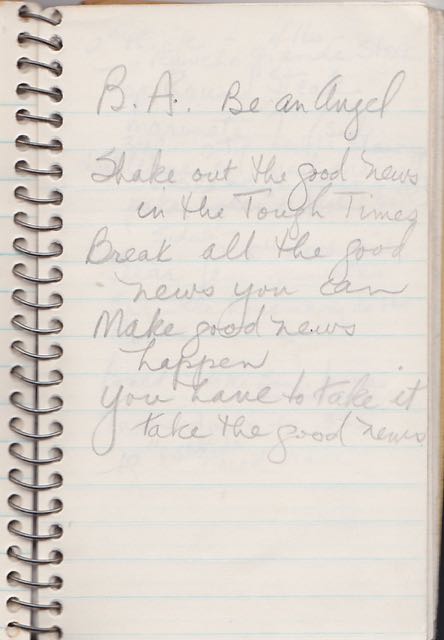
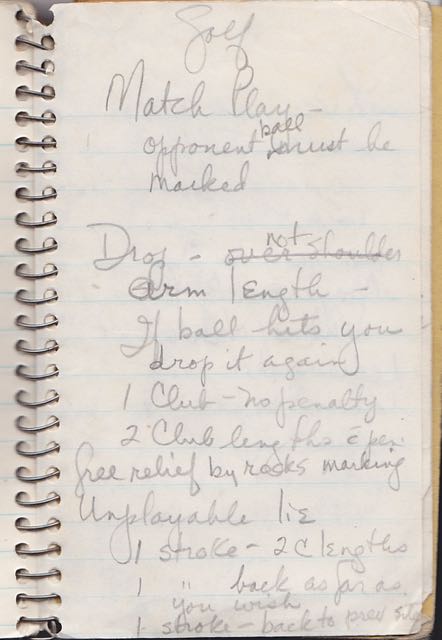
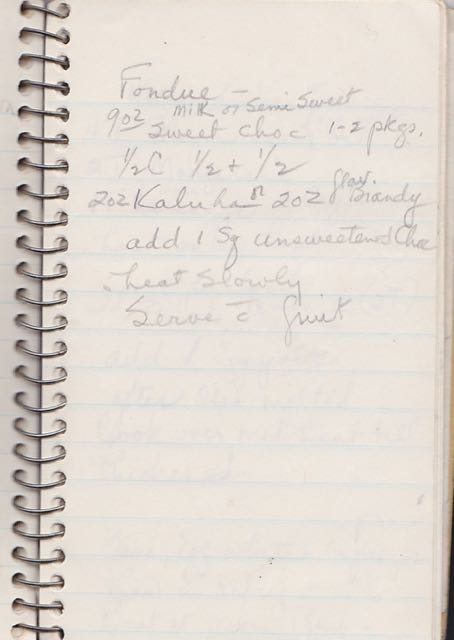
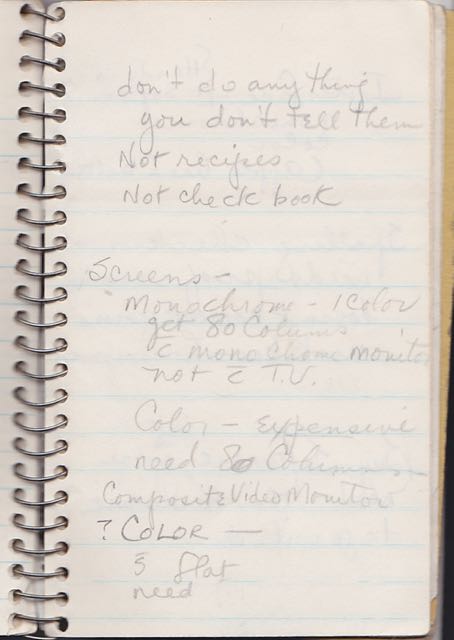
scn_0001-2I found a little notebook that my mother probably kept in her purse in the mid-to-late-1980s. The notes inside cover a huge span of topics:

Sermon notes?
Sermon notes?
Golf rules
Golf rules
Recipes
Recipes
Other miscellaneous notes

She even wrote a cheat sheet for my husband’s siblings. He has eight brothers and four sisters, so she wrote out their names and little reminders to help her keep them straight. I should have been so smart.

One note bothered me – partly because I couldn’t figure it out what she was trying to say, and partly because I have anxiety about doing things right for my father.

don’t do anything
you don’t tell them
Not recipes
Not checkbook

Helping elderly parents involves walking a fine line. On the one hand, I have a tremendous amount of respect, appreciation, and love for them, but on the other I sometimes need to take the reins.

The other day I took my father to get his haircut. When he was done, he fished his wallet out of his back pocket. He rifled through it with his fingers, pausing on a five dollar bill before looking at me questioningly.

“What do I need here?” he asked, and he pushed the wallet into my hands.

I handed the woman a twenty — the haircut cost $10 — and she gave back a five and five ones. I handed these to my father. “You need to decide how much you want to tip her,” I said.

It was awkward. She picked up the broom to start sweeping. He fanned out the money in his hand and fiddled around with the bills.

“What are you doing to me?” he said. Clearly he couldn’t think through the next step.

I felt terrible. I took some of the ones and handed them to the stylist.

But I wasn’t doing anything to him. I was trying to allow him some autonomy.

At home I’ve started paying some of his bills without discussing them with him. The bills are confusing for him, but cutting him out of the process feels wrong to me too.

don’t do anything
you don’t tell them
Not recipes
Not checkbook

The words in the notebook stung. I’m trying so hard to do right by him.

I have a futile hope that someday he’ll be able to do it all again. Will he understand why I took over?

I pulled out Mom’s notebook again and studied the rest of what was written on that page.

Screens –
monochrome – 1 color
get 80 columns
c/ monochrome monitor
not c/ T.V.
Color – expensive…

The next page had more computer-buying advice. Were these notes from an introductory computer seminar?

first
Buy Software ^ you
need — then Hardware
to go with it

Seriously?

But maybe those first lines, “don’t do anything you don’t tell them” refer to computers, and the fact that they are just machines.

But then, why “not recipes”?

Why “not checkbook”?

I’ll probably never know.

Alzheimer's · Faith · family · poetry

The Weight of Struggles

In 2011, my mind was spinning with all the information being thrown at me.  Bladder cancer.  Catheter care.  Chemotherapy.

That summer, my mother had been diagnosed with bladder cancer.

As if Alzheimer’s wasn’t enough.  As if a second bout with breast cancer wasn’t enough.  As if my father needing a pacemaker wasn’t enough.

In the midst of all this, I wrote a poem based on Milo of Croton, the legendary Greek wrestler who began each day lifting a calf.

Okay -- not lifting a calf here.
Okay — not lifting a calf here.

The legend goes that by lifting the same calf every morning, Milo could eventually lift a full-grown cow or bull. I didn’t need to lift a physical cow, rather a heavy load of struggles, one that was increasing in size.

If I lift the same calf every day
Could I someday lift a cow?
It seems logical and sensible
But impossible somehow.

Somehow I become broken
And it’s more than I can take.
Will I see failure coming?
Or do I need to break?

Or do I need a break
From lifting up the cow?
Am I stronger then, or weaker,
When I start to bow?

To bow under the pressure that’s
So heavy on my soul
That the spirit and mind and body
All begin to show the toll;

When can I say “Uncle”
And deal with this no more?
I strain under the calf-turned-cow
My cheek pressed to the floor,

Trying to lift up the cow,
But the Lifter of my head
Says, “Let Me help. Stop a while.
I’ll put others in your stead.

“Let friends come beside you.
You can take a rest.
Trust Me; it will be okay.
I really know what’s best.”

But the habit formed of lifting,
Lifting, lifting every day
Is scary to give up.
Lord, show me the way.

During that time I felt God answering every prayer I ever prayed about knowing Him more, trusting Him more, and resting in Him more completely.

The funny thing about challenges is that the harder they are, the deeper we grow.

I couldn’t meet the challenges.

At least not alone.

I found myself clinging to my faith during that challenging time.

Faith is not a crutch as some might say.  It is a Strength.

It’s also faithful friends — that hands and feet of Christ.

I wrote Milo of Croton 5 years ago — and I think I still haven’t learned to yield.

But I’m certainly stronger.

Thanks be to God.

family · Leaning In · Life

Trapped

In the spirit of “Leaning In,” I offered to help my father write some letters.

During December I felt trapped, much the way a mother of a toddler feels. I remember being home with small children and wondering what it would be like to be able to do and go without worrying about other people. Now I sometimes feel that way again, but it’s not because of small children.

I had asked Laurel some of the same questions I asked Mary (see Explanation). Laurel knew how old I was. She also astutely answered the what’s-my-favorite-thing-to-do question. “You like alone-time,” she said — and I felt a little lump in my throat because she understood me so well.

Alone time. I crave it. Like chocolate. Or coffee.

When I was home with toddlers, I would retreat to the bathroom — and they would stand outside the door, talking to me, trying to get in, asking when I was coming out.

In December, my father would sometimes stand at the bottom of the stairs. “Sally? Sally? Are you going anywhere today? I’d like to go out,” he would say. And I would feel so selfish that I just wanted to go out alone. All. By. Myself.

With toddlers, sometimes they would follow me everywhere. “Fred” used to sit on my foot and hold onto my leg. I would hobble around, my steps uneven because I was dragging a little boy with me. He simply wanted to be with me.  If I stopped to read with him or play with him, sometimes that would satisfy his Mom-time need, and, in turn, I would have a little alone time. In the kitchen. Woohoo.

Of course, I couldn't find a picture of Jacob hanging on my leg -- they do exist! -- but this him, the youngest at the time, at about the right age.
Of course, I couldn’t find a picture of “Fred” hanging on my leg — they do exist! — but this is him, the youngest at the time, at about the right age.

So — leaning in. I decided in 2017 that I wouldn’t try to escape, but would rather lean in. Embrace.

Instead of escaping upstairs, I asked my father if I could help him write a letter. He had been saying that he wanted to write to a few people, but, beyond the struggle of gathering thoughts into words, he also struggles with the fine motor coordination of writing.

Yesterday, we sat to “write.”

It took him a long time to formulate his thoughts, but his words revealed how trapped he felt, too. He told his friend why he couldn’t travel to visit her —

 … I feel like I should accept the wisdom of the rest of my family that I should not drive a car.  I agreed to this reluctantly, but there’s no way out.

No way out. What a terrible feeling.

He got frustrated with the writing process and we put the letter aside.

So today, we’ll finish that letter and get it in the mail.

And I’ll take him out with me.

It’s a lot slower running errands with a person with a walker.

Not unlike a child hanging on a leg.


family

Pursuing Dreams

I remember when Sam learned that he had arthritis.

He had been struggling with shoulder pain and gone for treatment for tendonitis, a common problem for swimmers. He couldn’t lift his arms over his head and the physical therapist commented that he was like an old man.

Fortunately, someone recognized that Sam had a bigger issue than tendonitis — a “more global problem” is how they put it.

After running a bunch of tests, they gave him the life sentence — psoriatic arthritis.

“What am I going to do?” he asked. “I won’t be able to do the things I love.”

By that he meant climbing, paddling, skiing and all sorts of other outdoor activities. Sam was tempted to throw in the towel.

His rheumatologist looked him in the eye and said, “It doesn’t mean that at all.” He encouraged Sam to pursue his dreams.

And Sam did.

That was ten years ago.

The first time we went to British Columbia, I knew Sam would thrive there.self-in-bc

img_0553Honestly, I wasn’t surprised when he wanted to make it his home.

And found a lovely Canadian woman to marry.

When Sam was home at Christmas, he mentioned going to “physio” — that’s Canadian for physical therapy. He works at a canoe and kayak store, and has recently been having trouble lifting boats over his head.

Instead of giving up, he’s working (again) at strengthening those shoulders.

Professional golfer Phil Mickelson is the poster boy for psoriatic arthritis.

I think Sam should be — his story is more inspiring.

To me, anyway.

But I may be biased.


Alzheimer's · Book Review · family

The Benefits of Rust

Remember when I said I would be rusty trying to write again? I was feeling that rust this morning as it seized up my writing gears.

Today I wrote a whole post, deleted half of it, wrote a little more, made a meme, considered dropping the whole thing in the trash, and then decided to just stick it in a draft folder. Here’s the meme, though —predictable

Then I looked back to see what else I had written on this day in history.

Five years ago, I had written a book-review-ish post for a fellow blogger, Christine Grote. We had started blogging about the same time and visited each other’s blogs fairly often. Each of us was dealing with Alzheimer’s — me with my mother and her with her father.

We cross paths with so many people, especially in the blogging world. When I visited her blog today, I felt like I was visiting a long-lost friend.

Here’s part of what I published 5 years ago —

Dancing in Heaven — a sister’s memoir is a tender story of growing up with a severely handicapped family member.  Christine’s sister, Annie, was so developmentally handicapped that doctors predicted she wouldn’t live past the age of eight.  Through the love, devotion and tireless care from the whole family, Annie lived to be 51.

Christine weaves into the story the onset of her father’s Alzheimer’s.  That’s what I had been following on her blog.  Before Alzheimer’s, however, she had interviewed her parents about life with Annie.  When she asked her father if he had any regrets, he said,

“The biggest regret I’ve got of the whole thing is that she cannot speak.  Everything else I can deal with pretty much as it comes along.”

As I read that part, I felt a catch in my throat.  His Alzheimer’s has taken away his ability to speak.

Alzheimer’s seems to affect people in very different ways.  Some symptoms are universal — the loss of memory, for example.  But my mother has not lost her ability to verbally communicate.  She can be sharp-tongued and nasty.  She can definitely communicate.

2017 note: My mother did eventually lose the ability to communicate. She rarely spoke near the end, and when she did, it made little sense.

Christine’s father has fallen into a silent world.  He doesn’t speak often.  As I read his quote about regrets in Dancing in Heaven, I remembered one of Christine’s posts about a communication break-through they had experienced using a whiteboard, Resolving a Quandary.  How much more meaningful that post became knowing how precious that ability to communicate was to him!

Thank you, Christine, for your beautiful memoir.  It is sweet, gentle, and encouraging.

In the intervening five years, Christine’s father passed away as has my mother. Today, when I visited her site, I saw that she had completed her book about her father, Where Memories Meet.

I guess rust can sometimes be a good part of the adventure. It made me slow down and help me reconnect.

I can’t wait to read her book.

Faith · family · flowers

Christmas Flowers

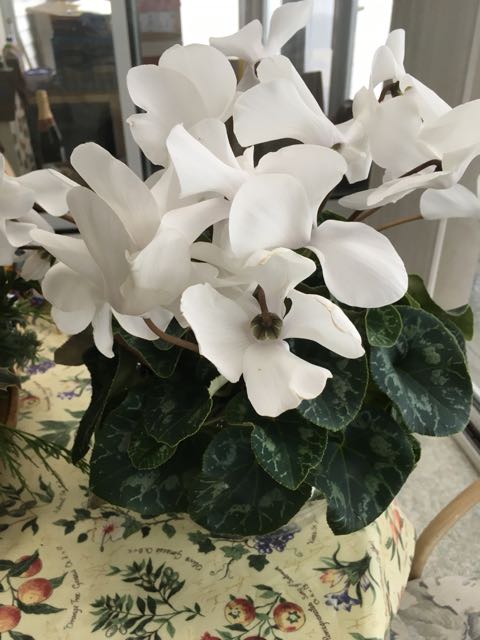
img_1016On Sunday the pastor announced that anyone who wanted Poinsettia or cyclamen was welcome to take plants home. The front altar had been filled with plants for the holiday season — so, so lovely.

The cyclamen on the piano had caught my eye. It was looking droopy and sad, kind of worn out. I understood how it felt.

We are invariably among the last to leave. Bud loves to visit with people and I try to wait patiently (albeit awkwardly). I watched plants leave the sanctuary, one by one, but so many still waited to be adopted. The cyclamen on the piano drooped even more. I  grabbed it and a poinsettia to take home before we left.

For my mother — you know? She loved plants. When she was alive, she always had Poinsettia at Christmas. Her Christmas cactus burst into bloom on cue with the season, as did her Crown of Thorns at Easter. It was magical.

Here is part of  a post I wrote nearly 5 years ago:

At the tower of Babel, God scattered the languages of the world, “so that they may not understand one another’s speech.” (Genesis 11:7)  But He left us some universal languages.

Music crosses cultures and generations.

Art speaks and moves me, though I may know not a word in the native tongue of the painter.

And flowers — God Himself uses this language to speak to us through their beauty.

Flowers may have been the language my mother understood best.  She worked tirelessly in her garden, weeding, tending, making it beautiful for all to enjoy.  Inside the house there was always something blooming — Poinsettia, Christmas cactus, Amaryllis, the crown of thorns, Easter lilies, mums.  She understood the language of the flowers and plants, and they understood her and responded.

As my mother descended into dementia, the plants in the house looked more and more sickly. Nearly all the plants eventually died. Her huge Christmas cactus and Crown of Thorns are gone.

As I left the sanctuary on Sunday holding my sad cyclamen, Bud noticed a healthy one in the vestibule. “Do you want this plant instead?” he asked.

“No,” I told him. “I want to try to revive this one.”

It’s amazing what a little water and sunshine will do.

img_1030

I used to tell myself that I had a black thumb and that I could never grow plants the way my mother did, but I understand better now. It’s not the color of my thumb, it’s the care and attention.

It holds true with plants.

It holds true with people.

Faith · family

Graceball


IMG_8900Cleaning off the shelves in my father’s study reminded me of the things he loves to read about — history and baseball. The older I’ve grown, the more I’ve loved reading about those things as well.

I’ve always loved reading about baseball. Not modern baseball, but the old days. Like the deadball days in The Glory of their Times by Lawrence Ritter, one of my favorite baseball books ever. Or the Brooklyn Dodgers. Or the Negro Leagues, both awful and beautiful.

So I grabbed a book on my dad’s bookshelf called The Teammates by David Halberstam. It’s a story about the enduring friendship between four ballplayers: Ted Williams, Bobby Doerr, Dom DiMaggio, and Johnny Pesky.

Ted Williams was one of my father’s heroes. An unlikely hero, in my mind, because he was a hero with baggage. He was foul-mouthed and arrogant. Loud. He wasn’t gracious, wouldn’t tip his cap to the crowd, even in his last game, at his last at-bat, where he nailed his last home run.

John Updike, in Hub Fans Bid Kid Adieu, said about Ted Williams, “Gods do not answer letters.”

But Ted Williams could hit the ball.  Lou Boudreau came up with the Williams Shift for a reason. Why Ted Williams, in that instance, didn’t follow Wee Willy Keeler’s motto — “Hit ’em where they ain’t” — is a mystery to me.

The Teammates softened my thoughts on Ted Williams. It showed a more human side to him.  One Ted Williams story lingers with me.  In the words of Bobby Doerr  —

“… and when lunch was over Ted turned to us and said he wanted to take and show his dad’s photography shop.  And so we went across the street from the hotel, and there was a building there, all the offices empty now, nothing there but an empty building. Then he began talking about his father, who had not been successful, was out of work a lot, and had been drinking a lot. And as he talked you could just see it roll out, this little kid in this terrible world, all the unhappiness, all the things which had never gone away, and which had been stored up for so long. It was clear that his dad had never been there for him.  And then when we came out he took us to this nearby corner, and he said, ‘This is where my mother made me march with the Salvation Army, and I would try and hide behind the bass drum.’ As he talked I could see it all, the little boy back then, the shame, and the pain, and the broken home, and how much he hated all of it. As we were walking around, and he was letting us into his childhood, I was thinking to myself, ‘This is where it all started.’ I’ll never forget that day when he took us around because all you could feel was the sadness of it. The sadness of that little boy, and the sense that it had weighed on him so heavily for so long.”

As I read that story i understood better how baseball is a game of grace. The very best players fail two-thirds of the time when they get up to bat. A batter is allowed three strikes. A pitcher is allowed four balls. A team three outs.

Baseball is not like the pure athleticism of a race, where the first one to finish wins. It’s a game of trying and trying again. Perseverance. Moving on past a failure. And another failure. And another failure. Grace.

The whole game is grace. There’s always another pitch, another at-bat, another game, another season.

It’s why the battle cry of the Red Sox — “Wait till next year” — rings true.

Hope is a cornerstone in baseball. It exists at every single base.

*****

Today my daughter Mary follows in my footsteps (and her aunt’s) by starting a job at the Baseball Hall of Fame.

When combined with the Daily Prompt: “Childhood”, and the fact that this post turned up when I did a draft folder search of that word, you can understand why I’m posting this today.

Originally written last October. Never posted till now.