
I sent this one to my son, Sam, because it fit his sense of humor. The caption went something like this — “He was so busy watching the man with the parachute that he didn’t notice the birds perched above his lemonade.”
It makes me chuckle.
Salty like hot dogs (and tears). Sweet like marmalade (and life).

I sent this one to my son, Sam, because it fit his sense of humor. The caption went something like this — “He was so busy watching the man with the parachute that he didn’t notice the birds perched above his lemonade.”
It makes me chuckle.
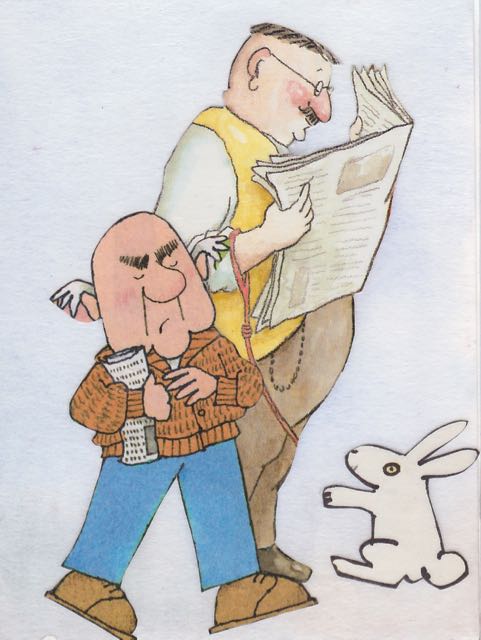
Last night, before I went to bed, I found myself looking through all my cards, considering ways to shuffle my A-to-Z plans in order to avoid using this one.
I’m really not happy with it.
This was an early card and has so many problems. Would you like me to point all the mistakes?
First, there’s no background. The characters are just kind of plopped into nothingness, a pale haze of watercolor that’s barely noticeable.
Then, the man reading the newspaper is holding a leash that leads nowhere. Where’s his dog? Why didn’t I include it?
Third, the old man’s right ear — I can’t believe that I never finished cutting around it.
When I’m aware of the mistakes, they become the only thing I see. It’s awful. I need to take a step back.
The story I had in mind for this was one of obliviousness — both the man reading the newspaper and the grumpy man clutching his newspaper are oblivious of the rabbit that’s right in front of them.
And, golly, isn’t that true?
I see the mistakes in the picture — but the “rabbit” that’s in front of me, the one I’m not seeing immediately, is that on this journey of collage, I’ve actually travelled quite a way. It was a bit of a jolt to realize that.
Compare “Newspaper” with this, the most recent collage I made —
The card is laid flat to show that I finally got smart enough to write the books I use right on the back of the card.
Interestingly, the story in this collage was also supposed to be about obliviousness. The boy is so taken with the tiny chicken perched on the piano that he doesn’t notice the baby polar bear sleeping beneath it.
The picture still has problems — but the problems are different. Overall, it seems more complete than “Newspaper.”
Sometimes it’s good to look back and see how far you’ve come.
It’s like a rabbit in the path. Good to notice.
Sort of.
Man reading the newspaper from Wheels on the Bus (a Raffi Song to Read book) illustrated by Sylvie Kantorovitz Wickstrom
Grumpy man from The Old Man and the Afternoon Cat by Michaela Muntean, illustrated by Bari Weissman
Rabbit from ??

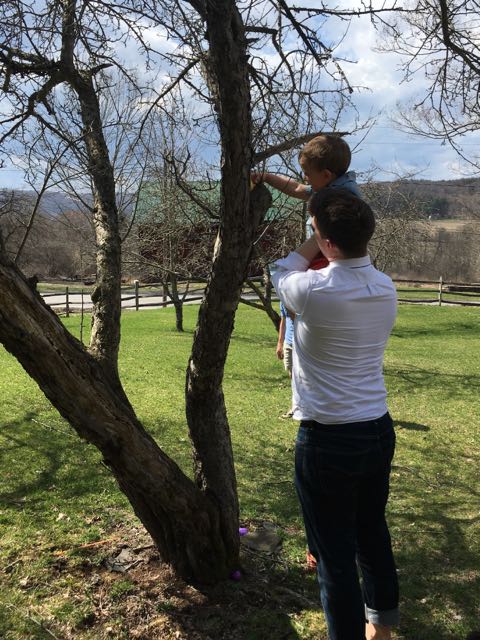
I was insistent that we have our Easter egg hunt in the orchard… because of this picture
Not quite 50 years ago, in that same exact spot, we hunted for Easter eggs — my brothers and sister and I. I don’t think we called it the orchard in those days because it was almost inconceivable that those saplings would actually grow into trees that would bear fruit.
My mother stood in the middle and watched us race around looking for eggs — real eggs, hardboiled and dyed, not plastic and filled with candy.
This year, we filled plastic eggs for Henry. Mary and Laurel hid them in the orchard and on the way to the orchard.

Some were placed high in the trees. Henry isn’t up to climbing yet, so his uncle “Fred” helped him reach them.
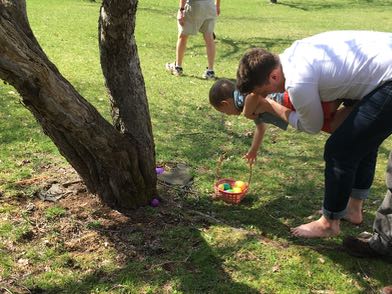
I know Easter isn’t about the eggs and the egg hunts, but there’s something deeply satisfying about so many generations doing the same activity on the same piece of land.
Part of my morning quiet time includes a creed — to remind myself of those things I believe to be true. It started with the basic Apostles’ Creed, but has grown. One part that I added is this:
I believe that the trials in my life are ultimately God’s good for me. They are like the grains of sand in an oyster that God uses to produce pearls.
The world is an unkind place. It’s full of people who thumb their noses and stick out their tongues.
Yesterday, in the checkout at the grocery store, the young woman behind me, obviously upset by something that had happened, said to her companion, “I just want to punch her in the face.”
With violent words, we betray the frustrations in our hearts.
This past Sunday, I was especially frustrated by a situation I knew that my father would encounter, where he would be excluded and pushed aside. The mama-bear in me raised her hackles and lashed out with words — words I didn’t entirely regret but wish I had said with a little more kindness.
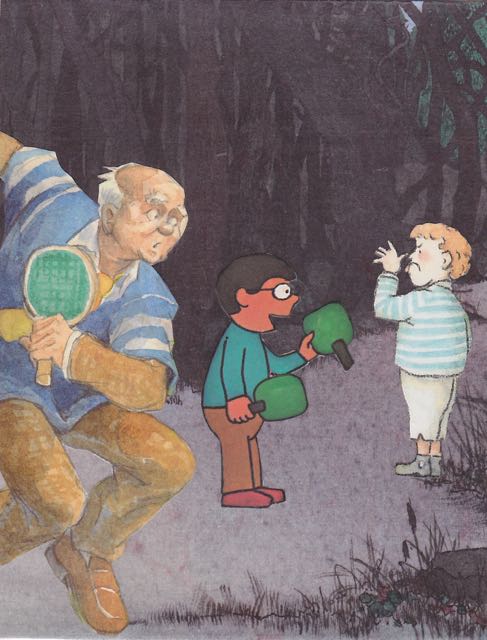
When I put together this collage, I wasn’t entirely sure what it was saying, but when looking for a “K” collage, I paused on it. Yes, I think I know now. It’s about right responses. It’s about kindness. So timely for me today.
The one boy is obviously the bully. He’s not nice. He’s not being nice.
The man is ready to rush in and give him a good smack.
But the other boy, he’s still extending the ping-pong paddle.
In kindness.
“Come and play,” he seems to be saying.
It’s Jesus. He constantly says, “There, there. I see. I know. Come unto me, you weary, heavy-laden, frustrated, overwhelmed child. I still love you. I still want to play ping-pong with you.”
And as I yield to Him, He adds another layer to the grit in my life, working to create a pearl.
Background from The Little Old Lady Who Was Not Afraid of Anything by Linda Williams, illustrated by Megan Lloyd
Man from My Dad’s Job by Peter Glassman, illustrated by Timothy Bush
Ping-pong paddle boy from My Fun With Words by James Ertel, illustrated by Geoffrey Brittingham, Seymour Fleishman, Vernon McKissack
Bully from Wheels on the Bus (a Raffi Song to Read book) illustrated by Sylvie Kantorovitz Wickstrom

If you’re here for a post about insects, sorry. This is more about creating and failing.
And yes, I know that a spider is an arachnid, but the bee is an insect, so I used it.
Last fall I went to a collage art workshop in Nashville taught by Wayne Brezinka. His artwork is stunningly beautiful and thought-provoking. I had been dabbling in my little cards and thought it might be interesting to see how such an acclaimed artist tackled collage.
First, we all had to introduce ourselves, telling why we were there. Immediately I was intimidated. The others in the class were artists, museum curators, people who were somebody. Mary and I sat on the far side of the circle. When it was our turn, it was another instance of I’m-with-her, as we both slouched in our folding chairs wishing we could disappear.
Wayne had planned several projects. First everyone made a picture of either a coffee cup or an apple. Some turned out gorgeous. Mine turned out odd at best.
After lunch, we spent most of the afternoon working on our own project. With you-don’t-belong-here you-don’t-belong-here throbbing through my mind, I stared at my canvas and wished I could leave. In fact, if it weren’t for the fact that Mary was there, I may have made some excuse and headed for the door.
But I didn’t.
I made this, a piece I still don’t really like. A house is adrift on stormy seas. A man in a row-boat is about to be swallowed by a wave or a fish or a giant snake. The Mr. Peanut sun doesn’t shed much light.
It’s probably reflective of how I was feeling. Overwhelmed. Sinking.
When I got home from Nashville, I wasn’t invigorated to do collage. I felt so inadequate.
I really enjoy making collages though, so, good or not, I continued.
Teddy Roosevelt said, “Comparison is the thief of joy.”
’tis so true.
And Tim Gunn said, “Life is not a solo act. It’s a huge collaboration.”
My collages now bear a little influence from Wayne Brezinka. I had to realize that I will never make art like Wayne because I am not Wayne.
I’m just me, and what I do is mine.
This insect card bears his influence though.
Wayne uses a variety of materials in his collages — found items, sticks, rocks, as well as the obvious paper. Our Christmas cyclamen was dropping its blossoms whole, so I pressed a few to see how they would dry. One appears on this card — a fragile white blossom for the spider to sit on.
Wayne adds physical depth to his work by layering and using cardboard to “pop” parts out. I popped the spider with a little cardboard behind.
I was frustrated that the child’s hand somehow got damaged, Mary said, “It’s okay. Nothing’s perfect.”
And she’s right. I kept the card because of Mary’s influence.
Now to unravel the rest of the (unwitting) collaborators — The background is from Ezra Jack Keats’ Over in the Meadow. The child is from The Silly Sheepdog by Heather Amery and Stephen Cartwright. The bee (and maybe the spider, but I’m not sure) is(are) from A Trip to the Yard, pictures by Marjorie Hartwell and Rachel Dixon.

Laurel sat next to me on the couch last night when I started this post by writing the title and inserting the picture I planned to use.
“Are you going to write about me?” she asked. “I help.”
Indeed she does. Laurel is an outstanding sous chef. She is often with me in the kitchen at dinner time helping with meal prep. She scours the internet for healthy recipes and sometimes volunteers to make dinner, on which occasions I am her sous chef. I think that’s pretty remarkable for a 13-year-old.
Mary helps, too, in her own way. She empties the dishwasher, unasked and often unseen. She brings my father his nightly beer. She makes sure he has the baseball game or Wheel of Fortune on after dinner. She has fixed him lunch on days when I’m not available. My father will say, “Mary is solid,” which I think may be cringe-worthy words for a 17-year-old to hear, but by which he means that he can count on her, a high compliment.
And the truth is, all my kids are great helpers. They have acted as gardeners and landscapers around my parents’ property, mowing the lawn, weeding the myrtle, cleaning up sticks and debris. They have chauffeured, accompanied, and assisted, attending to their elderly grandparents in so many ways.
Lately, some of my adult children have been caregivers, staying with my father over weekends when I need to be away. It’s a huge help to me.
I’m quite sure they inherited the helping gene from their father. Bud is one of the hardest-working, most generous people I know.
So thank you to all my helpers. You know who you are. I see what you’re doing and I appreciate it.
This picture is very early in my whole cutting-up-books-to-make-cards adventure.
The tree is from Garth Williams’ beautiful book, The Rabbits’ Wedding, the book that started it all. I picked it up at a yard sale, a gorgeous oversized picture book that had sat in the rain. It was starting to mold and smell — but the illustrations were so beautiful that I couldn’t stand the thought of it going to the dump. So, blindly, I paid a ridiculous amount of money for a soggy moldy book — 50¢ — and brought it home not knowing what I would do with it.
The girl is from Sarah’s Unicorn by Bruce and Katherine Coville. The illustrations in the book were all black-and-white, so I watercolored her, as well as the background.
I don’t know where the bird and nest are from.
The other day I stopped by the thrift store again.
I have a routine. When I drop my father at the nursing home where my mother had been — he likes to visit some of the employees — I make a quick trip to the thrift store. One is just down the road from the other.
I headed for the bookshelves where I found a worker was pulling books off and tossing them into a box.
“Are you getting rid of those?” I asked.
“Yes,” she replied. “Who would want them?” She picked up a paperback novel that had obviously either sat in the rain or been dropped in the toilet and held it out to me.
“I might like some of these picture books,” I said, pulling one out of the box.
I hit the mother lode that day.
Bedraggled, colored-in, torn, falling apart books are my favorite. I have no guilt cutting them up. I feel as though I’m giving them a new life.

When I made Laurel a coupon book for her 13th birthday, I cut up our personal copy of Tikki Tikki Tembo (author – Arlene Mosel, illustrator – Blair Lent). The book about the younger brother with a short name and the older brother with a very long name was a favorite with my children.
Chang is tenacious about getting help for his brother, the title character.
I think that’s what I love about the story. Brother looking out for brother.
For Laurel, my youngest daughter, a girl with seven older siblings, she has a lot of people to look out for — and a lot of people who look out for her. I thought it was okay to use that book. A good reminder.
Because that’s what family is all about — life/love in brokenness and care for one another.

The background is from Mother Night by Denys Cazet.
The family is from Wheels on the Bus (a Raffi Song to Read book) illustrated by Sylvie Kantorovitz Wickstrom.
I love the way this picture turned out. The family is the point of light in a dark world.
The question is, are they coming or going? Are they refugees fleeing a greater darkness? Or are they arriving home after a long journey?
Whichever it is, I see them pausing to look at their house.
In statistics, an outlier is an observation point that is distant from other observations.
I don’t think of my little family as outliers, though. I think of them as looking at home.
Jennifer Trafton Peterson, author of The Rise and Fall of Mount Majestic and her brand-new book, Henry and the Chalk Dragon, explained her writing process something like this — “I think of a picture that makes me laugh, something funny, and I write to it.”
When she read aloud a portion of Henry and the Chalk Dragon last fall at Hutchmoot, the annual gathering of Rabbit Room peeps, it was the funniest thing I had heard in a long time. Of course, I immediately pre-ordered the book.
It arrived the other day. Every time I see it — and I set it in a place I would see it often — it gives me impetus to finish the book I’m currently reading so I can dive headlong into Henry’s adventure. Yes, it was written for 3rd grade boys, but I can’t tell you about a time that I’ve been more excited to read a book.
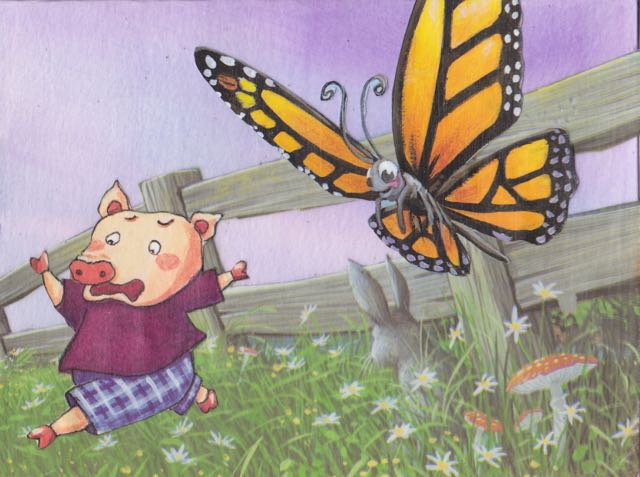
Henry and the Chalk Dragon has absolutely nothing to do with my “E” collage, except that I used the Jennifer Trafton method of creating. I sat one day with a pile of pictures spread out before me and thought about which ones would be funny together.
One of the results was this one — a butterfly chasing a pig.
It made me think of Monty Python’s Killer Rabbit of Caerbannog, when the knights were in denial of the danger, but it quickly turned to “Run away! Run away!”
My picture depicts a narrow escape from the Bloodcurdling Butterfly of Baoithein.
Fence and bunny from Catch Me, Catch Me! A Thomas the Tank Engine Story illustrated by Owain Bell
Fleeing pig from The Three Little Pigs and the Big Bad Wolf illustrated by Keiko Motoyama
Butterfly from — I’m so sorry, dear illustrator, I don’t remember!

Rabbit from A Boy Who Wants a Dinosaur by Hiawyn Oram and Satoshi Kitamura
Train tracks from Catch Me, Catch Me! A Thomas the Tank Engine Story illustrated by Owain Bell
Lego guy from Lego City: Snow Chase — Scholastic Books
Extraneous bushes from ??
Ways to deal with danger (note — not all these are optimal):
Things to do in the wake of tragedy (note — not all these are optimal):
Yesterday my Facebook news feed held horrific images from Syria.
I don’t do well with horrific images.
In fact, I turned off the television for years after seeing bodies floating in the Kigali River during the Rwandan genocide.
Mary was asking me about my memories of the Vietnam War era the other day. I told her that Time Magazine had images that I can’t erase from my mind.
I never watched Schindler’s List because I knew I couldn’t handle the violence of it. Someone told me that you get sort of used to seeing a Nazi pull out a gun and shoot someone in the head. I never want to get used to that.
At the same time, I don’t to be unaware, sticking my head in the sand. I read the news avidly.
I want to push back against the darkness in the world. How can I do that?
At the very least, I can champion for good with my words.
 Hot Dogs and Marmalade