Hutchmoot

News Storms

“Are you feeling better?” my father asked me Monday morning.

“What do you mean?” I asked.

He looked at me, perplexed. “You’ve been sick,” he said.

I laughed. “No, Dad, I’ve been in Nashville at that conference I go to every year.”

“When I didn’t see you,” he replied, “I thought you must be sick and in the hospital.”

His world consists of a failing mind and body. To explain my absence, he made up a story that fit his world.

While I was in Nashville, I didn’t read the news. Not a once. For four whole days.

No news may not be good news, but sometimes it’s just good.

Oh — I thought about it. People talked about it. The news felt like a rip current that threatened to pull us under and drown us in our differing opinions.

But at Hutchmoot, grace, tenderness, and humility surrounded us like a warm blanket. Our commonalities pulled us close and the day’s political controversies didn’t drive us apart. In fact, when, one evening at Hutchmoot, that rip current threatened in a particularly diabolical way, Andrew Peterson, our proprietor and host, showed us how to handle even the most treacherous waters — reaching out like the very best of lifeguards to pull us to safety.

The Brett Kavanaugh – Christine Blasey Ford controversy is mostly over, ending while I was away. It was an earthquake followed by a tsunami — and now America moves on – battered, skeptical, self-protective, and uglified by debris.

I couldn’t help thinking about how my father truly believed his own story of me being in the hospital. It fit his world.

And I daresay people who could insert themselves into Christine Blasey Ford’s story, who knew what it was to be sexually assaulted, found themselves making their story her story. Perhaps they remembered how they couldn’t tell anybody because of the shame they felt. Perhaps they remembered how they wanted to move far far away and start over in a new place without the reminders of that terrible act.

On the other side, people who had been falsely accused, who had been doing their best to do their best, working hard and keeping their nose clean for decades, who suddenly had been falsely blindsided by some incident from 30 years ago — perhaps they watched Brett Kavanaugh and asked themselves, how would I handle this? Perhaps, they told themselves, This is so unfair. Perhaps they know that they, too, would have gotten a little testy under that questioning.

But we don’t take the time to stand in someone else’s shoes. We put them in our story and force it into a narrative that may or may not be true. We make it make sense in a way that makes sense to us.

Like my father putting me in the hospital.

At Hutchmoot, I found a tranquil haven from the current current-news storm.
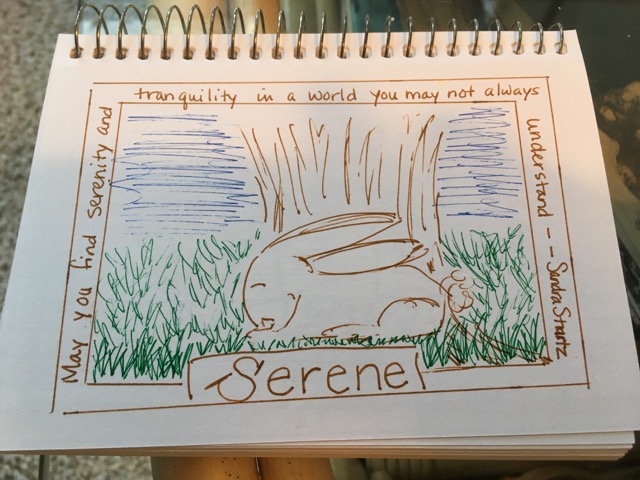
My October 2 Inktober attempt. “May you find serenity and tranquility in a world you may not always understand.” — Sandra Sturtz Hauss

Thinking ahead to the next storm and the next — because we seem to be in a political hurricane season in the US — I’m going to try to do more listening, less trying to inject my assumptions into the news stories. More trying to understand the fraught emotions on both sides, less knee-jerk judgmentalism. More compassion, more looking for common ground.

I would rather be a safe haven than a whitecap on this stormy sea.


Life

Denying the Doughnut

Laurel started in the public school this year as a sophomore. Had I known that last year was to be my last year homeschooling, I may have grieved.

Or not.

Life is busy and full and rich and keeps moving along.

I wanted to take one of those “First Day of School” photos that I see people post. But “ain’t nobody got time for that” is an accurate double negative. Some people DO have time for that — just not me.

Anyway, Laurel was rather nervous about starting school, and, therefore, rather uncooperative about a First Day of School photo. This was all I got:

So we have a new normal and a new morning routine.

Every weekday morning I join the throngs of parents driving their child(ren) to school. I follow the precise hand gestures of the sometimes-meter-maid police officer as he directs car past the elementary school. I wait in the line of cars to reach the drop off spot at the high school.

After I drop Laurel off and I start driving home, I think about the bakery.

Seriously.

This is a true confession here.

I love Schneider’s Bakery in Cooperstown.

They have the best doughnuts in the history of doughnuts. Their old-fashioned doughnuts are my favorite.

So I drop Laurel off, and think about swinging past the bakery to buy a doughnut for myself.

Comfort food for my grief, you know.

Every day, though, I turn to head back home instead of going to the bakery.

It’s an empowering moment — knowing I could make an unhealthy choice, but am choosing to make a good one.

Last Friday, I made my healthy choice, patted myself on the back, and went home.

Two hours later I had a meeting to attend. When I walked in the office at the pool I saw a box from Schneider’s Bakery sitting on the desk.

“Would you like a doughnut?” one of the guys asked and opened the box to reveal its contents.

“No, thanks,” I said, and looked longingly in the box.

We had our meeting. An hour later, he opened the box again to offer doughnuts to us.

I could smell them. I looked. And looked.

Finally, I pulled one doughnut out of the box and broke it in half.

“When you break them in half, the calories fall out,” I told him.

He laughed.

I took a small bite of my half-doughnut.

It was so good. Not too sweet. Not too doughy. Crisp on the outside and tender on the inside. Heaven in a doughnut.

I write all this to tell you two things:

One — Denying the doughnut at the beginning of the day is a great way to start. One good choice leads to another good choice and another good choice.

And, two — Eating a doughnut is not a terrible thing. It’s a thing to be savored and enjoyed. Just not every day.


Life · photography

God’s Handwriting

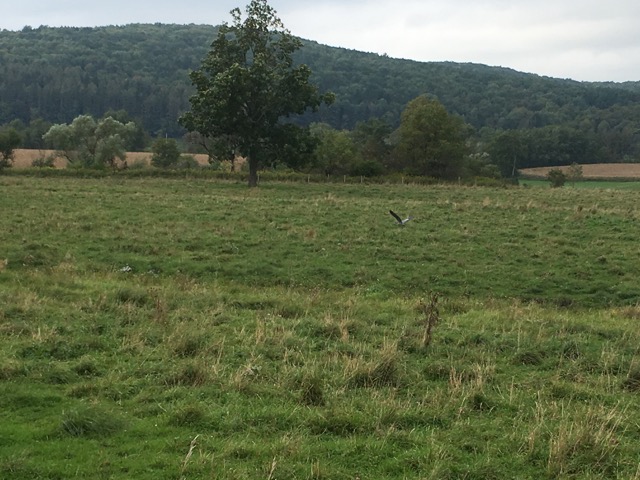
I knew the blue heron was there because I had seen it land, settling in the mid-pasture marshy land.

Can you find the heron?

Does this help?

How about this?

As the heron flew off, I did my best to capture him in a photograph. For a moment, he was easier to see.

Charles Kingsley said,

“Never lose an opportunity of seeing anything beautiful. Beauty is God’s hand-writing — a way-side sacrament; welcome it in every fair face, every fair sky, every fair flower, and thank for it Him.”

He forgot “in every heron.”

Life

Having a Hard Time

I thumbtacked this to my bedroom wall yesterday. These are words I need to remember.

The other day I waited at the deli counter. The woman ahead of me asked for something they were out of.

“What do you mean?” she screeched at the deli worker. “It’s in the ad! It’s on sale!”

“I’ll check the cooler again,” replied the deli lady, and she disappeared into the back.

The customer turned and said at me. “Is this when I’m allowed to start swearing?! Do you believe this place?!”

I shrugged meekly and thought about the quote. It sure looked like the customer was giving the deli worker a hard time, but, really, she was having a hard time herself. When deli meat becomes the make-or-break in a day, a person is having a pretty bad day.

My father spent Monday night in the hospital. When I walked in his room the next day, his room-mate said to me, “You must be Sally.”

“Yes,” I said, wondering how he knew.

“I’ve heard your name a few times,” he said. “At 1 AM. At 2 AM…”

When my father calls for me in the middle of the night, he’s not giving me a hard time. He’s having a hard time.

“I’m so sorry,” I said to the roommate.

The nurse came in to go over paperwork with the roommate. Honestly, I wasn’t intentionally listening, but only a curtain separated me from them.

Nurse: Who do you live with?

Roommate: I live alone.

Nurse: Do you have any family that lives near you?

Roommate: My kid lives about three hours away.

Nurse: Is he able to come help you when you go home?

Roommate: I ain’t spoke to him in two years.

Nurse: Is there anyone who can help you when you get home?

Roommate: My neighbor helps me if I ask.

Nurse: How many levels in your house?

Roommate: One. It’s an old huntin’ cabin.

Nurse: Do you have running water?

Roommate: Nope.

Nurse: What?! (long pause) You don’t have water?! What do you do?

Roommate: Buy it in town. My neighbor gets it for me.

Nurse: I’m surprised that you don’t have water. (another pause) No, I’m sorry. I’m not surprised. It’s fine.

I was busy helping my father and didn’t hear some of her questions. The next one I heard was –

Nurse: Do you have television?

Roommate: Nope.

Nurse: What do you do?!

Roommate: Whaddya mean, what do I do?

Nurse: For entertainment. In the evening.

Roommate: I have a big garden. There’s lots to do without a television.

I could hear her frustration and his annoyance.

I wanted to lean past the curtain and whisper to her — He’s not giving you a hard time. He’s having a hard time. He didn’t get much sleep last night and he’s about to go into surgery. He’s anxious and alone. Can you get him through the next few hours and then come back to this?

And I wanted to whisper to him — She’s not giving you a hard time. She’s having a hard time imagining your life which is so different from hers.

Taking a moment in the other person’s shoes can make a difference.

I now have a daily reminder to do that.


elderly

Guilty

When I first laid eyes on Joseph Zupnik three and a half years ago, he was late for the Family Council meeting at my mother’s nursing home, Focus Otsego.

“LATE!” I jotted into my little notebook. Not a good first impression.

He walked in the door and I barely noticed him. I thought he was a late-arriving family member, but he walked right over to the seat next to the administrator.

Joseph Zupnik was tall and thin, the kind of person who folds when he sits down and unfolds when he stands again. His pants were about an inch too short at the ankles and an inch too high at the waist. The muted tones of his plaid shirt were understated and unassuming, like he was. Quiet, mild, articulate. And young.

Almost immediately people started demanding answers from him about staff shortages and retention of the remaining staff. The rumor was that Focus cut salaries by 15% across the board when they took over. The fact was that staff had left in droves.

Joseph sat, calmly folded in his chair, legs folded as he crossed them at the knee, manicured hands folded across his knee, body folded somewhere between slouched and erect. He seemed so relaxed.

And he calmly fielded the questions and spoke of industry standards and union negotiations.

I wanted to say that no one cares about industry standards. These are our parents, not statistics.

Others spoke up though, and talked of how much better this place was than other ones.

And I wanted to say to them that I don’t want relatively good care for my mother. I want the best care.

He stayed with us for an hour and a half. Listening, responding, listening some more.

He knew his stuff. He fully understood the business end of this industry.

He was clinical and dispassionate — a walking statistics book.

Yesterday, Joseph Zupnik pleaded guilty to endangering the welfare of an incompetent or physically disabled person.

Seven other charges against him were dismissed.

His slap on the wrist includes community service. I’d like him to work as an aide in a nursing home for the same number of years he owned nursing homes.

And I’d like him to live on the same pay as the aides who had worked under him.

To me, that would be justice.

And mercy.

He would be a better man for it.


A little background and a final thought.

In the early 1970’s a new building combining the Otsego County Home and the Otsego County Infirmary was built down the road from where I grew up. It was renamed The Meadows, and I remember visiting there with my father when I was young. I believe he was the Medical Director.

When I took a year off from college in 1979, I worked as a nurse’s aide there. Everyone should work in a nursing home at some point to learn compassion (if that can be learned) and to experience how hard and thankless the work is.

Both of my grandmothers and one grandfather were residents at The Meadows.

My father-in-law was a resident of The Meadows when the new building, The Manor, was built. He was among the first crop of residents at The Manor.

My mother lived at The Manor. She was there when it changed hands.

When the county decided to sell, my father had been on the task force charged with finding a buyer.

We had ties to the Otsego County nursing home no matter what its name was.

In the end, the legislators voted to sell to the highest bidder instead of the most qualified purchaser. It was more of an “unloading” than understanding what an important part of this rural area that county facility served. They simply wanted to be rid of it. In my mind those legislators who voted to sell The Manor to Focus Corporation (and Joseph Zupnik) also bear some culpability.


dementia

Sitting in the Ashes

A friend sent Bud a text Sunday evening that said, “Tell Sally that I’m sorry I couldn’t stay to chat. I don’t think crying counts as chatting.”

She and I have done that dance before — asking how things are going and then watching the other’s eyes fill with tears as she tries to find words. The slow demise of a parent is not easy.

Yesterday a lady from the Alzheimer’s Association called me.

Last week, when I had been in semi-crisis mode, a nurse had called her on my behalf but she had been on vacation. Now she was back and checking in.

“What’s going on?” the Alzheimer’s Association lady asked.

I replied with a lengthy convoluted story. It was like my poor attempts at knitting when I kept dropping stitches. Over and over I had unravel a little to go back and fill in a gap.

“I’m not telling this very well, am I,” I asked. I hadn’t known where to begin the story. A month ago? A year ago? While my mother was alive?

“I’m following,” she said.

And she listened.

For a long time.

When I was done, she didn’t offer advice or even the usual perfunctory consolations. She matter-of-factly told me about the services available through her organization and offered to send me some fact sheets.

Having a stranger listen — just listen — was exactly what I needed.

I wish I could do that for my friend — just sit with her in the ashes so she knows that she’s not alone.

dementia · elderly · family · Life

Buried Gold

It’s been a rough few days… make that weeks.

My father has been struggling with anxiety. Anxiety and dementia go hand-in-hand. The world doesn’t make sense. Memories jumble around. People telescope in and out. Switchbacks define the landscape.

“DON’T GO THROUGH THAT DOOR!” he cries whenever I leave him alone in his room. Waylaying me with his hand on my arm, he looks over his glasses and says in a confidential tone, “There’s nothing out there. Nothing. You can’t go there.”

But I must and I do. His world may be confined to one room. Mine is not.

If I coax him out to the sun porch, I struggle to coax him back in.

He’s leery of entering the dining room. He forgets that he sits at the head of the table and takes my seat.

Which, of course, is fine. Just odd.

“When I was in World War II, I was stationed by the Red Sea. I buried a lot of gold there. We need to go back and get it,” he told me the other day. Except he was in high school during WWII and was never stationed by the Red Sea. He went there on holiday when he was stationed in Ethiopia in the early 60s, but not WWII.

He told someone today that gold was buried in the back yard. Here.

The only gold we have here are little bits of dental gold that the dentist gave me after she removed some of his teeth. It’s gross, probably not worth much, and certainly not buried. That sounds like a good idea though because I don’t know what else to do with it.

I’ve been so tired because I’m up multiple times during the night with him. He can’t sleep. He’s so anxious.

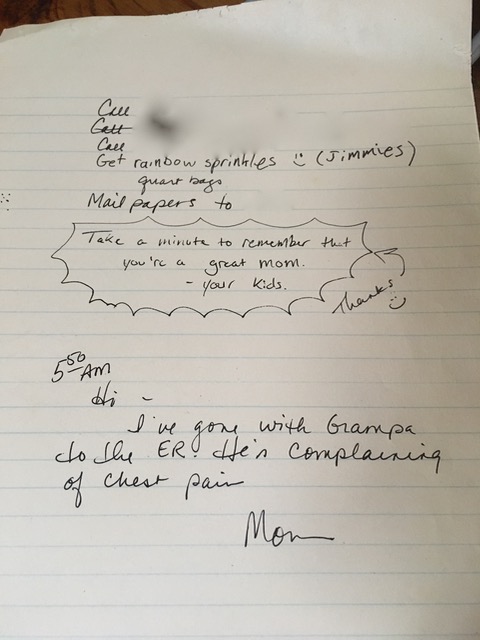
Last night I made a to-do list so I could make sure I got done what needed doing today. Phone calls, shopping, and mail.

Mary added the part about rainbow sprinkles. Rainbow sprinkles make things better.

Karl added the great mom part. The pat on the back meant a lot.

Sometimes life gives more gut punches than pats on the back.

My father didn’t get to sleep last night until 11 PM — which meant that I didn’t either. He woke me at 5:05 AM.

Through the monitor I heard, “Sally! SALLY!”

I ran downstairs, my heart pounding.

“I’m having terrible chest pain,” he said. I called the ambulance.

The paramedic asked him about the pain.

“10,” my father replied. “Crushing chest pain,” he added.

By the time he got to the Emergency Room, he was fine.

“He has dementia,” I told the ER doctor.

“I got that,” she said, smiling.

“Can I get you something to drink?” she asked my father.

“I like beer,” he said. It was 6:15 AM.

He hasn’t had a beer since he ordered a flight a couple of months ago at his favorite restaurant. He was baffled by the four little beers served on a board. “What do I do with this?” he asked.

“You taste them,” I said.

He gave them to Karl.

We were home from the ER shortly after 7 AM. God bless the ER doctor who didn’t do a full cardiac workup.

Sometimes gold is in rainbow sprinkles and kind words.

Sometimes it’s in the not following protocol and using common sense.

Sometimes it’s buried in the backyard but I’m not going to count on that today.

Travel

Why Norway — part 2

Lest anyone think we’re independently wealthy and that’s how we travel the world, two things:

  1. International travel is not much more expensive than travel within the USA. In fact, I honestly think it could be less, depending on the country. Food and lodging can be pretty cheap in some parts of the world.
  2. Each of my children received some money from my mother’s estate in the same way her mother gave money to each of her grandchildren. My money from my grandmother was used to purchase my first car – a 1970 VW bug. Some of my children used their money towards a car, too. Mary and Karl both expressed a desire to travel.

Why Norway? I asked Karl on our way home. Norway wasn’t on my radar at all.

If someone asked me, I would say Israel — but that’s not a trip that can be safely done on a whim.  It’s my dream, though, to go to Jerusalem. I want to pray with my hands on the Western Wall. I’d like to go to the Temple Mount, the Mount of Olives, the Garden Tomb. I want to visit Yad Vashem and I want to eat fish on the shore of the Sea of Galilee.

Instead I ate fish soup on the wharf in Bryggen. (It was amazing.)

Karl’s reason? “The pictures looked cool.”

I guess that’s reason enough.

In retrospect I can see how much I needed Norway.

My father’s world shrank significantly while I was away. He’s afraid to go into rooms, and when he enters, the door must be closed behind him.  He throws his hands up in fear or anxiety when I open the door to leave.

“Sally! Don’t DO that!” and he grabs my arm if I’m close enough. “Don’t go out there! You don’t understand!”

He’s right. I don’t understand.

And he can’t explain it.

So we stay in stuffy rooms watching Wheel of Fortune and Jeopardy.

And I think about the vistas of Norway.

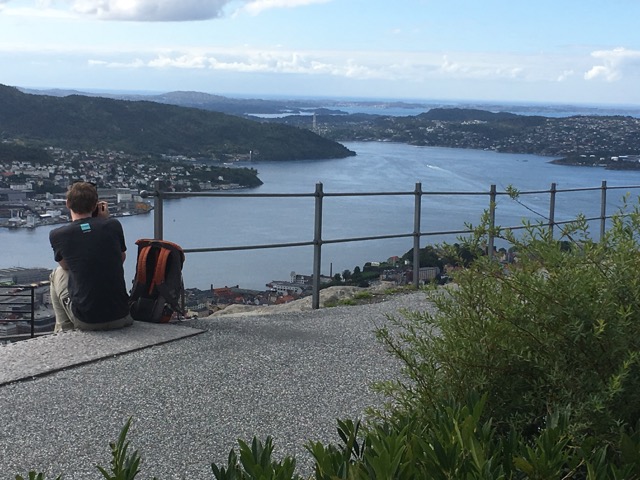
Fløyen, above Bergen
The view from our Airbnb

The mind can be so fragile. While I was gone, the fragile balance was upset, and I don’t know how to put it back.

So I think about the piles of rocks I saw along the river, and the raging waters that were so close, and how we all teeter at times.

On the way from Berekvam to Flåm

I drove in Norway — not something I recommend. The roads can be narrow and winding. My father would have remarked on the switchbacks that we saw from the train.

Switchbacks

When I drove, I was too busy worrying about running into another car to try to imagine the switchbacks. I drove roads barely wide enough for the VW Golf I rented, and would come around the corner and meet another car going in the opposite direction.

This was a two-way road.

I quickly learned to throw the car into reverse and back up to a broader area where the other car could get past me.

Or be grateful when the other car did that for me.

Life has been like that for me, too. I can’t see what’s ahead and I don’t have much wiggle room.

But I have Norway, and it was beautiful.

So I’ll cautiously proceed.

When my father tells another switchback story, I’ll have some of my own now.

family · Life · Travel

Why Norway

The place we used to stay in Myrtle Beach had no phones in the rooms. This was back in the 70s, when phones that fit in your pockets weren’t even a twinkle in a computer chip’s eye. Phones had dials and cords.

In those first few years in Myrtle Beach, if someone needed to reach my father at The Teakwood, they had to call the motel office. Someone from the office would find my father and he would have to go to the office to take the call or return the call. Things really advanced when they got a phone with a portable handset.

At the Teakwood

I asked my mother about the lack of phones. Somehow it made The Teakwood seem inferior to its phoned competitors.

“It helps Dad relax to get away from the telephone,” she said. I hadn’t thought about the tyranny of the telephone until that conversation.

I recently heard on a podcast that the presence of a phone at a meal — even if it’s facedown on the table — causes the conversation to be more shallow.

But this isn’t about phones.

It’s about why I went to Norway.

Last year I traveled to Europe for the first time since I was 5 years old. Twice.

The first trip was to take my father to Normandy, something he had longed to do for many years. I was excited for my father, but ambivalent for myself. I knew that I should be excited. I just couldn’t muster up the excitement on my own.

Then we went to Normandy and I loved it. I think I could live in Bayeux and be quite content there. The cathedral, the farmers’ market, the patisseries, the narrow streets, the old buildings — all of it lovely. I didn’t think anything could top Normandy.

Until Bosnia two months later. The land, the people, the hospitality. I came home from that trip quite full.

So when I was feeling depleted this year, and so many people kept reminding me that caregivers need to be sure to take care of themselves, I thought about what had pressed a reset button in my soul and given me rest and strength for the days ahead. Travel. Like the phoneless Teakwood did for my dad.

I applied and was accepted to a writer’s workshop with Ann Voskamp — but it was in the wilds of Alaska. When I realized how remote the workshop was, and how, if something happened at home, I would have a hard time making an emergency trip back, I asked to postpone my attendance for another year.

Then I considered a trip back to Bosnia, but nothing seem to fall into place with that.

Finally, I asked Karl — who had been saying that he wanted to travel — where he wanted to go.

“Norway,” he said.

So Karl, Mary, and I traveled to Norway. And Denmark. And Sweden.

If an emergency had come up, I was always near an airport.

Except for the day we kayaked in the fjords. But truthfully, that was the most renewing day of all.

dementia · family · Travel

While I Was Away

I can still see the woman’s face as she said the words to me.

She started off saying, “It’s such a good thing you’re doing — keeping your father home.” But then she stopped smiling and looked me in the eye, “You can’t do this forever, you know. There’s going to come a point when you have to place him somewhere that can take care of him.”

My dander rose a little when she said that. I thought, That day will never come.

It nearly came last night.

Ten days ago I took a trip with two of my children. Something changed with my father in the week that I was away. He started fearing certain doorways and needing certain doors to be closed. He started refusing to go down hallways in the house where he has lived for 50 years.

“You don’t understand, Sally,” he’ll say to me, gripping my arm and pulling me close to hear his words. “You don’t want to go there.” He’s emphatic. His words have an urgency evidenced by his tight grip as he says them.

When I tell him that I don’t understand, he says, “How can I explain this to you?” After a long pause during which he’s unable to come up with an explanation, he’ll simply say, “Please don’t open that door.”

Last night he turned off the baseball game and headed to the dining room, announcing that he was going to bed.

“Where are you going to sleep?” I asked.

“Here,” he said, and he pointed to his heart.

“Will you walk with me to your bedroom?” I asked, slipping my arm under his to support and guide him at the same time.

He planted his feet. “You don’t understand.”

After a bit of coaxing, loud arguing, pleading, and everything else I could think of, Bud and I, one on either side of him, forced him to take the steps he clearly didn’t want to take. Once he saw his room and his bed, he was fine (more or less). For a few minutes, though, it was ugly.

I lay in bed afterwards feeling discouraged and thinking, What would Penelope Lumley do?

Penelope Lumley is the plucky governess in The Incorrigible Children Of Ashton Place series (by Maryrose Wood). The motto for the school she attended, The Swanburne Academy for Poor Bright Females, was, “No hopeless case is truly without hope.”

I pictured the woman saying, “You can’t do this forever,” and I pictured the fictional Penelope Lumley reminding me that “No hopeless case is truly without hope.”

There has to be a solution.

In Norway (that’s where I went on my trip) we saw a house set up high overlooking a fjord.

Our guide told us that it has no road access. The old farmhouse had fallen into disrepair until a couple bought it and turned it into successful guest accommodations. Visitors arrive by boat at the base. They climb ladders and hike steep trails with switchbacks to reach Stigen Gard. It takes over an hour to make the ascent.

Some would have said the rundown farmhouse was hopeless, but no hopeless case is truly without hope.

The view at the bottom was beautiful.

I’m sure the view at the top is even better.

I just have to figure out how to do it.