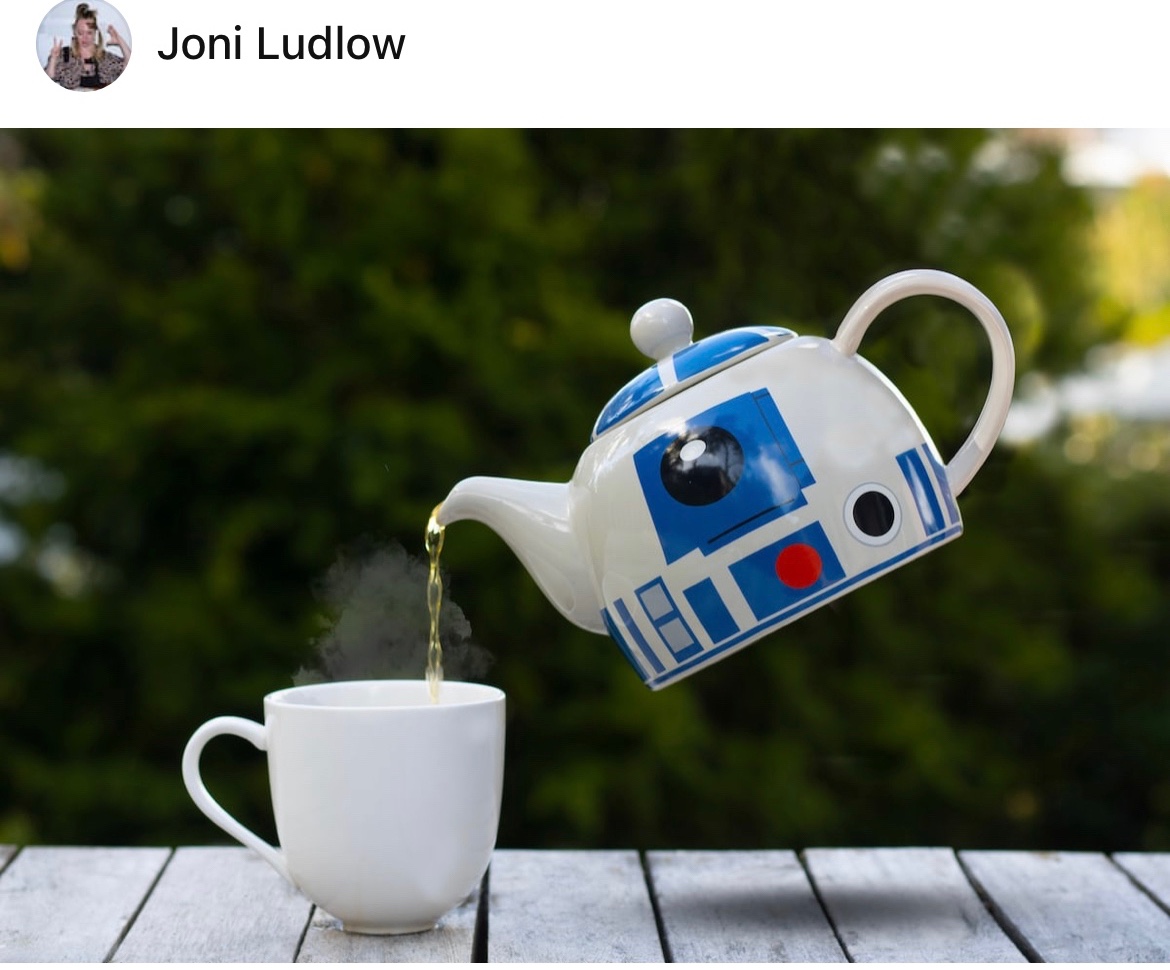
I’m a little teapot in the air As you might guess I’m exceedingly rare How it is I do this I can’t share I’m just a teapot in the air
I’m a special teapot You’ll agree There’s magic all around us for those who can see Maybe you can fly too! Count to three — Click your heels and follow me
~~~~~~ OR ~~~~~~
I’m a little teapot Watch me fly I hover, I pour, then zoom on by Signal that you need me and I’ll try To zip on over and resupply
~~~~~~ OR ~~~~~~
I’m a special teapot Yes, it’s true Here, let me show you what I can do I can pour hot tea all over you Be nice to me or get your due
~~~~~~ OR ~~~~~~
Maybe it’s a secret teapots keep More than holding water and letting tea steep Oh, the things that happen while you sleep! Or do you think a broom just sweep-sweep-sweeps
Spring, Summer, and Autumn I keep my windows open at night. In the morning, I sit in an easy chair at the front of the house near the open windows and read-journal-read before I start my day.
That’s when I’ve heard the owl.
And, during the day, the crows, who fight over whatever I’ve put in the compost.
The other day in the early morning, I heard a bird that I didn’t recognize so I recorded it with my phone on the window sill, and then asked a birder I know at work to listen and identify it for me. It was a red-bellied woodpecker — which, may I point out, does NOT have a terribly red belly.
One of my co-workers suggested I get the Merlin app which would have done the identifying for me.
“I’d rather ask a person,” I said, in part because of the delightful bird conversation that followed the identification.
We’re fighting a battle, don’t you think, where people are being replaced by technology. Self-checkout at the grocery store. Robo-calls and now robo-texts. Apps for everything.
It’s like a metronome, constant and rhythmic. I can hear him come up the hill, getting louder and louder. Once he passes, the sound fades until he’s over the crest.
Newer runners slow as they come up the hill. It’s a steady grade and exhausting.
When there are runners, cars slow down (usually).
If I hear a car slow down and don’t hear a runner, I peek out my window to see what’s happening. Usually it’s a cyclist or a deer.
The ones that drive me crazy are the cars that don’t slow down for anything.
I’m pretty sure they are all from New Jersey.
One of my co-workers was lacing up her shoes for a “little run” the other morning. “How far do you usually run?” I asked out of curiosity.
“Since the Boilermaker [a local 15K race that happens every July], I only run three to five miles a day,” she said, and shrugged.
Mind you, I haven’t run anything even close to a mile since high school. If I did it then, it was because we had to.
I’ve tried running every now and then, but it hurts, so I quickly give up. Something about running is so pounding and jarring that makes it not feel good at all. Maybe I’m not doing it right.
Plus, I’m a fast walker. I have overtaken runners while I walk. I walk nearly every day.
Mostly I consider myself a swimmer, even though I don’t get in the water as much as I would like. Swimming feels natural and at home. I get lost in thoughts. I stretch and rotate and breathe.
As I go up and down the lane, I think, think, think — about things I’ve read, or heard said, or the sounds I heard as I sat in my chair earlier in the morning.
Like an owl or a red-bellied woodpecker or a runner’s footfalls.
“Once upon a time,” Dad began, “there were three chairs. Papa Chair, Mama Chair, and Baby Chair.”
“Chairs?” asked Junior, scrunching up his face.
“Yes, chairs,” Dad replied. He continued, “So Papa Chair said to Mama Chair –“
“Chairs don’t talk,” interrupted Junior.
“These chairs do,” Dad said. “Papa Chair said –“
“How can a chair talk? It doesn’t have a mouth,” said Junior.
“Maybe the wind whistles through the slats and makes a noise,” Dad explained.
“But then the chair has no control over it. It has to wait for the wind to come along.”
Dad sighed. “Just let me tell the story. Papa Chair said to Mama Chair, ‘How are you today?'”
“Maybe Papa Chair squeaked. Sometimes chairs squeak, right?” Junior interjected.
Dad ignored him. “Mama Chair didn’t answer, but Baby Chair said, ‘Can’t you see Mama Chair is a broken mess?'”
“Of course Papa Chair couldn’t see. Chairs don’t have eyes,” said Junior.
Dad continued, “Papa Chair didn’t know what to do! Baby Chair said, ‘Just call a committee.'”
“This is getting stupider, Dad,” Junior said.
Dad pretended not to hear. “Papa Chair said, ‘What committee? Why?’ Baby Chair said, ‘Any committee could help. They all have Chairmen.'”
“Yeah, well, when my chair broke, you just said that it was letting me down.” Junior said. “And then, you said that you had thought about replacing it with a rocking chair, but you kept going back and forth on it. Psssfftt… Dad jokes”
The poem is made up of quatrains with an aabb rhyme scheme. Syllable count 3-7-7-1. Lines one and two rhyme on a two-syllable word; lines three and four rhyme on a monosyllabic word.
I’m reading a book called Hoop: A Basketball Life in 95 Essays by Brian Doyle. It almost makes me want to watch a basketball game.
Almost.
I don’t think I’ve watched a basketball game since high school. When I went to Syracuse University, I got to know a few of the basketball players, but I never went to a single game.
This was back in the ’70s when they had a new young coach named Jim Boeheim. He retired after the 2022-23 season. I heard a radio announcer on the NPR station talking about the SU basketball coach retiring and she referred to him as Jim Bohemian. I laughed. I knew his name well. I thought it sad that after decades of coaching, he was still unknown to some.
But that’s true of all of us.
No matter how notable our lives, we’re equally unnotable.
And that’s okay.
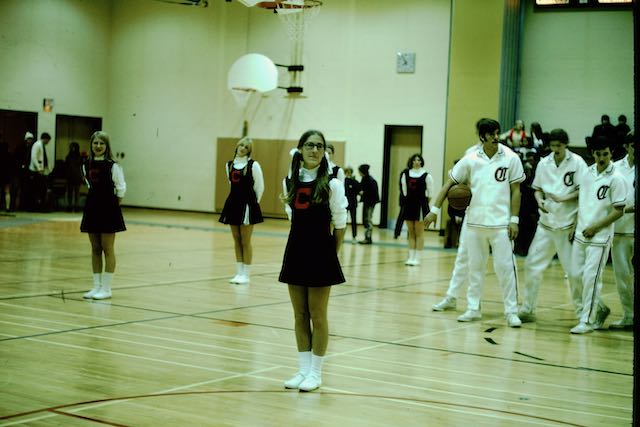
Mostly, I watched games in high school as a cheerleader.
Yes, I was a cheerleader. I followed in my sister’s footsteps.
Oh, the good old days.
Not really.
My freshman year I had planned to play field hockey but I got very sick with mono and missed three weeks of school. I never tried to play another sport.
Then, I was a cheerleader, as I said. I didn’t — and still don’t — really understand football. But I know the cheers. “First and ten! Do it again!” Don’t even try to explain it to me.
Basketball made ever-so-much more sense. At least I understood the basics.
Reading Brian Doyle’s book makes me understand how much of the game I missed — such as the grace and beauty of dribbling a basketball.
The other day I was walking on the track above our basketball courts at the sports facility where I work. Below me, kids were playing basketball. They had just finished their first day of school and come to the gym. It’s a time-honored tradition in Cooperstown.
I watched one boy trying to dribble two basketballs — one with each hand — and struggling to keep them even. Before long, it looked more like playing the bongos than dribbling a basketball.
A bit later, a girl took up that same challenge, same activity. She was considerably younger, shorter, and more athletic. She made it look easy. I watched her in admiration. If I hadn’t seen the boy struggling to do the same thing a few minutes before, her ease wouldn’t have stood out to me.
But it did.
I hoped the boy would stick with it — practicing, practicing, practicing.
I thought this morning, as I was reading another Brian Doyle essay on basketball, that I should write a book about swimming.
About the grace and beauty of it.
About the heartbreaks and the victories, the old pools and dank locker rooms, the shiny pools and pristine locker rooms. About parent timers who forget to stop the stopwatch because they’re so intent on watching their child. About the officials who have fallen in the pool during a meet, or had a coach in their face about a disqualification.
Mostly, though, about the Zen reality of swimming laps – swimming down, pushing off the wall, swimming back, over and over and over. Because if that doesn’t mimic life, I don’t know what does.
At least, it mimics life for me.
This stream-of-consciousness blather is brought to you by Linda Hill’s Stream of Conscious Saturday, where the prompt for today was mostly/at least.
It was roughly the size of a grapefruit, translucent, mottled, and reflecting the gold of the cushion it rested on. The sign next to it read, “MAGIC. DO NOT TOUCH!”
Mairi reached toward it, but Iain slapped her hand away.
“DON’T TOUCH IT!” he yelled. “Can’t you read?!”
“I just want to look at it better. I can’t tell what it is,” Mairi said, her lower lip trembling.
The two children stared at ball. It had mysteriously appeared on the table.
“We should tell Mom,” Iain finally said. “It gives me the creeps.”
“She’s in the kitchen with George,” Mairi said. The tone of her voice and the accompanying eye-roll said everything about her feelings toward George.
“I’ll get her,” Iain said. “You wait here, but don’t touch it.”
She frowned and stared. “What makes it magic?” she said aloud and reached for the ball as her mother and Iain came in.
*POOF* Mairi was gone.
Iain grabbed hold of his mom, terrified. “What just happened?!” he cried.
Behind them both, a deep voice ordered, “Bring that here.”
Iain looked at George. His height and heft alone were scary, but that booming voice made Iain’s stomach feel all squeezy.
“Bring it here,” he ordered again.
“But… but…” Iain stammered.
George took a step toward him, so Iain reached for the orb.
*POOF* Iain was gone.
George slid his arm around their mother.
“Now, where were we?” he said, smiling wickedly.
This is my response to this week’s Unicorn Challenge — write a 250 word story based on the picture shown above.






 Hot Dogs and Marmalade