Life · Writing

Decision Making

My youngest daughter is faced with a challenging decision. She and her current roommate are moving into a new apartment. It’s two bedroom, two bath, but one of the bedrooms has a bath attached while the other bedroom would use the common bathroom.

“The one with the private bath is clearly the better one,” she told me. “How do we choose who gets it?”

Draw straws? Flip a coin?

One of her sisters suggested they each bid on the room. How much more would they be willing to pay for the room with the private bath? Later, though, she said that would kill their friendship. Both girls would feel resentful — one for the privacy, the other for the money.

I asked dilemma-daughter again the other day. “Did you figure it out?”

“No,” she said sadly. “This is so hard!”

And yet I think we both know that if this is the hardest decision she has to make in her life, her life will have been pretty easy.

It’s less about making the right decision, and more about being able to sit with whatever decision is made. She will have another hard decision next week, next month, next year. Another opportunity to move on and not second-guess.

I think that’s called living.


This is my post for Stream of Consciousness Saturday, where the prompt was “Straw.”

It’s been a while since I’ve participated in this weekly prompt, but I’m trying to get those creative juices flowing again.

fiction · Writing

Skeecher

“Mom! I can’t find Skeecher!” Jeremy yelled.

Mom turned from the sink. This was the third time this week that Skeecher, a strange statue that Jeremy had unearthed in the garden, had gone missing.

Last week when she had sent Jeremy out to pick rocks from the newly-tilled soil of the garden, he moaned about the work like any normal 10-year-old. But when he came running in holding this dirt-covered statue of pot-bellied humanoid, he was anything but annoyed. He was delighted. Why Jeremy named it Skeecher was as much a mystery as the thing’s origins.

“Did you look on your dresser?” It sounded like an obvious place, but that’s where Skeecher was yesterday when they went to look.

“No! I looked there. AND the window sill. AND the closet,” Jeremy said, listing off Skeeter’s previous hiding places.

“I’ll help you find him” she said, drying her hands and heading down the hall. She opened the door to Jeremy’s room, and there was Skeecher standing in the middle of the floor.

“Is this a joke?” she asked.

Jeremy didn’t say anthing. He just scooped up the figure and hugged it.

The next day, while Jeremy was at his friend’s house, Mom heard noises in Jeremy’s room as she passed. She opened the door to see 6-foot tall Skeecher leap onto the desk and shrink to his normal size.

She ran in and grabbed the statue. His body still felt supple. His eyes blinked open and met hers.


This is my contribution to the Unicorn Challenge. It’s a challenge with only two rules: 1) no more than 250 words, and 2) inspired by the photo.

I know, I know — I’ve been MIA, but the creative tank has been low. Life.

And I realize this is an incomplete story. Again – life.

Don’t you think life is just one big incomplete story?

A to Z Blogging Challenge · Writing

I is for Imagination

If you want to know what loving your neighbor is all about, look at them with more than just your eyes.

Frederick Buechner, Whistling in the Dark


I recently started a writer’s group at the senior program where I work.

We’ve had two meetings, but only one person — the same person — has come each time. The last time we met I was feeling so overwhelmed with life that we hardly talked about writing until at the end when we were talking about all that’s going on these days. Something clicked in my brain.

“This,” I said, making a grandiose gesture with my arms to indicate the world in which we live, “is why writing is important. Writing helps us understand.”

It was at just such a time as this that I started this blog, although it wasn’t the country in turmoil. It was my mother’s dementia. I was having a hard time processing it.

Just like I’m having a hard time processing what’s going on today.

Writing taps into something — surely there is a word for it — that unravels the knot.

I think it has to do with imagination — with seeing with more than our eyes.

fiction · Writing

Mr. Barleigh

Mr. Barleigh kept the floors clean at the primary school. He swept. He mopped. He picked up trash.

Mr. Barleigh moved at one pace. It wasn’t slow, really. It wasn’t fast, certainly. It was an amble.

Mr. Barleigh was tall and thin. He had minimal hair, peppery-grayish. His uniform shirt was loose, as were his pants, but his suspenders kept everything in order. He had suspenders in a variety of colors and patterns. The children were always interested to see which suspenders he had on.

Mr. Barleigh knew every student’s name and greeted them by name every day.

Mr. Barleigh carved turtles out of little bits of wood and he gave one to each student. “We can learn a lot from turtles,” he would say, “but the two most important things are ‘Move at your own pace’ and ‘Be comfortable in your own shell.'”

Mr. Barleigh smiled when one of the 2nd grade teachers used his turtle sayings for a bulletin board. “I hope you don’t mind,” she said, “but there’s so much wisdom in those words!”

Mr. Barleigh always ate his lunch in the cafeteria, sitting with a different group of children every day.

One day, Mr. Barleigh didn’t come to work. Teachers and students alike were concerned. The police officer who went to his house found that he had died in his sleep. He also found that every bit of wallspace in his house was covered with school photos and drawings from children.


This is my submission to the Unicorn Challenge. The rules for the challenge are simple — no more than 250 words and use the photo as a prompt.

fiction · Writing

The New Swans of Ballycastle — Chapter 2

Chapter One — if you haven’t read it.

CHAPTER TWO

Corrie was worried. Deirdre’s behavior was causing the worry.

She had been watching Deirdre withdraw, become more sullen, snap at her family over little things.

Could it be the natural changes that occur in a pre-teen girl? Corrie wondered. But, no, this seemed different.

Once, when she went to check on Deirdre in her room, she found the girl studying something in her hand, stroking it with the index finger of her other hand. Corrie spoke and the girl jumped. She hid whatever-it-was behind her back and snarled at Corrie to go away.

Corrie went back down to the kitchen. As she kneaded that day’s bread, she thought and thought. Push-pull-fold-turn, push-pull-fold-turn. The process of kneading dough was cathartic. It helped her concentrate. It released all the emotions she had been holding. Push-pull-fold-turn, push-pull-fold-turn. Something was very wrong with Deirdre, she knew. Push-pull-fold-turn, push-pull-fold-turn. Should she talk to the girl, or should she talk with Brian first?

A few days later, when the children were outside, Corrie went into Deirdre’s room. She opened the drawer in her bedside stand and saw the Golden Swan coin there.

Her heart stopped. Quickly, she slid the drawer closed and backed away. She swore that she had seen Deidre throw that coin into the sea, but there it was.

Corrie went out to find the children. The three of them were in the backyard. Michael and Kevin were playing a one-on-one game of tag. Deirdre was sitting alone on a bench, staring at the sky.

“Can I sit with you?” she asked the girl.

Deirdre shrugged. “I don’t care,” she muttered.

Corrie hestitantly began the conversation. “I’m concerned about you, Deirdre. You seem unhappy about something.”

“I’m fine,” Deirdre replied, emphasizing the word “fine” like it was the most distasteful word in the language.

Corrie reached over to put her arm around the girl, but Deirdre jerked away.

“Don’t. Touch. Me,” Deirdre said. “You wicked stepmothers are all alike.”

Corrie tried to protest, but Deirdre kept going. “You’re mean. You’re ugly. I wish you had never come here.”

Kevin and Michael stopped running. They looked puzzled and alarmed. They looked from Deirdre’s face to Corrie’s and back to Deirdre’s.

“C’mon, boys,” Deirdre said. “We’re going to the beach.” She grabbed Michael’s hand and jerked him along. “Without her.”

Kevin walked beside Deirdre, head down. Michael had no choice except to go with his sister, but he kept looking back over his shoulder at Corrie.

poetry · Writing

Writer’s Dice (Sort of)

Moments, Grateful, Grandkid, Free

Well, I just wrote a long post of gratitude yesterday and I saw two of my grandchildren today. I’m going to take that “FREE” cube and run with it.

This coming week, on Thursday, we’re having a Robert Burns celebration as part of our senior program. I’m excited and terribly anxious. I ordered haggis for it, then came into work one morning last week to see the box of haggis sitting beside the front desk. It had arrived after I left the previous day. It was clearly labeled, “PERISHABLE. REFRIGERATE IMMEDIATELY.” But there it sat in the lobby.

I was so upset that I couldn’t even open the box, so one of the custodians did it for me. Everything was still frozen inside. It was packed in styrofoam and ice packs. I’m still amazed that it was so cold.

Today, though, I worked on my own version of “To a Mouse” which I may share at the Burns event. In Robert Burns’ version, he’s apologetic for disturbing a mouse’s nest while plowing. I am slightly less kind. The first two lines are all Rabbie Burns’. The rest are mine.

Wee, sleeket, cowran, tim’rous beastie
Oh, what a panic’s in thy breastie!
I ken, I ken — ye smelt the yeastie
in discarded bread
But would it be too much to ask ye
go somewhere else instead

Ye leave yer jobbies* and I find them
On the counter, near a bread crumb
Or by the garbage, where ye oft come
to find a treat or two
I recognize where jobbies come from
they cause me to say “Ewww!”

Today I grant ye sweet release**
Across the street — and wish ye peace
Instead of plotting yer decease
I will allow ye live
May yer domestic tribe decrease
Today’s nibblin’s I forgive

But tomorrow, oh tomorrow
I may wish ye endless sorrow
Ye come into my home and borrow
That which is nae yers
Mousetraps are set those places ye go
BAM SNAP! – yes, death occurs


*Jobbie is a Scottish term for excrement.

** Yes, I release mice that are alive across the street in our compost pile.

fiction · The Swans of Ballycastle · Writing

The New Swans of Ballycastle

In the Irish seaside town of Ballycastle, the people still tell the story of the three wandering swans…

Thus begins the original Swans of Ballycastle, and thus begins my tale.

The children and a single father are introduced: “Deirdre, the oldest was ten, Kevin was eight, and Michael was only five. Their father’s name was Brian and he kept a small shop in the center of Ballycastle. The three children and their father lived on the second floor over the shop. Their mother had died when Michael was very young. Brian, the father, raised the children as best he could.

The children were incredibly happy. They played make-believe games in the shop or wandered to the beach and built sandcastles. They were happy. They were content. Life was good.

One day, their father journeyed to Belfast to buy goods for the store. “In his absence, Widow MacConnell ran the shop and looked after the children. Not that she had much to do on that score, for Deirdre, as usual, took care of her younger brothers. She cooked, served the meals, swept and dusted and saw that her brothers went to bed on time.

Brian was gone a long time.

One morning the children rose and went downstairs. In the kitchen they found their father. With him was a strange woman.

[Here the Sally-version takes over]

She was short and round. Her hair was white and curly, like the caps on the waves. She wasn’t old, but she wasn’t exactly young either. Her dress was ocean blue, billowy and soft. Her smile, when she saw the children, grew and grew. It was warm and welcoming.

Deirdre wanted to run to her immediately for a hug, but something stopped her. She didn’t know this woman and she was her brothers’ protector. Instead she looked to her father.

He took another sip of his coffee, stood, and said, “Deirdre, Kevin, Michael — This is your new mother.”

He opened wide his arms and the children ran to him. While they were gathered in their family hug, he reached his arm out to the new woman and pulled her into the embrace. Deirdre thought she smelled like the sea breeze and welcomed her closeness.

Her name was Cordelia, but she insisted that the children call her Corrie. “I would never dare to presume that I could replace your mother,” she said, “but I promise to love you as best I can.”

Corrie’s favorite thing to do was walk on the beach. Every morning, she led the little entourage to sandy shore. Michael held her hand now, instead of Deirdre’s when they walked.

Kevin and Deirdre found that Corrie had a wealth of wisdom about the sea and the shells and the birds and the fish. They would run ahead when the beach was in view and begin their hunts.

“What’s this?” they would ask, bringing her a shell. She always knew the name and a story about the creature that lived inside.

One day Deirdre found a golden coin stamped with the picture of a swan. “Look, Corrie,” she said, extending her open hand to her with the coin on it.

A shadow crossed Corrie’s face. “Throw that away,” she said sharply, “as far as you can into the sea.”

Deirdre pretended to throw it, but she folded her thumb over the coin while she made the throwing motion, then stealthily slipped it into her pocket.


Okay — this new story is going to take more than one day’s work. Tune in next Tuesday, for part Two.

family · Life · Writing

The Swans of Ballycastle

I ordered some of the books people recommended after 12 Months to read 12 Books but none have arrived yet. Meanwhile, I found this book in a pile while cleaning and read through it yesterday.

It’s an Irish folktale about three children with a single dad. They live an idyllic life with him until he goes off to Dublin and comes home with a wicked stepmother. Some other stuff happens (magic) and they turn into swans. They paddle off to live on an island with other swans.

There’s more to the story, of course, but I got stuck on the wicked stepmother. I mean, take Cinderella — what if her stepmother wasn’t wicked, but was nurturing. What if Snow White’s stepmother didn’t feel threatened by Snow White’s beauty? What-ifs can take a story in a whole new direction, right?

Tune in tomorrow for the delightful stepmother edition of The Swans of Ballycastle.

Life · people · Writing

Essay on Lessons from an Angry Stranger

It’s Writer Blocks Day. Here’s my roll: Essay, Lessons, Angry, Stranger.

Forgive me if I’ve told this story before.


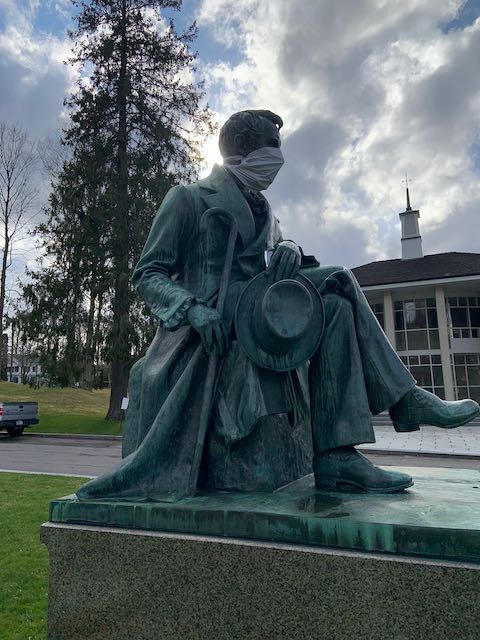
Remember the days of COVID when businesses shut down and then slowly reopened with new rules and regulations. Masks. Social distancing. Hand sanitizer. Who could have imagined it all?

Cooperation was palpable in those early days. We looked for ways to make it all work. Hand-sewn masks were made and distributed because manufactured masks weren’t available. Restaurants developed take-out menus. Zoom changed its meaning; it became a way to meet and connect, rather than something a car did on the highway.

When the sports facility where I worked reopened, we required everyone to wear masks. In the pool, where masking wasn’t possible, we implemented social distancing rules. Every other lane was left vacant and swimmers had to sign up to reserve their lane.

Over time, the restrictions were slowly lifted. The mask rule remained, however, long after other businesses in town had removed it.

One morning, A.M. (Angry Man) came in the front door. “WHAT THE #@*!$# DO I HAVE TO WEAR THIS FOR?” he yelled across the foyer to me.

I started to answer, but he continued cursing and yelling. “I DON’T HAVE TO WEAR IT ANYMORE. THE STATE LIFTED THAT REGULATION.”

I wanted to say that I understand. I wanted to tell him that I’m sorry; I don’t make the rules. I wanted to remind him that we are privately owned and run; we have to wait for The Foundation to lift the rule.

But he was yelling and other members were coming in, wearing masks, checking in at the front desk.

As one woman scanned her membership card, she said to me, “This is how Hitler got started, you know,” and she pointed at her mask.

A.M. was still yelling, F-ing this and F-ing that. I swear, the Hitler woman was smirking at me behind her mask. Other people were staring — at me, at A.M., at the mask sign on the front desk. I turned and walked away.

I walked into the back office where my supervisor worked. She wasn’t there. I walked down the long hallway to the Director’s office and knocked on the door. I interrupted a meeting.

“I don’t get paid enough to be compared to Hitler,” I said, and I told her the whole story.

When I finished talking, I saw A.M. coming down that long hallway. He reached me and went down on his knees.

“I’m so sorry,” he said. “Please forgive me. I’m so sorry for the way I spoke to you.”

“Of course, I forgive you,” I said. “Thank you for apologizing.”

We had a brief conversation and I went back to work. I think he stayed to talk with the Director.

Just the other day he was in my office.

“You know I have opinions,” he said.

I smiled. “Yes, you do, but this is a nicer way to handle them.”

He shared with me a concern/complaint/suggestion. I listened and thanked him.

That first angry interaction did not define our relationship and he is no longer a stranger. I think there’s a lesson or two in there somewhere.

Writing

Musings on American English vs British

I’m fascinated by the minute spelling differences between American English and British.

For instance, on the front of the bulletins we hand out at church, it says, “Thank you for worshipping with us today.” A month or two ago, Father brought them to me and asked me to change it to “worshiping.” Brits use 2 p’s; Americans prefer 1.

Or do we?

Between us, I think 2 p’s makes more sense. The “i” is short, so we should double the consonant. Worshiping looks like the root word should “worshipe”. Yeah, no, not a fan.

Then there’s the whinge-whine connection. Brits whinge; Americans whine. In this instance, the words have slightly different meanings. Whinge means “complain persistently and in a peevish or irritating way,” but whine is the actual noise — that high-pitched complaining cry.

So when today’s word for JusJoJan was “pernickety” — whereas I only knew the word “persnickety” — I should have guessed that it was the old Brit-American issue. They both mean a fussy, particular attention to detail. But British English is the older spelling. Americans had to go and change it.

Why? Usually Americans are dropping letters, like the whole worshipping thing. In the case of persnickety, they added a letter!

I like that we dropped that unnecessary ‘u’ from words like color and neighbor. Shorter, more practical, good.

Then there’s biscuit vs cookie, or football vs soccer, torch vs flashlight. (Seriously – a torch has fire leaping from it, right? If a flashlight is a torch, what’s a torch called?)

How about you? What words do you notice that are different?