A to Z Blogging Challenge · dementia · Faith · family

Blessed are the P’s

Blessed are the Painters of pictures for their work brings joy to others.

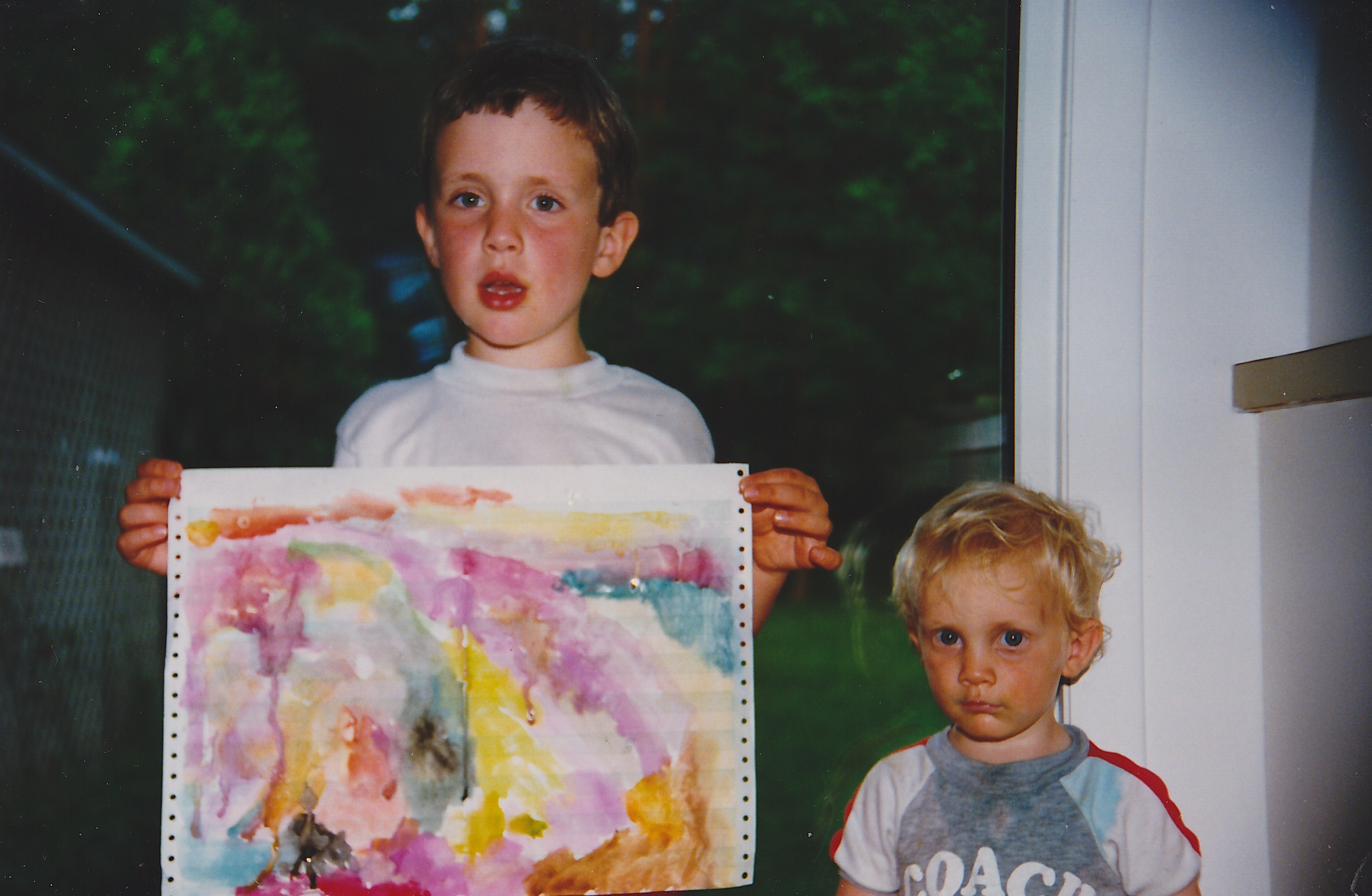
Philip water-colored a picture.
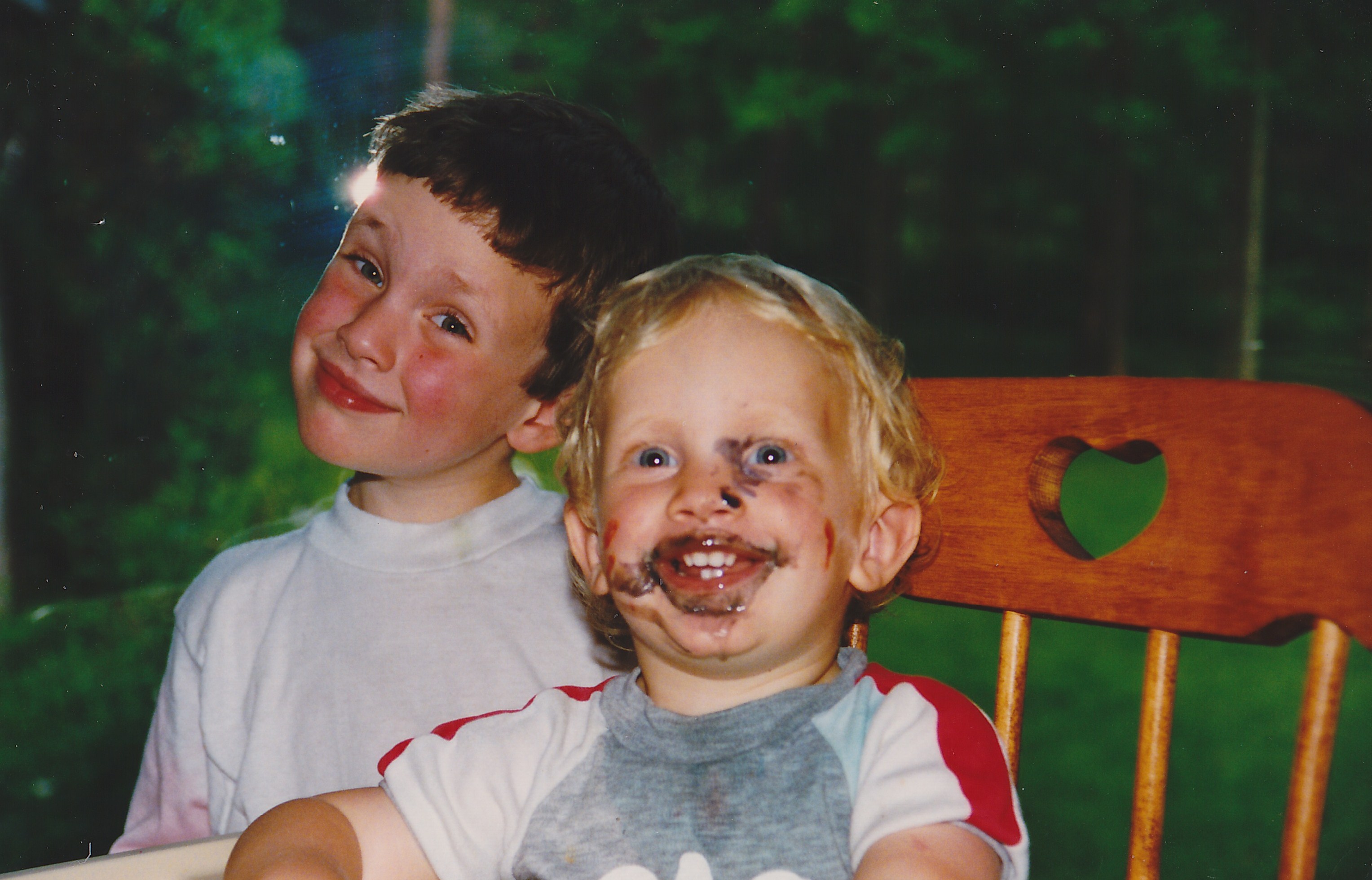
Owen water-colored himself.
Two artists

Blessed are the Painters of chicken coops for they beautify the world, or at least a tiny piece of it.

1989?
2019 — a work in progress

Blessed are the Preservers of the Past; blessed are those who Push for Progress;

In a sidewalk in Boston — “Friend –  Look up and see the North Church Tower … This view preserved for all future generations…”
View of the North Church Tower

And blessed is the balance between the two.

I recently went to Boston with my daughter, Mary. We walked the Freedom Trail from Faneuil Hall to the Massachusetts State House. Along the way, we saw the large medallion pictured above, telling us to “Look up and see the North Church Tower.”

“One if by land and two if by sea…” My mother could recite Paul Revere’s Ride well into her dementia. Earlier that day, I had attended worship at the old North Church, where the usher let me into my own private box. I read the sign on wall there that told of Charles Wesley preaching there. I was in awe.

But I could barely see the North Church from the site of medallion. Oh, it’s there. It’s spire rises above whatever that blue-green thing is.

Boston is a city that works hard to preserve the past.

It’s a balancing act, though.

For instance, the Old Corner Bookstore, built in 1716, is now a Chipotle restaurant. Mary bemoaned its fate. On the other hand, I pointed out to her that the building was going to be demolished in 1960 and turned into a parking lot, but investors purchased it and revitalized it. It’s still standing.

Preservation versus progress.

Both are necessary.


Blessed are the Perseverators.

I can’t remember exactly what my father was doing at the time, but I remember Helen telling me that he was perseverating. It was a new word for me,

but certainly not a new concept.

The repetition that goes with dementia, or autism, or brain injury may be all too familiar to some of us.

Lately my father has been perseverating over church. Our conversations go like this:

Dad: So are you going to take me to church?

Me: No, Dad. Today is (fill in the weekday). You go to church on Sunday.

Dad: Why?

Me: Because that’s when they have worship services. If we went there right now, nobody would be there. You go on Sunday.

Dad: Ok. (short pause) Are you going to take me to church now?

Me: No, Dad. Today is (fill in the weekday). You go to church on Sunday.

And so on.

He wants to go to church, and I remind myself what a blessing that is. He perseverates over a positive.

Blessed are those who Persevere.

I admit that I get frustrated with the perseverating.

It happens all day.

It happens all night.

I’m getting tired.

Yesterday I had to re-certify my lifeguarding. For the first time, the pre-test — a 300 yard swim followed by a timed brick retrieval — was daunting.

I knew I could do it, but my body wasn’t so sure.

Had I thought of it, I could have sung the Dorie song — “Just keep swimming, swimming, swimming…”

Instead, I did the Little Engine That Could — “I think I can, I think I can,” and slowly, slowly I completed the swim. (Okay, well, not too slowly. I swam it well within the allotted time.)

Perseverance sometimes requires a series of inner pep talks.

Each time I had to climb out of the pool at the wall, I had to remind myself that I could do it.

Each time I start feeling frustrated with the perseverating, I also have to remind myself that I can do this.

I can.

I can.

I love this man and I can answer the same question 257 times.

In one day.

Blessed are those who persevere, who run the race with endurance, who finish the swim test, who live with perseverators, for they shall hear, “Well done.”

A to Z Blogging Challenge · Faith

For Those Who Work Behind the Scenes

Blessed are those who work behind the scenes —

the dishwashers,
the line cooks,
and the sous chefs,

the delivery truck drivers,
and the shelf-stockers,

the shut-ins who pray,
but say, “I wish I could do more,”

the gardener who weeds
and weeds
and weeds,
making the garden beautiful
by removing the unsightly,
knowing most people will only notice
where he fails to do his job.

Blessed are the set-changers
and the prop placers,

the page-turner for the pianist,

the proof-readers,

the collaters
and assemblers,

the trash emptiers,

and the little man with the push broom
who sweeps the last of the refuse in the dust pan
before shutting off the light
and closing the door.

Each person
Each small act
Is seen
And noted
by the One who sees all.

All work can be an act of worship.

One of my mother’s gardens

A to Z Blogging Challenge · Faith · Writing

Blessed Are the Daily Bloggers

Over eight years ago, I started writing in this little corner of the internet with nothing more than a silly name and a struggle to understand my mother’s dementia.

I wrote nearly every day. It was as if some unseen floodgate opened. A tidal wave of stored-up words poured out.

Three years later, at Laity Lodge, I shyly told a then-new-now-old friend about my blog.

“How often do you write?” she asked.

“Every day,” I replied.

“Every day?!” she repeated.

I realized then that blogging every day isn’t normal. Or expected. I started giving myself more permission to skip days.

Over the years, though, I wrote about my mother’s decline, my father’s health struggles, my brother’s death, my mother’s death, my children, my grandchildren, my husband. I wrote about writing. I wrote about spiritual things. I wrote when I was angry, sad, confused, grieving, joyful, content, challenged.

It’s rare when I write these days. I have 255 drafts in my draft folder today.

I start. I stop. I think it’s all stupid. A few days pass, and I repeat the process. 255 times.

The exception to my lack of posting has been April’s A-to-Z Challenge. Give me a task and a schedule, and I’m much more likely to get something done.

Lately, in the mornings, I’ve been thinking on the Beatitudes (Matthew 5 — the Blessed-are-the’s). I’ve also been doing some local research.

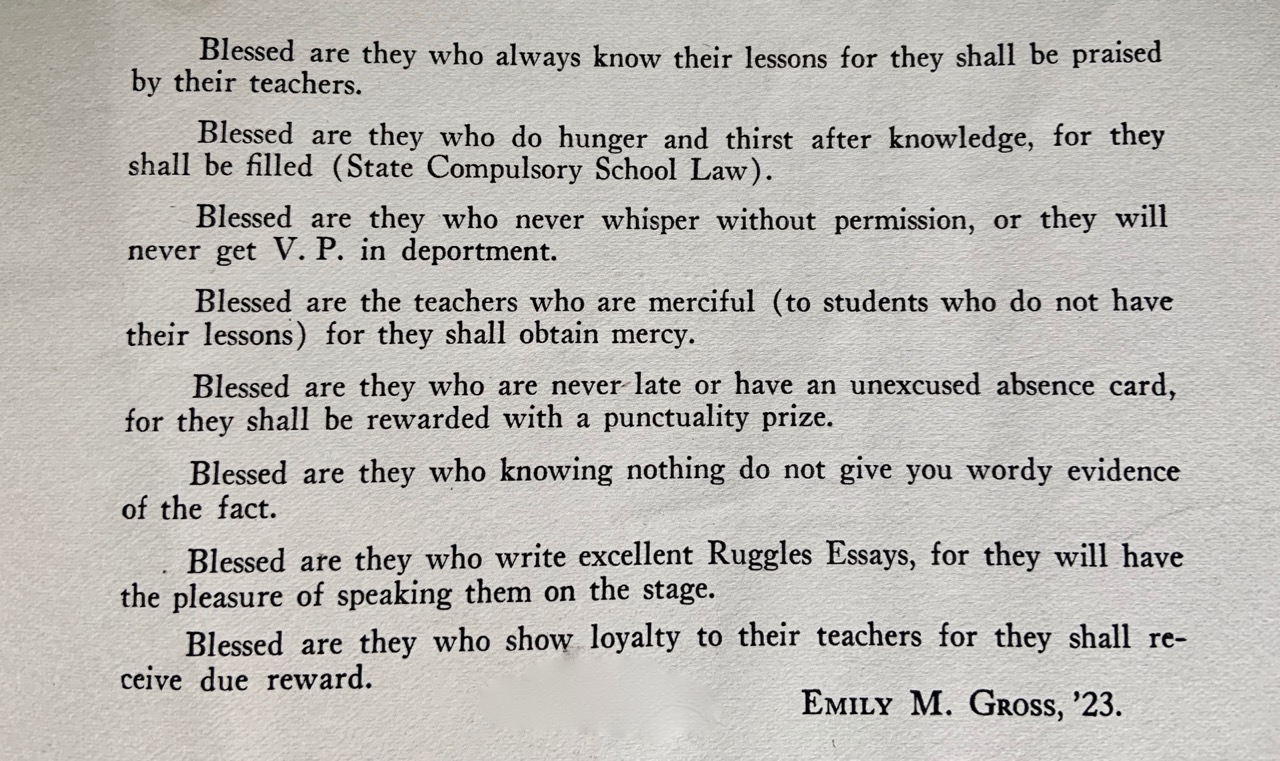
Yesterday I picked up a copy of Cooperstown High School’s 1922 yearbook, called “The Pathfinder.” A graduating student had rewritten the Beatitudes for Cooperstown students:

I don’t know what a V.P. in deportment is and I don’t think the punctuality prize is awarded anymore. But the Ruggles Essay contest — where every student in the Junior class writes an essay on the topic of their choice and the top essays are read to the entire student body who votes on the winner — is still going on today. (The earliest account of the Ruggles’ Essay contest that I could find was 1896, but it could precede that date.)

My favorite of Emily’s Beatitudes was #6 — “Blessed are they who knowing nothing do not give you wordy evidence of the fact” — probably because it’s one of my biggest fears as a writer.

All this is to say that for June, I’ll be sharing an A-to-Z of beatitudes.

Or at least I’ll be trying.

Either my draft folder will expand to 281 or I’ll give you wordy evidence of the nothing I know.

Faith · Life

The Adult Swim Lesson

I stood in the warm water of the teaching pool helping Nahla (not her real name) float on her back. It was my second time giving adult swim lessons, and, honestly, I love it.

Nahla had grown up in another culture, one that didn’t have access to swimming pools and swimming lessons. She wasn’t the person who started me thinking about immigration, but it has been weighing on my mind. I’m too much of a news junky not to think about it, but I’m always frustrated with the one-sided telling of the story.

“What do you think of immigration?” I asked a wise friend a few days later.

Jonathan paused before he answered me. “That’s a big question,” he said.

I had made a quick trip to Washington, DC, and gotten together with some people I know from Hutchmoot. I knew that I would get a thoughtful answer.

My own experience is limited. It is, perhaps, a downfall of living in a small, rural community. A few weeks of international travel opened my eyes, but certainly has not made me an expert on much of anything.

Doug, the other person at the mini-moot in Washington, joined in by telling a story about something that had happened when he was working with refugees. Then he told a story about his father, followed by a story from Sweden. He strung the stories together with the common thread of immigration. Some revealed one side of the issue; others revealed the other.

Never once did he tell me what I should think. Nor did tell me exactly what he thought.

His and Jonathan’s stories made the topic of immigration multi-dimensional. I could walk around the issue while I thought about it — kicking the tires, tooting the horn, taking it for a test drive.

On the other hand, memes — and I feel like I’ve been inundated with memes lately — take a complex issue and flatten it into a pithy saying.  Sometimes the pith is crumpled, fed into a cannon, and fired at those with opposing views. Those who agree laugh and A-men. The targets become offended and angry.

Memes are not conversation, nor are they conducive to conversation.

Last week, a picture showed up in my Instagram feed that showed a young woman holding a sign that said, “Behind millions of successful women is a an abortion they don’t regret.” Frankly, I found it offensive.

I thought, I’d love to introduce you to some women who do have regrets about their abortion.

I thought, I’d love to introduce you to some women who didn’t choose to have the abortion, and yet are still successful.”

And how do you measure success anyway?

Then I thought about the fact that the woman holding the poster has a story, too. I need to hear her story — with open ears and an open mind. She probably won’t change mine, and I won’t change hers, but we’ll be one step closer to understanding each other.

I thought about the pro-lifers who wave posters showing gruesome pictures of aborted fetuses. I’ve wanted to tell them about my friend who 30-some years ago had a late-term abortion because complications with the pregnancy were causing her kidneys to shut down. She and her husband had to make a Sophie’s choice. They don’t need their noses rubbed in it.

Oh, how we need to hear each other’s stories!

So I stand in the teaching pool, gently supporting Nahla’s back, encouraging her that it’s okay because I’m right there in the water with her.

A thousand thoughts run through my head — thoughts on immigration and fear and courage and the struggles women have and how grateful I am for this moment.

Mostly, that’s it — I’m grateful.


A to Z Blogging Challenge · Faith

K is for Known

God is not fully known when He is only “known” by the understanding.
He is best known by us when He takes possession of our whole being and unites us to Himself.

Thomas Merton, Bread in the Wilderness


It is the “great mystery of Godliness” which occupies him (Saint Bernard) before all else.

What is that mystery?
Not an idea, not a doctrine, but a Person: God Himself, revealed in the Man, Christ.

How is this doctrine understood?
When the Person is known.

How is He known?
When loved.

How loved?
When He lives in us and is Himself our love for His Father.
Loving the Father in us, He makes us one with the Father as He Himself is.

Thomas Merton, Last of the Fathers


Known and loved


A to Z Blogging Challenge · Faith

A is for Advent

In Seasons of Celebration, Thomas Merton reflects on the writings of Saint Bernard of Clairvaux. Saint Bernard spoke of three advents of Christ.

The first advent is “that in which He comes to seek and to save the lost.”

The third advent is “that in which He comes to takes us to Himself.”

The second advent, the one which I’ve been thinking on ever since reading about it, is the present advent which “is taking place at every moment of our own earthly life as wayfarers.”

Thomas Merton said, referring to the second advent, the one between the first and third,

To meditate on these two Advents

is to sleep between the arms of God

with His left hand under our head

and His right hand embracing us. 

It is also to sleep ‘between the lots’ —

that is to say to

‘live at peace in the midst of our inheritance’.


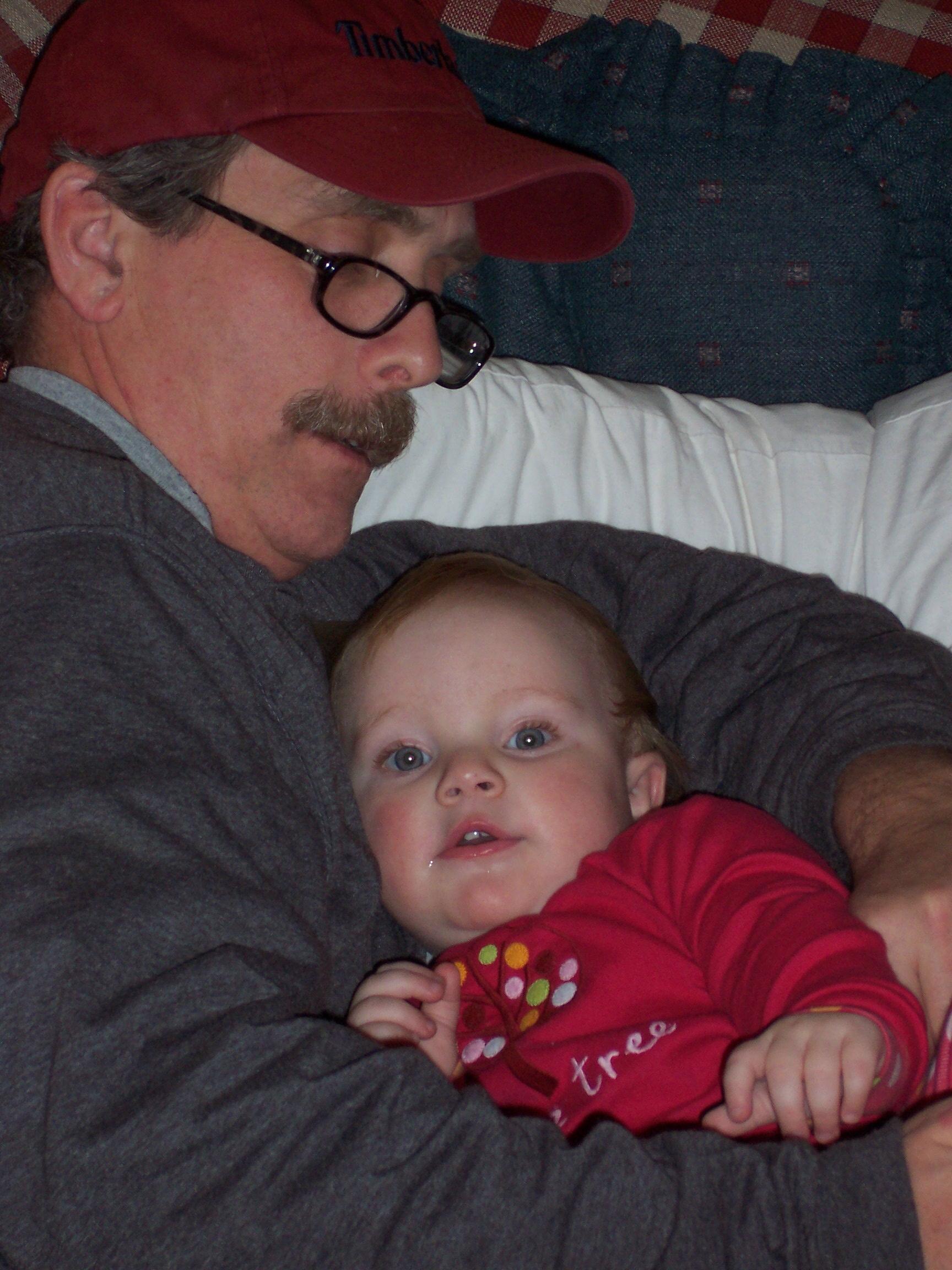
Bud snuggling with Laurel.
Faith · Life · Social justice

A Year With Merton

2019 is the year of Encouragement.
(I wrote about it here.)

2019 is the year of No Snark.
(I decided this after laboring over a response to an upset swim mom in December. She had been rude and unreasonable, so the first things I thought about saying were on that level. Then I went snarky. Then I wrote a reasoned response. I thought, I need to train myself so that the reasoned response comes more readily. So I’m setting snark aside.)

2019 is the year of Merton.
(Thomas Merton, that is. I realized that I’ve read essays and quotes but never a whole book of his. I’m going to start and keep going to see how many Merton books I can complete in one year.)

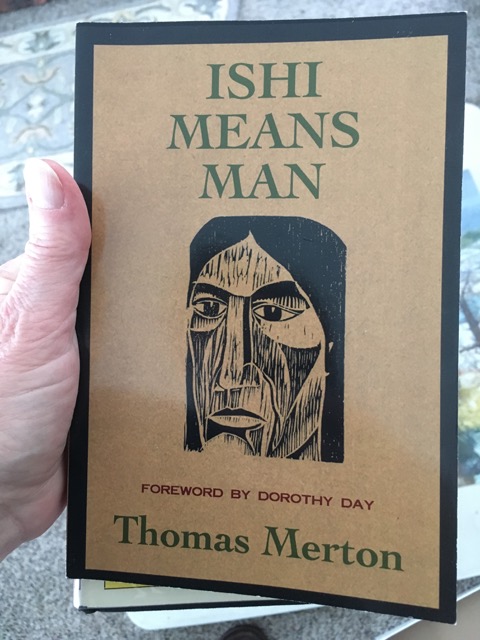
I finished my first Merton book today — Ishi Means Man. If you’ve never heard of it, don’t worry. I don’t think it’s one of his better known works.

Honestly, I thought I had grabbed Seeds of Contemplation. That sounded like a nice way to begin the year. But when I settled in my chair on the morning of January 1, I saw that I must have pulled off the shelf the book next to Seeds of Contemplation. 

Chapter One — The Shoshoneans. Merton comes out with guns blazing. Literally. He goes back to the days of our country when the Native Americans were called Indians and considered a problem. We found a solution.

In putting the Indian under tutelage to our own supposedly superior generosity and intelligence, we are in fact defining our own inhumanity, our own insensitivity, our own blindness to human values. In effect, how is the Indian defined and hemmed in by the relationship we have imposed on him? His reservation existence… is as close to non-existence as we can get him without annihilating him altogether. I fully realize that this will arouse instant protest.The Indian is not confined to his reservation: he has another choice. He is free to raise himself up, to get out and improve his lot, to make himself human, and how? Why, of course, by joining us, by doing as we do, by manifesting business acumen and American know-how, by making money, and by being integrated into our affluent society. Very generous indeed.

Was Thomas Merton just snarky?

In another chapter, Merton tells the haunting story of Ishi, the last of the Mill Creek, or Yana, Indians in California. I always thought that genocide was something that happened other places — Nazi Germany, Rwanda, Bosnia. But we annihilated an entire tribe. I can’t read the story without feeling sick inside.

Honestly, one of the things that has bothered me about Germany’s holocaust is the question of what the people who lived on the other side of the death camps did. How can someone live on one side of a wall enjoying warmth and food and relative prosperity, while on the other side people are being slaughtered? I never want to be the idle bystander.

What would I have done if I lived in turn-of-the-twentieth century California?

What will I do in 2019?

Ishi Means Man seems an inauspicious beginning to 2019. A little foreboding.

But Seeds of Contemplation seems to be missing now from the shelf and I’m not sure where to go.

How about here?


Faith · family

Unwrapping

Every man, however matter-of-fact and prosaic, likes to receive his presents wrapped… He hesitates to cut the string; he prefers to untie the knot, to unfold the paper, and so to come slowly upon the fond surprise awaiting him. The contents element he will be able to enjoy for months, perhaps for years; the parcel element he can only enjoy for a few blissful seconds; he therefore lingers over it that he may taste its drawn out sweetness to the full.  It is part — and a striking part — of our human love of mystery.

Like so many other things that are pregnant with romance, brown paper and string look commonplace enough; yet, in reality, they embody all the wistfulness, the tenderness and the sacredness of Christmastide.

… I have an old hymnbook in which the words [to a classic Christmas hymn] are rendered:

“Wrapped in flesh the Godhead see,
Hail the Incarnate Deity!”

Wrapped in flesh! It is the phraseology of the parcel! The child’s eyes sparkle as he catches a glimpse of the present through the paper. Human eyes have been entranced as they have beheld the unspeakable gift ‘wrapped in flesh‘ — the Deity Incarnate!

From My Christmas Book, by F. W. Boreham

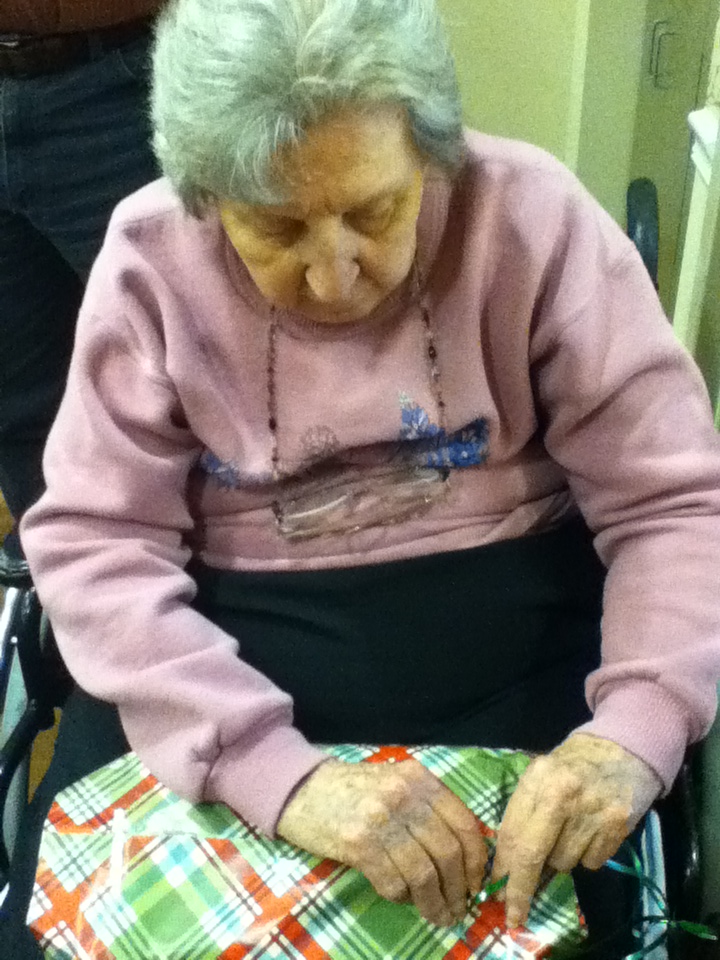
I read that passage the other morning and immediately thought of my mother. She could unwrap carefully with the best of them.

Below is a post I wrote in 2013 about my mom unwrapping a Christmas present.

“Mom, the suspense is killing me,” I told my mother yesterday.  She took, oh, I don’t know, close to twenty minutes to unwrap a single gift.

My mother has always been a careful unwrapper.  I would blame it on our Scottish heritage, except that’s my father’s side of the family.  Are the Danish thrifty too?  For as long as I can remember, though, she has carefully peeled the tape off packages so as not to tear the wrapping paper.  It can be reused, don’t you know.

Alzheimer’s hasn’t taken that trait away from her.  Old age has slowed her down.  When you combine the two, well, let’s just say, it can take a painfully long time to unwrap a gift.

“Here’s a gift from Donabeth,” I said, placing it in her lap yesterday.  She looked at me with watery eyes.  I wasn’t sure she understood.

“Open it, Mom.  Let’s see what’s inside,” I said.

She held it on her lap for a long time.  I suggested, cajoled, encouraged, prodded, goaded, urged.  Nothing seemed to work.  Finally I said the line about suspense.

“That’s the name of the game,” she said. “Suspense.”  Maybe she was more aware than I gave her credit.

She turned the package over and began picking at the tape.  Did I mention that this was a slow process?

So slow, in fact, that she fell asleep while doing it.  Fortunately it was just one of the doze-y little catnaps that lasts only a few minutes.

Once the pretty paper was removed we found that my sister had the nerve to also wrap the gift with a layer of bubble wrap.

I began the same “encouragement” process, but Bud came over and simply removed the bubble wrap.  None of this waiting around stuff.  The suspense was killing him, too.

Inside was a music box that played “Amazing Grace.”  My mother listened to “Amazing Grace” over and over.  When I thought she had lost interest, I put the music box on the table.  I went to do something else and heard it playing again; my mother had retrieved it and opened it again.  Over and over.

Music still touches something deep inside.

I’d say she liked it.

Merry Christmas, Mom.

Faith

Boreham’s Introduction to Advent

I hate the saying “It’s easier to ask forgiveness than permission.”

And yet… I’m going to do that.

If F. W. Boreham was alive, by all means, I would ask. “Could I please, please, please, put your introduction to My Christmas Book on my blog? I promise to give you credit and direct people to where they can buy the book. It’s just so relevant to today.”


But he died in 1959, before I was even born.

I wish I could remember how I stumbled across Boreham. I read one of his books earlier this year — A Bunch of Everlastings.

Then I did that other thing that I hate for people to do. I bought something for myself that was on my Christmas wishlist. I bought a second Boreham book — My Christmas Book: A Handful of Myrrh, Aloes and Cassia.

I was going to wait for Advent to start reading it — but I couldn’t. Since reading the intro about a week ago, his hope-filled words have been running through my mind.

From Boreham’s “My Christmas Book”:


By Way of Introduction

A Child is Born! That is Forever and Forever
The Message of Christmas.

A Child is born!  In the early days of the nineteenth century, men were following with bated breath the march of Napoleon and waiting with feverish impatience for the latest news of the wars. And all the while, in their own homes, babies were being born. Just think of some of those babies. Why, in one year, lying midway between Trafalgar and Waterloo, there stole into the world a host of heroes! During that year, 1809, Mr. Gladstone was born at Liverpool; Alfred Tennyson drew his first breath at the Somersby rectory; and Oliver Wendell Holmes made his initial appearance in Massachusetts. On the very self-same day of that self-same year, Charles Darwin made his debut at Shrewsbury and Abraham Lincoln in Old Kentucky. Music was enriched by the advent of Frederick Chopin at Warsaw and Felix Mendelssohn at Hamburg.

But nobody thought of the babies. Everybody was thinking of battles. Yet, viewing that age in the truest perspective which the years enable us to command, we may well ask ourselves which of the battles of 1809 mattered more than the babies of 1809. When a wrong wants righting, or a work wants doing, or a truth wants preaching, or a continent wants opening, God sends a baby into the world to do it. This is why, long, long ago, a Babe was born at Bethlehem.


You may not agree with his list of heroes, (or the comment about “opening continents”) but you get the gist.

Hope is here. It’s born every day. An echo of the ultimate Hope born in Bethlehem.